


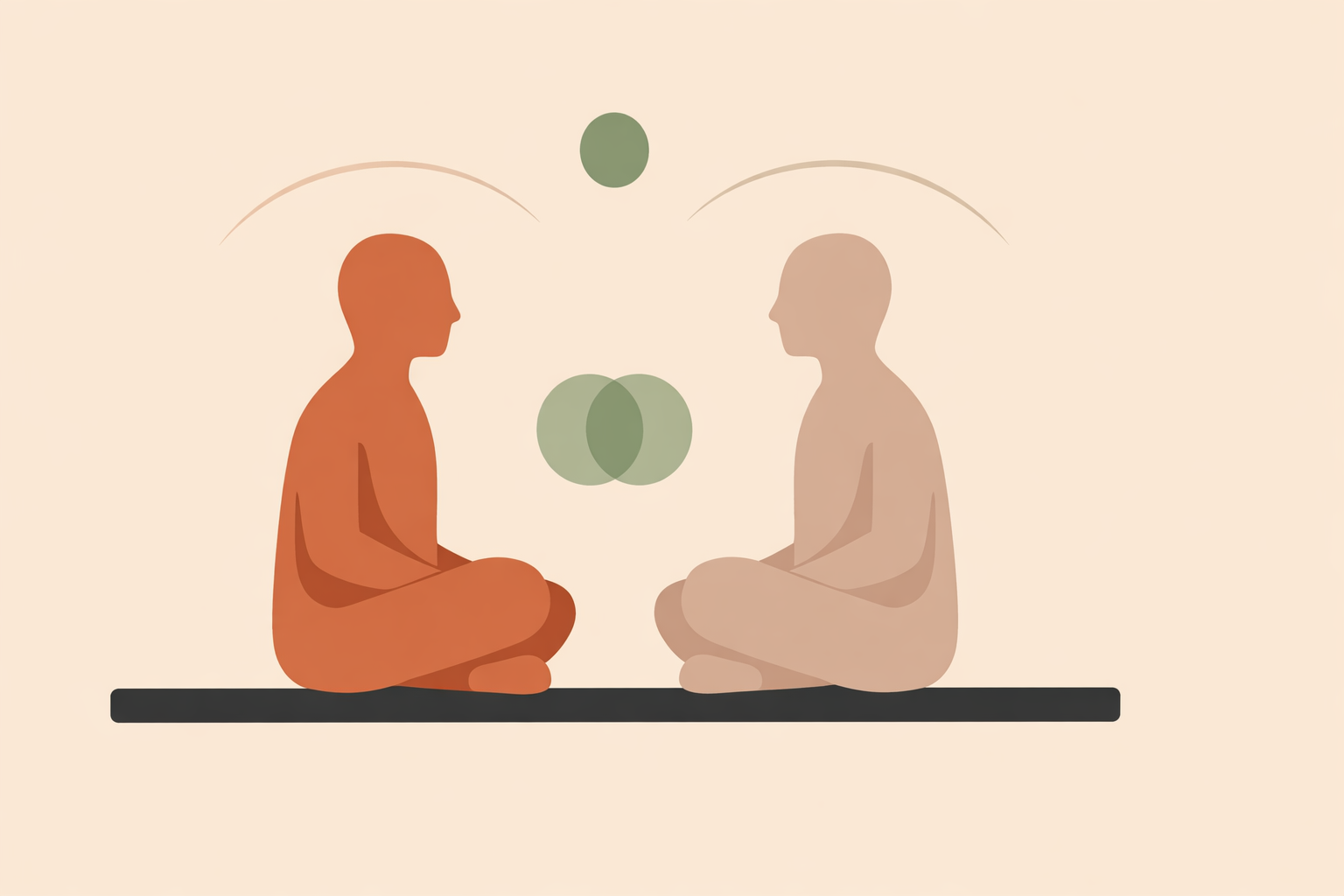
Many coaching sessions start with goals, context, and quick problem-solving. When someone arrives scattered or overloaded, that pace can keep the conversation looping. A more skillful opening is often simpler: help the person settle first, then think together.
Key Takeaway: A short mindfulness reset can help coaching sessions move from reactivity to clearer, more values-led action. A practical flow is: arrive, breathe, notice the body, step back from thoughts, name emotions, reconnect with values, and choose one concrete next step. Used gently and consistently, this structure supports steadier attention, better listening, and more useful momentum in session.
Step 1: Arrive together before doing the work
The first shift is relational. A brief arrival helps both people come fully into the space before the session asks for clarity or change.
Keep it simple: feet on the floor, a softer gaze, one shared breath, and a moment to notice contact with the chair. That kind of opening often changes the quality of the conversation, bringing less rushing and more presence.
In mindfulness-based coaching practice, shared arrival supports steadiness and can help both people feel more grounded and responsive.
Try a 60-second script like this: “Before we begin, let’s arrive. Feel your feet on the floor. Notice where your body is supported. Let your gaze soften. Take one easy breath in, and a long, unforced breath out. Notice that you are here.”
If someone still feels scattered, stay here a little longer. Invite them to notice three sounds in the room or three points of contact with the ground. A small adjustment at the beginning often makes the rest of the session easier to work with.
Step 2: Use breath as a gentle anchor
Once you have arrived, breath is usually the simplest next step. The intention is attention, not breath control.
A short, unforced breath focus can support clearer thinking by easing stress in the moment. Traditional breathing practices have worked with this for centuries: when attention steadies on the breath, the whole person often becomes less reactive.
A useful prompt is: “Let your attention rest where the breath is easiest to feel: nostrils, chest, or belly. No need to change anything. Just notice one inhale and one exhale at a time.”
If helpful, add a light count: “In-1, out-1 ... in-6, out-6.” When the mind wanders, invite a kind return rather than effort. Gentle attention tends to work better than trying hard to calm down.
Many people do not need a long practice in session. They need a brief anchor that brings them back enough to think, speak, and choose with more care.
Step 3: Bring attention into the body
After breath, shift from mental content to physical experience. Stress is often easier to meet through sensation than through explanation.
Clients may say, “I’m overwhelmed,” but the body often gives more precise information: tight jaw, lifted shoulders, fluttering chest, hollow stomach, cold hands. This turns a vague state into something observable and workable.
Brief body-awareness practices sit at the heart of many coaching and contemplative traditions. They help people notice what is happening without rushing to solve it, and that alone can change the stress response.
Try a short scan: “Notice the forehead, jaw, and throat. Sense the shoulders and hands. Feel the back against the chair. Notice the belly on the exhale. Let the legs and feet be heavy. Is there one place asking for a little more ease?”
The invitation is not to hunt for tension or force release. It is to notice, allow, and soften where possible, at a pace that feels respectful.
Step 4: Create space around thoughts
Once the body is more settled, thoughts can be held differently. The aim is to reduce fusion with the thought.
One of the most useful shifts in coaching is moving from “This is true” to “I’m noticing this thought.” That change often opens choice.
Creating distance from thoughts can increase flexibility, making it easier to choose a next step instead of reacting automatically.
A simple prompt is: “What is the thought that keeps pulling you?” Then rewrite it as: “I’m having the thought that...” This wording helps the thought become something observed rather than something obeyed.
If it helps, ask the client to place the sentence on paper beside them. The thought is still there, but it no longer has to run the whole session.
Step 5: Name emotions clearly and kindly
After thoughts, turn toward feelings. Emotional naming is often a quiet turning point because it replaces vagueness with contact.
Instead of “I’m a mess,” the client may find “fear,” “grief,” “frustration,” or “shame.” Even one accurate word can soften the intensity.
In coaching, labeling emotions often reduces intensity. Many practitioners also find that naming a feeling with care lowers the extra layer of self-judgment that tends to gather around it.
Try: “If this feeling had a name, what would it be?” Then ask, “Where do you feel it most clearly?” and “How strong is it right now, from 0 to 10?”
Follow with simple recognition: “That makes sense.” Often, that acknowledgment is enough to help the nervous system settle.
This step works best when it stays light and respectful. The goal is clarity and kindness, not a dramatic breakthrough.
Step 6: Reconnect with values
When the session has more space, bring it back to what matters. Values turn steadiness into direction.
Without values, mindfulness can stay as a pause with no path. With values, the reset becomes meaningful: the person remembers who they want to be in relation to the challenge.
A practical check-in is: “Which value wants a seat at the table right now?” Common answers include care, honesty, steadiness, learning, fairness, or courage.
Then ask: “If that value had a voice, what would it ask for today?” This often changes the tone immediately, moving the conversation away from urgency and toward grounded direction.
Across many wisdom traditions, well-being is not only about comfort. It is about living in right relationship with oneself, with others, and with one’s commitments. This step brings that wider view back into the session, much like eudaimonic happiness does in coaching.
Step 7: Turn the reset into one concrete action
The final move is practical. Calm is useful because it supports a clearer next step.
Choose one action small enough to do soon, ideally the same day. Let it express the value named in the previous step.
Use prompts like these:
- Name the action: “What is one small step you can actually do?”
- Make it visible: “What will completion look like?”
- Place it in time: “When exactly will you do it?”
- Support follow-through: “What reminder or cue will help you remember?”
For example, if the value is clarity, the next step might be: “Draft three bullet points for the conversation before 4 p.m.” If the value is care, it might be: “Pause before replying and write the opening sentence more gently.”
The action does not need to be impressive. It needs to be real, because that is what carries the benefit of the reset beyond the session.
How to make this a natural part of coaching
These seven moves form one arc: arrive, breathe, notice the body, observe thoughts, name emotions, reconnect with values, and choose the next step. Together, they help shift a session from activation toward steadier, more useful movement.
You do not need every step every time. Some sessions need only arrival and breath. Others need body awareness and emotion naming. With practice, you will feel which doorway best supports the person in front of you.
Stay flexible and respectful. Trauma-sensitive adaptations matter, and many people do better with eyes open, shorter pauses, an external anchor, or gentle movement first, especially when bringing mindfulness in coaching into session.
Keep your language invitational. Offer rather than impose, and let the client keep agency at each stage.
Over time, this stops feeling like a technique added onto coaching. It becomes part of how you hold the space with steadiness, warmth, and clear next steps within positive psychology and wellbeing practice.
Coach with positive psychology
Build values-led session structure with the Positive Psychology Coach Certification.
Explore Positive Psychology Coach Certification →










