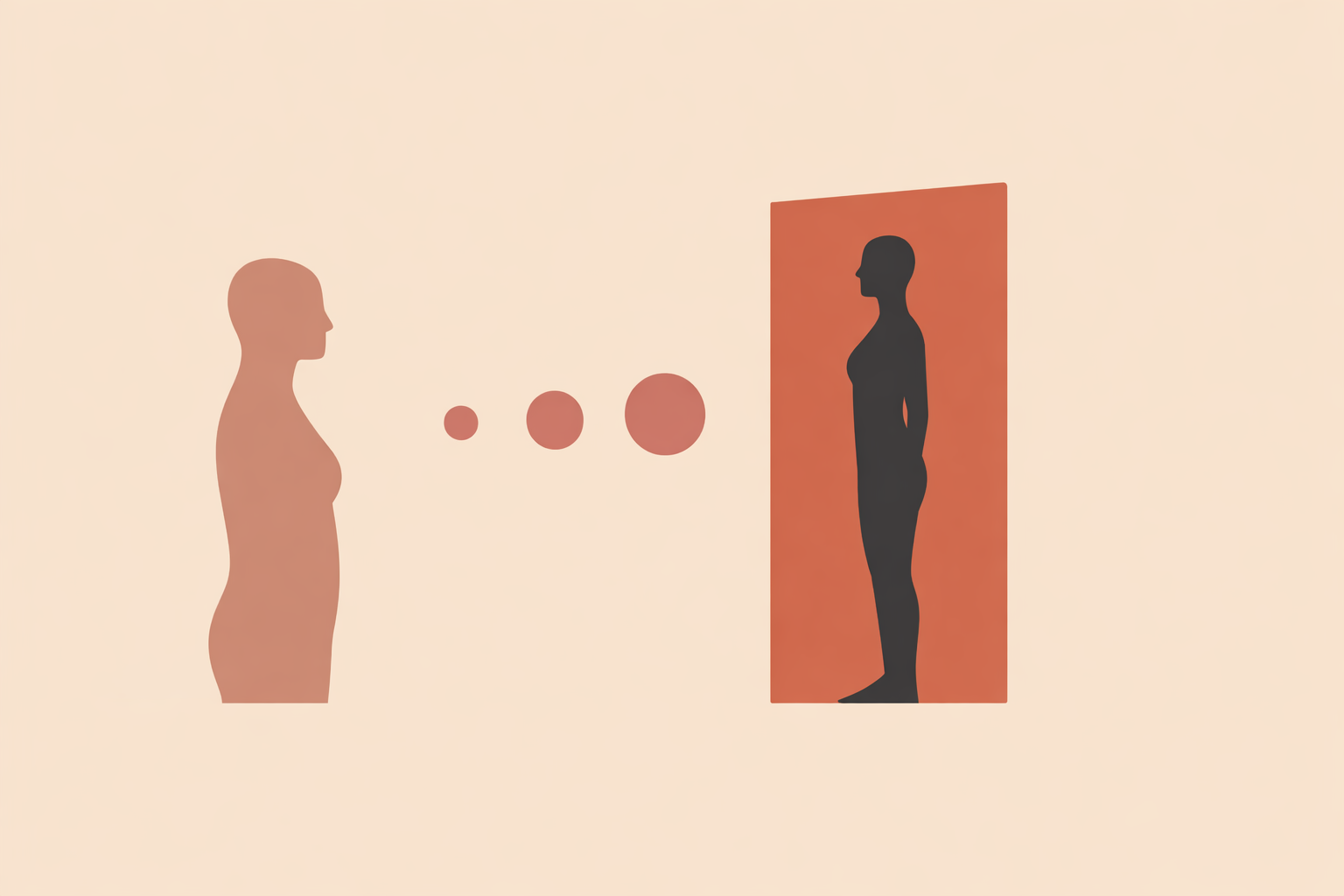
When body-image conversations get stuck, the issue is often the frame. If the mirror becomes a fact-checking device, the work can shrink into reassurance, comparison, and constant correction. A more useful Lacanian frame treats the mirror as a question of identification: not only “What do you see?” but “Which image are you organizing yourself around, and what does that image promise?”
Key Takeaway: Body-image support becomes more spacious when the mirror is approached as identity work rather than an accuracy test. Using Lacanian ideas such as the Ideal-I, misrecognition, and the Imaginary, Symbolic, and Real, practitioners can move conversations away from perfection management and toward belonging, meaning, and embodied experience. This article offers practical prompts, a digital “mirror” lens, and session-ready ways to step out of reassurance loops without stepping out of warmth.
Why the Mirror Stage Still Matters in Body-Image Work
Lacan’s mirror stage is often taught as an early developmental moment, but its core insight stays relevant for adult life: the self is shaped in relation to images. Contemporary Lacanian writing still discusses ego formation through identification with an external image, which helps explain why mirror distress so often carries questions of identity, not just appearance.
In real conversations, people are rarely hunting for a “perfectly accurate” reflection. They’re looking for an image that feels like it grants coherence, acceptability, desirability, safety, or social ease. When a practitioner listens at that level, the work usually becomes more honest and less driven by perfection.
Try questions like:
- “When you imagine looking ‘right,’ what kind of person are you allowed to be?”
- “What does that image promise you?”
- “Who taught you that this image matters?”
From Accuracy to Identification
A familiar line is: “If I could just know what I really look like, I’d calm down.” It sounds like a request for clarity, but it’s often a request for inner resolution: if the right image appears, the tension can finally settle.
This is where the Lacanian Ideal-I becomes practical. In body-image distress, someone may chase a reflection that “confirms the truth,” while the deeper strain is the mismatch between an idealized image and a body that changes, feels, ages, and lives in time.
That mismatch explains why reassurance fades fast, why one “good” photo rarely ends the struggle, and why neutral facts don’t touch the real concern.
A small shift can open the work:
- Instead of: “Is that thought accurate?”
- Try: “Which image are you trying to become?”
- Then: “What would become possible if you became it?”
This reframing often reduces shame and brings in curiosity. It also helps the practitioner stop policing perception and start tracking desire, belonging, and how the person is trying to hold themselves together within mental health frameworks.
Working With the Ideal-I Without Arguing With the Mirror
The Ideal-I is more than a preferred look. It’s a more unified, more complete version of the self a person hopes to inhabit, which is why body-image pain can feel so charged. The visible goal carries a bigger promise.
One person’s “lean” can mean chosen. Another person’s “soft” can mean unsafe. Someone else’s “polished” can mean finally being taken seriously. Once the promise is spoken aloud, sessions stop orbiting around surfaces.
Useful prompts include:
- “When you say ‘toned,’ what picture appears?”
- “Where did you first learn that picture?”
- “If you reached it tomorrow, what would it finally give you?”
- “What parts of you are missing from that image?”
These questions don’t dismiss appearance concerns. They return them to a wider human landscape, where images are entangled with dignity, safety, status, love, and belonging.
Imaginary, Symbolic, and Real: Three Practical Lenses
When a body-image conversation goes in circles, it helps to rotate through three Lacanian lenses: the Imaginary, the Symbolic, and the Real. One focuses on the picture, one on the meaning, and one on what exceeds both picture and explanation.
Imaginary: the image itself—silhouette, angle, symmetry, comparison, aesthetic ideal.
Symbolic: the meaning attached to that image—rules, roles, labels, and the language that makes a body seem acceptable or unacceptable.
Real: what won’t fit neatly into image or language—sensation, intensity, contradiction, and lived bodily truth.
You don’t need heavy theory in a session. One question from each lens is often enough:
- Imaginary: “What picture are you comparing yourself to today?”
- Symbolic: “According to whom does that picture mean ‘good’ or ‘worthy’?”
- Real: “What is happening in your body right now that this picture does not capture?”
This three-lens approach is especially helpful when the work becomes repetitive or overly intellectual.
Listening for Signifiers in Body-Image Speech
A strong Lacanian move is to follow the person’s own words with care. Certain terms carry more charge than they first appear: “Clean.” “Strong.” “Soft.” “Disciplined.” “Natural.” “Sharp.” “Messy.” “Real.” These words often hold a whole personal and cultural history.
As signifiers connect into chains, you can hear how an appearance goal is tied to promised outcomes. A wish for a “flat stomach,” for example, may lead to “disciplined,” then “respected,” then “safe.” When that chain becomes audible, the work naturally shifts from managing appearance to exploring meaning.
What to listen for:
- Repeated words
- Sudden substitutions
- Scare quotes or sarcastic tone
- Laughter after a charged description
- Shifts in wording depending on the imagined audience
- Words that seem simple but feel loaded
A practical sequence might sound like:
- “You’ve said ‘clean’ three times. What does ‘clean’ mean here?”
- “And if you were ‘clean,’ what would that say about you?”
- “What does the opposite of ‘clean’ feel like in your world?”
These small questions often reveal the real stakes far more quickly than debating whether the reflection is “accurate.”
The Digital Mirror and the Modern Gaze
The mirror is no longer just glass. Feeds, filters, front-facing cameras, comments, and imagined audiences now function as reflective surfaces too. Research links social-network exposure with body-image concerns, and newer reviews describe how idealized, digitally altered images can intensify dissatisfaction through constant comparison and editing.
In practice, digital mirrors often shape how someone believes they appear far beyond any bathroom mirror. The gaze becomes distributed across partner expectations, workplace norms, peer groups, family culture, online audiences, and internalized beauty ideals.
Digital spaces also increase the pressure by making the body continuously available for editing and ranking. The body isn’t only seen; it becomes curated, circulated, and anticipated.
Helpful questions include:
- “Whose eyes are present when you judge this image?”
- “What would that audience decide about you from this angle?”
- “What changes when the goal is not just to look a certain way, but to be seen a certain way?”
A one-week mirror audit can be revealing. Invite the person to notice every “mirror” they use: actual mirrors, phone cameras, selfies, comments, certain rooms, certain relatives, certain social spaces. Then ask:
- “What body do I try to become here?”
- “What part of me goes quiet here?”
- “Which mirror is the loudest?”
- “Which mirror is the gentlest?”
This kind of audit quickly clarifies which gaze holds the most authority in their day-to-day life.
Reassurance, Desire, and the Limits of Approval
When someone asks, “Do I look okay?”, the request is rarely only about appearance. It can carry a need for safety, a demand for reassurance, and a deeper desire for recognition, permission, or ease.
That’s why reassurance becomes a loop. It soothes briefly, then collapses under the next mirror, photo, comment, or comparison. Approval can’t resolve the deeper question once and for all.
This doesn’t call for being cold or withholding. Warmth works best alongside steadiness. Rather than becoming the authority who certifies attractiveness or worth, the practitioner can help name what the image is promising.
Three useful steps:
- Name the pattern kindly: “I notice we’re looking for a green light again.”
- Follow the promise: “If you got that green light, what would it guarantee?”
- Widen the options: “How else could that quality be lived today, without requiring a particular image?”
Two respectful lines that preserve dignity:
- “I care about how intense this feels, and I also don’t want to become the judge of your worth.”
- “Let’s stay with what this image promises, rather than asking it to settle everything.”
In adjacent helping spaces, transference can show up as a pull for the practitioner to certify attractiveness, worth, or transformation. Naming that dynamic gently can protect the work and keep it oriented toward agency rather than verdicts, especially in Lacanian psychoanalysis.
Holding the Mirror More Wisely
A body is never only a body. It’s also an image, a story, a cluster of signifiers, a field of sensation, and something shaped by relationship and gaze. Body-image support deepens when the struggle is understood as more than visual accuracy.
Holding the mirror more wisely means loosening the grip of the image without shaming someone for caring about it. Ask what the picture promises, who it answers to, and what kind of life has been placed on the other side of looking “right.”
This perspective also sits comfortably beside ancestral and cultural approaches to self-presentation: adornment as storytelling, grooming as ritual, posture as dignity, elder standards as influence, and beauty as a social language. Explore these layers with care, respect, and cultural humility.
Three grounded ways to bring this into sessions:
- Keep the three lenses close: picture, meaning, remainder.
- Map one signifier chain in each body-image conversation.
- Use a mirror audit to include digital, relational, and cultural mirrors, not only the glass one.
Practiced steadily, these moves turn the mirror into information rather than a verdict. The aim is to help people relate to images with more freedom, more honesty, and a larger sense of self than any single reflection can hold.
Train in Lacanian Psychoanalysis
Deepen your body-image work with clinical Lacanian tools in the Lacanian Psychoanalysis Certification.
Explore Lacanian Certification →