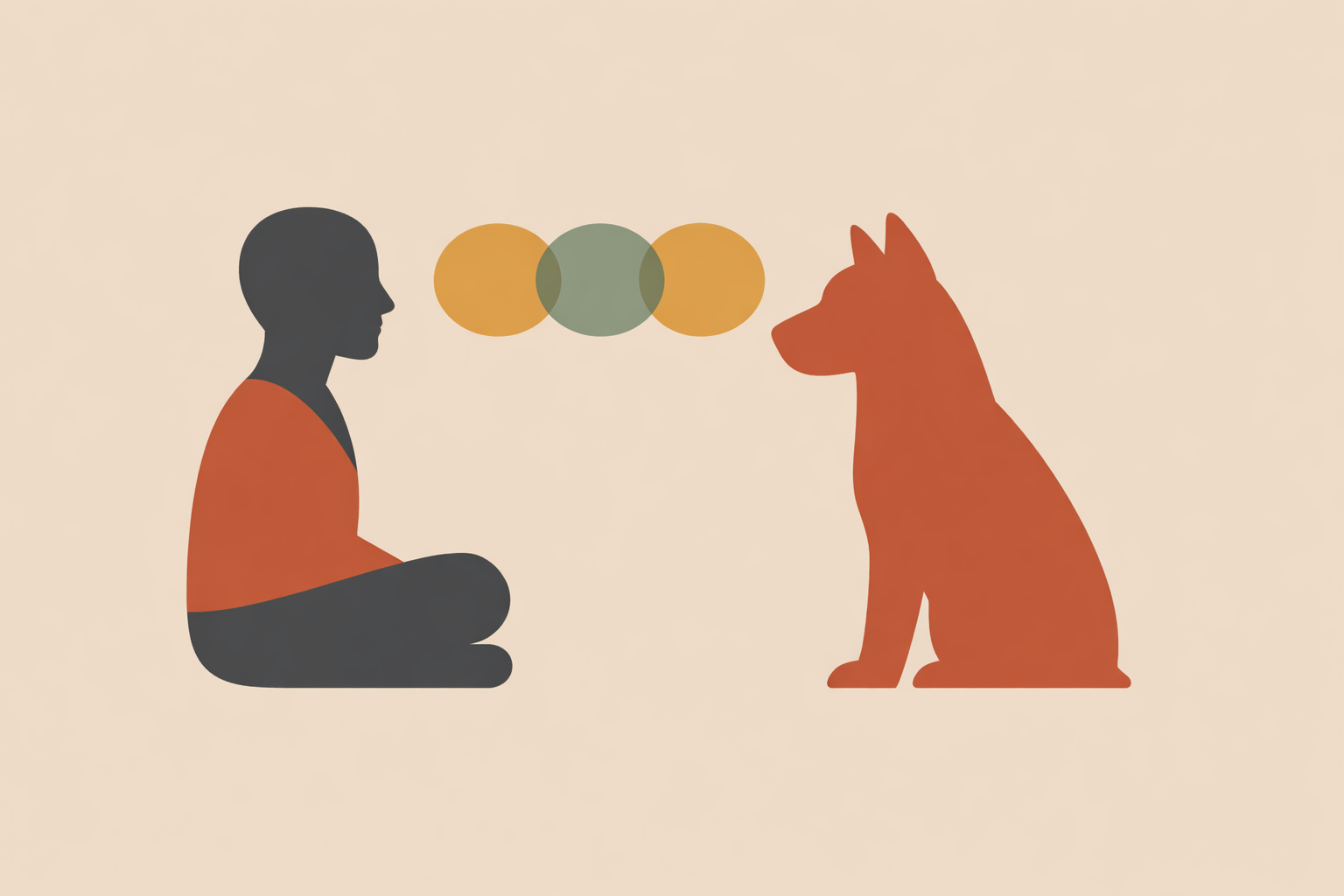
Intuitive animal communication becomes far more useful when it’s practiced as a disciplined form of listening rather than performance. Impressions can arrive fast, but trust grows when you stay steady, record what you notice faithfully, and translate it into grounded next steps. When that process is clear, sessions feel less vague, notes become more usable, and guardians leave with something they can actually work with.
Key Takeaway: Reliable interspecies communication rests on a calm listening state, sensory-specific reception, careful discernment, and ethical translation. A simple repeatable process—prepare, receive, record, translate, and validate—helps practitioners offer sessions that are compassionate, specific, and practically supportive.
Build a steady listening state first
The tone of a session is set before the first question. Animals often respond more openly when the human presence is steady, receptive, and kind. In the wild, animals show more relaxed behavior when humans are respectful and non-pressuring, and that same principle carries into intuitive practice.
Practitioners often describe the best listening state as relaxed but alert: soft enough to receive, clear enough to notice detail. Traditional lineages have valued this state for centuries, whether it’s reached through stillness, prayer, breath, or focused attention.
A practical reset: inhale for four counts, exhale for six, and repeat for several rounds. Slow breathing is linked with parasympathetic activity, which supports a calmer, more receptive state. Then soften the jaw, relax the eyes, place a hand over the heart, and briefly call up genuine appreciation.
Before beginning, write one clear sentence: “Today I’m listening for the animal’s experience, not my agenda.” It’s a small move that keeps the whole session cleaner.
Notice how impressions arrive
Once you’re settled, the next skill is recognizing your reception channels. Impressions may arrive as images, words, body sensations, emotions, or a simple knowing. In practice, four channels show up again and again: visual, auditory, kinesthetic, and cognitive.
These channels often blend over time. An image may come with chest pressure, or a word may arrive with a strong sense of movement. The aim is to notice your first clear signal and record it plainly, without steering it toward a preferred style.
If a guardian asks why Jasper resists the car, you might suddenly see a blur of motion, hear a heavy thump, feel a pull in the belly, and know there is pressure around the ears. Write exactly that: “motion blur; low thump; belly pull; ear pressure.” Keep it literal before turning it into explanation.
A steady drill helps: practice one channel at a time for five minutes. Ask a simple question, then note the first faint impression rather than the loudest thought.
Use discernment to separate signal from projection
Discernment is what turns intuition into craft. Many inaccurate readings come from rushing to interpret. Raw impressions are usually brief, specific, and a little surprising. Projection tends to feel familiar, dramatic, moralizing, or overly neat.
A useful screen is the 3-S test:
- Specific: Is the impression concrete enough that it could be wrong?
- Sensory: Does it include sight, sound, sensation, smell, movement, or texture?
- Sparse: Did it arrive quickly, without mental padding?
“He feels off” is too vague to support anyone. “Cold floor under chest; sharp irritation at door noise; drawn to window at sunset” gives the guardian something observable and checkable.
The discipline is simple: receive first, explain later.
Let the animal’s sensory world lead
Good communication meets the animal through its own experience. This aligns with what scholars describe as an animal’s subjective world: reality shaped by its senses, habits, and way of moving through life.
Impressions often follow the animal’s strongest channels rather than yours. A dog may bring scent, direction, and atmosphere. A horse may communicate through balance, weight, pressure, and space. A bird may lead with brightness, distance, rhythm, or texture.
Instead of pushing for human-style explanation, try: “Show me through your senses.” Then wait for the first image, smell, bodily feeling, or environmental cue.
This keeps sessions cleaner because you’re tracking lived experience instead of trying to decode an abstract personality.
Use a repeatable session protocol
A consistent structure supports confidence and trust. Animals also tend to respond better to predictable, non-threatening human behavior. Over time, consistent behavior helps reduce pressure and supports steadier interaction.
A simple flow can look like this:
- Consent and frame: Quietly ask permission to connect, and set the intention to listen respectfully.
- State shift: Take six slow breaths, settle, and choose one word of appreciation.
- Tune and greet: Bring the animal to mind and notice the first felt sense of its presence.
- Ask one concrete question: Keep it simple and specific.
- Receive for 60–90 seconds: Let impressions come without editing.
- Write raw notes: Record exactly what you notice.
- Translate gently: Turn the raw notes into plain-language possibilities.
- Validate: Invite the guardian to confirm, reject, or refine details.
- Close: Thank the animal and end clearly.
Repeat this structure and you’ll build rhythm in your own system. Many practitioners find animals also meet the work more easily when the approach is steady and recognizable.
Keep raw impressions separate from translation
One of the most reliable quality upgrades is separating what you received from what you think it means. A split page works well: one side for raw impressions, one side for translation.
For example:
- Raw: “sweet-sour breath; stiff backing up; gravel flash; dull ache right side; green hose by gate”
- Translation: “possible discomfort around backing up; environmental association near the gate; check whether that area feels difficult or tense”
This preserves fidelity and reduces the pull to turn a clean signal into a polished story.
You can also label each impression by channel—Image, Word, Body, or Knowing—and add a timestamp. Over a few weeks, patterns often emerge that sharpen your craft.
Work within clear ethics and scope
Ethics shape the quality of intuitive work. Never force contact. Ask inwardly for consent from the animal, and if the connection feels closed, scattered, or quiet, pause rather than push.
Use careful language: preferences, patterns, support, and observation. Offer perspective without positioning it as absolute authority.
When a session touches behavior, routine, or household stress, keep suggestions practical and humane. Small environmental shifts, slower pacing, more choice, and better observation often open the next step, especially within a broader animal wellness approach.
If another kind of support would clearly benefit the situation, say so plainly and kindly. Good practice includes knowing where your role begins and ends, with clear scope at the center.
Support animals through stress and change
Communication can be especially supportive during transitions: moving home, changes in family rhythm, reduced vitality, introductions, grief, or environmental disruption. In these moments, animals often benefit most from comfort, predictability, and sensory ease.
A simple check-in question works well: “Show me what feels heavy. Show me what brings comfort.” Answers often arrive through temperature, location, texture, sound, or distance.
For an older cat, impressions of soft warmth, lower light, and quiet edges may translate into a warmer resting place, a dimmer corner, and more protected down time. Keep notes concrete; grounded observations are the most useful.
Approach lost-animal work with steadiness
Lost-animal sessions call for care, discipline, and realistic expectations. The work can support focus and prioritization, so keep the process simple and practical.
A grounded approach for the first day may include:
- Focus on the animal’s face and ask for the last clear landmark from its perspective.
- Record only the first one or two details.
- Ask for the nearest safe hiding quality rather than forcing a full story.
- Turn impressions into action: search routes, flyer placement, quiet calling times, likely shelter points.
- Alternate short check-ins with rest and practical follow-through.
Protect your energy. Fatigue is associated with reduced accuracy, and depleted practitioners become less reliable. In lost-animal work especially, steadiness matters more than intensity.
If you receive “metal stairs; yeast smell; echo,” keep it literal. Those details can be more actionable than broad emotional interpretation.
Understand resonance without overcomplicating it
Many practitioners describe a wordless layer of communication as rhythm, resonance, or tone. The language is metaphorical, but the experience is familiar: when you settle enough, you sense the pace and quality of another being more clearly.
Heart-focused breathing helps some practitioners feel stable and less mentally noisy. Slow breath plus genuine appreciation is often enough to create a cleaner listening field.
Warm, gentle interaction also matters. In dogs and humans, mutual gaze and friendly contact are associated with shared oxytocin responses, which helps explain why calm connection can feel so regulating and relational.
In session, resonance may feel like naturally slowing with a reptile, brightening with a bird, or widening with a horse in open space. You don’t need to force it. Notice it, and keep listening.
Respect wild animals and clear boundaries
Wild animals usually communicate best through distance, restraint, and respect. Often, the clearest message is that they prefer space. Research on wild animal behavior shows that staying outside their flight distance allows more normal feeding, resting, and observation.
The protocol stays similar, but your posture changes: ask less, watch more, keep it brief. If the impression is “don’t come closer,” take that seriously.
This approach protects integrity. Not every being invites prolonged connection, and skilled practitioners know how to hear no.
Use spontaneous writing to capture what comes
Spontaneous writing keeps a session honest. Set a timer for three minutes, ask one simple question, and let your pen move without editing. The aim is to catch the first layer before analysis takes over.
You might write: “sun on right flank; stop tight rope; slower before bend.” Later, the guardian may recognize a handling or environment pattern that fits those raw notes closely.
Over time, this also creates a record you can review for accuracy and repeating themes.
When you finish, close clearly: “Thank you. I’ll carry this with care.” Endings help keep the work contained and respectful.
Track your accuracy and learn your patterns
Growth comes from feedback. If you want your communication to become more trustworthy, track it lightly but consistently.
- Write impressions before hearing too much background.
- Mark what was confirmed, partly confirmed, unverified, or clearly off.
- Review patterns monthly.
- Notice which channels are strongest under which conditions.
This becomes an “accuracy map” of your practice. Many people discover, for example, that body-based impressions stay dependable while rushed sessions blur visual detail.
Clear state, simple questions, and good notes usually outperform effortful pushing.
Hold grief work with gentleness
After an animal’s death, many guardians continue to sense connection in ordinary but powerful ways: a familiar sound, a sudden warmth, a distinct scent, a strong felt presence. These experiences often express an ongoing bond.
In grief sessions, simplicity helps. Light a candle, say the animal’s name, and ask, “What would you like carried forward?” Keep it brief and tender. The point is not to prove anything; it’s to make space for meaning and relationship.
Rituals can support this process. Continuing-bond approaches suggest that maintaining symbolic ties can help a relationship evolve after loss rather than disappear. A small altar, a weekly walk, or a letter read aloud can all support remembrance.
Practice in a steady arc
Skill grows through modest, regular repetition. A six-week arc is often enough to build real momentum when the practice stays consistent.
- Week 1: Daily breath and settling practice; begin a basic accuracy log.
- Week 2: Train one perception channel at a time.
- Week 3: Observe one species closely each day and note its sensory priorities.
- Week 4: Practice split-page note-taking and cleaner translation.
- Week 5: Refine consent, boundaries, and session closure.
- Week 6: Complete several short sessions and review your patterns.
By the end of a cycle, many practitioners have enough notes to see what’s becoming reliable for them. Sessions tend to feel less strained, and the animal’s distinctive “signature” becomes easier to recognize.
Bring science and mystery together with humility
Not every part of intuitive animal communication maps neatly onto current research, and that doesn’t reduce its value when it’s practiced with integrity. Some elements sit comfortably alongside evidence on breath, attention, bonding, fatigue, and animal behavior. Other elements live within traditional knowledge, direct experience, and careful lived practice, including formal training in animal communication.
What matters most is the stance you bring: humility, consistency, respect for the animal, and willingness to validate what you can. Mystery doesn’t excuse vagueness, and evidence doesn’t require cynicism.
Interspecies communication matures when steadiness, sensory precision, and kindness meet. Start small: a few quiet breaths, one sincere question, and a page of faithful notes. Over time, that’s how intuition becomes a dependable craft and a genuinely supportive skill for the animals and people who invite your help.
Train Animal Communication Skills
Deepen your process with the Animal Communication Certification and build clearer, more ethical, repeatable sessions.
Explore Animal Communication Certification →