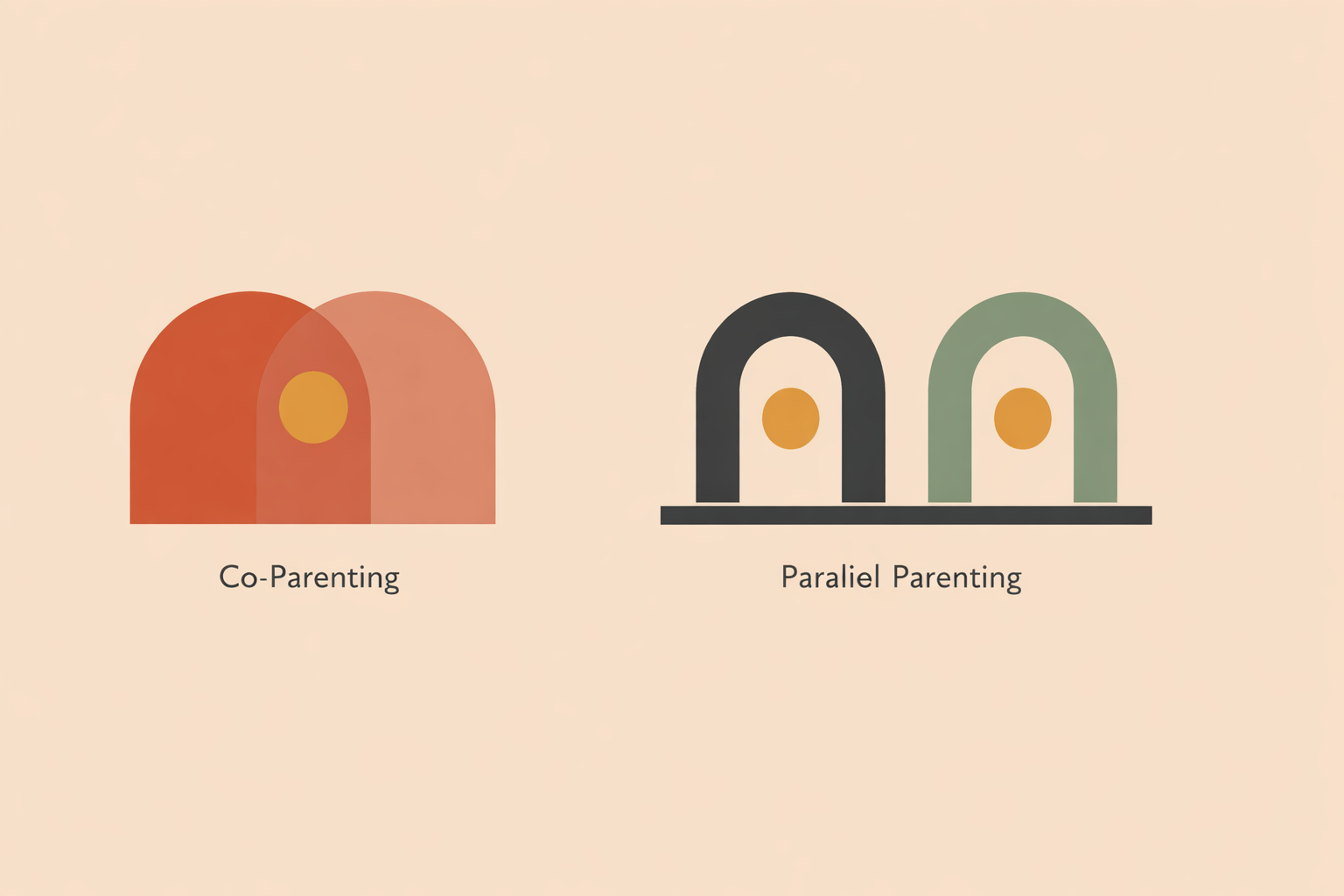
Many people supporting families through abuse recovery are taught to aim for cooperative co-parenting. In calmer situations, that can work well. But in entrenched high-conflict or narcissistic dynamics, the same advice can keep a parent stuck in constant escalation. When every update becomes an argument, every handoff stirs dread, and every boundary invites more pressure, cooperation stops being the goal. Structure becomes the goal.
Parallel parenting is often the better fit. It lowers friction, reduces openings for conflict, and helps the steadier parent preserve enough calm to stay present for the child.
Key Takeaway: In entrenched high-conflict or narcissistic dynamics, parallel parenting is a protective, behavior-led structure that prioritizes the child and the steadier parent’s capacity to stay grounded. Rather than pushing collaboration where it repeatedly breaks down, it relies on low-contact logistics, written communication, clear routines, and observable patterns. The most useful plans are simple, specific, and sustainable: they reduce conflict exposure for the child, support steadier exchanges, and only soften into more cooperative contact if behavior remains consistently calm over time.
Why Parallel Parenting Is Protective, Not a Failure
Parallel parenting is sometimes treated like a second-best option. In practice, it’s often the wiser one.
The goal isn’t to repair the adult relationship. The goal is to reduce friction so the child’s daily life isn’t saturated with adult conflict. That means fewer spontaneous negotiations and fewer chances for power struggles.
In real coaching work, this often looks like:
- written-only communication for logistics
- fixed exchange times and locations
- clear rules for schedule changes
- minimal discussion beyond what directly affects the child
This structure isn’t cold or punitive. It’s a boundary-based way to support steadiness, especially when someone has shown, repeatedly, that they won’t engage respectfully. Many parents feel relief when they stop chasing cooperation and start protecting their bandwidth.
A helpful reframe is: “You did not fail at co-parenting. You chose a structure that fits the behavior in front of you.”
Let the Nervous System Guide the Model
One of the clearest ways to assess whether co-parenting is workable is to notice what happens in the body around contact.
If a parent reliably goes into panic, rage, numbness, shutdown, or obsessive scanning before and after communication, that’s important information. A parenting model has to be sustainable, not constantly destabilizing.
Parallel parenting helps by narrowing the contact window and making it predictable. Predictability alone can shift the whole week: a parent prepares, responds briefly, and then returns to daily life instead of staying on alert for the next message.
Regulating practices work best when they’re paired with these predictable “stress points.” Slow breathing can reduce arousal and help a parent settle before opening an app, reading a message, or heading to an exchange.
Many practitioners also find value in simple body-based and contemplative rituals around transitions, such as:
- structured breathing before reading messages
- a cold-water face splash after a tense exchange
- a short walk outdoors before pickup or after drop-off
- music, stretching, or quiet decompression once the child is settled
These practices aren’t about doing it perfectly. They support a workable range of steadiness so the plan is actually livable.
A useful tool is a simple State Map with three columns: Before contact, During contact, After contact. Track body cues, common triggers, and what helps most. Patterns usually show themselves quickly.
Protect the Child From Conflict, Not Just From Distance
In high-conflict family systems, more adult contact isn’t automatically better for a child. Less conflict is often the real protection.
Children are sensitive to tension, divided loyalties, and unpredictability. Even when they don’t fully understand the details, they often feel it in their bodies and routines. Many children settle when exchanges are cleaner, communication is contained, and they’re no longer standing in the middle of adult hostility.
That’s a core strength of parallel parenting: it reduces exposure to arguments, pressure, and triangulation. Instead of expecting a child to bridge two adults who can’t work together, it creates clearer separation between the adult systems.
Some principles stay simple and non-negotiable:
- children do not carry messages
- children are not asked for updates or loyalty checks
- adult frustration stays with adults
- routines around transitions stay as calm and predictable as possible
Traditional practice also reminds us that regulation often returns through rhythm, sensory grounding, and nature. After handoffs, many families benefit from a short settling ritual: water, a snack, a walk, naming what they can see, or a quiet pause outdoors. These anchors help a child reorient after a tense transition.
A micro-practice a parent can use: “After each exchange, we stop for five minutes, drink water, and name five green things we can see.” Small rituals often do more than long explanations.
Behavior-Based Signs That Parallel Parenting May Be the Better Fit
There’s no need to label the other parent’s personality to make a sound coaching decision. Patterns are enough.
Parallel parenting is often the stronger fit when these behaviors repeat:
- logistics conversations consistently escalate into blame, hostility, or long arguments
- agreements are regularly ignored, “forgotten,” or reopened at the last minute
- schedule changes are used to create pressure or instability
- the child is drawn into adult issues, asked to carry messages, or pushed to take sides
- there are repeated boundary violations, including excessive messaging or surprise appearances
It also helps to notice what constant documenting is doing to the steadier parent. In some high-conflict situations, hypervigilance can deepen when someone starts recording every slight and scanning constantly for proof, instead of preserving energy for daily life and connection.
Documentation works best when it stays purposeful. Track patterns, significant deviations, and concrete events. Avoid turning the whole day into surveillance.
Useful coaching questions include:
- How many logistics exchanges stayed calm in the last month?
- What happens in your body before, during, and after contact?
- How often were exchanges on time and uneventful?
- Was the child pulled into the conflict in any way?
These questions help clients reality-test without getting pulled into labels or endless narrative review.
How to Coach a Parallel Parenting Plan Within Scope
When a client is ready to shift, the plan needs to reduce ambiguity and stay simple enough to hold under stress.
Start with the structure:
- set clear pickup and drop-off times
- choose one written channel for communication
- limit messages to child-related logistics
- decide how schedule-change requests must be made
- define how far in advance non-urgent changes must be requested
Then help the client prepare language they can repeat without getting pulled off course. Brief, factual, neutral responses usually land best.
For example:
- “Pickup is Saturday at 10:00 as scheduled.”
- “Please send schedule requests through the app.”
- “I am not available to discuss this by phone.”
- “I will follow the current agreement.”
Add regulation around the structure so the parent can follow through. Predictable routines before and after contact windows often make the biggest difference: breathing, stepping outside, delaying replies until a set check-in time, or a short reset after a difficult message.
Documentation can support clarity when it stays focused:
- Event: “9/12, 11:02pm — request to switch weekends outside plan.”
- Response: “9/13, 8:15am — declined and referred back to plan.”
- Outcome: “No change. Exchange happened as scheduled.”
Within scope, a coach supports clarity, steadiness, scripts, and sustainable routines. That includes communication boundaries and reality-based planning, while formal disputes and legal strategy belong with the appropriate specialist support.
When Cooperative Elements Might Return
Some clients eventually ask whether the structure can soften. Sometimes it can, and the standard stays the same: behavior over hope.
A return to limited cooperative contact works best as a cautious experiment rather than a response to apologies, charm, or a brief warm spell. In abuse-informed practice, a reconciliation phase can be part of a repeating cycle; the honeymoon phase can look reassuring without reflecting real consistency.
What matters is a sustained stretch of calm communication and uneventful exchanges. Many practitioners look for roughly 90 to 120 days of non-escalating written communication, on-time handoffs, and no child triangulation. It’s not a universal rule, but it’s a practical threshold.
If the pattern truly has changed, add only one cooperative element at a time. For example:
- attending the same school event while sitting separately
- using back-to-back conference slots rather than a joint meeting
- keeping all follow-up communication in writing
Then review what happened in real life: Were boundaries respected? Did anyone escalate? Was the child pulled into the middle? If the answer is no, the experiment can continue. If not, returning to the more protective structure is a grounded choice.
Choosing the Structure That Protects Daily Life
In high-conflict or narcissistic dynamics, parallel parenting often creates the most reliable stability. It reduces unnecessary contact, protects the child from adult conflict, and gives the steadier parent a structure they can sustain.
For some families, that structure stays long term. For others, it softens slowly as calm behavior becomes consistent rather than occasional. Either outcome can support a healthier daily rhythm.
The deeper aim isn’t the appearance of harmony. It’s enough predictability and steadiness that the child’s world feels safer, and the steadier parent stops bracing for the next escalation.
That is often the real work: less performance, more protection; less negotiation, more clarity; less reactivity, more grounded presence.
Train in Narcissistic Recovery Coaching
Deepen your parallel-parenting support skills with the Narcissistic Recovery Coaching Certification.
Explore Narcissistic Recovery →