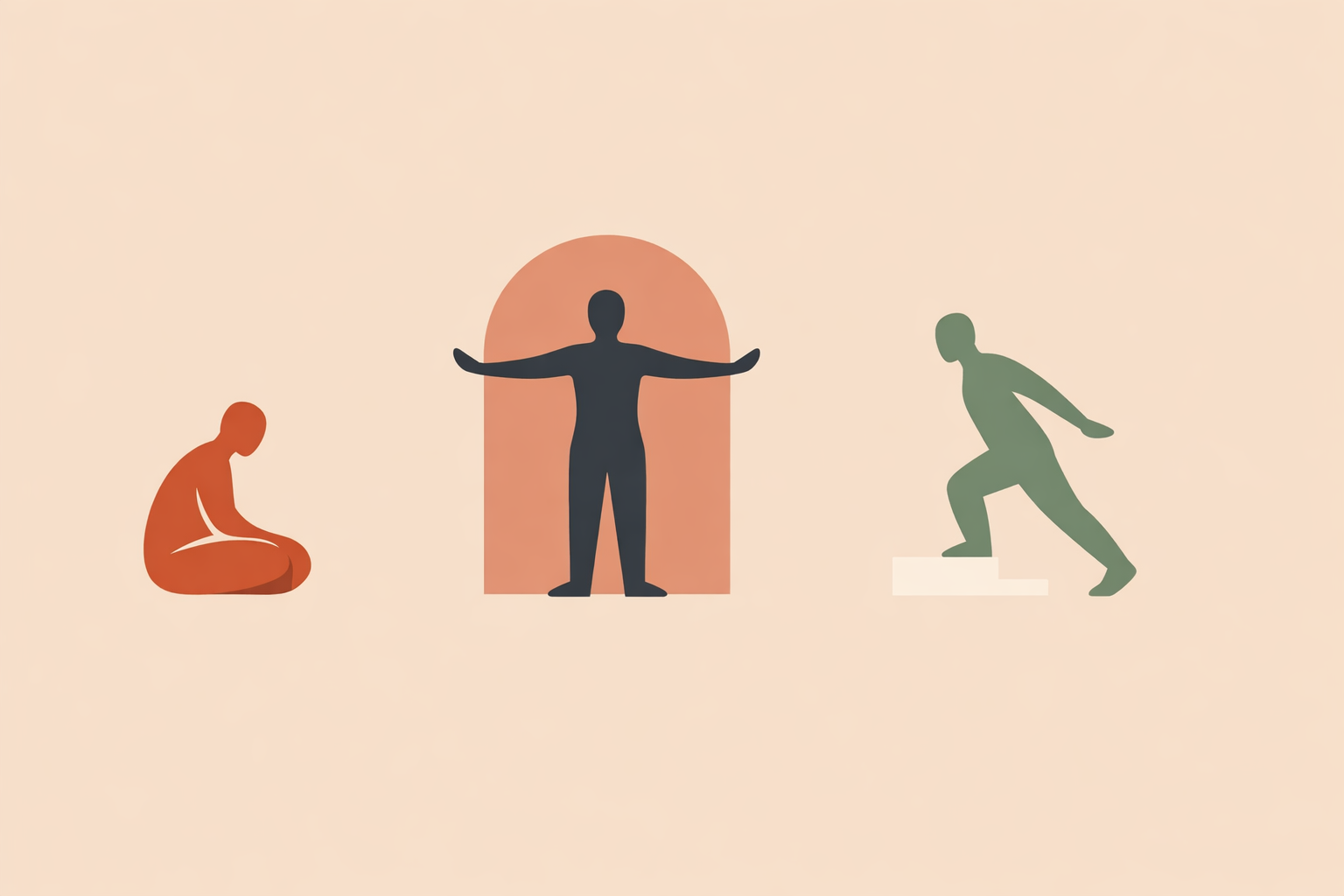
When clients arrive stressed, many practitioners fall back on a familiar routine or turn up the intensity to “burn it off.” It often backfires. The person with a high chest breath and tight jaw leaves more wired; the low-energy person pushed through big ranges feels depleted, not clearer. The issue is rarely a lack of care. It is usually a mismatch between the practice and the pattern in front of you.
This is where a TCM-informed lens becomes useful. Instead of zooming in on isolated symptoms, you track what’s observable across breath, posture, pace, mood, and energy, then choose a direction: settling, spacious, or gently activating. From there, Qi Gong becomes simpler to guide and easier to adapt in the moment.
Key Takeaway: Effective Qi Gong for stress relief starts with reading stress as patterns and matching the practice to what you observe. A TCM-informed lens helps you notice breath, posture, pace, and mood, then choose between settling, spacious, or gently activating flows. In practice, Qi Gong supports regulation by coordinating movement, breath, and attention. With clear consent, adaptable options, and a simple session arc, you can guide short, supportive flows that meet people where they are.
Seeing stress as patterns through a TCM-informed lens
Through a Traditional Chinese Medicine lens, stress is often more useful to read as a pattern than a checklist of complaints. You’re noticing how someone is organizing themselves right now: how the breath moves, where effort gathers, what the eyes and face are doing, and whether the overall feel is agitated, stuck, or heavy.
This keeps your guidance grounded and practical. Instead of chasing labels, look for a few clear tendencies:
- Is the breath high and quick, or lower and steadier?
- Is there obvious holding in the jaw, shoulders, belly, or hands?
- Does attention seem narrow and jumpy, or foggy and diffuse?
- Does the pace feel rushed, stalled, or flat?
The classic Eight Principles can sit in the background as a helpful grid, even if you never name them out loud. They can quietly shape your pacing, tone, and movement choices without turning a session into analysis.
Within TCM, ideas such as qi, blood, Yin and Yang, emotions, lifestyle factors, and the 14 meridians form part of a traditional language for understanding change. Standardized WHO terminology also includes meridian names, while these channels remain part of a traditional system rather than anatomical structures in the Western sense.
The goal is not the perfect label. The goal is a useful direction for practice.
A quick scan, even under a minute, usually gives you enough to choose well:
- Breath: silent or audible, upper chest or lower belly?
- Posture: shoulders lifted or resting, jaw clenched or soft?
- Pace: fidgety and quick, or slow and effortful?
- Mood: edgy, stuck, heavy, or mixed?
Then reflect back what you see in a supportive way: “I notice your shoulders are working hard and your breath is a little quick. Let’s choose something that slows the pace and gives those areas permission to do less.”
How Qi Gong supports stress relief
Qi Gong works through coordination. Movement, breath, and attention are guided as one experience, which is why it can feel grounding quickly.
Traditional teaching consistently returns to three elements you can coach in almost any setting:
- Posture and movement: simple shapes, balanced alignment, fluid transitions
- Breathing: quiet, unforced breaths that travel with the movement
- Attention: gentle awareness of body, breath, and surrounding space
Modern reviews often describe Qi Gong in the same way: focused attention combined with movement, breathing regulation, and relaxation, with many reports pointing toward lower stress and anxiety. Another review highlights slow breathing paired with movement as a pathway that supports a relaxation-oriented shift in the body.
This is good news for real sessions: you don’t need a large repertoire to help someone shift state. A small, repeatable sequence is often enough.
Try this simple “Open and Close” practice:
- Stand or sit comfortably.
- On an easy inhale, let the arms float wide.
- On the exhale, let the arms soften back toward each other.
- Repeat 6 to 8 times, keeping the breath smooth and unforced.
If it feels natural, allow the exhale to lengthen slightly. No counting required; aim for ease.
Useful cues include:
- “Let your breath be quiet enough that only you can hear it.”
- “Let the shoulders do 10% less.”
- “Move as if you are in warm water.”
These cues change the whole pattern at once without overexplaining.
Preparing to guide safely and respectfully
Before the first movement, establish choice. Qi Gong lands best as an exploration, not something to push through. People settle faster when they know they can adapt, pause, or stop at any time.
You can set that tone in a few practical options:
- Offer seated and standing variations.
- Normalize smaller ranges and slower pacing.
- Invite eyes open, soft gaze, or looking around the room.
- Use external anchors such as the floor, sounds, or contact with the chair.
A short script works well: “You are in charge of your range and pace. If anything feels too much, we make it smaller, slower, or skip it.”
Observation matters, and so does humility. Notice breath, facial tension, and movement quality, then let that inform your next cue. You don’t need to narrate everything you see; the kindest support is often a simple adjustment.
Pattern 1: Rising tension and mental overactivity
When the pattern feels wired and upward, less effort usually helps more than more effort. You might see quick breathing, a clenched jaw, raised shoulders, fidgety hands, or trouble shifting out of work mode. A slower pace plus wider awareness often helps the person feel less tightly wound.
The intention is to create more room around the energy.
A settling flow can look like this:
- Arrival: feel the feet on the floor or the body on the chair.
- Shoulder floating: inhale to lift the shoulders halfway, exhale to let them melt down. Repeat 6 times.
- Open and Close: arms widen on the inhale, soften inward on the exhale. Repeat 6 to 8 rounds.
- Gentle spinal wave: small nod and lengthen, moving comfortably. Repeat 4 times.
- Cloud Hands: slow side-to-side sweeping with relaxed wrists for 1 to 2 minutes.
- Settling hands: one hand at the lower abdomen, one at the chest, breathing quietly for 30 to 60 seconds.
- Stillness: pause and notice the room.
Keep breath guidance simple: quiet, natural, unforced. If a longer exhale arrives on its own, welcome it.
Helpful language includes:
- “Let the shoulders practise doing less.”
- “We are not fixing the mind; we are giving it more space.”
- “Let the end of the exhale arrive on its own.”
Research on qigong and stress commonly reports reduced stress when slow movement, breath, attention, and relaxation are combined, which fits this settling direction well.
Pattern 2: Restlessness, irritability, and feeling stuck
Sometimes the person has plenty of movement, but it feels blocked or fragmented. They may pace, sigh, turn the head quickly, or start and stop repeatedly. In traditional practice language, this often responds best to rhythm, space, and direction rather than more stillness.
The aim is to restore a sense of smooth movement without forcing release.
A spacious flow can include:
- Rooting stance: feet a little wider than hips, knees soft, weight even.
- Side-opening stretch: open one side body, return to center, then change sides for 6 rounds.
- Waist turning: gentle turns side to side with relaxed arms for 60 to 90 seconds.
- Wave hands: soft circles in front of the body for 1 minute.
- Sweeping arms: gather from the sides, then sweep down the center for 6 to 8 rounds.
- Walking Qi Gong: slow steps forward and back with natural arm swings for 1 to 2 minutes.
- Grounded finish: stand still and take two easy, longer exhales.
Repetitive whole-body movement paired with a simple attention anchor is often especially supportive when someone feels mentally and emotionally jammed. Formal research tends to report broad outcomes like reduced stress rather than pattern-specific effects, so pattern matching remains largely a matter of practitioner skill and traditional understanding.
Useful cues:
- “Let the waist lead and the arms follow.”
- “Imagine you are creating space in front of you.”
- “Keep the rhythm steady enough that the body can trust it.”
For seated options, keep the same logic with heel lifts, arm swings, and small turning movements.
Pattern 3: Low energy and heaviness
When the pattern feels heavy, flat, or dull, the most supportive response is usually gentle activation rather than intensity. You may notice slow transitions, slumped posture, low visual engagement, or a general sense that the system needs warmth and momentum.
The intention is to build alertness gradually while staying kind to breath and joints.
A gently activating flow might include:
- Grounding breath: sit or stand tall and take three easy breaths.
- Heel raises: rise onto the balls of the feet, then lower slowly. Repeat 6 to 10 times.
- Gathering and lifting: sweep the hands up the midline to chest height, then release down the sides. Repeat 6 to 8 rounds.
- Tapping or brushing: light fingertip tapping or palm brushing along the arms and upper chest, or simply brush the air around the body.
- Open the chest: gentle shoulder rolls and a small chest opening for 4 to 6 rounds.
- Supported squats: tiny sit-back movements with a chair nearby for 4 to 6 repetitions.
- Stillness: pause and notice any return of brightness or engagement.
Some research also reports improved alertness and vigor in certain settings, which aligns with the traditional use of gradually warming, activating practice.
Useful cues include:
- “Think of this as turning on a low light, not flipping a floodlight.”
- “Wake the body gently.”
- “Let the movement brighten you, not drain you.”
For seated work, keep the upper-body sequence and add toe taps or small ankle lifts to echo the rising quality of heel raises.
How to structure a short client session
A clear session arc helps the practice feel coherent. It also gives people a clear beginning, middle, and end, which many find regulating on its own.
A simple 10-minute structure works well:
- Minute 1: arrive and confirm choice, pace, and comfort.
- Minutes 2 to 3: begin with gentle mobilising, such as shoulder floating and Open and Close.
- Minutes 4 to 8: choose one pattern direction: settling, spacious, or gently activating.
- Minute 9: finish with grounding or quiet standing.
- Minute 10: reflect on what shifted.
Keep reflection light. A few short prompts are enough:
- “What feels most noticeable now?”
- “What became even 5% easier?”
- “What would help you carry this into the next hour?”
Consistency matters in lived practice. Many programs use repeated sessions over weeks, and in everyday coaching settings, shorter regular practice tends to be easier to sustain than occasional long sessions. For most beginners, 10 to 20 minutes a few times per week is plenty.
When you make notes, keep them observational and practical. For example: “Chose settling flow. Smaller range was preferred. Breath became quieter; shoulders dropped; client reported feeling more spacious.” This supports clarity while staying firmly within a well-being scope.
Closing thoughts on pattern-based Qi Gong for stress relief
The heart of effective Qi Gong for stress relief is not perfect form. It’s good pattern sense, steady presence, and the willingness to adapt. Match the practice to what’s actually happening, and the whole session becomes easier to guide.
Current research suggests Qi Gong may support lower perceived stress and improved well-being for many people, while the research base itself is still developing. Alongside that, the tradition offers a long, living body of practitioner wisdom that continues to hold up in real sessions.
Honouring Qi Gong’s roots means using language carefully, acknowledging lineages where appropriate, and avoiding inflated claims. It also means staying clear about scope: this is supportive well-being work, grounded in observation, consent, and steady practice.
If someone feels overwhelmed, dissociated, or unsafe during practice, pause, orient to the room, and return to simple anchors like contact with the chair or feet on the floor. When needed, encourage them to seek appropriate professional support.
Used in the right spirit, a few quiet minutes of coordinated movement, breath, and attention can be enough to create a meaningful shift.
Explore TCM Foundations
Deepen your pattern-reading skills for Qi Gong with Traditional Chinese Medicine Foundations.
Explore TCM Foundations →