In many traditionally informed movement plans, the question isn’t whether to use Qi Gong or Tai Chi—it’s which to lead with when stress, low mood, or physical discomfort shows up. They can look similar from the outside, but in day-to-day life they create very different experiences for beginners.
The first choice often shapes what happens next: early follow-through, the kind of calm (or lift) a client feels, and how easily you can adapt the practice around fatigue, balance concerns, or tight schedules. A clear decision frame helps you choose for the client in front of you—not just based on what you personally enjoy.
Key Takeaway: Choose the starting practice based on capacity and desired “feel”: Qi Gong’s modular, repeatable sets often work best for low energy, stiffness, or minimal time, while Tai Chi’s flowing sequences better suit clients seeking grounding, rhythm, balance, and a longer-form practice that builds coordination and confidence over time.
Qi Gong and Tai Chi: same roots, different expressions
Both arts grow from the same traditional soil: Qi, Yin and Yang, breath, intention, and coordinated movement. The real difference isn’t “which is better,” but how each expresses the same principles.
Qi Gong is the broader family, spanning many methods built from posture, breath, focused attention, and simple repeated movements. Tai Chi developed later; while rooted in martial tradition, it became widely practiced for vitality, coordination, and well-being beyond combat, evolving into a health-promoting practice.
That’s why many practitioners teach Tai Chi as a specialized expression within the larger Qi Gong family: shared inner logic, different outer structure. For clients, that structure is often what determines whether the practice feels immediately doable or like a longer-term craft.
It’s also important to name what’s being carried forward. These are living Chinese arts, refined for generations across communities and lineages. Honoring those roots—and staying rooted in context, terminology, and transmission—is part of practicing with integrity.
How Qi Gong and Tai Chi feel to learn and practice
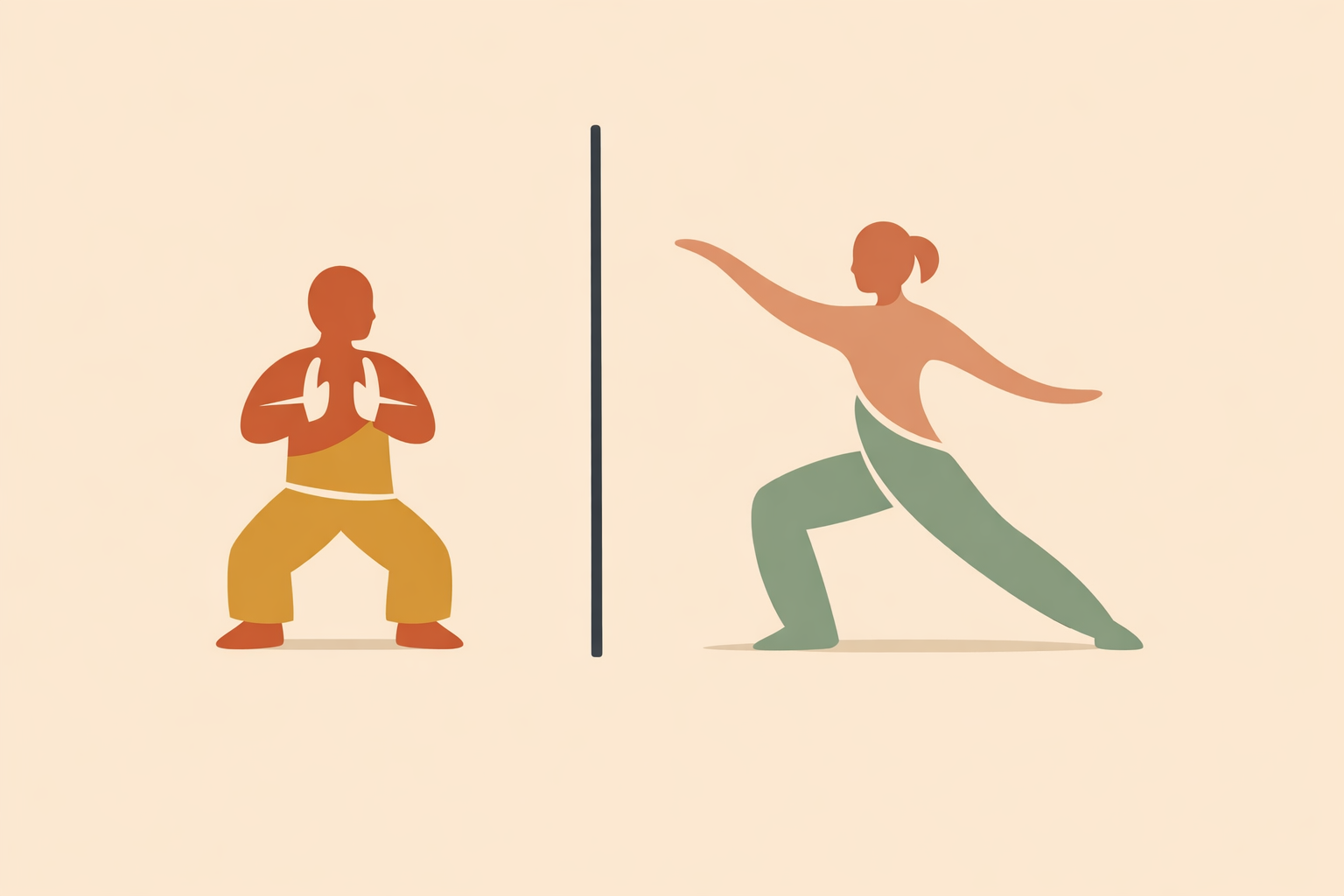
The most practical difference is structure. Tai Chi often feels like a continuous dance of linked postures, while Qi Gong tends to feel like modular, repeatable exercises. Essentially, one is a flowing sequence; the other is a set of pieces you can scale up or down.
As one teacher explains: “Qigong can be thought of as a movement you do for a certain situation, as opposed to tai chi form, which is a series of movements that work on the entire body in a flowing sequence.”
Qi Gong usually asks less of memory at the start. A client can learn a small set, repeat it, and feel competent quickly. Tai Chi often asks for more patience early on—transitions, timing, and weight shifts take time before the form feels smooth.
- Qi Gong is often easier to turn into short, reliable home practice.
- Qi Gong can help a hesitant beginner feel capable quickly.
- Tai Chi rewards patience with whole-body integration over time.
- Tai Chi often fits clients who want one cohesive daily ritual.
This naturally becomes a coaching question: does this client need an easy entry point—or are they ready for a more structured path?
Over the long term, Tai Chi is especially well-known for building stability and confidence in movement. Consensus guidance links Tai Chi with improved balance, reduced fear of falling, and stronger lower-body function over time.
Matching the practice to emotional patterns
Both arts can settle the nervous system, but practitioners often notice a different “flavor.” Qi Gong can feel more nourishing and lifting, while Tai Chi can feel more smoothing and grounding. It’s not a hard rule—but it’s a useful compass when you’re trying to match practice to pattern.
Research summaries support that big picture: Tai Chi and Qi Gong may improve mood and reduce anxiety, depression, and stress-related burden. Here’s why that matters in practice: the pathway to that steadiness can differ from person to person.
For the “wired but tired” client, Tai Chi’s continuous flow gives restless energy somewhere to go. Instead of forcing stillness, the client moves into calm through breath, sequence, and rhythm—often a good first fit for anxious, mentally overactive patterns.
For the “flat and heavy” client, Qi Gong can feel more reachable: a small series repeated with breath, without the mental load of memorizing a long form. Reviews suggest Qigong may support depressive symptoms and psychological well-being, which aligns with traditional observations that it can mobilize and gently brighten.
For deeper exhaustion—post-viral fatigue, burnout, or long-haul fatigue—many practitioners begin with very light Qi Gong, even seated when needed. Think of it like opening a door softly rather than pushing it: small, repeatable movement respects capacity and helps rebuild consistency.
Matching the practice to physical goals
If balance, stability, and movement confidence are the main priorities, Tai Chi is often a strong lead. If stiffness, limited mobility, or apprehension around movement is more central, Qi Gong is often the gentler first step.
Tai Chi has particularly strong visibility in public health conversations around stability. Reviews and summaries note it may reduce falling and improve balance, especially for older adults and anyone rebuilding confidence in movement.
Qi Gong is usually easier to tailor when someone feels stiff, deconditioned, or cautious. Because it can be practiced standing, seated, or in short sequences, it offers a kinder re-entry. Whole Health guidance describes Tai Chi and Qigong as tailored to different people’s needs and generally adaptable under guidance.
When discomfort and restricted mobility are present, many practitioners start with accessible Qi Gong. NCCIH summaries note Qigong may support concerns such as fibromyalgia pain and chronic neck discomfort, with mixed findings overall.
In traditional language, Tai Chi’s weight shifts cultivate rootedness, while Qi Gong’s circles, opening patterns, and breath-led movements help unstick what feels stagnant. Used together, they’re naturally complementary: Qi Gong can warm the river; Tai Chi can strengthen the banks.
Time, energy, and adherence: designing a practice clients will keep
Consistency beats intensity—especially here. The most elegant practice is the one a client actually keeps.
Benefits tend to show up through steady repetition over weeks and months. Reviews reflect the importance of regular practice, and traditional teaching has always said the same thing in plainer terms: small daily movement changes the terrain.
This is where Qi Gong often shines. The “practice container” can be tiny and still meaningful:
- 5 minutes between meetings
- 10 minutes in the morning
- one short seated set on a low-energy day
- a single standing sequence repeated daily for two weeks
Tai Chi can also be taught in manageable steps, but early on the home-practice burden is often heavier because the client is learning sequence as well as state. For some, that’s inspiring. For others, it’s just enough friction to break momentum.
When choosing a starting point, it helps to ask:
- How much memory and coordination can this client comfortably carry right now?
- Do they need a quick win or a longer-form discipline?
- Can they realistically practice for a few minutes most days?
- Would a modular set support confidence better than a flowing form?
A small plan that succeeds usually outperforms an ideal plan that never happens.
Safety, scope, and cultural respect
Both arts are generally low-impact and widely adaptable when introduced gradually, which makes them suitable for many people returning to movement with care. Whole Health resources describe Tai Chi and Qigong as low-impact, adaptable practices that can be adjusted to different levels of experience and capacity.
In a responsible coaching and well-being setting, a clear container keeps the work steady and respectful:
- frame the practice around well-being, regulation, and embodied awareness
- adapt pace and posture to the individual
- keep expectations grounded
- avoid exaggerated claims
- honor the cultural and philosophical roots of the arts
This kind of container improves safety and protects the integrity of the tradition. These are living Chinese arts, not empty aesthetics—so naming context, sources, and lineage with care matters.
Tai Chi and Qi Gong also pair naturally with other supportive tools such as breathwork, acupressure, self-massage, reflection, and Qi-aligned nutrition. Whole Health frameworks present them as integrative and whole-health approaches that can support broader well-being plans.
Clear recommendations: when to start with Qi Gong and when to start with Tai Chi
A simple, client-friendly rule works well: start with Qi Gong when capacity is low, time is tight, or the person needs a gentle, immediate entry point. Start with Tai Chi when they’re ready for a flowing ritual that builds grounding, coordination, and long-term movement confidence.
- Stressed, anxious, mind racing: Tai Chi is often the better first choice to smooth reactivity and entrain a calmer rhythm.
- Low mood, flat energy, heaviness: Qi Gong is often the better first choice to mobilize and brighten.
- Deep fatigue or energy sensitivity: Begin with brief Qi Gong and layer Tai Chi later as capacity increases.
- Balance, stability, movement confidence: Lead with Tai Chi, using Qi Gong as a preparation or warm-up.
- Stiffness, hesitation, low exercise confidence: Start with accessible Qi Gong as a gentle reentry to movement.
Ultimately, it’s less about choosing sides and more about choosing timing. When you match the form to the client’s pattern, bandwidth, and readiness, both Qi Gong and Tai Chi become reliable ways to build steadiness, confidence, and a more balanced relationship with the self—one practice at a time.
Explore Chinese Medicine Practitioner
Build deeper context for practices like Qi Gong and Tai Chi in the Chinese Medicine Practitioner course.
Explore Chinese Medicine →