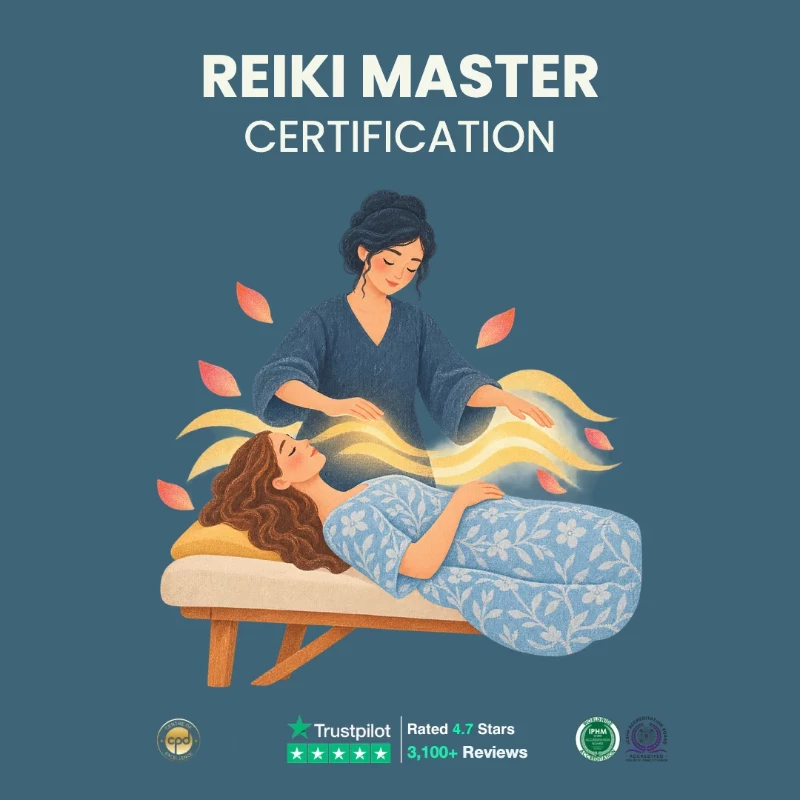
The Reiki Master Certification on Naturalistico takes you through all three levels of the Usui system in one self-paced course: Level I for self-practice, Level II for treating others and working at a distance, and Level III for the Master symbol and teaching. Nine modules, about 6 hours 19 minutes of narrated audio, 16 downloadable guides, quizzes, a final exam and a verifiable certificate. It currently costs $97 with a 30-day money-back guarantee, and 35 verified students rate it 4.69 out of 5.
Reiki attracts strong claims from both directions, so this guide takes the careful route. It covers what the training actually contains, what the evidence does and does not show, and what you can honestly say to a client. That last part matters more in this field than in almost any other we write about.
Below: what a Reiki practitioner does, the three levels, who the course suits, what students say including a serious complaint, cost, accreditation, and the language that keeps your practice safe.
Key Takeaway: The Reiki Master Certification is a self-paced course covering all three Usui levels, from self-practice through treating others and distance work to the Master symbol and teaching. The article covers what Reiki is according to a neutral authority, what the research honestly shows and does not show, the nine modules, who the course suits, verified student ratings including a complaint worth reading, format and price, what IPHM, CMA and CPD accreditation means, and the claims a practitioner must never make.
What Reiki is, and what a practitioner does
Start with a neutral description rather than a promotional one. The National Center for Complementary and Integrative Health describes what Reiki is as a complementary health approach in which practitioners place their hands lightly on or just above a person, with the goal of directing energy to help facilitate that person's own healing response. The National Cancer Institute classifies it the same way, under energy healing, and draws the line that matters: complementary approaches are used alongside standard care, while alternative means instead of it. Reiki belongs firmly in the first category.
Now the evidence, stated plainly, because you will be asked. NCCIH's position is that Reiki has not been clearly shown to be effective for any health-related purpose, that most studies have not been high quality and results have been inconsistent, and that there is no scientific evidence for the existence of the energy field itself. It also notes Reiki has not been shown to have harmful effects. Research does exist: a review of thirteen controlled clinical trials found most reported Reiki performing better than placebo while describing it as a safe and gentle complementary therapy and calling for more research, and a 2022 review of mental health outcomes found effects above placebo for stress, depression and anxiety while stating that the findings remain inconclusive because each area rests on a small number of studies.
None of that stops Reiki being taken seriously as comfort care. Hospitals offer it: University of Kentucky HealthCare provides Reiki to patients, families and staff on site at its cancer centre, and NYU Grossman School of Medicine runs hospital Reiki programs for patients and caregivers, stating that the practice can be performed alongside conventional treatment. That is the honest position for a practitioner: a gentle, low-risk practice many people find comforting, offered next to medical care and never instead of it. This piece on practice and teaching separates the two roles a Master title covers.
What the certification covers
Nine modules and about 6 hours 19 minutes of narrated audio, with 16 PDF guides. The structure follows the traditional three levels, which the course page frames as apprentice, practitioner and master healer.
- Modules 1 and 2, foundations: The history of Reiki, including Mikao Usui and how the practice reached the present day, and The world of Reiki, covering the levels, what a session involves, the initiations, and both the effects and side effects people report.
- Module 3, Level I techniques: the longest early module. The five principles, hand positions, the aura, meridians and chakras as the tradition describes them, and self-practice.
- Module 4, Living the Reiki: the practice as a daily discipline rather than a technique you deploy.
- Module 5, Level II techniques: the symbols of power, harmony and distance with their mantras, treating other people, and distance work. This module and Module 8 are where most of the practical content sits.
- Module 6, Advanced techniques: extending the Level II material.
- Module 7, Organizing your Reiki sessions: the business module, covering communication, identifying who you serve, setting up a space and promoting your work.
- Module 8, Level III techniques: the Master symbol and its mantra, related techniques, and visualisation and reflection exercises.
- Module 9: a closing module on deepening your connection to universal energy and adding other energetic and spiritual approaches to your practice.
Two practical notes. First, this is a distance-learning course, so the attunements are taught and described rather than transmitted in person by a teacher, which is a real difference from lineage training and one you should be clear about with clients and students. Be straightforward about that with anyone you later attune. Second, the distance-work material in Module 5 is the part students use soonest, and these distance sessions flows show how a full session runs start to finish.
Who it's for
- People already practising Reiki at Level I or II who want the Master material and a structured route through it.
- Massage therapists, bodyworkers and beauty practitioners adding an energy-based offering to hands-on work they already do.
- Yoga teachers and meditation guides looking for a complementary practice for one-to-one sessions.
- Nurses, carers and hospice volunteers drawn to Reiki as comfort care, which is how hospitals use it.
- Self-practitioners who mainly want the discipline for themselves, with teaching as a possibility later.
It is not the right course if you want in-person attunement from a teacher in a lineage, if you want a clinically recognised qualification, or if you expect a certificate to let you make health claims. Reiki is complementary care, and treating it as treatment is the fastest way to harm both a client and your practice.
What students say: 4.69 out of 5 from 35 verified reviews
At the time of writing the course holds 4.69 out of 5 from 35 verified student reviews, a smaller base than most courses on the platform, against a platform average of 4.84 from more than 10,000 verified reviews across 180 courses.
Positive reviewers describe a clear, well-paced route through the three levels, with the history and principles material landing better than they expected and the session and business modules giving them a way to start offering sessions. Several came in with existing practice and used it to fill gaps rather than to begin.
The criticism is worth reading before you buy. Two students had trouble with the quizzes and exam, describing the questions as not always matching the material. More seriously, one reviewer raised a complaint about the certificate itself and what it carried. We are not in a position to verify that account, and it is one review out of 35, but it is the kind of thing to resolve before you rely on the credential commercially: if the certificate matters for your insurance or your clients, ask support exactly what is issued and check it through the public Certificate Lookup before you enrol. Given the small review base overall, the 30-day money-back guarantee is doing more work here than the rating is.
Format, time and cost
Fully online and self-paced with lifetime access. Nothing is required live: the site FAQ confirms no trips, workshops or scheduled classes, with material delivered as downloadable PDFs and audio, plus a weekly live Q&A and a student forum where replies usually arrive within 48 hours. The course page lists about 6 hours 19 minutes of audio across the nine modules, with 16 PDFs, and estimates around 40 hours in total including reading, quizzes and the exam.
Module quizzes are ungraded. The final exam is multiple choice, needs 80 percent to pass, and can be retaken at any time.
The price shown to US visitors at the time of writing is $97, listed as a discount from a regular price of $398, with a 30-day money-back guarantee. Pricing is promotional and geo-dependent, so check the Reiki Master Certification page for the live figure in your currency. The course is the anchor of the energy healing learning path, which continues into chakra work, sound therapy, lithotherapy and spiritual healing if you want a staged route.
Accreditation, and what it means here
The certificate is accredited by IPHM, CMA and CPD. IPHM is an independent professional accreditation board for alternative therapists, practitioners, healers and training providers, offering members a trustmark, a directory listing and insurance discounts. The CMA is a UK membership body for complementary practitioners and training schools, with its own code of ethics. CPD certification means an independent service, established in 1996 with members in over 100 countries, has assessed the learning against continuing professional development standards. Note what that last one does: it accredits learning activities, it does not license practitioners.
Reiki is unregulated in most countries, so no body licenses you to practise and no accreditation changes what you are allowed to claim. What these do provide is recognised professional development, a verifiable certificate through the public Certificate Lookup, and eligibility for the practitioner insurance most Reiki practitioners carry, which the course page lists and which you should confirm directly with your insurer.
What you can and cannot say
This is the section that protects your practice. Reiki has not been shown to treat or cure any condition, so a practitioner who implies otherwise is making a claim the evidence does not support and, in several countries, one that advertising rules do not permit.
Practical language: offer relaxation, comfort and a calm hour, not outcomes. Never advise a client to stop or change medication, never suggest delaying medical care, and never diagnose. Position your work exactly as hospitals do, alongside conventional care. This list of safe language for Reiki practitioners is a useful reference to keep beside your website copy.
The scope principle is the one professional bodies use generally. The code of ethics published by the International Coaching Federation, which is a model here rather than a Reiki authority, asks practitioners to work within their competence, disclose when they are acting in another role, and raise a referral when their work is not the right fit. In practice: screen at intake, keep a referral list, and say plainly what a session is and is not. This guide on when to refer covers the situations that come up most. If a client is in crisis, they need urgent help: in the United States the 988 Suicide and Crisis Lifeline takes calls, texts and chats around the clock, and elsewhere use local emergency services.
How to enrol and what happens after
Enrolment is immediate and everything opens at once. Work through the levels in order and sit with each one before moving on, since the tradition treats these as stages rather than chapters. The final exam comes at the end, and the certificate is issued with a verifiable ID.
Afterwards, practise on yourself daily before you offer sessions to anyone else, then start with friends and family while you build session confidence. Get insurance before your first paying client, write a plain-language description of what a session involves, and if you intend to teach, be transparent with students about how you trained. Distance training is legitimate and increasingly common; presenting it as in-person lineage transmission is not.
Frequently asked questions
Can you become a Reiki Master online?
Yes, and many practitioners do, though in-person attunement is still the traditional route and some lineages will not recognise distance training. Be open about how you trained, especially if you plan to teach.
Does Reiki actually work?
NCCIH states Reiki has not been clearly shown to be effective for any health purpose, with most research low quality and inconsistent, and no evidence for the energy field itself. Some reviews find effects above placebo for stress and mood while calling their own findings inconclusive. Many people find it calming, and it has not been shown to cause harm.
Do you need a licence to practise Reiki?
No licence exists in most countries, since Reiki is unregulated. What matters is insurance, honest claims and a clear referral practice.
How long does the certification take?
About 6 hours 19 minutes of audio across nine modules, and roughly 40 hours in total with the 16 guides, quizzes and exam. Self-paced with lifetime access.
Can I charge for Reiki sessions after this?
Nothing legally prevents it in an unregulated field, but get practitioner insurance first, keep your claims to relaxation and comfort, and practise enough to be genuinely steady before charging.
What is the difference between Level II and Master level?
Level II introduces the first symbols, treating others and distance work. Master level adds the Master symbol and the material associated with teaching and initiating others.
Is this the right next step?
If you want in-person attunement inside a lineage, or a credential a healthcare system will recognise, this is not it. If you want an affordable, structured route through all three Usui levels, with the history, the symbols, the session structure and the practical side of offering sessions, this course covers that ground for less than the price of most single Level I workshops. Go in knowing three things: the review base is small, the evidence for Reiki is weak and you should say so honestly, and the practice is still valued in hospitals as comfort care. That combination is workable, as long as you are the practitioner who tells the truth about it.
Train Through All Three Reiki Levels
Nine modules with lifetime access, 16 guides, and a verifiable accredited certificate.
Explore the Reiki Master Certification →