


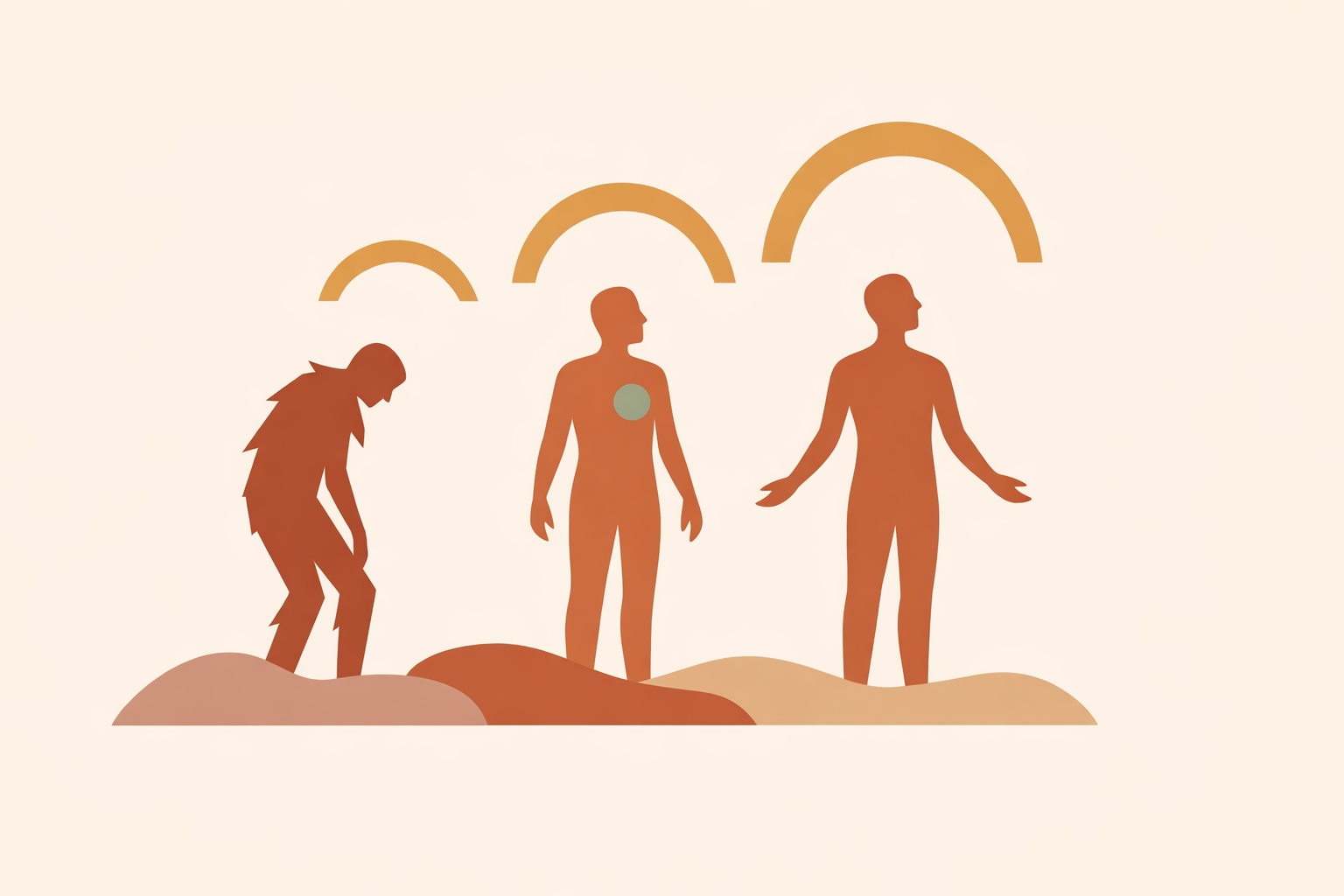
Many trauma-trained practitioners learn a hard lesson: someone can describe what happened in clear detail, yet feel more wired or more shut down after each retelling. Sleep can worsen, startle responses rise, and daily life can shrink. What looks like “resistance” is often a body that has already gone beyond its current capacity.
A gentler, body-led pace usually serves better. When regulation comes first, story work becomes easier to hold. Somatic Experiencing offers a practical framework for this by working with sensation, orienting, and small doses of activation to build capacity before asking for more meaning-making.
Key Takeaway: Building resilience after overwhelm often calls for a body-led, titrated approach that restores regulation before intensive processing. Somatic Experiencing supports this by working with sensation, orienting, resourcing, and careful pacing so people can widen capacity without flooding. In practice, this means adapting the dose to the person in front of you, integrating body-based work with other coaching approaches when helpful, and tracking change through concrete markers such as presence, recovery between sessions, mood, and everyday functioning.
How trauma shows up in the nervous system
Trauma is often best understood as survival learning that has outlasted the original event. The body organizes around protection first, and that organization can remain long after danger has passed.
Survival strategies like mobilization, freezing, and dissociation can persist long after the original danger has ended. People may feel stuck in alarm, stuck in collapse, or bounced between both.
Seen through this lens, hypervigilance isn’t a character flaw. It’s learned protection. That reframing often softens shame and opens the door to curiosity: what is this response trying to do for me, and what else can the body learn now?
Resilience grows as the nervous system relearns flexibility. Under conditions of safety, the autonomic system can support physiological flexibility and more easeful engagement with life. Repeated experiences of settling, orienting, and returning from activation build that flexibility over time.
Bottom-up work matters because it shifts physiology first. Somatic approaches support change through body-focused processing, and reflection often becomes more available after the body has had real experiences of settling.
The vagus nerve is a useful part of this map. It strongly influences social engagement, rest, and recovery, and polyvagal-informed models describe broad states of connection, mobilization, and shutdown. Even where some anatomical details remain debated, the language can still help people recognize inner state shifts with more compassion.
What Somatic Experiencing is
Somatic Experiencing (SE) is a body-oriented approach that supports regulation and a felt sense of safety by working with sensation, impulse, and movement.
SE works gradually and with care. It asks: what happens if activation is approached in sips instead of gulps? That pacing often makes change feel achievable and sustainable.
SE is especially known for a few core skills:
- Titration: approaching activation in very small doses
- Pendulation: moving between challenge and resource
- Orienting: noticing present-time cues of safety or neutrality
- Completion: allowing interrupted protective impulses to settle
- Resourcing: strengthening what supports steadiness
In practical terms, this might sound like: “As you think about that moment, notice the first hint of tightening. Now come back to the support under your legs.” The aim is capacity.
Research on SE is still developing, and the early findings are encouraging. One trial found reduced symptom severity and lower depression scores after SE sessions compared with a waitlist group. A later review also reported promising long-term reductions in posttraumatic stress patterns, while noting that the research base is still maturing.
For many practitioners, the appeal is straightforward: SE offers a structured way to follow the body’s timing while staying clear, grounded, and compatible with other trauma and emotional healing coaching frameworks.
How Somatic Experiencing builds resilience
SE builds resilience by helping the body experience safety, activation, and recovery in manageable cycles. Over time, these cycles become familiar pathways rather than rare exceptions.
Resourcing comes first. A resource is anything that genuinely steadies someone in the moment: warmth in the hands, the feeling of the floor, a supportive memory, a protective image, a familiar rhythm.
Orienting then helps counter threat bias. Noticing light, color, sound, distance, and support reminds the system that this moment is different from the original moment.
From there, the practitioner may invite a small amount of activation and then guide a return to steadiness. This back-and-forth is where capacity grows. Pendulation is especially useful because it teaches the body that activation can move through without becoming overwhelm.
Practitioners often notice micro-shifts as the work lands:
- a softer breath
- a spontaneous swallow or sigh
- warmth returning to the hands
- less bracing in the jaw or shoulders
- more contact with the chair or floor
These changes may look small, but repeated over time they often become meaningful new patterns. Many people describe a turning point in simple terms: “I felt like I had a choice.”
A brief sequence might look like this:
- Find one resource: “What feels 5% easier right now?”
- Touch the edge: “Think of the situation for just a moment. What is the first body cue?”
- Return: “Come back to the easier place and notice what settles.”
Adapting the work for acute shock, complex trauma, and attachment wounds
The principles stay consistent, but pacing should match the history in front of you.
With acute shock, the work is often concrete and narrow. Incomplete protective responses—bracing, pushing, turning, pulling away—can remain unfinished, and completion becomes especially relevant. A practitioner may help the person revisit only the first second or two of the event, then support the body to finish a small protective impulse in a careful, contained way.
With complex trauma, the priority is usually broader capacity-building. Pendulation becomes central because it strengthens tolerance without flooding. Sessions often spend more time on resourcing, orienting, boundaries, rhythm, and returning to the present.
Attachment wounds call for even more relational sensitivity. Difficulty with trust, closeness, and co-regulation can shape everything from pacing to eye contact to how much silence feels workable. In these cases, the session structure itself becomes part of the resource.
Useful adaptations include:
- For acute shock: keep attention narrow, brief, and specific
- For complex histories: spend longer building resources before approaching activation
- For attachment wounds: make choice explicit around pacing, distance, eye contact, and pauses
The key question stays the same: what dose supports presence right now?
Integrating Somatic Experiencing with other approaches and traditional practices
SE doesn’t need to stand alone. Many practitioners weave it alongside cognitive, narrative, relational, and culturally rooted approaches.
Because SE works from the body upward, it can be especially helpful when someone can’t yet tolerate more intense trauma-focused methods. Many practitioners use it as a bridge: support regulation first, then invite meaning-making when there is more room to stay present, including within broader cognitive work.
Polyvagal language can also be useful as a heuristic. Broad maps of connection, mobilization, and shutdown can clarify state shifts for clients, even if some finer anatomical claims remain under discussion.
Traditional practices also pair naturally with SE-informed work when used respectfully. Breath, humming, rhythm, movement, song, and grounded ritual have supported regulation across cultures for generations. The guiding principle is context: follow the client’s own roots where possible, credit living traditions, and avoid borrowing practices as aesthetic add-ons.
Two simple integrations:
- SE plus cognitive work: begin with orienting, explore the thought pattern, then return to the body to notice what shifted
- SE plus traditional regulation practices: use a familiar sound, rhythm, or movement as a resource, then track the body’s response in real time
The art is choosing what this person can use today while staying connected to their own values, culture, and inner signals.
Safety, pacing, and tracking change
SE-informed work asks for restraint as much as skill. Too much, too fast can unsettle rather than support, so consent and pacing stay central.
Good practice includes a clear agreement about how the session will unfold, what to do if activation rises too quickly, and which stop signals the person wants to use. Narrow dosing, explicit permission, and regular check-ins protect trust.
Signs the work is moving too fast can include lingering escalation after sessions, more nightmares, sharper panic, increased dissociation, or a noticeable drop in everyday functioning. When these appear, it’s usually time to slow down, strengthen resources, and reduce the dose.
Readiness for deeper processing is often less about having the “right words” and more about regulation in action. One practical marker is the ability to stay present with some activation and return to baseline between sessions.
Expect change over weeks, not minutes. SE-informed work commonly supports improvements in areas like posttraumatic stress patterns, mood, anxiety, somatic distress, fear of movement, and quality of life, which are useful domains to track in a trauma healing coach certification context.
Helpful things to monitor include:
- how quickly someone notices activation
- how easily they return to steadiness
- sleep quality and dream intensity
- capacity for boundaries and difficult conversations
- sense of choice during stress
- overall mood and daily functioning
A simple note template can keep the work grounded:
- Resource today
- Activation cue noticed
- How long it was tracked
- What supported settling
- Micro-shifts observed
- Between-session practice
This kind of tracking keeps resilience practical and visible. Small recoveries, repeated often, add up.
Conclusion
Resilience is the growing ability to recover, reorient, and reconnect after stress.
Somatic Experiencing offers a humane way to support that process: sensation before story, pacing before pressure, and capacity before intensity. For many practitioners, this changes the work at its roots because the body sets a rhythm that the mind can genuinely follow.
When that rhythm is respected, small moments carry real weight: one softer breath, one completed impulse, one return from activation, one experience of choice where there used to be only survival. Over time, those moments become resilience.
Train in Trauma Healing
Deepen your pacing and regulation skills with the Trauma healing coach certification.
Explore Trauma healing coach certification →










