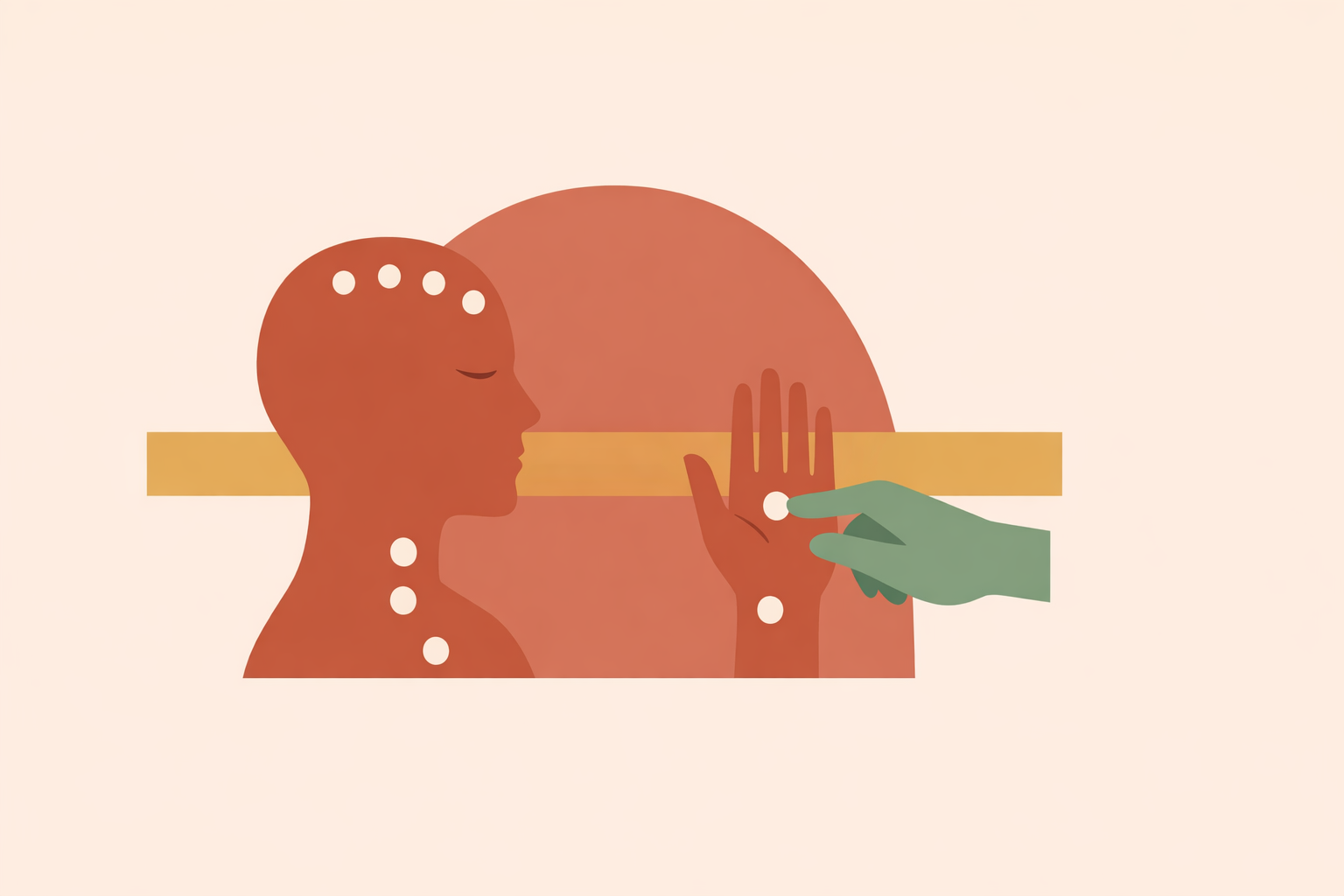
Every practitioner has met a client who arrives already in overdrive: speech quick, jaw tight, breath shallow, attention everywhere at once. When you move straight into conversation or pre-checks, the session can lose its thread. In practice, muscle testing is often less useful when attention is fractured and the chest stays braced.
A steadier first move is to help the system settle before asking it to focus. In kinesiology sessions, brief acupressure can do that beautifully. With consent, light contact, and one or two simple breath cues, these points can bring someone back into a more workable state without turning the appointment into a long relaxation sequence.
The points below are easy to integrate when you want to restore presence before energetic pre-tests, circuit mapping, or muscle testing. Start with what’s most obvious: racing thoughts, scattered attention, fluttery chest, tearfulness, jaw tension, irritability, or locked breathing.
Key Takeaway: Brief, targeted acupressure can help clients return to workable focus during a kinesiology session. Yin Tang is useful for racing thoughts; Du20 for scattered attention; PC6 for a fluttery, unsettled chest; HT7 for tearful or restless states; LI4 for jaw and head tension; LV3 for irritability and pent-up energy; and Ren17 for tight breath and held emotion. In practice, two or three well-chosen points are often enough to help the session regain steadiness.
Yin Tang for racing thoughts and frontal tension
When the mind feels loud, beginning at the brow often brings quick relief. Yin Tang, the point between the eyebrows, is simple, accessible, and frequently centering. It’s widely used in traditional practice when someone feels mentally crowded, overstimulated, or unable to land.
Place a relaxed fingertip between the brows and hold for 60 to 120 seconds. Keep the pressure steady and light. A single cue is plenty: “Let the exhale get a little longer.”
This is often where the first visible shift appears: the forehead softens, blinking slows, the jaw begins to unclench, and attention comes back online. Many integrative self-care materials also use Yin Tang for stress.
If you want structure, do a quick 0–10 check-in, hold the point for about two minutes, then ask again. The aim is gentle change the client can feel, not a dramatic swing.
Du20 for scattered attention and a more centered focus
Du20, at the crown of the head, is a favorite when someone feels mentally dispersed. In traditional terms, it gathers what feels scattered. In session, it often supports a more organized, workable focus.
Find the crown area and hold with light, steady pressure for 60 to 90 seconds. Keep your contact calm and unhurried. This point responds well to simplicity.
A small posture cue can deepen the effect: “Let the back of your neck lengthen a touch.” That gentle adjustment often invites a fuller breath without layering on lots of instructions.
Traditional point descriptions commonly associate Du20 with a calmer mind and clearer attention. When the client’s focus starts to organize, sensations in the chest often become more noticeable, which makes the inner wrist a natural next place to go.
PC6 for a fluttery chest and surging emotion
PC6, on the inner wrist, is a strong choice when stress shows up as a fluttery chest, shallow breathing, queasiness, or a sense of being close to the edge. It’s one of the cleanest points to use when the system feels unsettled but still responsive.
Hold PC6 for 1 to 2 minutes with gentle, steady contact. If the client is willing, pair it with paced breathing: “Easy inhale, longer exhale.” If they prefer more structure, a counted rhythm works well.
Mainstream and integrative resources commonly use P6 for stress, especially when the chest and stomach both feel unsettled. A brief hold here often restores enough steadiness to continue with the session.
HT7 for steadier ground when someone feels tearful or restless
HT7, at the wrist crease in line with the little finger, is a gentle point for moments when presence feels shaky. Tearfulness, edginess, inner restlessness, and emotion sitting close to the surface often respond well here.
Use very light contact for 60 to 120 seconds. This is a point that works best when the hold feels quiet, respectful, and unintrusive.
A supportive cue is: “You don’t need to change anything. Just notice the easiest part of the breath.” Traditional use places HT7 among classic calming points, and many practitioners value it for helping someone feel more internally steady.
When it lands well, the client often becomes more coherent and able to engage with simple questions or pre-checks. If the strain is living more in the jaw, temples, or head pressure, LI4 is usually more direct.
LI4 for jaw tension, clenching, and mental pressure
LI4, in the web between the thumb and index finger, is a practical point when stress is caught in the face and head. Jaw clenching, temple tightness, and that compressed “too much in my head” feeling often shift quickly here.
Apply moderate, non-painful pressure for 60 to 90 seconds. If it suits the client, invite a brief clench and release of the jaw to highlight the difference between gripping and letting go.
Traditional practice has long used LI4 when tension accumulates in the head and face. In session, it can free up attention fast because the client stops spending so much effort bracing through the jaw.
Use this point thoughtfully in pregnancy, or choose another option if there’s any uncertainty or if the client prefers to avoid it. Consent and comfort come first.
LV3 for irritability, pent-up energy, and grounding
LV3, on the top of the foot between the first and second toes, is a classic point when stress presents as irritability, fidgeting, heat, or that “about to snap” quality. It helps bring the experience down out of the head and into a steadier, grounded state.
Hold for 60 to 90 seconds with steady, comfortable pressure. This point pairs well with grounding language: “Let your attention drop into the support beneath you,” or a brief orientation to the room.
Traditional use often frames LV3 as a point for moving pent-up energy and restoring smoother internal flow. It’s especially useful when the client is charged, prickly, impatient, or emotionally hot.
With consent, LV3 is sometimes paired with LI4 as the “Four Gates” combination. Many practitioners use this when someone feels stuck or hard to settle, and it can create noticeable softening without much talking.
Ren17 for breath, voice, and chest release
Ren17, at the center of the chest, is especially helpful when breathing feels locked, the ribs seem braced, or words are hard to access. It’s a deeply useful point when stress sits behind the sternum and the person needs support to soften there.
Use gentle contact for 90 to 120 seconds. The pressure should feel calm and reassuring, never intrusive. If direct touch isn’t wanted, invite the client to place their own hand there.
A smooth breathing rhythm can work well here, such as four counts in and six out. Traditional use closely associates Ren17 with the chest, breath, and emotional holding, and many clients feel more space through the ribs and a steadier voice after a short hold.
Afterward, ask one simple question: “What feels easier now?” Even subtle changes can be enough to continue with better participation.
How to choose points in session
You don’t need all seven points in one appointment. Most of the time, two or three are enough. Choose according to what’s most obvious.
- Racing thoughts, furrowed brow, mental noise: Yin Tang
- Scattered attention, spaced-out feeling: Du20
- Fluttery chest, unsettled breath, queasy edge: PC6
- Tearful, restless, emotionally spillable: HT7
- Jaw clenching, temple tension, head pressure: LI4
- Irritable, fidgety, pent-up, edgy: LV3
- Tight sternum, held breath, voice caught: Ren17
A simple sequence might look like this:
- Start with a quick stress check-in.
- Use one point for 60 to 120 seconds.
- Add paced breathing or a single posture cue if helpful.
- Re-check presence, breath, and attention.
- Use a second point only if needed.
- Return to pre-tests or muscle testing once the client feels more available.
Consent, pacing, and scope
Keep the process collaborative. Ask before touch. Offer self-holding as an equal alternative. Use plain, grounded language. The goal is to help the client reconnect with themselves, not to perform technique.
These point holds are supportive tools, not a script to force onto every person. Some clients shift quickly; others need slower pacing, less touch, or a different route. Skilled practice stays responsive.
For safety and comfort, work within your training, keep pressure gentle, and choose alternatives when a point feels inappropriate (including extra care around LI4 in pregnancy). Used thoughtfully, a minute or two of wise contact and steady attention can turn a scattered arrival into a workable, connected session, and your kinesiology flow becomes clearer from there.
Train in Kinesiology Certification
Build confident session flow and supportive touch skills in the Kinesiology Certification.
Explore Kinesiology Certification →