When a session starts to drift, many facilitators reach for more questions, tighter timing, or a stronger prompt. That can help briefly, but if the same few voices keep filling the space—or someone leaves feeling they went in circles without landing anywhere—the deeper issue is often the container. A circle can change that by creating a shared center, clear edges, and a visible structure people can orient to without force.
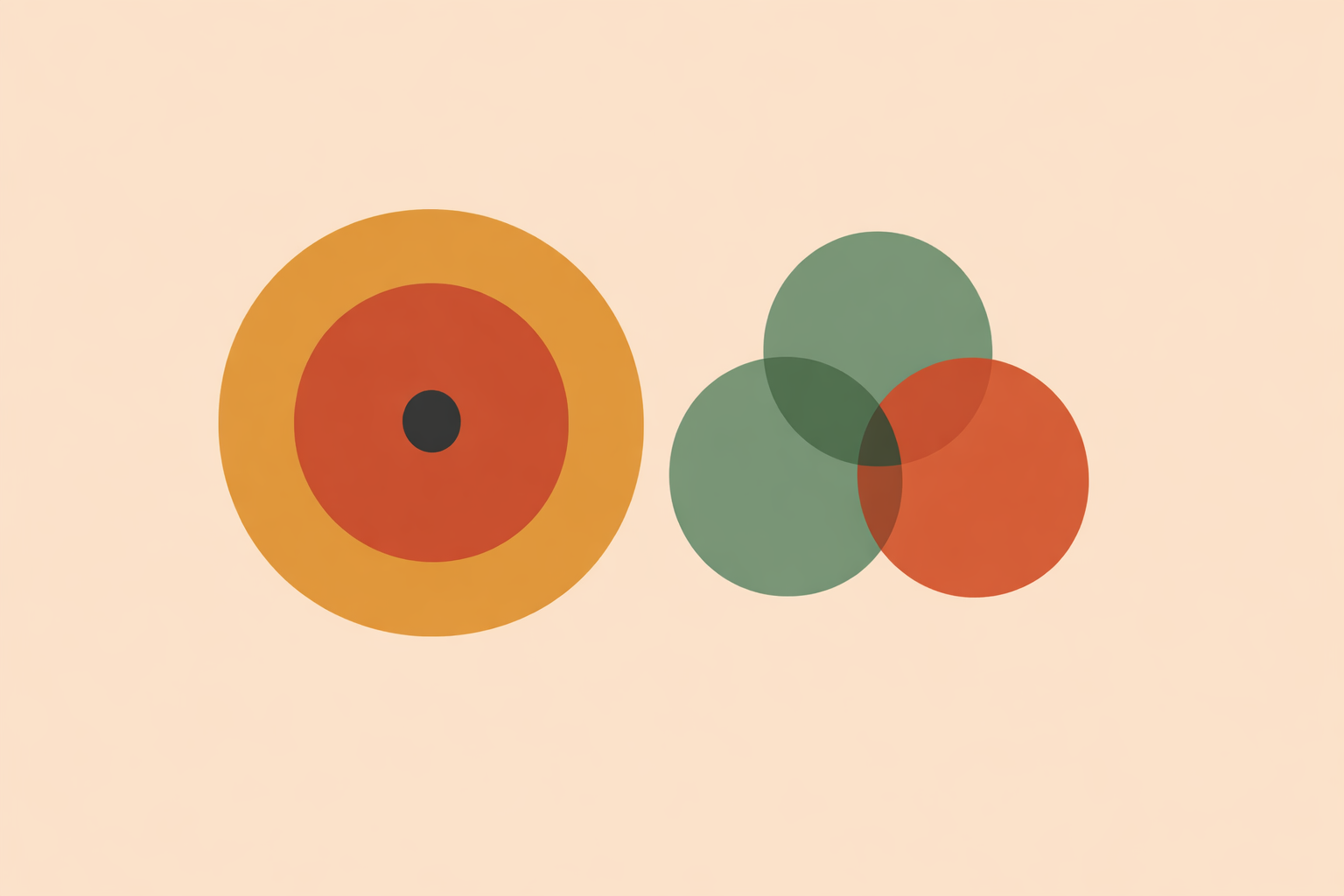
Used well, circle symbolism is practical session design. A center can hold values or intention. A rim can hold actions, phases, or agreements. Overlap can show where connection ends and personal responsibility begins.
Key Takeaway: Use the circle as a design tool. Center, rim, and overlap turn symbolism into visible session structure that people can understand quickly and follow with ease. These three forms work especially well for values clarification, cyclical growth, and relational boundaries, while keeping the work grounded, consent-led, and adaptable.
Why Circle Structure Changes Group Dynamics
A circle changes more than the look of a room. It changes how attention moves. When people sit at equal distance from a shared center, turn-taking gets easier and hierarchy softens. In group settings, circle formation can support mirroring and offer containment, helping people settle into the shared space.
This is one reason circles have such staying power across traditions. They make belonging visible. No one sits at the “head,” and the shape quietly communicates that each voice has a place.
That sense of safety matters in real facilitation. Peer-support guidance describes well-held groups as a safe place to share, without sliding into advice-giving or fixing. In circle work, that steadiness is the point: listening, clear agreements, and enough structure for honest speech.
Over time, circle-based processes are also associated with improved well-being. Many practitioners recognize the same shift in the room: slower breathing, longer pauses, more thoughtful language, and less impulse to interrupt.
Circles also tend to strengthen communication. Much of that comes from simple design choices—equal seating, visible agreements, a clear opening, and a clean closing—that help people feel held without feeling managed.
In practice, it can be very simple: eight chairs, one object at the center, and an opening round such as, “Name one quality this group needs today.” That single move often steadies the whole session.
Circle Script 1: Centering Values
If you want a session to focus quickly, begin with the center. Place one value, intention, or guiding quality in the middle, then build outward into concrete action. People feel the link between inner orientation and outer behavior right away.
The center holds the “why.” The edge holds the “what.” This distinction helps people move from insight to follow-through while keeping the meaning intact.
Use this script:
- Materials: plain paper, pen, and something round to trace if needed.
- Step 1 — Draw one large circle and place a word in the center. Ask: “What quality do you want to embody here?” Examples: steadiness, courage, patience, clarity.
- Step 2 — In the inner area, note three strengths or supports already present. These might be habits, relationships, or personal qualities.
- Step 3 — On the rim or just beyond it, write three to five small observable actions that express the center value.
- Step 4 — Circle one action to complete within the next 48 hours.
- Step 5 — Mark a check-in point: a time, date, or next session where the person will return to it.
This values-and-goals circle works across coaching, creative work, and behavior change learning spaces. It stays honest: if the center says “clarity,” the outer action needs to look like clarity in lived life.
Keep the language plain. Ask one meaning-making question, then one behavioral question:
- “What matters most here?”
- “What is one small action that would show it?”
That pairing is often enough to preserve symbolic depth while producing something usable.
In one-to-one work, someone might write “Presence” in the center, list inner supports such as “lunch outside” or “phone off by 9 p.m.,” then choose edge actions like “close laptop at 5:30” or “leave my phone in the other room during dinner.” Ten minutes can shift the session from aspiration to a grounded next step.
In groups, co-create the center together. Ask for one shared value, place it in the middle, and invite each participant to name one edge action that brings that value into the room.
Circle Script 2: Cycles of Change
Not all growth is linear. Much of it is cyclical, and people revisit themes without repeating them in the same way. The circle supports that reality by normalizing return without framing it as failure.
When someone says, “I thought I had already worked on this,” a cycle map can reduce shame and restore perspective. The goal is to notice patterns, timing, and support needs more accurately.
Use this script when recurring themes are part of the work:
- Materials: a circle divided into four to eight segments.
- Step 1 — Title the wheel with a repeating theme, such as energy through the month, creative resistance, social confidence, or work stress.
- Step 2 — Label the segments by time period or phase.
- Step 3 — In each segment, add one lived example of how the pattern shows up there.
- Step 4 — Add one support for each segment around the rim.
- Step 5 — Mark where the person is now and ask, “What is different on this turn?”
This gives recurrence a place to live. Instead of “I am back at the beginning,” the frame becomes “I am in a familiar phase, and I know more than I did last time.” That shift often protects momentum.
Micro-closures help keep it light and actionable. End with one sentence, such as:
- “What will support me before the next turn?”
- “What is one small adjustment I want to try this week?”
- “How will I know I handled this phase with more skill?”
For example, someone mapping “Creative Energy” across four weeks might see that week two reliably brings overcommitment and scattered attention. They place supports beside it: fewer calls, one protected walk, and no scrolling before noon. The circle shows what repeats and what support belongs to that phase.
Circle Script 3: Relational Boundaries
Some of the most useful circle work happens when the question becomes: how do I connect without overextending myself? Overlapping circles are especially effective for this.
Two equal circles help people distinguish my space, your space, and our shared space. The visual is gentle, yet clarifying. It reminds people that connection doesn’t require collapse, and shared life doesn’t erase individual responsibility.
Use this structure with care and clear consent language from the start. Offer the option to pass, anonymize examples, or begin with lower-intensity situations.
Script:
- Step 1 — Draw two overlapping circles. Label them “Mine,” “Theirs,” and “Ours.”
- Step 2 — Invite two minutes of private note-taking before any sharing.
- Step 3 — In “Mine,” list responsibilities, needs, preferences, and decisions that belong to the individual.
- Step 4 — In “Ours,” list shared commitments, agreements, or areas requiring collaboration.
- Step 5 — Add a final area outside the circles: “Not mine to hold.”
- Step 6 — Ask what small agreement would create a healthier balance.
This works because it gives form to what many people feel but struggle to name. Naming “Not mine to hold” can be especially powerful for someone who tends to over-function, rescue, or absorb what doesn’t belong to them.
Structure matters even more in shared settings. Holding the agreement that participants listen rather than respond can reduce pressure, protecting reflection and preventing someone’s boundaries from turning into a debate.
If the topic is sensitive, start lighter. Facilitation guidance often recommends beginning with a light question; colleagues, projects, or household logistics can be a better entry point than highly charged relational material.
Some topics don’t belong in a circle space, especially where there is coercion, a strong power imbalance, or an active safety concern. Keeping a clear scope is part of ethical practice.
A practical example: two collaborators map “Mine” as creative direction for one person and operational systems for the other. “Ours” holds quarterly goals, brand values, and hiring decisions. Outside the circles, they place each other’s personal work rhythms under “Not mine to hold.” One visual adjustment can create a more workable agreement and noticeably less friction.
Using Circle Scripts Ethically
Circle work is simple, but it is not casual. The quality of the container matters as much as the diagram. Equal seating, clear agreements, and predictable openings and closings often support a group more than clever prompts.
If you’re using these scripts over multiple sessions, sequence them gradually. A gentle progression might look like this:
- Session 1 — Centering Values
- Session 2 — Cycles of Change
- Session 3 — Relational Boundaries with lower-stakes examples
- Session 4 — Integration, reflection, and renewed commitments
This pacing gives people time to trust the structure before moving into more vulnerable material.
Circle-based practice also has deep cultural roots. Working respectfully means not flattening those roots into a trend or aesthetic. Use what serves your setting, stay transparent about scope, and avoid borrowing language or ritual elements you don’t understand well enough to hold with integrity.
Firm agreements help. A simple set may include:
- speak from personal experience
- listen without interrupting
- passing is welcome
- share only what feels manageable today
- respect confidentiality within the limits of your setting
These agreements create enough containment for the process to breathe.
Tracking Change Without Overstating It
Circle work doesn’t need heavy measurement to be meaningful. In many settings, lighter reflection is more useful and more honest.
Three indicators tend to work well across contexts:
- Self-ratings: “How aligned did your chosen action feel this week, from 0 to 10?”
- Follow-through: “Did you do the one action you circled?”
- Belonging statements: “I felt heard,” “I felt able to participate,” or “I felt more connected.”
They’re easy to repeat and specific enough to show change over time. Client-defined indicators work well too, and so can simple ways of tracking progress. One person cares most about follow-through; another cares about feeling less scattered or speaking more clearly in a group.
Short role-play can also support integration, especially when the next step involves communication. A few minutes of rehearsal helps people try new language in a contained way before using it in everyday life.
A circle doesn’t need to become a scorecard. A few honest indicators, returned to consistently, usually show whether the structure is helping.
Conclusion: A Simple Form With Lasting Use
The circle endures because it’s both symbolic and practical. It can hold values at the center, map recurring phases around a rim, and clarify shared space through overlap. These are usable structures that help people orient, reflect, and act with steadiness.
In practice, the power of the circle is rarely dramatic. It’s quieter: less cross-talk, more clarity, and more room for each person to hear themselves and be heard by others.
When held with respect, consent, and clear scope, circle work becomes a dependable way to support reflection, connection, and meaningful next steps people can return to again and again, including in broader mindset and behavior change work.
Explore Sacred Geometry Certification
Connect these circle scripts to deeper geometric principles in the Sacred Geometry Certification.
Explore Sacred Geometry →