Anyone who works seriously with shapes knows the familiar pressure: people want meaning fast, projects move quickly, and a circle rarely shows up as “just a circle.” It arrives with stories, feelings, and inherited assumptions.
The quickest route is a universal meaning list—triangles mean fire, circles mean wholeness, squares mean earth. It also tends to blur distinct lineages into one script, inflate what we can responsibly claim about history or well-being, and distract from what the work actually shows.
A steadier approach is to separate form, context, and claim. Start with what the eye can verify. Then place the shape in a real cultural, artistic, or practical setting. Only then decide how strongly to speak about meaning. That keeps symbolic work clear, respectful, and creatively alive.
Key Takeaway: Symbolic work with shapes becomes more reliable when you separate observable form, cultural context, and interpretive claim. This helps you avoid universalizing, stay honest about sources, and make room for both tradition and personal reflection without confusing one for the other.
Check 1: Start with form before meaning
Begin with what the eye can verify. Description first. Interpretation second.
When someone says, “It’s a spiral of growth,” return to the drawing. Is it a smooth expanding curve, a tight hand-drawn coil, or a broken circular rhythm? Those differences change how meaning lands.
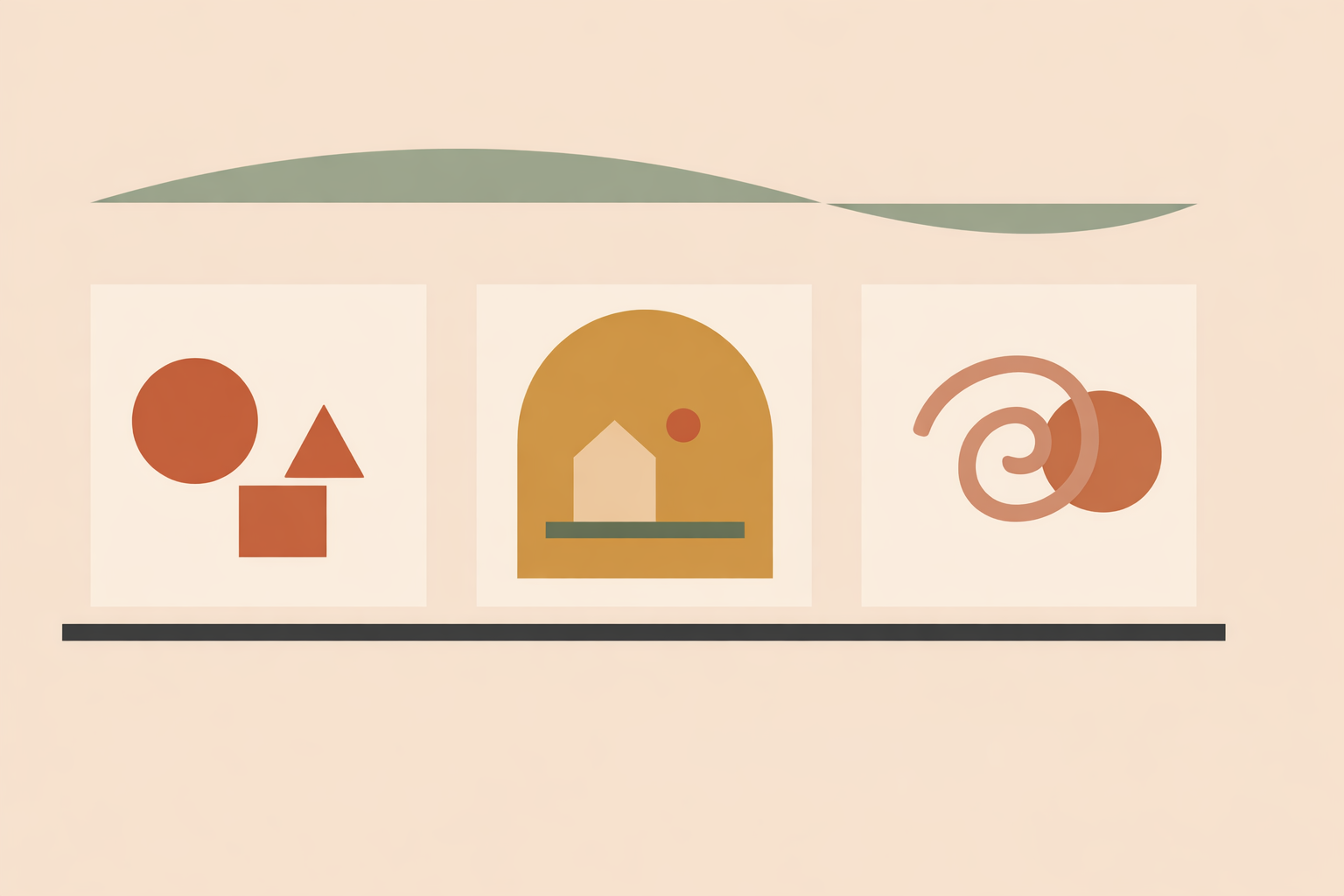
A short descriptive drill can be enough: one large circle near the upper edge, three smaller circles to the right, broken radial balance, low contrast, one bright focal point. Even before symbolism enters, the work becomes clearer.
Useful categories for description include:
- Basic forms: circle, square, triangle, rectangle, polygon, spiral, line, grid, lattice
- Symmetry: bilateral, radial, rotational, approximate, broken
- Relationships: scale, spacing, repetition, orientation, density, contrast, placement
Perception has its own structure. Research shows bilateral symmetry strongly shapes visual attention, a reminder that some effects happen before symbolic language enters at all.
For teaching and critique, relational language helps. “A small circle sits inside a larger square” is observable. “This depicts spiritual wholeness” is interpretive. Both can belong, but they shouldn’t be treated as the same kind of statement.
Two columns—Observable and Interpretive—often changes the whole conversation. Symbolic readings get stronger because they stay anchored in what’s actually there.
Check 2: Place the shape in context
A form becomes more meaningful when we know where it lives.
The same geometry can move through very different worlds. A six-pointed form on a synagogue door, a sixfold rosette in Moroccan tilework, and a hexagonal diagram in a classroom may share structure while carrying different functions, histories, and expectations. Context keeps those differences intact.
Three questions usually do the job:
- Who is using this form?
- Where does it appear?
- What is it doing there?
This is especially important with living traditions. Hindu and Buddhist mandalas function as devotional, meditative, and cosmological practices, with trained relationships to teaching and lineage. When contemporary workshops borrow circular structures from those traditions, it helps to say so clearly and name what has changed.
Simple source-labeling goes a long way. When you note where an image, construction, or teaching approach comes from—and where you’ve adapted it—people can see what’s preserved, what’s transformed, and what’s newly added by the current maker or guide.
A short context checklist can sound like this:
- Name the source community, region, period, or maker when known.
- State the function: architecture, manuscript, textile, drawing, logo, classroom exercise.
- Identify adaptations clearly.
- Name boundaries around restricted, ceremonial, or culturally specific forms.
That level of clarity often makes people more relaxed, because the frame is honest.
Check 3: Match the strength of the claim to the strength of the support
Once form and context are clear, the final step is choosing language that fits.
Not every statement about shapes carries the same weight. Some are observations. Some come from documented sources. Some are interpretations. Some are personal reflections. Confusion starts when those categories blur.
A useful set of labels looks like this:
- Observation: “This design has sixfold symmetry.”
- Record: “The maker notes that the triangle refers to sunrise.”
- Interpretation: “The repetition suggests continuity.”
- Personal reflection: “This pattern feels centering to me today.”
- Empirical claim: “This pattern reliably creates a specific outcome.”
That last category deserves the most care. For example, popular claims that the golden ratio appears everywhere and proves universal beauty often stretch beyond solid support. The number itself is real and mathematically elegant; the sweeping story built around it is less consistent. Seeing Fibonacci-like relationships in a pinecone or a composition can be aesthetically meaningful without automatically confirming a larger spiritual thesis.
Strong studio language stays clean: “We can measure this. We can trace this meaning to a particular lineage. Anything further is interpretation or personal response.”
Using the three checks in practice
With a little repetition, the three checks become quick and natural. Here are four common situations.
Circle: from immediate feeling to precise reading
A bright disk against a dark field may feel calm, lunar, or solitary. Those responses belong in the conversation, but they aren’t facts about the image.
- Form: one high-placed circle, strong contrast, wide negative space, slight glow
- Context: contemporary poster design with no explicit traditional reference
- Claim: the circle acts as a focal point; some viewers may read moon, stillness, or distance
The shift is small: form first, then meaning. You don’t need a universal theory of circles to speak clearly about what the image is doing.
Triangle: keep lineage-specific meanings in their place
Triangles attract quick symbolic language: ascent, fire, striving, direction, imbalance. Sometimes that’s grounded in a lineage; sometimes it arises from composition; sometimes it’s personal.
- Form: one centered equilateral triangle, one leaning scalene, one faint inverted triangle
- Context: painting inspired by mountain horizons and climbing memory
- Claim: the composition creates stability with tension; some traditions read the upright triangle as ascent, but that meaning is not automatically universal
This is where phrasing matters. “I read effort and lift here” stays accurate to your experience and leaves room for other readings.
Contemporary mandala workshops: clear framing matters
Mandala-style sessions can be beautiful and genuinely supportive when they’re framed with care and cultural respect.
- Form: radial drawing built with compass, circle lattice, repeated petals, optional asymmetry or collage
- Context: a contemporary creative practice inspired by historical forms, not a ritual object
- Claim: this kind of art-making may feel soothing for some people, while others may feel restless, overstimulated, or simply unmoved
Current evidence suggests anxiety reduction can occur across several mandala and drawing approaches, while the broader picture remains uncertain because the evidence base is still limited. That aligns with long-standing practitioner experience: a radial “container” often settles attention, but each person’s nervous system has its own truth.
In groups, choice points strengthen the space. Participants can pause, step out, decline to share, change materials, or keep their page private.
A simple opening script works well: “We’re using radial structure as a creative container. This is a contemporary practice inspired by older forms. You’re welcome to engage in the way that feels right for you, including changing course or opting out of sharing.”
Square in circle: classical form without borrowed authority
A square inscribed in a circle can easily trigger sacred-geometry language, even when the maker never intended that reference.
- Form: equal-sided square inside a circle, slight rotation, stable axis
- Context: visual identity for a makerspace or studio project
- Claim: the design creates tension between containment and structure; it uses classical construction without requiring spiritual framing
This is often enough. You can acknowledge that similar constructions appear in traditional symbolic systems while staying honest about your own purpose.
A steadier way to work with symbolic shapes
Symbolic work becomes steadier when you keep the layers distinct: description, formal analysis, contextual interpretation, and personal reflection. Personal meaning still matters; it just isn’t the same as shared evidence or lineage-based meaning.
A reliable rhythm is straightforward: describe the form, place it in context, then calibrate the claim. You stay precise without becoming rigid, and respectful without shrinking your voice.
If you want a quick closing check for any project, use these three questions:
- What can I clearly observe in the form?
- What context gives this reading its shape?
- How strongly am I speaking, and does that strength fit what I actually know?
Used consistently, this keeps symbolic work honest and culturally attentive, while still leaving room for tradition, craft, and lived experience. Shapes can speak powerfully. The point is to let your language show how carefully you’re listening.
Explore Sacred Geometry Certification
Apply this form-context-claim framework in the Sacred Geometry Certification to interpret symbols with more precision.
Explore Sacred Geometry →