Most teen coaches reach a familiar friction: you can hold a powerful conversation one week and watch momentum evaporate the next. Guardians want clarity on scope and progress; teens want voice and privacy; your calendar wants predictability. Without a shared map, sessions rely on improvisation, updates feel ad hoc, and boundaries get stretched by competing expectations. Even seasoned practitioners feel the drag when notes, check-ins, and logistics live in different places. The result is more cognitive load for you and more stop-start engagement for the teen.
Putting a 6–12 week session map in front of the work changes the tone fast. A repeatable, phase-based container sets expectations, steadies the relationship, and frees you to be fully present instead of designing on the fly. Built with adolescent development in mind and anchored in culturally respectful practice, the map keeps ethics visible, centers teen-led goals, and turns insight into small, durable habits. It also gives guardians a clear view of roles and updates without compromising confidentiality—and it stays flexible, so you can adjust pacing while keeping the throughline intact.
Key Takeaway: A clear 6–12 week, phase-based session map reduces friction for teens, guardians, and coaches by setting roles, boundaries, and a steady arc. Use Foundation, Exploration, and Integration to keep goals teen-led, protect confidentiality, integrate culturally respectful practices, and translate insights into small habits that carry beyond coaching.
Know the Teen Landscape: Development, Identity, and Context
Teens aren’t miniature adults. They’re in a potent window where identity, social belonging, and decision-making are actively forming—so coaching design has to meet the moment.
Adolescence includes heightened brain plasticity and strong sensitivity to peers and environment. Essentially, teens are built for learning fast—especially when the learning is meaningful. Cognitive, emotional, and social shifts shape relationships and self-concept, which is why a session map should support the whole ecosystem, not just “mindset.” Teens also assess risk and respond to pressure differently from adults, so clear agreements and boundaries aren’t optional—they’re part of ethical practice.
Modern science and ancestral coming-of-age wisdom
Across cultures, traditional communities have long recognized adolescence as a threshold: rites of passage, mentorship, circle practice, craft, and relationship with land and elders. That is meaningful evidence in its own right—centuries of lived observation about what helps young people become steady adults.
The National Academies highlight how opportunities, environments, and trusting adult relationships shape teen trajectories; ancestral traditions knew this intuitively. It’s why an affirmation can land so deeply at this age. In A.A. Milne’s gentle words, “You are braver than you believe” (A.A. Milne).
Design your map with this truth at the center: teens thrive when trustworthy adults hold a space where identity is welcomed, voice matters, and culture and community are honored—without borrowing from cultures you don’t belong to or understand.
Design the Arc: Three Phases Over a 6–12 Week Teen Journey
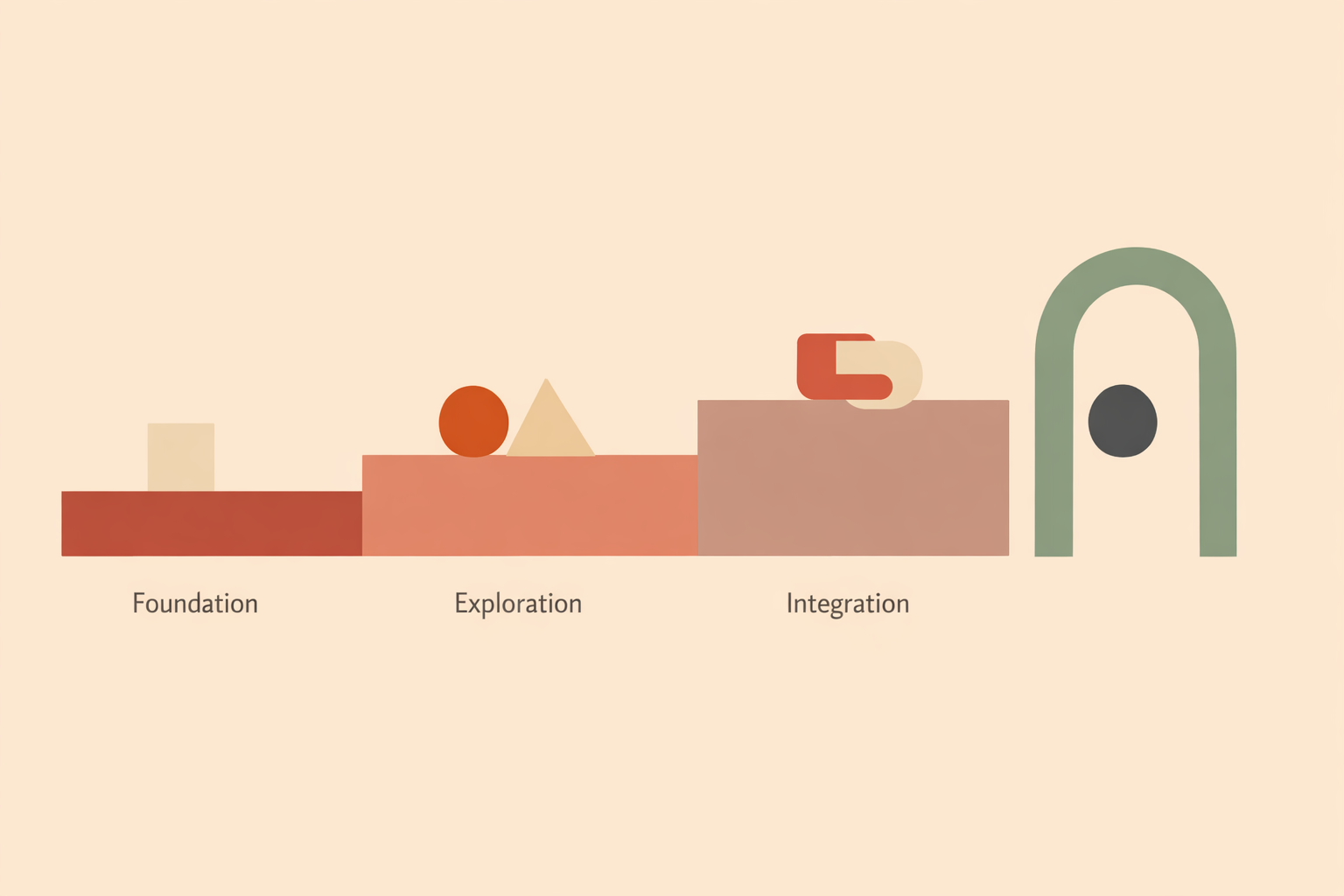
Think in three flexible phases—Foundation, Exploration, Integration. The timeline can stretch from 6 to 12 weeks, but the arc stays steady.
Many effective youth programs move from basics into applied practice, mirroring Naturalistico’s “skills into real-world support” structured pathway. Planning resources for coaches also point to how a staged 12-week structure can support both the practitioner and the client. Youth toolkits like SALTO-YOUTH’s CoachEm reinforce the staying power of phase-based engagement, and common coaching elements like check-ins fit naturally inside that container.
Foundation, exploration, integration
Here’s the arc:
- Foundation (Sessions 1–2): Build safety, clarify roles with guardians, co-create agreements, and set teen-led goals.
- Exploration (Sessions 3–8): Identity work, capacity-building, and meaningful practice that blends modern coaching with traditional tools.
- Integration (Sessions 9–12): Consolidate insights, strengthen leadership, and plan a supported transition.
“People do not decide their futures, they decide their habits and their habits decide their futures” (habits). Here’s why that matters: the arc is really a habit-builder—habits of attention, reflection, and follow-through.
With the arc clear, the phases become easy to deliver consistently.
Phase 1 (Sessions 1–2): Orientation, Safety, and Shared Goals
Start slow to go fast. The first two sessions establish safety, clarity, and shared intent with the teen and, where appropriate, guardians.
This is where scope and boundaries get named, not assumed. Naturalistico’s guidance emphasizes clear scope and kind boundaries, with thoughtful collaboration with guardians when appropriate. The Teen Life Coach path centers ethics, so you make room early for consent, confidentiality limits, and role clarity. Simple written agreements help everyone relax because expectations are visible.
Co-create agreements with teens and parents
Teens open when they feel seen and safe. The APA notes that a trustworthy adult can buffer stress and support healthier adjustment—so your steadiness is a central tool from minute one.
Bryant H. McGill puts it plainly: “One of the most sincere forms of respect is actually listening to what another has to say” (listening). In Phase 1, you don’t just say that—you operationalize it through pacing, choice, and shared agreements.
Practical flow for Session 1:
- Warm welcome: A quick check-in (mood meter, one-word weather, or a simple drawing).
- Scope and roles: “Here’s what coaching is and isn’t; here’s how we handle privacy and safety.”
- Agreements: Co-draft 5–7 norms (phone off, speak from the “I,” you can pass, respect culture and pronouns, end with a next step).
- Goal seeds: A values mini-exercise (three words that matter this season).
- Guardian sync (when present): Logistics, boundaries, and an update rhythm that respects confidentiality.
Session 2 usually deepens context and sharpens goals. A simple “Future Snapshot” works well (imagine 90 days later—what’s different at school, at home, in your body, online?), then translate hopes into 1–3 observable behaviors.
By the end of Phase 1, you have a compass everyone understands.
Phase 2 (Sessions 3–8): Exploration, Skills, and Ancestral Tools
Now the work gets alive. You explore identity, build skills, and practice—drawing from both modern coaching and traditional wisdom that’s held with respect and context.
Teens learn best by doing. SALTO-YOUTH’s CoachEm compiles practical tools designed to involve young people actively, and core coaching elements like values clarification and action planning translate well into age-savvy exercises. This stage of life is primed for rapid learning, so well-timed practice can leave a long echo.
Blending modern coaching with traditional practices
Naturalistico invites practitioners to integrate culture and lineage with contemporary methods (ancestral). The guiding principle is straightforward: keep practices sincere, contextual, consent-based, and never appropriated or stripped of meaning.
Mix-and-match session ideas:
- Identity mapping: Draw circles for roles (friend, sibling, student, artist, gamer), then add values and “what feeds this role.” End with a one-week micro-practice.
- Story practice: A three-beat origin story (Where I come from, a challenge I faced, what I’m learning). If the teen offers a proverb or family saying, let it lead.
- Breath and posture basics: Two simple breaths the teen chooses and one grounding posture for tests or tryouts.
- Boundaries role-play: Build 15-second phrases for “No” and “Not now,” then practice with real scenarios (texts, DMs, group chats).
- Circle minutes: If appropriate, open or close with 60 seconds of silent attention or gratitude—guided by the teen’s culture and consent.
- Digital hygiene: Design a phone ritual (sleep mode, app limits, a home screen tied to values words) connected to goals.
“Tell me and I forget, teach me and I may remember, involve me and I learn” (involve me). Put simply: Phase 2 works when the teen is participating, not performing.
Structure for a typical mid-journey session:
- 2–3 minutes of check-in (color, weather, one word).
- 10 minutes reviewing last week’s micro-practice: what worked, what didn’t, what to adjust.
- 15–20 minutes for the main activity (identity, skill-building, or a culturally rooted practice).
- 10 minutes translating insight into a new micro-practice.
- 1–2 minutes closing with breath, gratitude, or a simple reflection.
Keep it light, embodied, and sincere. Teens notice presence more than polish.
Phase 3 (Sessions 9–12): Integration, Leadership, and Transition
Phase 3 closes the loop without closing the door. You consolidate insights, strengthen agency, and support a dignified handoff to everyday life and supportive adults.
Naturalistico trains practitioners to support journeys end-to-end, not just the “middle sessions.” By this phase, many teens report more confidence, perspective, and self-leadership. The UCLA Center for the Developing Adolescent notes that these years can shape long-term trajectories—so integration deserves real attention, not a rushed ending.
Closing the loop without closing the door
Integration flow:
- Mirror: Reflect wins in the teen’s words (“You kept your promise to yourself three weeks running”).
- Harvest: “What surprised you? What practice felt most like you? What would you teach a friend?”
- Leadership moment: Invite a small teach-back (the teen leads the breath or explains their boundary script). The National Academies emphasize the value of youth responsibility opportunities for healthy transition.
- Transition map: Outline the next 30–90 days: supports at home/school, one anchor habit, and a check-in plan that fits your scope.
- Celebration: Close with acknowledgment that feels authentic (a note, a simple ritual, or a moment of silence for what’s been completed).
As Arthur Ashe said, “Start where you are. Use what you have. Do what you can” (Do what). Integration helps teens feel that truth in their bones: they leave with tools they can actually use.
When appropriate, do a brief guardian sync focused on process-level observations (not private content) and what helps keep the container steady.
Turn the Map Into a Repeatable, Ethical Teen Coaching Offer
Once your arc is clear, operationalize it. Document the 6–12 week journey, keep it flexible for different teens, and refine it as your practice grows.
Scalable doesn’t mean one-size-fits-all; it means a strong core you can adapt with integrity. Naturalistico outlines how standardized structures can be customized for different contexts while staying sustainable. A shared framework also travels well across regions, reflected in Naturalistico’s availability in multiple languages.
Put your offer in writing—overview, phases, roles, privacy approach, pricing, and scheduling—because clear documentation supports trust and reduces back-and-forth.
From template to living, culturally rooted program
Keep your map honest to you, your lineage, and your local community. Name where practices come from, and when you’re uncertain, ask and credit.
Naturalistico positions coaching as an evolving craft. Or, as Einstein put it, “Once you stop learning, you start dying” (Once you). Think of your map like a well-used trail: it gets clearer, kinder, and safer the more you walk it—then maintain it with care.
Practical steps to publish your offer:
- One-page program sheet: Who it’s for, outcomes, the 6–12 week arc, time/price, and how guardians are involved.
- Welcome kit: Agreements, privacy notes, schedule, payment, and a brief “How we’ll work” written for teens.
- Intake flow: Short teen form (goals, supports, stressors), optional guardian form (logistics, strengths), plus a short fit call.
- Feedback loop: A two-minute pulse at Weeks 2, 6, and close; update your map quarterly.
When your map is published and practiced, your presence relaxes—and teens feel that steadiness immediately.
Conclusion: Bring Your Teen Life Coach Session Map to Life
A solid 6–12 week session map is an act of care—for you, for the teen, and for the wider family system. It gives you a steady arc to hold, so your attention can breathe and your tools can land with integrity.
Start with Foundation, deepen through Exploration, and close with Integration. Keep it practical, culturally respectful, and teen-led. Structured learning paths have been linked with confidence and self-leadership, and you can bring that same clarity to coaching while honoring the teen’s autonomy. Blend contemporary insight on adolescent development with the wisdom of traditions you genuinely know, and let your framework evolve in relationship with real teens and communities.
Save a few cautions for your closing practice: keep confidentiality clear, keep boundaries consistent, stay within scope, and be especially careful with cultural material—only use what you have permission, understanding, and context to hold.
Above all, honor the teen’s voice. “Always be a first-rate version of yourself instead of a second-rate version of somebody else,” Judy Garland reminds us (Judy Garland). Your map is ready—now bring it to life with presence, kindness, and steady practice.
Train as a Teen Life Coach
Build an ethical, teen-led 6–12 week coaching container with the Teen Life Coach program.
Explore Teen Life Coach →