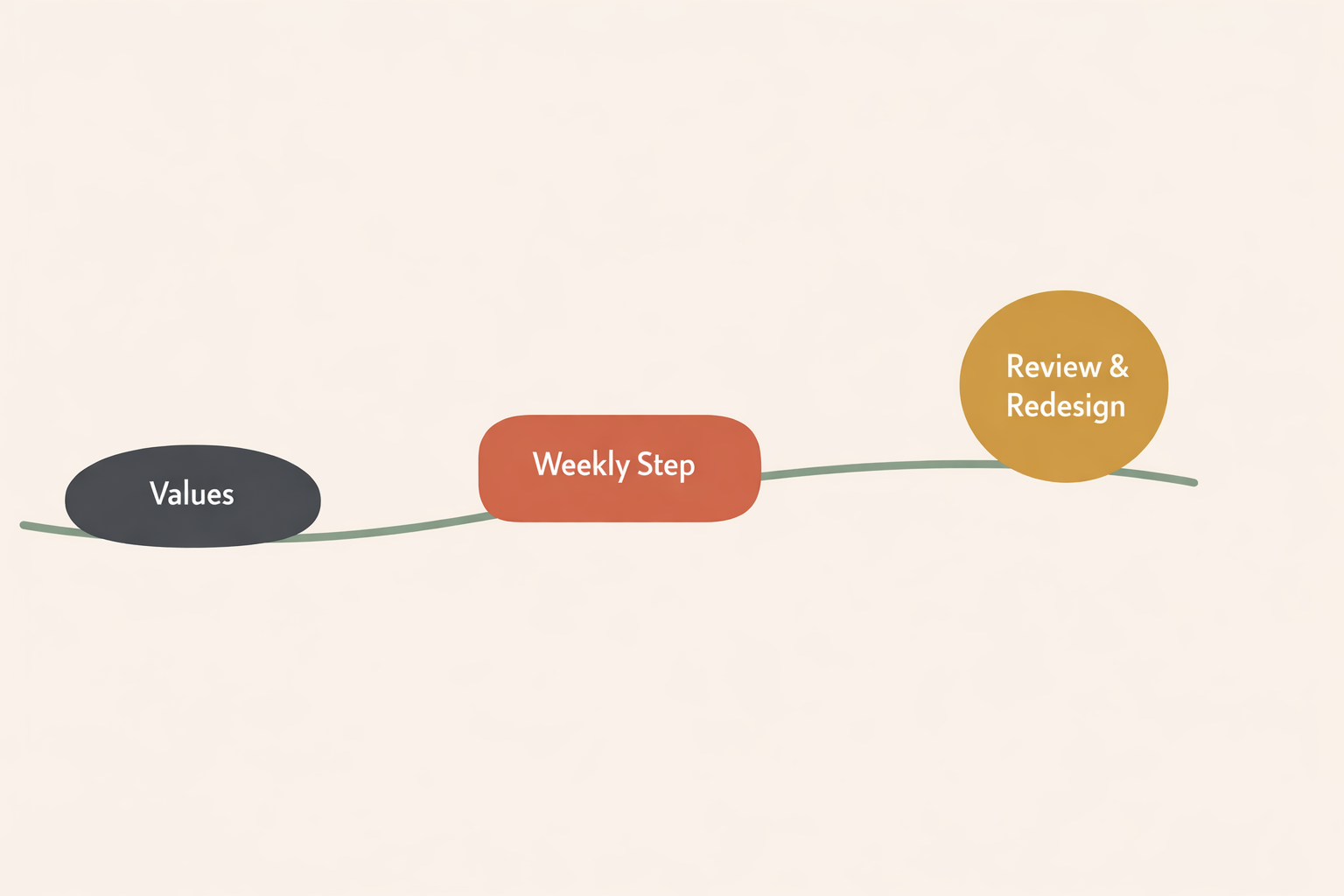
Many coaching plans start with tidy goals, clear metrics, and a tracking tool. That structure can spark a quick burst of motivation. But when a goal doesn’t feel genuinely chosen, momentum usually fades. In day-to-day practice, stalled plans rarely fail because a client “lacks discipline.” They stall because the goal belongs more to expectation than conviction.
Values-based goal setting takes a steadier route. It begins with what the client stands for, then turns that into small, workable action. When goals are internally endorsed, people are generally more likely to stay engaged over time. In real coaching, this often looks like choosing one named value, translating it into one visible weekly step, anchoring it to a clear cue, and reviewing progress in a way that builds learning rather than shame.
Key Takeaway: Values-based goal setting helps clients stay engaged because it shifts attention from borrowed targets to self-chosen action. A practical rhythm is simple: name the value, choose one small weekly step, anchor it with an if-then cue, review what happened, and redesign the plan when life changes. The result is a coaching process that feels more human, more sustainable, and more connected to who the client is becoming.
Start with values, not problems
Values-based work starts with what matters, then builds change from there. This doesn’t ignore difficulty. It gives the client a stable foundation so the work feels worthwhile, not punishing.
Values aren’t tasks to complete. They’re directions to live by: generosity, devotion, steadiness, curiosity, reverence, courage, reciprocity. They name the deeper reason a goal matters in the first place.
So the opening question shifts from “What do you need to fix?” to “What do you want to stand for here?” That small change often brings dignity into the conversation and leads to goals the client can recognize as their own.
For example, “I need to network more” can soften into “I value reciprocity and learning.” From there, the next step becomes more natural: offer one thoughtful introduction, send one note of appreciation, or ask one genuine question in a meeting. The action feels like alignment rather than performance.
Values also work well in weekly coaching because they’re ongoing. Nobody “finishes” courage or completes presence. They practice them.
How to turn a value into one weekly action
The most useful next step is usually small, visible, and ordinary enough to survive a real week.
Choose one value, then express it through one concrete action over the next seven days. Keep it specific enough to notice and gentle enough to do even on a lower-energy day.
- Name one life area that matters right now: self, relationships, work, community, home, or spiritual practice.
- Choose one value that feels alive in that area.
- Finish the sentence: “On an ordinary weekday, this value looks like…”
- Turn the answer into one small action for this week.
- Keep the action observable, not abstract.
Examples:
- Value: Belonging
- Weekly action: Send two check-in messages to friends
- Value: Presence
- Weekly action: Eat dinner without a phone three nights this week
- Value: Learning
- Weekly action: Write one paragraph of reflection after Monday’s meeting
Small steps matter because they create real contact between a value and everyday life. Over time, that repetition becomes its own source of motivation.
Use if-then planning to make the action easier to do
Once the action is clear, the next job is helping the client remember it and start it. If-then planning makes that easier.
Implementation intentions link a chosen action to a reliable cue: “If this happens, then I do that.” The cue can be a time, place, or routine that already exists.
Examples:
- If I finish lunch, then I send one check-in message.
- If I boil the kettle, then I do five stretches.
- If I open my laptop in the morning, then I read my three-line intention.
This matters because motivation shifts with context and energy. A well-chosen cue reduces decision fatigue. The client doesn’t have to renegotiate the plan every time; they follow what they already decided.
The best cues are obvious and already part of real life. A modest plan that fits an actual Tuesday beats a perfect plan that only works on ideal days.
Review progress in a way that builds trust
Weekly review can strengthen commitment or quietly erode it. If check-ins feel like judgment, clients get guarded. If they feel like a place to notice effort and learning, clients stay engaged.
A light review structure works well:
- What did you intend?
- What happened?
- What helped?
- What got in the way?
- What felt most aligned?
- What is the next smallest useful step?
This approach is supported by what we know about goal review and self-monitoring: staying connected to the plan helps people stay connected to their reasons.
Keep tracking light. A client might note frequency, ease, energy, or felt alignment with the value. Two or three indicators are usually enough; beyond that, tracking can become another burden.
The aim isn’t surveillance. It’s awareness. “I only did it once, but it felt true when I did” can be more useful than a spreadsheet.
When the plan breaks, redesign the action
Missed actions are information first. They often point to poor fit, poor timing, unclear cues, or an action that was simply too big for the week that actually happened.
In coaching conversations, it’s easy to misread missed follow-through as a discipline problem. More often, it’s misalignment or weak design.
Return to three practical questions:
- Was the action small enough?
- Was the cue clear enough?
- Did the action still match the value that mattered most?
If any answer is no, redesign. Clients tend to sustain change better when interruptions lead to adjustments, not self-criticism.
One reliable method is to create three versions of the same action:
- Full version: what you do on a spacious day
- Minimum version: what you do on a busy day
- Recovery version: what keeps the thread alive when the week goes sideways
For example, if the value is vitality:
- Full: 30-minute walk after work
- Minimum: 10-minute walk after lunch
- Recovery: open the window, breathe deeply, and stretch for one minute
This kind of flexibility protects continuity. It helps the value stay present even when circumstances change.
Let strengths and cultural roots carry more of the load
Goals become easier to sustain when they grow from what’s already alive in the client: their strengths, their rhythms, and the practices that already belong to their world.
Strengths-based work often feels lighter because it asks, “What quality in you can carry this value into action this week?” Kindness, humor, perseverance, patience, devotion, and curiosity can all become vehicles for follow-through.
For example:
- Value: Community
- Strength: Kindness
- Action: Write two thank-you notes after a shared event
- Value: Learning
- Strength: Curiosity
- Action: Ask one sincere question in Monday’s meeting and note the answer
Cultural and ancestral practices can support this work just as powerfully. For some clients, gratitude lives in a family blessing, a song, tending a garden, calling an elder, preparing tea with intention, or holding a weekly ritual of rest. These practices carry meaning because they’re rooted, familiar, and already proven in lived experience.
The key is respect. The practitioner’s role isn’t to romanticize tradition or impose symbolism, but to help the client choose practices that feel honest and sustaining within their own culture and story.
When a goal is carried by lineage, place, or familiar ritual, it often stops feeling like another task and starts feeling like a return to something known.
A simple weekly values-based goal-setting protocol
Once the pieces are clear, the whole process can stay simple. A steady weekly rhythm usually works better than a complicated system.
- Name one value that matters this week.
- Review the previous week without judgment: what happened, what helped, what did not.
- Choose one small action that expresses the value.
- Create one clear if-then cue.
- Set a minimum or recovery version if needed.
- Track two or three light indicators.
- Reflect briefly at the end of the week and redesign from what you learned.
This rhythm fits naturally into coaching because it stays practical and adaptable, and aligns well with positive psychology and wellbeing. It doesn’t demand a personality overhaul. It asks for one value lived a little more visibly this week.
Over time, that repetition strengthens confidence and steadiness. The client starts to recognize a deeper identity statement: “This is how I want to live.”
Conclusion
Values-based goal setting works because it returns effort to meaning. Instead of chasing goals that look impressive from the outside, clients practice what feels true from the inside. One value, one action, one cue, one review is often enough.
For practitioners, this is steady craft: stay close to what matters, keep the step human-sized, and let each week teach the next one. As with any approach, it benefits from flexibility and cultural respect. When the plan is too heavy, shrink the action, strengthen the cue, and return to the value that started it all.
Explore Positive Psychology Coaching
Build values-led behavior change skills in the Positive Psychology Coach Certification.
Explore Certification →