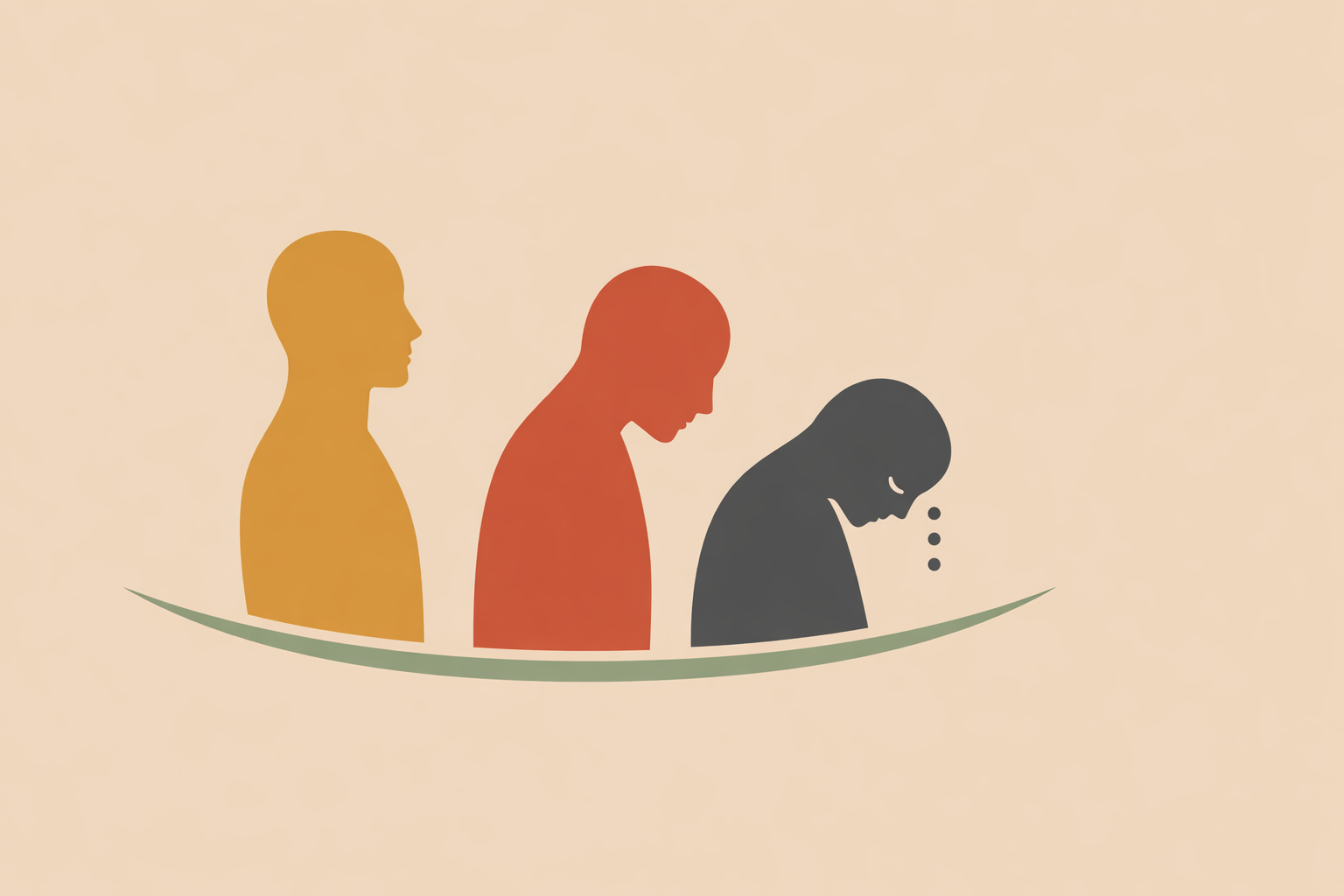
IThere’s a familiar moment in practice: someone who was engaged goes quiet, their eyes drift past you, and their answers shrink to polite yeses. The instinct can be to lean in with more questions. Often, that backfires.
More often, the simpler explanation is the useful one: the nervous system has downshifted. For people living with chronic stress, trauma exposure, or sensory overload, that shift can happen quickly and without words. In a polyvagal frame, it’s less about resistance and more about protection.
Key Takeaway: When someone withdraws or goes quiet, treat it as a protective downshift in capacity rather than resistance, and adjust the pace accordingly. A simple three-state map (connection, mobilization, shutdown) can guide you to lower demand, offer choice, and support gentle re-orienting before pursuing insight.
A simple polyvagal map: connection, mobilization, shutdown
A practical way to track what’s happening is to think in three broad patterns: connection, mobilization, and shutdown. Polyvagal Theory describes three autonomic states that many practitioners use as a working map.
- Connection: more social engagement, curiosity, flexibility, and responsiveness.
- Mobilization: more activation, urgency, fight-or-flight energy, and narrowed focus.
- Shutdown: less energy, less initiative, less expression, and a pull toward withdrawal.
Shutdown often follows prolonged activation or repeated stress—especially when active defense no longer feels viable. In that sense, it’s adaptive rather than defective: the system protects itself by pulling energy down and in.
Use this map lightly. It can organize what you notice, but it should never replace attunement, context, or the person’s own language for their experience.
What dorsal vagal shutdown can look like in the room
In shutdown, the body often tells the story before words do. Gaze, tone, movement, and posture can all drop as part of energy conservation.
You may notice:
- a faraway or unfocused gaze
- less orienting to the room
- fewer spontaneous movements
- rounded shoulders or a folded-in posture
- a visible loss of vitality or tone
- minimal facial animation
Some cues are easier to recognize in real life than to describe neatly in research language. Practitioners often notice an unfocused “through you” gaze, reduced blinking, or a distinct loss of tone that feels different from ordinary slouching—sometimes a stillness that feels deadened rather than restful.
Flat affect and reduced facial expressivity are also common when ventral social engagement drops. The person may still be awake and trying hard to cooperate, while having much less available capacity.
“When the social engagement system is working, it down-regulates defenses… we look at people and feel good.”
That contrast matters. Grounded calm still has some flow in it. Shutdown tends to feel narrower, quieter, and less alive.
How shutdown sounds in session
Shutdown has a sound as well as a look. Speech may get softer, slower, flatter, or simply harder to access.
Common cues include:
- reduced volume
- flatter tone or less prosody
- longer pauses before answering
- shorter replies
- going blank mid-thought
- nodding or agreeing without much presence behind it
Polyvagal-informed work links social engagement with vocal prosody, so when that capacity drops, speech often becomes less prosodic. The person may still respond, but the usual spark, elaboration, or initiative isn’t there.
For some neurodivergent adults, shutdown can also include temporary loss of speech or being limited to a few words. Put simply, reduced language is often a capacity issue—not unwillingness.
A steady rule of thumb: when prosody flattens and initiative drops, track state before story before content.
How shutdown may feel from the inside
From the inside, shutdown is often described as numb, foggy, far away, or unreal—emotions can feel muted or “behind glass.”
Clients may describe:
- numbness
- mental fog
- distance from the room or from themselves
- time speeding up or slowing down
- patchy recall for parts of the conversation
- a heavy, pinned-down feeling in the body
Descriptions of dissociative responses commonly include numbness, detachment and distance. Some people stay outwardly functional while feeling inwardly on autopilot, with a more visible collapse showing up only when capacity drops further.
After overload, shutdown can feel like a crash. A person may understand what’s being said and still have little access to movement, speech, or response—sometimes alongside cold hands, digestive discomfort, faintness, or that pinned-down heaviness.
Deb Dana’s language is useful here: trauma can involve a “stuck state,” and the work is to support movement back toward connection without forcing speed or performance.
Calm vs shutdown: how to tell the difference
Quiet isn’t the issue. The real distinction is whether there’s still access to connection, curiosity, and choice.
In calm states, attention stays flexible. Breath and micro-movements continue, eye contact comes and goes naturally, and there’s some liveliness—even in silence.
In shutdown, attention narrows, initiative drops, and social engagement becomes harder to access. Polyvagal-informed work often contrasts regulated states as more flexible with shutdown states as more constricted movement.
It also helps to remember: shutdown reflects reduced capacity, not reduced interest. What looks like disengagement is often an involuntary protective response, not a choice.
When in doubt, avoid snap judgments. Track clusters of cues, notice changes over time, and pair your observations with the person’s own words.
What tends to help when someone is shutting down
In dorsal states, less is more. The most supportive response is usually to reduce demand and increase dignity.
When insight work isn’t accessible, accurate state recognition helps you choose respectful next steps. Polyvagal-informed approaches emphasize choice-based strategies and gentle pacing in low-engagement states.
- Slow the pace.
- Use one simple question at a time.
- Offer explicit choice: pause, continue, stand up, sip water, look around.
- Orient gently to the present moment.
- Invite tiny movements rather than big shifts.
- Name the protective state without shaming it.
Orienting can be especially helpful: noticing colors, sounds, temperature, or contact with the chair supports present-moment sensory orientation without pressure.
Small movements can help too—pressing feet into the ground, rolling shoulders, stretching hands, or standing briefly. Think of it like adding a small flame under a pot: just enough warmth to encourage movement, not enough to boil over. The key is titration, especially with sensory overload, where mild and steady inputs tend to work better than anything intense.
Language matters. A simple reflection like, “It seems like your system may be pulling back to protect you; we can go more slowly,” often lands better than an elaborate explanation.
Bringing a traditionally grounded lens to polyvagal work
Polyvagal ideas sit comfortably beside many older, culture-rooted ways of supporting regulation. You don’t have to choose between a modern map and traditional wisdom—experienced practice often thrives by holding both.
The vagus nerve plays an important role in social engagement and behavior, including facial expression, vocal prosody and listening. At the same time, many cultures have long relied on simple, relational practices that help people settle, reconnect, and find rhythm again.
These may include:
- paced breathing
- humming or gentle song
- rocking
- prayerful or contemplative attention
- time in nature
- steady, consent-based sensory anchors
Across cultures, these are trusted because they’re simple, repeatable, and meaningful in community. Research also suggests that slow breathing and chanting can enhance vagal tone and support stress regulation.
The key is to avoid superficial borrowing. Work with respect for roots, context, and the person in front of you. A non-pathologizing stance fits naturally here: collapse can be understood as body wisdom asking for a different pace, not as failure.
A grounded way to keep building this skill
Recognizing dorsal vagal shutdown is a learnable relational skill. With time, you start to see the pattern sooner: the faraway gaze, softened tone, flattened prosody, longer pauses, reduced initiative, and reports of numbness, fog, or distance.
As recognition becomes steadier, your responses get simpler and kinder. You push less, pace better, and protect the connection that makes deeper work possible.
Keep the order clear: organize each session around the nervous system—state first, content second. Honor the protective response, support a little more capacity, and let connection return in its own timing.
Train in Polyvagal Therapy
Build confident, ethical shutdown support with Naturalistico’s Polyvagal Therapy Certification.
Explore Polyvagal Therapy Certification →