Many conversations about the human biofield start with big claims, heated debates, or flashy devices. In day-to-day sessions, it’s usually much simpler. Someone arrives feeling scattered, heavy, flat, restless, or emotionally crowded, and the practical question is how to meet that experience with steadiness and respect.
Key Takeaway: The human biofield can be used as a practical whole-person framework for noticing patterns in sensation, emotion, attention, and context. It gives practitioners a shared language across traditions, helps organize techniques into a repeatable flow, and supports clearer tracking without over-claiming. Used well, it stays client-led, observational, and ethically held.
What is the human biofield? A working definition
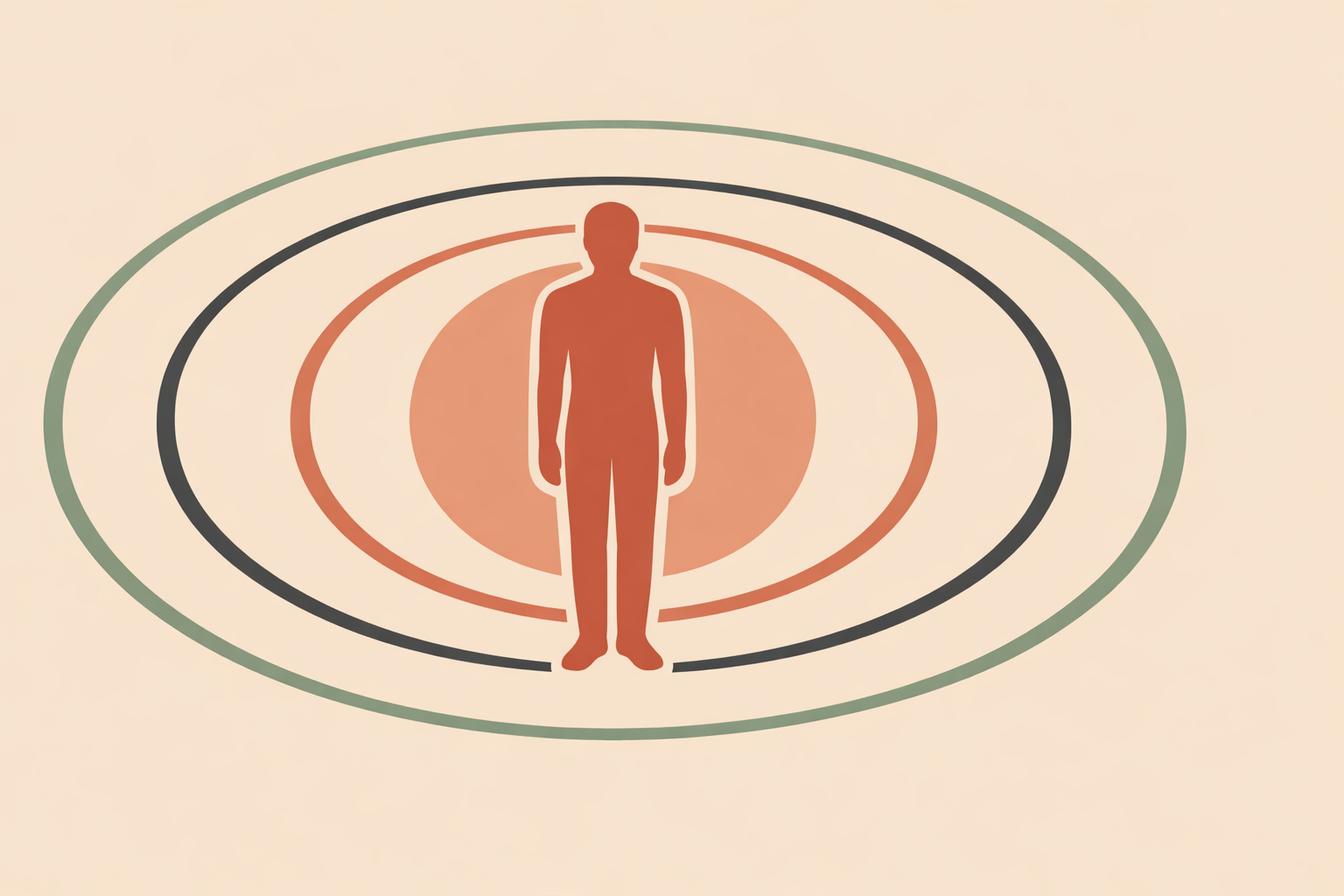
The human biofield is a whole-person way of noticing how body awareness, emotions, attention, relationships, and environment interact, and how that interaction can feel more or less steady, coherent, and connected.
This working definition is intentionally practical. It respects traditional maps while staying accessible to people who prefer straightforward observation. You can use it well without resolving every philosophical question first.
In everyday practice, “biofield” is often used in three overlapping ways:
- Spiritual: a sense of personal presence, aura, or felt atmosphere.
- Traditional: the life-force language of a lineage, such as qi, prana, chakras, or meridians.
- Practical: a framework for tracking shifts in sensation, emotion, attention, and context.
A client-friendly explanation might be: “When I say biofield, I mean how your system feels as a whole. We’ll track it through sensations, attention, and simple check-ins, without forcing any belief system.”
From scattered techniques to a repeatable framework
Many practitioners inherit a patchwork of methods. One approach settles the breath, another strengthens grounding, another supports emotional spaciousness. Without a unifying frame, it can feel like you’re switching tools without a clear thread.
The biofield brings those pieces into a repeatable structure. Grounding supports steadiness. Centering gathers attention. Alignment invites a sense of inner order. The terms vary by lineage, but the practical progression is familiar.
After a few quiet breaths with feet on the floor, someone might report softer shoulders, warmer hands, or a calmer mind. Those are simple changes to track and easy to teach. That’s often where the biofield earns its place: as a reliable way to notice what supports coherence.
Is the human biofield scientifically proven?
A balanced view leaves room for three kinds of evidence: research findings, traditional knowledge, and lived experience. Each contributes something real to how practitioners understand and apply the idea.
Modern research into non-touch and energy-based practices shows mixed findings. Some results are promising, and overall quality varies across studies. Meanwhile, field-like concepts have been refined inside traditional systems for generations, and they continue to translate well to real sessions.
Practically speaking, the biofield isn’t one settled scientific object with universal agreement. It functions well as a working concept that organizes perception, practice, and reflection.
You don’t need to present the biofield as hidden anatomy to use it responsibly. It’s enough to use it as a whole-person framework and track whether certain practices support more steadiness, clarity, or connection over time.
How to track the biofield in everyday life
A grounded approach separates what you notice from what you conclude. That keeps your inquiry clean and your communication respectful.
Start with observation:
- Physical sensations: warmth, pressure, tingling, heaviness, spaciousness.
- Emotional tone: calm, guarded, irritable, tender, flat, open.
- Attention quality: focused, scattered, inward, outward, foggy, clear.
- Context: sleep, food, movement, social contact, workload, screen exposure, environment.
“Tightness around the chest” is an observation. “Blocked heart energy” is an interpretation. Keeping those separate supports clearer reflection and reduces projection in practitioner-client conversations.
A short tracking log can include:
- Where you are and what the environment feels like
- A steadiness rating from 0 to 10
- Three neutral sensations
- One or two words for emotional tone
- The quality of attention
- Relevant context such as sleep, stress, or screens
- The practice used
- What changed, if anything
- Any uncertainty you want to keep in view
This kind of tracking tends to reveal useful patterns over time. It also supports clear session notes without turning interpretation into fact.
A simple one-week biofield experiment
To make the idea practical, use a short daily sequence for one week. Keep it light, consistent, and repeatable.
Try this five-minute flow:
- Look around the room and name three neutral details.
- Feel the support under your feet or seat.
- Soften your shoulders and jaw.
- Name three sensations in neutral language.
- Name your emotional tone and attention quality.
- Set a one-word intention such as steadiness or clarity.
- Stay with one anchor for two or three minutes: feet, breath, or visual orientation.
- Re-check sensations, tone, and steadiness.
The goal is to notice patterns, not to prove anything. With consistent tracking, many people find their experience becomes easier to read and regulate, especially when they focus on small, repeatable shifts that fit energy healing practice well.
A useful page template might include:
- Date, time, and location
- Context first
- Baseline steadiness and three sensations
- Intention
- Anchor used
- After-practice steadiness and two or three observed changes
- One sentence on what surprised you
Using chakras, meridians, and auras with respect
Most practitioners work through a preferred map. The skill is using that map as a lens for inquiry rather than a verdict about the person.
With chakras, you might explore themes such as grounding, creativity, agency, compassion, expression, insight, and meaning. With meridians, you might explore recurring patterns in vitality, movement, tension, or time of day. Offered gently, these frameworks can deepen reflection without taking over the client’s own language.
Auras deserve similar care because they are deeply subjective. Lighting, fatigue, expectation, and suggestion can all shape what someone believes they see or sense. When a client reports a color or image, it often works best as personal symbolism or lived perception, held lightly and explored collaboratively.
A grounded response sounds like: “What does that image mean to you?” or “Does that description match how you’ve been feeling lately?”
Can the biofield be measured? Devices and inner sensing
Some clients will ask about gadgets, aura cameras, or scoring tools. A clear answer helps: devices can measure certain physiological processes, but they do not directly measure subtle energy as a whole.
Biofeedback tools can track heart-rate variability, skin conductance, breathing patterns, temperature, and brain waves. These signals are useful, but they remain physiological metrics rather than direct measures of spiritual or subtle experience.
Many aura-imaging systems also convert bodily inputs into colors or shapes using proprietary algorithms. These images can be interesting prompts for reflection, but they are not definitive portraits of someone’s inner life.
Inner sensing still matters. A person’s lived experience, consistent self-observation, and careful reflection often provide the clearest picture of change over time.
Ethical, client-led biofield work
Whatever language or lineage you use, ethics are what make this work steady and trustworthy. Supportive biofield practice rests on informed consent, clear scope, and language that doesn’t overreach.
Professional ethics guidance emphasizes informed consent, working within competence, respect for autonomy, and avoiding claims beyond one’s role.
Before any energy-alignment exercise, explain what will happen, how long it may last, whether touch is involved, what alternatives exist, and how the person can pause or stop. Then confirm understanding and agreement.
If touch is part of the session, ask for explicit permission that is separate from general session consent. Be specific about area, purpose, and the option to decline.
Documentation matters as well. Clean notes preserve trust: record the agreed focus, consent details, practices used, what the client reported, and what you observed as observation. Avoid turning energetic interpretations into fixed conclusions.
Client-led language changes the tone of the work:
- Instead of “Your energy is blocked,” ask, “Where do you feel constriction right now?”
- Instead of “Your aura is muddy,” ask, “What do you notice in your breath, focus, or mood?”
- Instead of “I’ll fix this,” say, “We can explore a few approaches and see what supports you best.”
Reputable professional codes commonly emphasize client autonomy and pacing. That keeps the work collaborative and respectful.
Practising with the biofield, one observation at a time
The human biofield is at its best when it stays close to lived experience. It helps practitioners honor traditional maps, organize subtle practices, and track change without overreaching.
Over time, this builds a mature confidence rooted in careful attention. You notice what repeats, keep context in view, and let sensation and symbolism inform the next step without rushing to certainty.
To close with a grounded note: stay clear about scope, keep consent explicit, and treat devices and interpretations as prompts rather than proof. Held this way, biofield work remains a respectful practice of awareness, patterning, and support, including in energy alignment training.
Explore Energy Alignment Certification
Build ethical, client-led skills with the Spiritual Healing and Energy Alignment Certification.
Explore Energy Alignment →