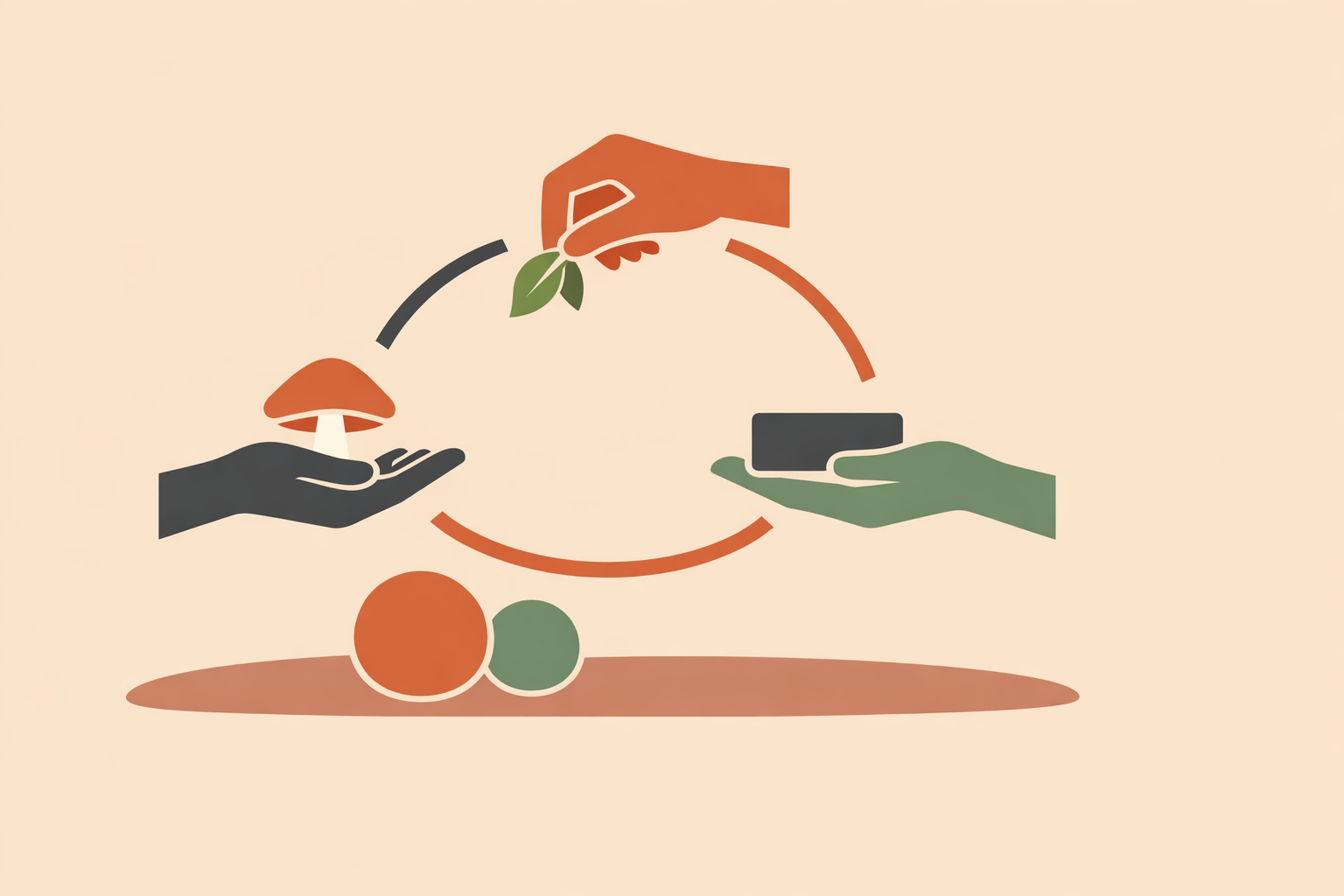
When a client’s afterglow collapses into insomnia, panic, numbness, or derealization by nightfall, the impulse is often to do something big. Many coaches respond by stacking techniques, rushing into meaning-making, pushing catharsis, or hinting at another dose. In practice, those moves can outrun capacity and deepen the spiral. The steadier leverage is usually smaller: a clearer container, simpler language, and decisions sized to the nervous system that exists right now.
A more useful frame is that what looks like “failed regulation” is often feedback about overload, timing, or context. Integration support becomes straightforward: stabilize before interpretation, match support to the state in front of you, and bring meaning back in gently, with clear boundaries.
Key Takeaway: Integration coaching when regulation falters works best when you stabilize first, read the state in front of you, and pace meaning within clear ethical boundaries. In the early window, focus on space, body, and safety; over the next week, track function rather than chasing a perfect feeling; then reintroduce narrative work slowly, with small and reversible steps.
When regulation feels like it has collapsed
Sometimes the shift is abrupt. A person who woke up feeling clear and open may be wired by evening, unable to sleep, flooded with fear, emotionally flat, or unsettled by a sense that reality feels strangely distant. Practitioners often see repeating patterns here: panic, existential shock, dissociation, self-perception disturbances, resurfacing difficult material, and disappointment when the aftermath doesn’t match the hoped-for glow.
This does not mean anything is “wrong” with the person. More often, it means the system is signaling that the experience was bigger than its current capacity to digest smoothly.
In session, language can restore agency quickly. Shift from “What’s wrong with me?” to “What is happening right now?” Then narrow it down: what raises this by 5%? What lowers it by 5%? What would make the next hour workable?
A composite example: on day two after a strong journey, Jordan reports chest tightness, looping fear of “never coming back,” and an urge to message everyone about a life mission. Instead of analyzing the mission, the work is to notice patterns: caffeine and scrolling intensify it; warm food and one trusted voice help. That’s enough to design the next hour well.
Many people leave a journey believing they touched their “real self” and then lost it. A steadier view is that integration means bringing something meaningful into ordinary life, not chasing a peak state.
First 24 hours: stabilize space, body, and safety
When dysregulation is rising, interpretation can wait. The first day is for reducing load, supporting the body, and protecting basic safety. Keep it simple enough to follow.
A short check-in can orient the moment:
- Did they sleep at all?
- Have they eaten and had water?
- What is the sensory load like around them?
- Are they alone or in contact with someone steady?
- Have they used any additional substances?
- Do they feel at risk of harming themselves or someone else?
From there, use a simple rhythm: reduce, restore, reconnect.
- Reduce: dim lights, lower noise, mute notifications, postpone major decisions, and stop trying to “fix” the experience through intensity.
- Restore: warm, grounding food; steady fluids; a shower or bath; a short walk; and a realistic bedtime.
- Reconnect: choose one trusted person, one simple contact point, and one brief grounding practice that doesn’t require insight or performance.
A stable 24-hour plan might be: one nourishing meal, one 15-minute walk, a low-stimulation evening, no added substances, one call with a trusted friend at 7pm, and lights out by 10:30. If panic rises, return to the same sequence rather than inventing a new protocol.
One boundary helps many people right away: don’t encourage redosing to repair difficult material or chase a fading afterglow. In practitioner work, escalation after instability rarely creates the steadiness someone is hoping for.
How to read post-journey states clearly
One-size-fits-all tools fail because dysregulation doesn’t look the same in every person. The steadier move is to read the pattern in front of you and match support to that pattern.
Polyvagal language can be useful as a light map. The point isn’t to label someone; it’s to choose the next support wisely.
Activation and panic
This state often looks fast, charged, and frightened. Breath may be quick, thoughts race, startle increases, and fear climbs, while reality testing still seems intact. In broad reviews of difficult psychedelic effects, anxiety and insomnia are commonly reported later adverse effects.
Helpful responses are usually plain and sensory, and nervous system regulation starts with keeping the next step simple:
- lower stimulation
- orient to time and place
- lengthen the exhale without forcing it
- offer warmth
- eat something simple
- protect the next sleep window
A simple script: name five things you see, four things you hear, count backward from 30 on the out-breath, drink something warm, and leave big questions until morning.
Shutdown and dissociation
This state tends to feel far away rather than too fast. A person may seem numb, blank, slowed, disconnected from time, or strangely absent from themselves. When this is the picture, strong inward focus or emotional pushing can be too much.
Support works better when it’s external, gentle, and predictable:
- orientation to the room
- warmth and steady tone
- brief co-regulation
- small rhythmic actions like walking, sipping, or naming colors
- clear consent around touch or closeness
The aim is enough contact and rhythm for capacity to begin returning.
Derealization and depersonalization
Here, surroundings may feel unreal or dreamlike, or the self may feel distant and strange. People often get pulled into what this “means” about consciousness, identity, or existence.
The immediate coaching task is practical: check whether reality testing is still present. Can the person consider more than one explanation, and can gentle orientation help? If yes, grounding, routine, and reduced stimulation tend to help more than a philosophical deep dive.
Wash dishes before debating the universe. Let the body return to ordinary rhythm before asking it to carry metaphysical weight.
Risky elevation
Sometimes the post-journey state looks expansive rather than distressed: very little sleep, rising energy, grand plans, impulsive spending or travel ideas, and rapid stacking of goals. This can be mistaken for clarity when it actually calls for firmer structure.
Lower the threshold for additional support. Slow commitments down. Put major decisions behind basic gates: two nights of sleep, regular meals, and reality-testing with grounded people before acting on big impulses.
What matters is protecting judgment while intensity settles.
The first week: do less, more consistently
Once the first day is steadier, the next task is building a seven-day bridge back to ordinary life. This phase is about rhythm. Many practitioners prioritize sleep, food, gentle movement, and brief check-ins because consistency rebuilds capacity.
Track function rather than chasing a perfect internal state. Useful markers include:
- sleep becoming more regular
- meals becoming easier to manage
- focus returning in short blocks
- appetite reappearing
- willingness to speak with a trusted person
- emotional range broadening
- safer decision-making
These practical shifts often arrive before a stable feeling of calm.
A simple daily card can help:
- Orient: date, time, place
- Drink water and eat something substantial early
- Move lightly for 10 to 20 minutes
- Complete one ordinary task
- Send one message to a safe person
- Keep evenings lower stimulation than usual
It also helps to normalize a few ordinary after-effects. In the days after a psilocybin journey, some people report fatigue. Some also experience mild headaches that typically resolve on their own. In practice, steady meals, fluids, and light movement are often supportive.
Sleep is the trend to watch most closely. Rebuilding sleep is usually a positive sign. Decreasing sleep paired with rising energy is a cue to tighten boundaries and seek additional support sooner.
Meaning with a brake
Once the body has a foothold again, meaning-making can return slowly. The goal is to preserve the value of the experience without letting interpretation become another form of escalation.
Separate three layers:
- what happened
- what I think it means
- what, if anything, I will do now
This reduces confusion quickly. Direct observation is usually steadier than instant conclusions.
For example:
- Observation: I saw a serpent circling a mountain.
- Meaning I’m considering: something in me is changing.
- Action for this week: simplify one commitment and notice what that frees up.
- Observation: I felt overwhelming love and dissolution.
- Meaning I’m considering: connection matters more than I’ve been living.
- Action for this week: schedule one honest family call.
Prompts keep this grounded:
- What happened, in plain language?
- What am I feeling now?
- What do I know for certain?
- What is still unclear?
- What small and reversible step fits this insight?
Symbolic mapping can help too. Invite images, animals, songs, places, and body sensations onto the page. Let ancestral, spiritual, and contemporary interpretations sit beside one another without forcing a single final answer, including within spirituality and ritual frameworks. That respect for multiplicity often protects the depth of the experience better than premature certainty.
The brake is simple: write the insight down, wait, reality-test it with grounded people, and choose one small action instead of a life overhaul.
Relational support without overstepping
Regulation is deeply relational. A steady, consent-based conversation can soften isolation and help restore rhythm. Support is not the same as rescuing, and good boundaries make co-regulation safer for everyone.
Set the frame clearly from the beginning: communication windows, session boundaries, confidentiality limits, and what happens if someone needs support beyond your role. Clarity isn’t coldness; it’s part of containment.
Several small skills help a lot:
- “I’m here, and we can go slower.”
- “Would you like reflection, a question, or quiet?”
- “Let’s come back to that after food or rest.”
- “What would feel supportive, but not overwhelming, in the next hour?”
It also matters not to override someone’s meaning-making with your own worldview. Integration becomes less ethical the moment a guide treats their interpretation as the correct one.
Community can help, but discernment matters. Peer spaces can reduce shame and restore belonging, while some circles normalize risk, glamorize extremes, or blur consent. A simple filter helps:
- Are boundaries explicit?
- Is feedback welcome?
- Is there pressure, idealization, or guru behavior?
- Can someone opt out without social punishment?
Slow, respectful culture supports good integration. So does humility.
Conclusion
Post-journey dysregulation is not a personal failure. It’s often what happens when a large experience meets a human system that needs more time, rhythm, and support to absorb it well.
The practical response is rarely dramatic: stabilize first, read the state in front of you, keep the next step small, and let meaning arrive at a humane pace. Traditional wisdom has long understood this rhythm. Big experience is one thing; returning well is another. Warm food, trusted company, ordinary routines, time outdoors, prayer, song, and rest are often the bridge.
Do less, more consistently. A short walk, a real meal, one grounded conversation, and a simple bedtime can support deeper integration than another push for intensity. If someone’s safety feels uncertain, sleep continues to deteriorate, or reality testing starts to slip, that’s the moment to tighten the container and escalate to appropriate professional support, especially in psychedelic integration coaching work.
Train in Integration Coaching
Build safer, clearer support skills with the Psychedelic Integration Coaching Certification when regulation falters after journeys.
Explore Psychedelic Integration →