Many practitioners recognize the moment: a client notices a small flare and immediately forecasts a crash, lost days, or permanent decline. Reassurance alone often falls flat, because the real challenge is the meaning the mind attaches to the sensation. When alarm is already high, the most reliable path forward is language-led: validate what’s happening, soften the worst-case story, and give the person a steadier script to follow.
Key Takeaway: Chronic pain catastrophizing is a modifiable pattern that can be softened in hypnosis through validation, reframing, imagery, and repeated self-practice. The most effective sessions usually begin with a clear pre-talk, then use focused attention to separate sensation from alarming interpretation, reduce helplessness, and build a more workable sense of choice and influence.
Understanding Chronic Pain Catastrophizing
From the client’s side, catastrophizing rarely feels dramatic. It feels protective. A small shift in sensation can quickly turn into “What if this never stops?” or “I won’t cope,” and the body responds as if the threat is already here.
Catastrophizing is a negative response to actual or anticipated pain. It often shows up as threat amplification, repetitive focus, and a felt loss of influence, which is why one minor flare can seem to carry the weight of an entire future.
Over time, this thinking style tends to pull daily life inward. Pain can feel bigger, options feel fewer, and ordinary routines feel less trustworthy.
The Rumination, Magnification, and Helplessness Loop
A useful way to understand catastrophizing is through three recurring movements:
- Rumination: the mind keeps circling the sensation and what it might mean.
- Magnification: the meaning of the flare expands into a worst-case scenario.
- Helplessness: the person feels they have little or no influence over what happens next.
These three feed one another. A twinge becomes monitoring, monitoring becomes prediction, and prediction becomes collapse. It’s no surprise research links catastrophizing with higher pain and more disruption in daily life.
Because vigilance rises, attention narrows and the day can start organizing around avoiding the next flare. This becomes a whole-body alarm pattern, with thoughts and emotions reinforcing each other.
A gentle reframe can loosen the loop early: “Your mind is trying to protect you. Let’s help it do that with less alarm and more precision.” For many people, that’s the first time they feel understood rather than corrected.
Why Hypnosis Can Help Soften the Pattern
Hypnosis fits this work because attention, meaning, and expectation shape how sensation is experienced. Research shows expectation can meaningfully influence pain perception.
That matches long-standing traditional understanding: the way a person meets discomfort matters. In modern terms, pain is widely described as a multidimensional experience shaped by context, stress, memory, mood, and interpretation.
This never dismisses the reality of pain. It gives you more doors to walk through. In hypnosis, focused attention, pacing, and imagery can reduce alarm and help the client respond with more skill in the moment.
Catastrophizing also has movement in it. Evidence suggests it’s a modifiable pattern, which makes it an excellent leverage point for hypnotherapy and NLP-based support.
Start With a Pre-Talk That Builds Safety
Before any induction, the client needs a frame that feels respectful and believable. A good pre-talk lowers fear, normalizes the process, and makes hypnosis feel collaborative.
A simple opening might sound like this:
- “Your pain is real.”
- “The way attention and meaning shape sensation is also real.”
- “Today we’re going to work with those influences gently, so your system has more room and less alarm.”
This language lands well with skeptical clients because it doesn’t minimize their experience. It also sets the central aim: you’re not denying sensation; you’re changing how the mind organizes around it.
You can expand that frame with practitioner-friendly language such as:
- “Pain is a whole-system experience, influenced by history, stress, mood, and meaning.”
- “Catastrophic thoughts are understandable, but they can make pain feel louder and life feel smaller.”
- “Focused attention and imagery can help your system find a steadier response.”
Traditional cultures have long worked with rhythm, trance, story, and focused attention to help people relate differently to discomfort. A modern hypnosis pre-talk can honor that lineage while staying practical and clear.
Core Hypnosis Moves for Rumination and Magnification
Once safety is established, trance becomes a rehearsal space for steadier appraisal. The aim is to reduce the mind’s automatic leap from sensation to threat, without forcing positivity.
Evidence-informed hypnosis approaches that integrate cognitive principles can soften catastrophizing by strengthening more adaptive thinking patterns. In the room, this often looks like helping the client notice a thought, feel its impact, and then change how it’s held.
A useful in-session sequence often includes:
- Breath pacing: slow the rhythm and let each exhale cue a little more ease.
- Simple sensory labeling: notice “warm,” “tight,” or “pulsing” without building an alarming story around it.
- Reduced urgency: invite the idea that not every sensation needs an immediate explanation.
- Gentle reframing: replace “This will ruin everything” with something steadier and more workable.
Practice wisdom and research both support this direction. Hypnotic work that includes reframing and ambiguity tolerance can support ambiguity tolerance and weaken habitual worst-case conclusions.
For example, you might say:
- “Notice the sensation as sensation.”
- “You do not need to decide what it means right now.”
- “Your mind can soften the old alarm and respond one step at a time.”
That language helps the person stop fusing sensation with the story about sensation. Even a modest shift can create real breathing room.
Use Imagery to Dial Down Alarm
Imagery gives many clients a direct felt way to change appraisal. It’s often easier to do something with the mind than to argue with it.
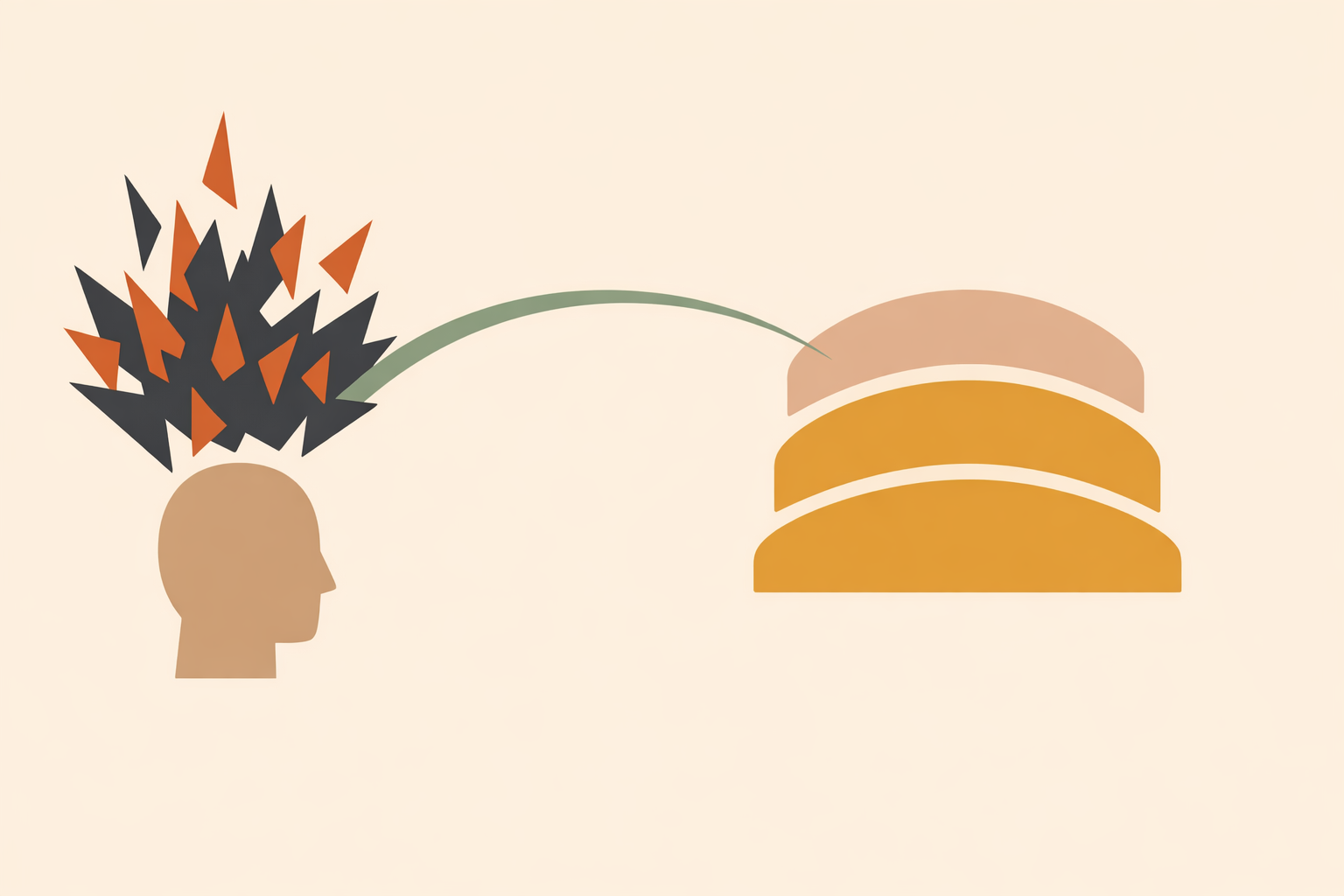
A common option is imagined sliders labeled “threat,” “tension,” and “space.” The client pictures turning threat down one notch and space up one notch. Imagery can influence both perception and evaluation, and research supports the role of mental imagery in changing appraisal; focused imagery can also modulate pain.
Other clients prefer waves settling, warmth spreading, distance increasing, or a protective boundary becoming calmer. The exact symbol matters less than the outcome: more steadiness and more choice.
Imagery should be individualized. What soothes one person can unsettle another, especially when a symbol carries strong personal associations. Choose images with the client, not for them; tailored guided imagery tends to work best when it fits the person’s own felt sense.
Address Helplessness Directly
Helplessness is often the heaviest part of catastrophizing. When someone feels they have no influence, every flare can seem final.
Hypnosis can counter this by emphasizing choice, pacing, and existing strengths. Some hypnosis-enhanced approaches are designed to strengthen self-efficacy and help reframing become more automatic over time.
A practical three-part structure is:
- Future-self imagery: invite the person to meet the version of themselves who responds to flares with more steadiness and skill.
- Values bridge: reconnect those skills to what matters most in everyday life.
- Identity reinforcement: remind them that steadiness is something they can practice, not something they either have or do not have.
You might say, “Each day, small choices build a reliable skill,” or “Some part of you already knows how to steady this.” Those lines matter because they move the person toward participation.
This shift is also reflected in outcomes. Reductions in catastrophizing are linked with better outcomes, including less interference and improved day-to-day functioning.
When Catastrophizing Surges Mid-Session
When the old story intensifies mid-session, direct correction usually backfires. Start with validation, then re-orient to choice and a smaller task.
A practical four-step response is:
- Validate: “Of course your mind went there. It is trying to protect you.”
- Offer choice: “Would you like to sit, stand, or recline? Eyes open or half-closed?”
- Narrow the task: “Let’s work with the next breath only.”
- Invite a testable reframe: “For a few moments, try the line: ‘This is a wave, and I can meet it one breath at a time.’”
This validate-first stance lowers shame and keeps the client connected to influence. Often, that’s enough to stop escalation.
You can also return to simple labeling: tight, warm, pressure, pulsing. Language that stays close to raw experience helps the person step out of prediction and back into present-moment contact.
Self-Hypnosis for Daily Flares
Sessions deepen when clients can repeat the skill in daily life. Self-hypnosis gives them a way to practice steadier appraisal between sessions, especially when flares show up unexpectedly.
Teaching self-hypnosis is commonly recommended in chronic pain support, and reviews suggest hypnosis followed by self-hypnosis can be especially useful as an ongoing practice.
A simple five-minute structure works well:
- Minute 1: slow breathing and a cue such as “one notch easier.”
- Minute 2: label sensations simply, without adding story.
- Minute 3: repeat a phrase that reduces urgency, such as “I do not need to solve this right now.”
- Minute 4: use a resource image like sliders, waves, warmth, or widening space.
- Minute 5: close with a self-efficacy cue such as “I can influence this one breath at a time.”
Short flare scripts can also help:
- “Name it, don’t narrate it.”
- “Threat down, space up.”
- “Waves move.”
- “One notch easier.”
- “I can choose my pace.”
Regular practice matters. Research suggests repeated self-hypnosis or guided imagery can support reduced intensity over time, and self-hypnosis can enhance a person’s sense of control rather than diminish it.
Practitioner Guidelines for Ethical, Respectful Work
A few principles keep this work grounded:
- Do not imply that pain is imagined simply because meaning influences experience.
- Avoid grand promises. Focus on easing alarm, expanding coping, and building steadier responses.
- Use invitation-based language rather than command-heavy scripts.
- Individualize imagery and pacing.
- Honor cultural roots with respect, context, and consent.
Traditional approaches to trance, story, rhythm, and altered attention have deep lineages. They deserve care, not casual borrowing. If you work with ancestral or culturally specific imagery, do so thoughtfully and only where it is appropriate for the person in front of you.
Closing Perspective
When chronic pain catastrophizing softens, life often starts to feel larger again. Sensation may still be present, but the person is no longer trapped inside its loudest meaning.
This is where hypnosis can be so valuable. It helps clients separate sensation from prediction, replace helplessness with participation, and practice a steadier inner response until it feels familiar. Done well, it restores room, choice, and dignity in the middle of a hard experience.
As a practitioner, your words matter. Validation lowers defensiveness. Imagery organizes attention. Repetition builds familiarity. A respectful trance process helps someone discover that even when a flare arrives, the old catastrophic story does not have to lead.
Master Pain Hypnosis Skills
Apply these reframes and imagery tools with Treating Physical Pain with Hypnosis in a structured, ethical approach.
Explore Treating Physical Pain →