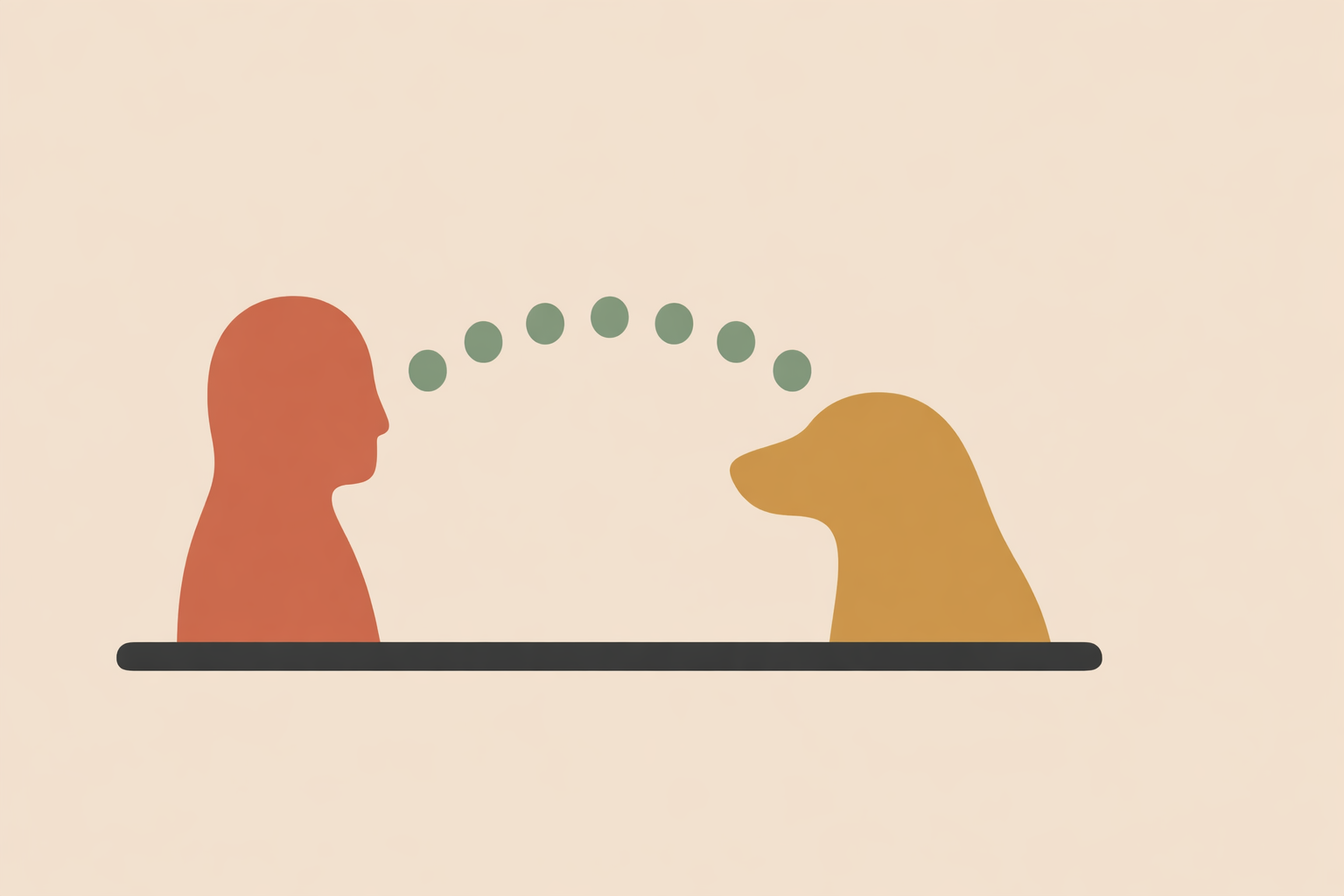
Nearly every intuitive animal practitioner hears the same challenge sooner or later: “So you talk to animals—can you prove it?” A good response stays calm and practical. It starts with what everyone already accepts, describes the work in everyday language, and makes your process easy to understand.
Key Takeaway: A steady way to speak about animal telepathy is to start with observable animal communication, then define intuitive work as focused attention plus subjective impressions that are always checked against context and behavior. This keeps the conversation grounded, protects trust, and leaves room for both traditional ways of knowing and honest uncertainty about mechanism.
Start with what people already recognize in animal communication
When someone sounds unsure, begin with shared ground: animals communicate constantly. They use posture, movement, timing, scent, touch, vocal tone, and space. Most people have watched a dog relax when a person softens, or seen a horse go alert before a human notices anything has changed.
This matters because animals can detect subtle changes long before we do. Dogs, horses, birds, and cats often pick up micro-movements, pressure shifts, scent changes, or faint vibrations that never reach our conscious attention.
Across many cultures, human–animal relationships have also been shaped by reciprocity rather than control, with relational exchange seen as part of living well alongside other beings.
A simple way to say it: “Your animal is already reading far more than words. My work begins by respecting that, then listening more carefully for what might be there.”
Define intuitive animal communication in grounded language
If you choose to use the word “telepathy,” define it clearly. Otherwise, people will supply their own meaning.
One grounded definition is this: intuitive animal communication is a practice of focused attention, empathy, and inner listening used to receive impressions about an animal’s experience. Those impressions are never offered as hard fact. They’re explored alongside behavior, history, and the guardian’s lived knowledge.
In practice, impressions often arrive as images and sensations, or as a quick “whole sense” of a situation rather than a tidy inner conversation.
Many practitioners also describe multisensory transmission: visuals, sounds, textures, tastes, emotions, or brief inner phrases that later need translating into ordinary language.
This framing helps people relax because it’s disciplined, not theatrical. You’re naming a skill of receiving, sorting, and translating subtle impressions while staying accountable to what can be observed.
You might say: “I start with what I can observe, and then I notice what impressions arise. Because impressions are subjective, I share them carefully and check them with you.”
Hold traditional knowing and modern evidence with honesty
People often want a binary answer: proven or nonsense. Real life is usually more nuanced, and that’s okay to say plainly.
Mainstream science has not established a telepathic mechanism between humans and animals. At the same time, traditions of interspecies listening stretch back a very long way, and many practitioners and guardians report experiences that feel meaningful and coherent, beyond what they believe ordinary observation explains.
Within practitioner circles, telepathy is often described as an energy exchange shaped by intention and attention, even when that framework doesn’t fit neatly into mainstream theory.
There are also many anecdotal reports of nonverbal experiences between humans and animals that ring true for the people involved. That isn’t the same as proof, but it is part of the real-world landscape this work has always lived in.
A strong, balanced phrasing is: “Science hasn’t confirmed a mechanism for this. I do work within a long tradition of intuitive listening with animals, and I share impressions in a way that stays respectful and checkable against what you already know.”
Explain your process: observation, impressions, interpretation
Trust grows when people can see how you work, not just hear what you got.
A helpful structure separates the process into three layers:
- Observable behavior
- Intuitive impressions
- Interpretation
Observable behavior includes posture, breathing, pacing, vocalization, orientation, and how the animal relates to people, other animals, and place. This is the foundation.
Intuitive impressions are the inner pieces that come quickly: an image, bodily feeling, emotion, phrase, or an overall sense of what’s happening.
Interpretation is where care and humility matter most. You explore what an impression might mean, whether it fits the situation, and whether it’s yours rather than the animal’s.
Experienced practitioners learn to spot projection. If fear, hope, or expectation shows up, it’s named as the practitioner’s experience, not assigned to the animal. That discernment is central to ethical practice.
A practical sequence can look like this:
- Settle your attention.
- Establish consent and clear intention.
- Observe the animal’s presence and behavior.
- Receive impressions without forcing them.
- Write them down quickly before analysis reshapes them.
- Cross-check them with the guardian and the wider context.
When you name the steps, the work feels understandable: a structured practice of sensing, sorting, and checking.
Use language that is clear, modest, and useful
The words you choose shape the whole experience. Clear language protects the animal, supports the guardian, and keeps expectations realistic.
Many practitioners find that “observable behavior + intuitive impressions + interpretation” helps people feel at ease. It signals transparency and lowers pressure to sound all-knowing.
You can also make your role explicit:
- “I share impressions, not certainties.”
- “I’ll tell you when I’m describing behavior and when I’m describing intuition.”
- “We only keep what feels relevant and grounded.”
- “My role is to support understanding, connection, and reflection.”
This matters even more when emotions are high. Rather than declaring, “Your horse hates the stable,” you might say, “I’m getting a strong impression of discomfort around confinement. Does that match what you’ve been noticing?”
It keeps the exchange collaborative and respects the animal as a being in relationship, not an object to decode for certainty.
How to answer “Isn’t this just body language?”
This question deserves a steady, non-defensive reply. Much of the time, body language is a big part of what’s happening, and it’s fine to say so.
You can say: “Body language is central. Animals communicate constantly through what they do, how they orient, and how they respond. Intuitive work doesn’t replace that. It sits alongside it.”
Some practitioners also report rapid, holistic impressions that feel different from cue-by-cue analysis. Research on expertise describes whole-picture impressions that arrive quickly and feel different from stepwise reasoning.
Related work describes intuition as pattern recognition, where subtle cues and lived experience blend into a coherent sense before the mind has fully explained it.
That doesn’t settle the telepathy question, but it offers a practical bridge for skeptical listeners: refined perception and deep experience can create fast, accurate-feeling knowing.
How to answer “Can you prove it?”
A strong answer is calm, specific, and focused on what you can responsibly offer.
You might say: “I can’t offer proof in the way you may be asking for. What I can offer is a transparent process. I separate observation from intuition, I share impressions carefully, and I check them against the animal’s behavior and your lived knowledge of them.”
That approach is usually more persuasive than trying to win an argument.
It also helps to name the ethical frame. Both intuitive claims and emerging translation technologies can be misused. Ethicists warn that misuse can harm relationships and call for clear guidelines that prioritize welfare, privacy, and animal agency.
Whatever someone believes about mechanism, communication practices should never override an animal’s well-being or be used to control, shame, or sensationalize.
Speaking about animals who have passed
Conversations about animals who have died call for extra care. Here, tone matters even more than theory.
Many people describe ongoing bonds after death through vivid dreams, a felt presence, familiar sounds, or a quiet sense of contact. Research on grief and continuing bonds with companion animals describes common experiences like these.
Some people notice these experiences in the first days or weeks after the loss; others feel them over a longer period.
Observers also report a final surge of vitality near the end of life, and surviving animals may show behavioral changes after losing a companion.
Within practitioner circles, many describe a felt continuity with deceased animals: affection, guidance, presence, or a sense that relationship continues beyond physical form. For this topic especially, keep language gentle and make no promises.
You can say:
- “If you’d like, we can sit quietly and notice what arises in connection with your companion.”
- “I’ll share any impressions softly, and you can decide what feels meaningful.”
- “There is no pressure to make anything fit.”
This honors grief without turning it into a performance or a certainty claim.
Keep the practice ethical, steady, and human
The most convincing way to speak about this work is often the most grounded. Start with what animals clearly communicate. Describe intuitive work as an added layer of listening. Share your process and cross-check what you receive with context, behavior, and the guardian’s reality.
Let your words reflect the values behind the practice: respect, discernment, humility, and care. Animal wellness work like intuitive animal communication lands best when it’s spoken about plainly, with no hype and no inflated certainty.
A final note of caution belongs here: impressions are subjective, emotions can run high, and people can hear what they most want to hear. Staying transparent, collaborative, and welfare-led protects everyone involved and builds trust over time, especially in integrative pet care and related forms of animal wellness support.
Explore Animal Communication Certification
Build a grounded, ethical process for intuitive listening in the Animal Communication Certification.
Explore Animal Communication →