Practitioners often see the same pattern: a child arrives keyed up, someone offers a tidy routine, and the moment it starts to feel like a task, the child braces. More structure is not always the answer. What tends to help is something shorter, softer, and easy for the child to join on their own terms.
That is where Brain Gym can be genuinely useful. Offered with choice and lightness, these simple movements can help anxious children find more steadiness without feeling watched, corrected, or pushed.
Key Takeaway: Brain Gym often works best for anxious kids when it is brief, choice-led, and free from performance pressure. A simple sequence—Brain Buttons, Cross Crawl, and Hook-ups—can help a child orient, organize, and settle, especially when you use micro-doses, gentle pacing, and close observation rather than correction.
Why Brain Gym Can Feel Supportive for Anxious Kids
When a child feels wired, wary, or scattered, movement can offer a direct way back to themselves. Brain Gym tends to work well with anxious children because the patterns are simple, rhythmic, and low on talking.
In practice, many children respond to familiar themes: crossing the midline, coming back toward center, and pairing light touch with breath. Often the shift shows up in small cues—shoulders drop, eyes soften, the jaw unclenches, and words come more easily.
Modern research points in a similar direction at times. Short Brain Gym programs have been linked with lower anxiety scores in children, and repeated sets over time have shown improved attention in school-age groups.
The deeper appeal is practical: these movements support regulation without turning the moment into a lesson. The child does not need to “do it right.” They only need enough safety and permission to try.
What “Not Pushing Too Hard” Looks Like in Practice
Most anxious children do best with more room, not stronger prompting. In a kinesiology-informed approach, the aim is to offer a pattern the child can accept, decline, or adapt.
Choice is central. Offer two options, mirror the child’s pace, and keep the movement small if that is what feels manageable. It tends to land best when the child senses there is no judgment attached.
Timing matters too. These tools are often easiest to use early, at the first signs of tightening, rather than once the child is already overwhelmed.
A simple child-led structure can look like this:
- Ask first: “Want to try a quick crossing move or a calm-hands move?”
- Keep movements small: finger taps, seated knee touches, or light collarbone contact are often enough.
- Stand beside rather than in front, and model instead of instructing.
- Watch for signs of settling: fuller breath, softer eyes, less tension through the mouth and shoulders.
- Pause if the child turns away, stiffens, or starts to rush.
This gentle stance is often what makes the movements usable in the first place. Technique matters far less than the felt sense of permission around it.
Cross Crawl: Turning Busy Energy into Rhythm
Cross Crawl is often an easy starting point when a child feels buzzy, scattered, or stuck. The left-right rhythm gives that energy somewhere to go and helps the body organize around something predictable.
The movement is simple: opposite hand to knee (or opposite elbow to knee) at an easy pace for 20 to 40 seconds. Seated versions work beautifully, especially for sensitive or neurodivergent children.
Within movement and developmental frameworks, crossing the midline supports coordination between both hemispheres and can contribute to smoother attention and self-organization. In real-world settings, many practitioners experience Cross Crawl as a quick way to gather scattered energy and soften a racing or frozen stress response.
Repeated Brain Gym sets over several weeks have also been associated with attention gains in older children, though anxious kids often do best with brief rounds rather than long routines.
If you are guiding a child before school or after a noisy transition, use language that removes pressure: “Let’s do ten slow left-right taps, like walking through honey.” If the pace speeds up, slow it down or stop.
Useful adaptations include:
- Seated Cross Crawl for children who do not want balance demands.
- Micro-sets of 6 to 10 taps rather than longer rounds.
- Soft rhythm cues, like a calm clap or gentle counting.
- Permission to stop at any point.
Hook-ups: A Simple Shape for Settling
Once a child has a little more organization, Hook-ups can help bring the whole system toward quiet. Many children respond to the contained, centered feeling of this posture.
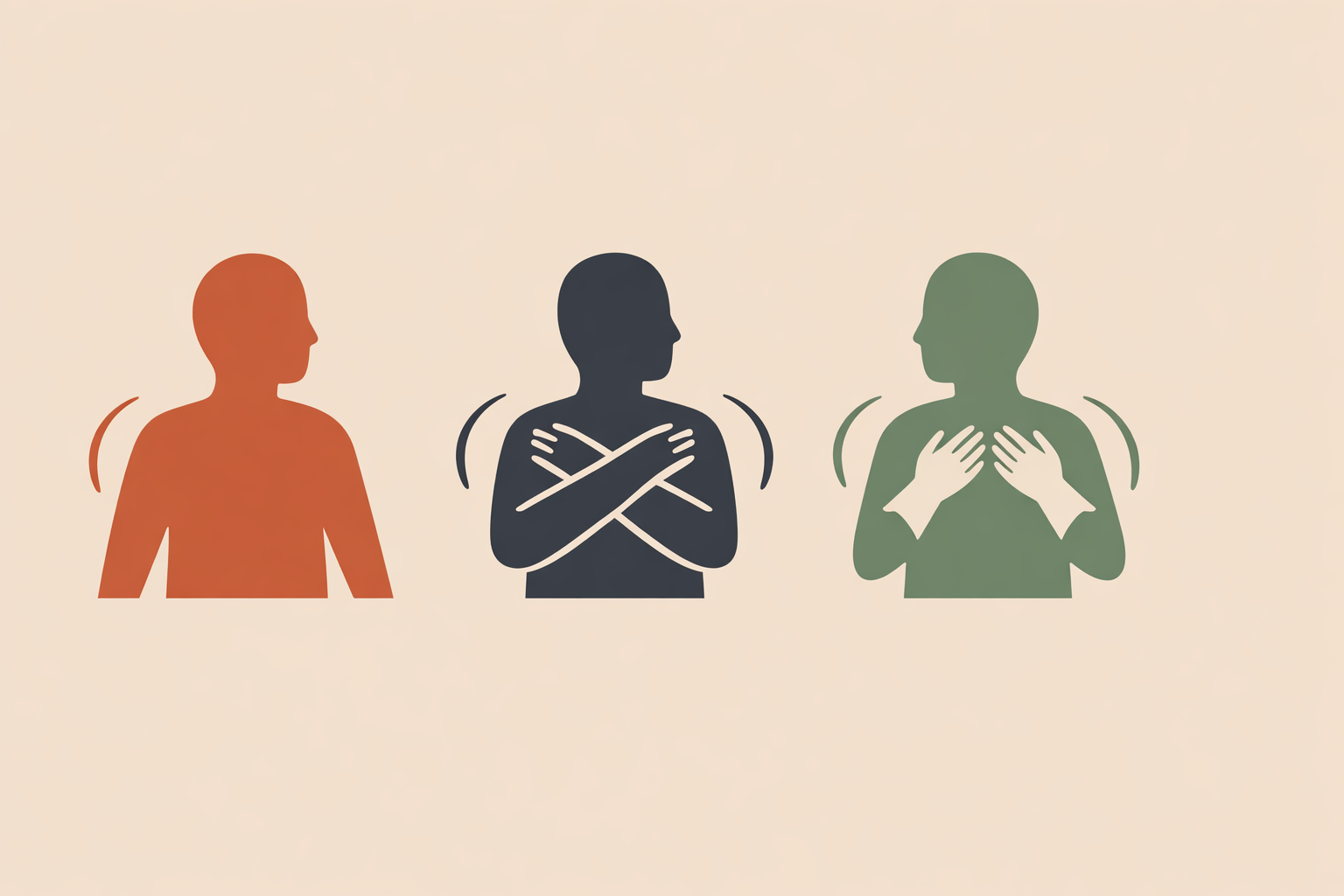
The classic version involves crossing the ankles, crossing and linking the hands, then resting in that shape before uncrossing and placing the fingertips on the chest. In practice, the exact form matters less than the quality of softness and containment it creates.
Hook-ups often follows Cross Crawl naturally: first organize, then settle. Many children describe the second part, with hands at the chest and breath slowing down, as the moment they can finally feel themselves again.
If the full posture feels like too much, simplify immediately. You can skip the crossed shape and use only the uncrossed hand-to-chest hold with a slow exhale. For many children, that is plenty.
Helpful adaptations include:
- Using only the second part of Hook-ups.
- Practising seated or lying down.
- Holding for 20 to 60 seconds instead of several minutes.
- Adding a blanket or cushion for a stronger sense of containment.
Watch the child, not the clock. If you see a sigh, softer eyes, or a clear drop in tension, it is doing its job. If it brings irritation or strain, change course.
Brain Buttons: Reorienting Attention and Breath
Brain Buttons are especially useful when a child seems foggy, breath-holding, or disconnected from their surroundings. The movement is small, yet it often feels immediate.
One hand rests on the navel while the other lightly rubs the soft spaces just under the collarbones for 30 to 60 seconds. In kinesiology sessions and energy healing settings, practitioners commonly use Brain Buttons before schoolwork, transitions, or any moment that calls for more orientation and spatial clarity.
Within kinesiology frameworks, these points are also associated with lung meridian themes such as grief, inspiration, and letting go. That traditional lens is one reason many practitioners naturally pair Brain Buttons with slow breathing.
Longer exhalations can help the body shift toward a calmer state, so Brain Buttons often land best when the touch is matched with an easy inhale and a slower, softer exhale.
This can be especially supportive for children who sigh often, breathe high in the chest, or seem to “forget” to breathe when pressure rises. A cue such as “inhale for four, exhale for six” is usually enough.
A Gentle 3-Move Ritual for Anxious Kids
Together, Brain Buttons, Cross Crawl, and Hook-ups create a short sequence that is easy to remember: orient, organize, settle.
The sequence can be very brief:
- Brain Buttons: 30 to 45 seconds.
- Cross Crawl: 20 to 40 seconds.
- Hook-ups: 30 to 90 seconds.
For many children, one round is enough. If you repeat it, add a pause between rounds with a sip of water or a few quiet breaths.
This kind of short ritual can still produce clear regulation signs. Brain Gym sequences have been linked with lower anxiety levels in child groups, and in everyday practice the changes are often visible: breathing slows, facial tension softens, posture becomes more organized, and speech or eye tracking becomes easier.
Watch for signs that the sequence is helping:
- Breath becomes slower and deeper.
- The jaw loosens and the face softens.
- The eyes track more smoothly.
- Posture looks less braced or collapsed.
- The child finds words more easily, or rests more comfortably in silence.
For practitioners who use muscle testing, before-and-after checks may suggest stronger engagement in indicators that initially seemed switched off. If muscle testing is not part of your work, simple observation is enough.
When to Use It, and When to Pause
These movements tend to work best when they are woven into ordinary life rather than saved for hard moments only. A quick round before school, before homework, after a loud transition, or at the start of a session is often easier than waiting until distress is already high.
Consistency matters more than length. A 90-second ritual used regularly often does more than a longer sequence used occasionally.
At the same time, not every child will want every movement every time. Pause or stop if you see glassy eyes, breath-clutching, rising irritation, people-pleasing speed, or a clear “no.” The work should stay supportive and choice-led.
Closing Thoughts
Cross Crawl, Hook-ups, and Brain Buttons form a simple trio that many anxious kids can learn to trust. The real skill is in the delivery: gentle pacing, real choice, and steady attention to the child in front of you.
There is still debate around Brain Gym’s broader mechanisms, and not every claim made around it is strongly supported. Traditional movement wisdom and day-to-day practitioner experience still show, again and again, that small, repeatable patterns can shift how a child meets stress.
Used this way, Brain Gym stays in its best role: practical, respectful support for well-being. Keep it light, keep it flexible, and let a small shift count.
Explore Kinesiology Certification
Learn choice-led regulation tools like these in the Kinesiology Certification.
Explore Kinesiology Certification →