Most group facilitators begin with words: agreements, introductions, a few questions to get things moving. Sometimes that’s enough. Just as often, people slip into social performance, quieter voices fade, and the group starts aiming for approval rather than honest contact.
Outdoors with horses, the centre of gravity shifts. Attention naturally widens to land, weather, sound, and movement. Choices show up first through posture, breath, distance, and timing, long before anyone explains what they feel.
Key Takeaway: Nature-based equine sessions can shift group dynamics by making the body, the environment, and the horse–human relationship central to connection. The strongest groups are designed around safety, choice, clear structure, and horse welfare, with enough repetition over time for trust and self-regulation to deepen naturally.
From Guarded Circle to Shared Herd Awareness
Most groups arrive a little activated. People scan for safety, wonder how they’ll be perceived, and carry different levels of tension into the space. In an equine setting, that first layer often eases as the session unfolds.
Work in animal-assisted settings suggests sessions can support expression and self-regulation. Many facilitators recognize the same arc in equine groups: guarded arrival, slower breathing, steadier attention, and clearer regulation by the end.
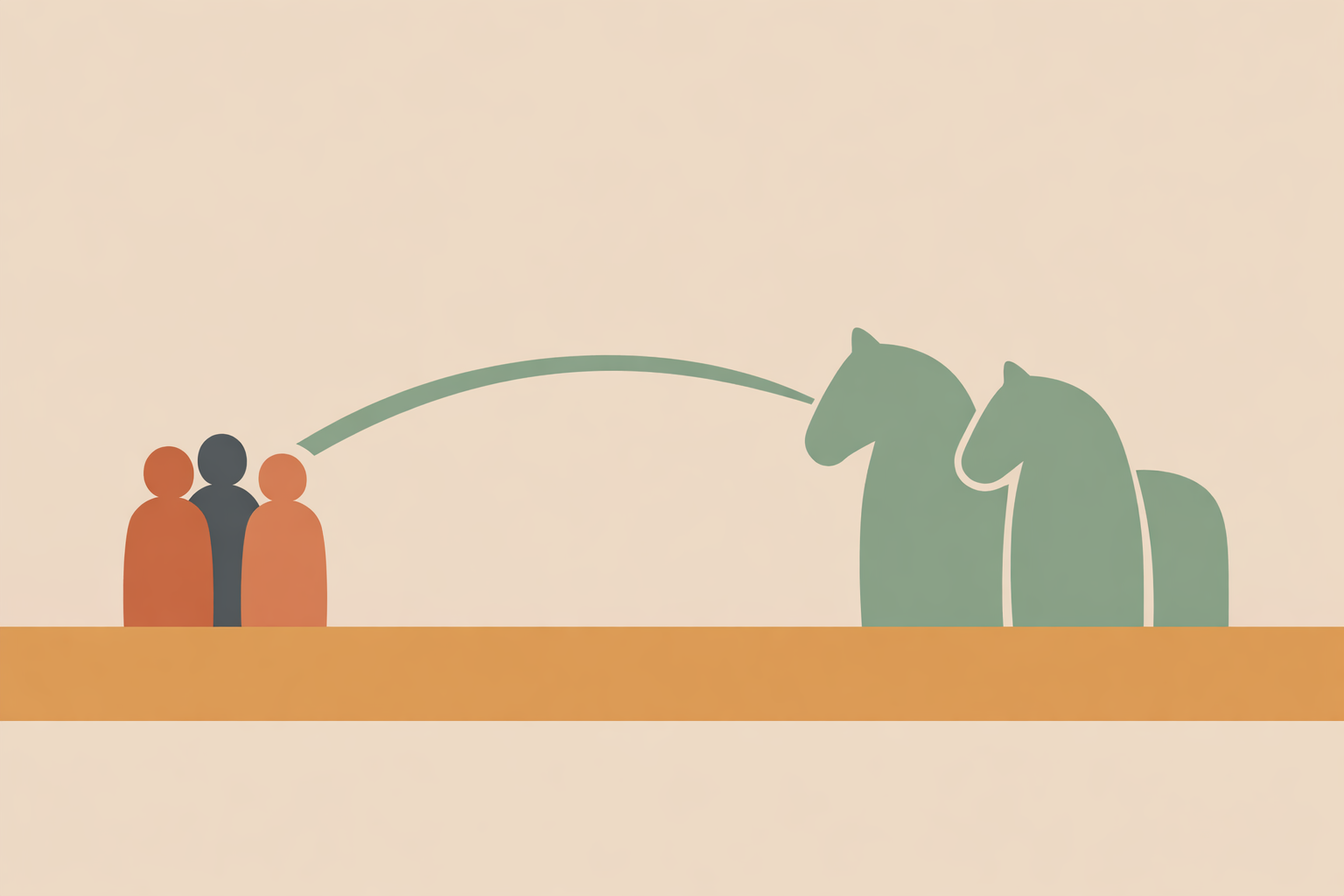
The change isn’t only personal. It becomes relational. Participants stop tracking status so closely and start tracking the wider field: the horse’s orientation, the herd’s movement, the effect of pace, and the quality of their own approach.
A steady practitioner principle holds here: embodiment precedes narrative. People often register contact in the body before they can explain it. They may not have a polished reflection yet, but they can name when their shoulders dropped, when breath returned, or when a horse’s willingness reshaped their sense of safety.
Early sessions often follow a simple arc:
- Arrival and pause at the gate
- Shared observation before interaction
- Choice-based approach at each person’s pace
- Debrief that includes body awareness, not just verbal meaning-making
That sequence helps the group cohere around direct experience instead of performance.
Designing Equine Group Sessions for Safety, Choice, and Co-Regulation
Strong equine groups are built on structure. Clear agreements, slow pacing, and observation-first design create the conditions for authentic co-regulation.
Trauma-informed equine frameworks consistently emphasize safety and consent, along with choice, trust, collaboration, and careful attention to somatic cues.
In group facilitation, that usually means keeping the container predictable:
- State roles and boundaries clearly
- Normalize opting in and opting out
- Use invitations rather than pressure
- Pause often enough for the group and horses to settle
- Let observation lead action
Many facilitators begin with groundwork rather than activating tasks. Grooming, leading, liberty observation, and quiet proximity give people time to settle and help the group organize around shared sensory reality. This sequencing is rooted in experienced practice and tends to hold up well in real sessions.
A first session might look like this:
- Opening agreements and orientation
- Brief land-based arrival practice
- Herd observation without interpretation
- Consent-based approach and pause
- Short somatic debrief
Two habits matter more than elaborate activities: offer choices constantly, and slow your voice to the rhythm of the calmest horse. In group work, tempo often does the heavy lifting.
Honouring the Horse as a Partner in the Process
Group outcomes depend on horse well-being. When horses are strained, shut down, or overfaced, the whole field tightens.
This is ethical and practical. Horses respond to human posture, voice, and presence in ways that shape the atmosphere. Research on horse–human interaction shows human cues can affect horses’ responses, which is why matching and pacing matter from the first minute.
Facilitators learn to read small changes early. A fixed ear, tightened muzzle, increased tail movement, bracing, disengagement, or reluctance to stay in contact can signal a need for more space, less demand, or a different setup. A soft eye, easy posture, willing approach, and relaxed feeding often suggest the environment is working well, and noticing these red flags early helps protect both trust and welfare.
Matching shapes the group, too. A thoughtful match can settle everyone; a poor match can ripple through the space. Horses respond to presence and behaviour in real time, so the facilitator’s choices quickly become the group’s emotional weather.
In practice, it helps to keep a living map of the herd: who feels steady with hesitant participants, who needs slower transitions, who prefers spacious contact over direct approach. Those notes often guide better than any scripted activity.
The Program Arc: Why Repetition Matters
Equine group work deepens through repetition. Trust tends to grow through familiar rhythms, consistent agreements, and enough time for people to notice what’s changing in them.
That’s why many facilitators choose multi-week formats. There’s no single ideal length, but repeated sessions reliably support relationship, ritual, and gradual integration more than one-off experiences.
Continuity matters more than novelty. Routines often do more than clever exercises. Participants learn the pace of the space, the patterns of the herd, and the inner signals that tell them when they’re bracing, softening, rushing, or choosing.
A simple arc across several weeks might include:
- Arrival, observation, and agreements
- Consent-based grooming and boundary awareness
- Leading with pauses and attention to pacing
- Distance work and nonverbal communication
- Low-pressure challenge tasks
- Partner or small-group coordination
- Choice-led activity design with horse welfare first
- Integration and closing ritual
Progress is often clearest in quiet metrics: start-and-end arousal ratings, brief cohesion check-ins, horse willingness notes, and small shifts like steadier breath, less rushing, or more grounded communication.
Bringing Equine Group Work Into Practice With Integrity
This work asks for humility. Horses are not props, and land-based traditions deserve respect rather than being borrowed carelessly or reduced to aesthetic language.
Bring equine group work in slowly, with care for cultural roots, the specific land you’re on, and the lived meanings participants bring. If you use symbolic or energetic frameworks, offer them as optional lenses rather than universal truths, and let people translate their experience into their own language.
It also helps to stay clear about scope. Horses can offer immediate embodied feedback in coaching and well-being spaces, especially because they respond strongly to emotional signals. Not every moment needs interpretation, and depth doesn’t depend on intensity.
Practical ways to begin with integrity, whether you are building toward animal wellness work more broadly or a focused equine therapy certification path:
- Start with a small pilot group
- Use clear consent language at every stage
- Build in enough staff attention for horse welfare
- Choose observation and pacing before complexity
- Track subtle progress over time
- Seek supervision, peer reflection, and ongoing skills development
When in doubt, slow down. That principle protects participants, supports the horses, and keeps the work honest.
Conclusion
Nature-based equine sessions shift groups because they move connection out of performance and back into lived experience. The land widens attention, horses sharpen honesty, and a well-held structure gives people enough safety to participate without force.
The strongest sessions aren’t the most dramatic. They’re the ones where pacing stays respectful, choices are real, horses remain well, and change has time to accumulate.
Go slowly, observe carefully, and let the relationship lead.
Explore Equine Therapy Certification
Build safer, choice-led equine sessions with the Equine Therapy Certification, grounded in structure, consent, and horse welfare.
Explore Equine Therapy →