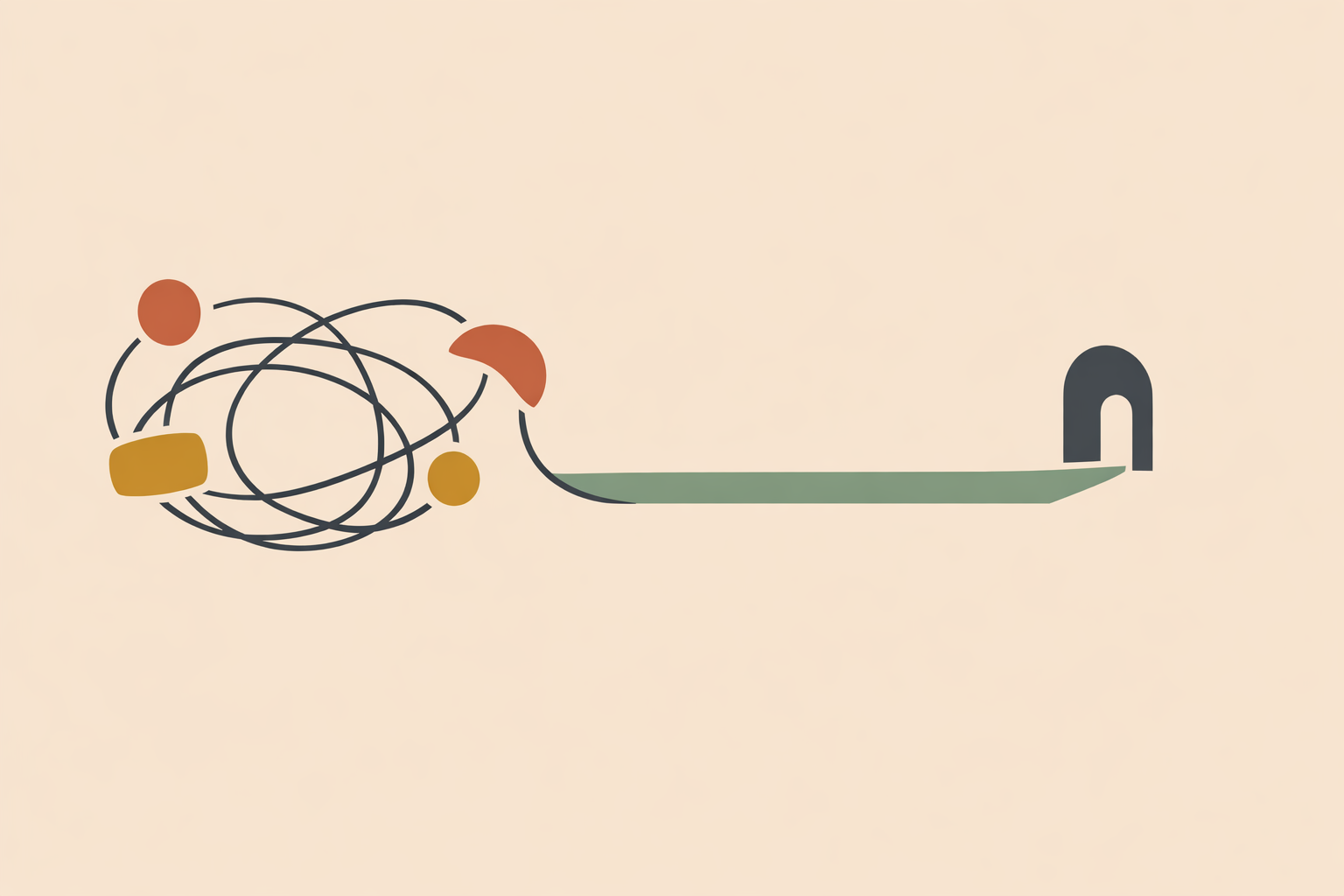
Most coaches learn to match a tool to a label or a headline symptom. That works until a client arrives with anxiety braided into perfectionism, low mood, sleep disruption, and habit loops like overworking or compulsive scrolling. Then support can sprawl: a breathing practice here, a thought log there, maybe exposure next week. The plan gets busy, but traction stays small.
A steadier route is to work from processes. Map how thoughts, emotions, behaviors, and context keep the loop turning, then choose the smallest move that interrupts it. This keeps support practical, measurable, and humane when concerns overlap, especially within broader mental health frameworks.
Key Takeaway: For complex anxiety presentations, choose tools based on the processes maintaining the pattern rather than chasing labels. Start by mapping triggers, thoughts, emotions, behaviors, and context. Use behavioral activation when anxiety is tangled with withdrawal and low energy; exposure and behavioral experiments when avoidance and safety behaviors are doing the heavy lifting; cognitive restructuring and problem-solving when thinking traps are clear and stressors are concrete; and mindfulness, self-compassion, and worry-time when rumination is central. Across all of it, sleep-friendly routines, calming practices, and culturally grounded supports make the plan easier to sustain.
Use behavioral activation when anxiety shows up as withdrawal, flatness, or low energy
When life has started to shrink, action often helps first. Behavioral activation rebuilds momentum through small, meaningful activities that restore pleasure, mastery, and daily rhythm.
At its core, behavioral activation reconnects people with activities linked to pleasure or mastery. It also targets the loop where pulling back reduces access to what nourishes. In broader behavioral models, avoidance and withdrawal are recognized as maintaining factors across emotional struggles.
This approach fits clients whose anxiety sounds like exhaustion: “I’m too tired to cook, too scattered to think, and too behind to start.” Often, depletion and avoidance travel together, and gentle structure helps a person re-enter their life.
Keep the plan small and concrete:
- Daily: 8-minute stretch while the kettle boils.
- Three times a week: 15-minute walk with one favorite song.
- Weekly: 30 minutes of a hands-on activity such as mending, cooking, watering plants, or sketching.
Track two ratings after each activity:
- Mastery: “Did this help me feel capable?”
- Pleasure: “Did this feel nourishing or enjoyable?”
For clients carrying mild low mood alongside anxiety, it often makes sense to start here. Reviews and guidance regularly place behavioral activation first for milder presentations, because routine and movement create steadier ground for other skills.
Traditional wisdom supports this beautifully. Communal tasks, movement with music, preparing food, tending herbs, making things by hand, and time outdoors restore rhythm without waiting for motivation to be perfect.
Use exposure and behavioral experiments when fear keeps the client busy but stuck
Not every anxious client looks shut down. Some look highly capable, productive, and constantly in motion, yet their days are organized around avoiding discomfort: delaying hard conversations, over-preparing, keeping endless backup plans, or saying yes to avoid disapproval.
These strategies soothe the moment, but they can keep the pattern alive. In cognitive-behavioral models, safety behaviors are understood to maintain anxiety because they block new learning.
That’s where exposure and behavioral experiments shine. The spirit is guided approach, with enough support to learn something new in safe-but-feared situations. Behavioral experiments work especially well because they use immediate feedback to loosen rigid predictions.
Try a small everyday experiment:
- Belief: “If I ask for more time, they will think I am incompetent.”
- Action: ask for a 24-hour extension on one non-urgent task.
- Prediction: rejection 8/10, shame 9/10.
- Outcome: extension granted, shame peaked lower than expected.
- Learning: direct communication did not damage respect.
You can also build a graded ladder around a common cue such as email dread:
- Open the inbox for 60 seconds without replying.
- Read one subject line and pause.
- Open one message fully and sit with the urge to escape.
- Send one brief reply.
As confidence grows, reduce habits that prevent learning. Reassurance-seeking, repeated checking, and elaborate backup plans often get in the way, and research suggests dropping safety behaviors can support better change than keeping them unchanged.
Many cultures also teach courage as something practiced in steps and witnessed in community. First public songs, first journeys, first speaking roles with elders nearby all reflect graded approach: courage grows through lived experience.
Use cognitive restructuring and problem-solving when the thinking trap is clear
Sometimes the loop is driven less by avoidance and more by a repeated story in the mind. When the thinking trap is obvious and the stressor is specific, cognitive restructuring and structured problem-solving can move things quickly.
Cognitive restructuring helps when distortions can be named clearly, such as catastrophizing, all-or-nothing thinking, or overgeneralizing. Problem-solving helps when the issue is concrete and practical. Reviews describe cognitive restructuring and structured problem-solving as distinct but complementary tools.
A quick thought check might look like this:
- Situation: “My teammate did not reply all day.”
- Automatic thought: “They are upset with me.”
- Emotion: anxiety 8/10.
- Evidence for: they seemed curt earlier.
- Evidence against: they mentioned a deadline and often reply late.
- Balanced thought: “They may simply be busy. I can follow up tomorrow.”
If the problem is practical, shift into decisions:
- Define the problem clearly.
- List a few workable options.
- Choose the smallest next step.
- Put it in the calendar.
This is also a natural place to draw on story, proverb, and inherited family wisdom to widen perspective. Instead of arguing with the mind, invite a steadier voice: “If someone wise in your family heard this story, what might they notice that you are missing?” For many clients, that reframe lands with less force and more dignity.
Use mindfulness, self-compassion, and worry-time when rumination is the main engine
When anxiety lives mostly in rumination, self-criticism, and constant what-ifs, the work often focuses on changing the relationship to thinking.
Mindfulness-based approaches can reduce rumination and reactivity, and compassion-based practices help when the inner voice is harsh. Recent reviews describe reduced rumination and stronger self-compassion as meaningful pathways of change.
Three simple practices are often enough to begin:
- Mindful minute: follow five slow breaths and gently return when the mind wanders.
- Self-compassion pause: “This is a hard moment. Hard moments are part of being human. May I meet this kindly.”
- Worry-time: set aside 15 minutes each day for worry, and postpone stray worries until then.
Worry-time is especially useful for minds that spin all day. Giving worry a boundary reduces the feeling that it must be handled immediately, and many clients find the thought stream becomes less sticky over time.
Contemplative traditions have long offered ways to witness the mind without obeying every story it produces: breath awareness, prayer, chant, silence, repetition, and time in nature. Introduced respectfully and aligned with a client’s background, these practices soften inner struggle and help other skills land.
Use sleep habits, environmental design, and calming practices to support any plan
Even a well-chosen technique struggles if daily life keeps pulling the client back into high arousal. Small changes around sleep, light, devices, and pacing often make the whole plan easier to follow.
Start with simple stimulus control habits:
- Keep a consistent wake time.
- Reserve the bed for sleep and intimacy.
- Dim light after dusk.
- Avoid work messages, news, and scrolling close to bedtime.
These habits are widely used in sleep-focused behavioral work, where consistent wake times and protecting the bed as a sleep space are core supports for better rest. In coaching, they also reduce vulnerability to late-night spirals and next-day fragility.
Relaxation practices help settle arousal so clients can use their other skills. Breathing practices, progressive muscle relaxation, and guided imagery are common options, and broad summaries describe how relaxation techniques can lower stress and anxious activation.
A simple one-week “calm design” plan might include:
- Sleep: fixed wake time and phone charging outside the bedroom.
- Light: step outside within an hour of waking.
- Devices: one-screen evenings and social apps off the home screen.
- Breath: two short slow-breathing pauses each day.
- Movement: one brief movement break every 60 to 90 minutes.
Use calming skills with discernment when the goal is approach practice. In exposure work, relaxation used as a safety signal may interfere with learning. A clean intention helps: settle before or after the challenge, rather than using calm to escape it.
Keep cultural context and scope in view
Complex anxiety support works best when it stays focused on the maintaining pattern while leaving room for culture, family, community, and daily reality.
Practically, that means choosing one or two levers at a time, tracking small changes, and letting the client’s language and traditions shape the work. For one person, regulation begins with breath counting. For another, it begins with evening prayer, a walk at dusk, cooking with a relative, singing, or sitting quietly outdoors. Respectful coaching makes room for these forms of wisdom without flattening them into trends.
It also means holding clear boundaries. Coaching is strongest when it offers structure, reflection, skills practice, and accountability while recognizing when added support is needed. Professional guidance consistently recommends referring out when intensity, risk, or complexity moves beyond coaching scope.
The heart of the work stays simple: match the tool to the pattern, keep the plan small enough to live, and notice what changes. Anxiety rarely untangles through heroics. It softens through steady practice and support that honors the whole person.
Go Further with CBT
Deepen your process-based coaching approach with the Cognitive Behavioral Therapy (CBT) Course.
Explore the CBT Course →