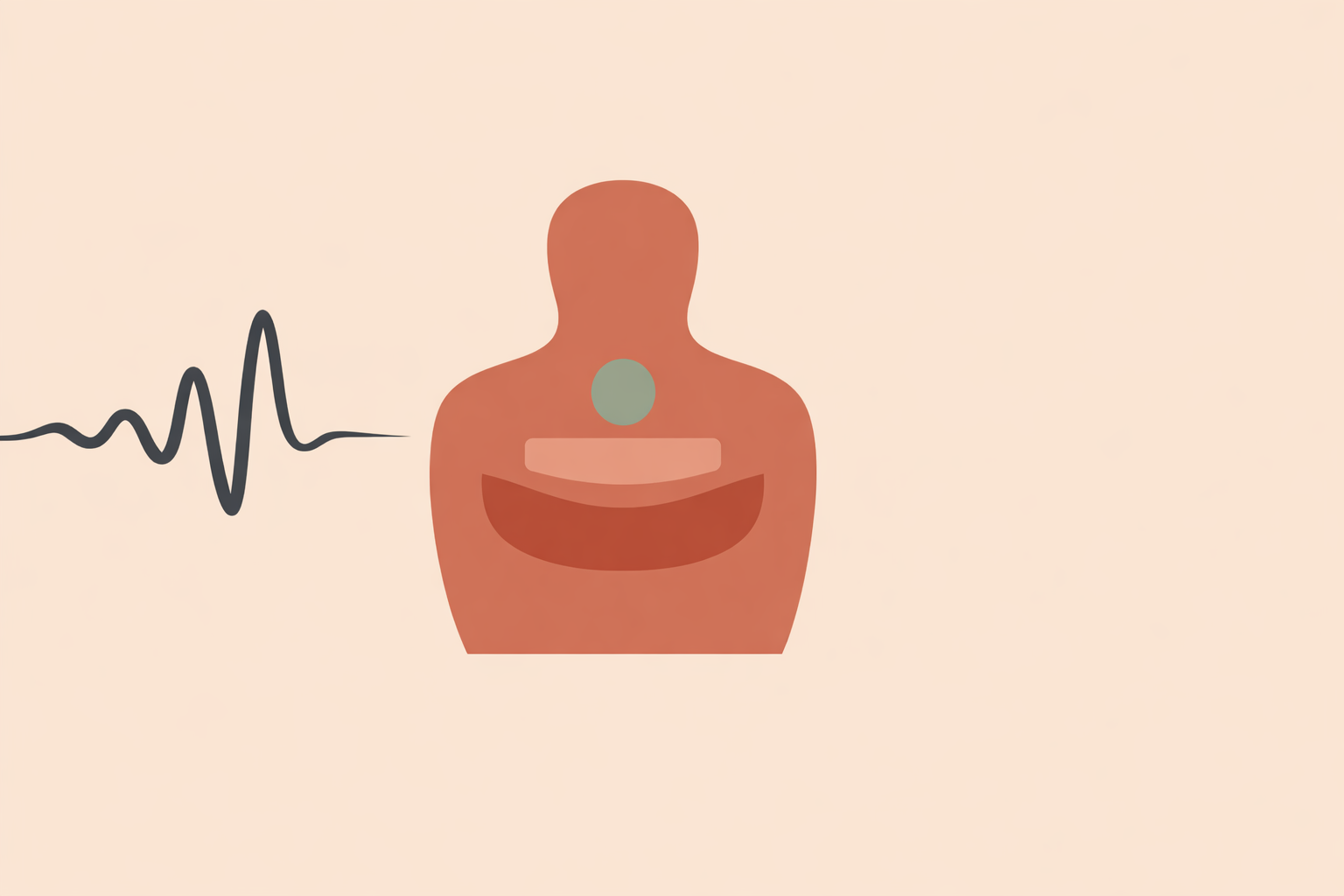
Many practitioners try to manage overload through content: clarify goals, slow the conversation, ask reflective questions. It works until the body has already shifted. By the time the story reveals that someone is over capacity, breath may have gone shallow, the jaw may be set, and the voice may have flattened. “How are you feeling?” often draws a tidy answer that lags behind what is happening inside.
Key Takeaway: Early detection of overload is body-led. The most useful approach is to build interoceptive skill, pair it with observable cues, and pace sessions around capacity rather than content alone.
Skill 1: Use interoception as an early-warning system
Interoception is the sensing of internal body signals and their interpretation. It includes internal signals such as breath depth, heart rhythm, temperature shifts, muscle tone, and gut sensations, often before the mind turns them into a narrative.
In practice, this matters because stronger interoceptive awareness is linked with emotion regulation. When a client learns their early cues, you can adjust pacing before a flood or shutdown takes hold.
Interoception also differs from general “body awareness.” It includes interpretation, which is why it can clarify meaning, need, and readiness.
Somatic traditions have always respected the body’s fast intelligence: the tight throat before a hard conversation, the fluttering stomach before saying no, the chest that narrows before withdrawal. Contemporary work on somatic markers suggests these bodily signals can shape choices before conscious thought catches up.
Try this in session: “Before we begin, give me a quick snapshot of breath, heart, and body temperature on a 0–10 scale.” Repeat it later. If the story still sounds calm but the heart rating rises or the breath rating drops, you have early information you can respond to gently.
Over time, clients usually identify their own signatures: a jaw that hardens, a hollow stomach, a drop in warmth through the arms, or a sudden narrowness in the chest. These patterns are often clearest in lived practice, so track them carefully and let them be personal rather than universal.
Skill 2: Build a baseline so overload stops feeling sudden
What feels “out of nowhere” is often a buildup that went unnoticed. A baseline makes small changes easier to spot, especially for people who miss thirst, hunger, tension, or rising activation until the day feels unmanageable.
In real life, low interoceptive literacy shows up in simple ways: hunger noticed only when irritability spikes, tension noticed only when a headache arrives, or breath restriction that goes unnoticed for hours. Stress patterns can also involve diminished awareness, which makes self-reading less reliable under pressure.
Start with contrast. Brief comparisons sharpen perception:
- Notice one forearm at rest for 20 seconds.
- Lift it overhead for 20 seconds.
- Lower it and compare.
These micro-contrasts help clients notice tone, pressure, warmth, effort, and aliveness. With repetition, that discrimination starts showing up in everyday stress detection.
A simple baseline check is often enough. Once a day for two weeks, invite a scan of breath, heart, gut, muscles, temperature, and overall tension. The aim is familiarity, so a shift like “breath from 6 to 3” or “stomach from quiet to buzzy” stands out quickly.
Language supports the skill. Instead of “Do you feel hot?” try, “How do you know you are getting warm?” That question guides attention toward direct sensing rather than guessing.
Skill 3: Track breath and heart shifts early
Breath is often one of the first places overload becomes visible. Stress commonly makes breathing faster and shallower, sometimes with chest-dominant breathing, sighing, or subtle pauses.
Polyvagal-informed perspectives describe a pre-conscious evaluation of safety or threat that can change breath and heart patterns before a person can explain what’s happening. This process, known as neuroception, helps explain why the body often “speaks” first.
In practice, watch for:
- shallowed inhales
- breath-holds at the top of the inhale
- a run of sighs
- sudden chest-only breathing
- a voice that loses resonance as the rib cage tightens
Use these as cues for curiosity, not as a verdict. Many practitioners still find respiratory changes are among the earliest signs that someone is nearing the edge of capacity.
Invite direct sensing as well. A 60-second pulse check at the wrist or a hand over the chest can help clients notice whether the beat feels steady, fast, thready, or full. Training interoceptive attention may support emotion identification over time, which makes this channel more useful with repetition.
Then offer one regulating option. Slow-paced breathing with a longer exhale can increase parasympathetic dominance. Traditional practices like humming, toning, mantra, and rhythmic exhalation fit naturally here, and slow breathing practices are associated with vagal activity even as details continue to be explored.
A simple script: “Let’s pause and notice your breath. Is it easy for the ribs to widen? Would a slower exhale or a soft hum help create more room?”
Skill 4: Read posture, movement, and voice from the outside in
Sometimes internal sensing is muted, confusing, or simply not accessible in the moment. When that happens, observable cues become an excellent doorway back to the inside.
Micro-tension in the jaw, rigid shoulders, a frozen smile, a forehead pinch, a protective curl through the body, sudden stillness, whispered speech, rushed speech, or a flattened tone can all signal rising load. Somatic traditions recognise these patterns consistently, whether or not a study has captured them neatly.
The key is not to interpret cues for the client, but to use them to open inquiry. Name what you notice without judgment, then invite inward attention.
For example: “I notice your left foot started tapping. Would you be open to feeling inside your calf for 10 seconds and describing what you find?”
Over time, this outside-in approach becomes shared language, and then self-language.
- Facial cues: jaw clench, frozen smile, forehead tension, eyes losing focus
- Vocal cues: monotone, sudden quietness, pressured pace, flattened prosody
- Posture and movement: rigid upright posture, collapse, leaning away, fidgeting, protective arm positions, sudden stillness
Used skilfully, these cues don’t replace interoception. They help restore access to it.
Skill 5: Use the window of tolerance to tell activation from overload
Not all activation is a problem. Growth usually includes some charge. The practical question is whether the person still has enough capacity to stay present, reflective, and choiceful.
A helpful rule of thumb: within the window of tolerance, a person can think and feel at the same time. When thought becomes scrambled or feeling becomes flooding, the pace has likely moved beyond a productive edge.
Interoceptive literacy supports pacing because sensing stress responses is part of effective self-regulation. When signals get missed, it’s harder to adjust in time.
Early signs of hyperactivation may include:
- racing thoughts
- shallow breath
- jaw tension
- agitation or urgency
Early signs of hypoactivation may include:
- heavy limbs
- foggy thinking
- flat voice
- reduced movement
Stress can also change perception. Acute stress may shift how bodily cues are noticed, sometimes amplifying sensations while dulling others. That’s one reason self-assessment can become less reliable as load rises.
Two simple tools keep the focus on capacity:
- Capacity check: “On a 0–10 scale, how able are you to feel and think right now?”
- Gear shift: downshift with longer exhales, orienting, and gentle movement, or upshift with firmer posture and more mobilising movement when heaviness is taking over.
Skill 6: Work gently with muted, confusing, or fear-laden signals
Some people feel very little inside. Others feel a lot and don’t trust what they feel. Both patterns make sense, especially when someone has lived through long periods of stress.
After chronic stress or overwhelming experience, people may stop trusting body signals, which can weaken emotional prediction and regulation over time. Some people also interpret neutral sensations as threatening, which is why consent-first pacing matters.
Chronic stress can increase distress around bodily sensations and lower confidence in reading them, making neutral sensations feel more loaded than they are.
Brief, collaborative sensing tends to work best. Let the person choose: sense for 5 seconds, 10 seconds, or not at all. Start with neutral anchors like feet on the floor, the contact of clothing, the weight of the hands, or the temperature of the air.
Also watch for quiet freeze. It can look calm from the outside while reflecting shutdown rather than ease. Polyvagal writing describes this low-energy defensive state as distinct from genuine regulation.
Helpful adjustments include:
- offer choice at every step
- keep sensing windows brief
- pair inward attention with outward orientation
- return often to neutral or pleasant anchors
- use objects, rhythm, or simple movement when direct inner sensing feels too charged
A reliable stance is warm, precise, and non-forcing. Curiosity supports capacity better than intensity.
Skill 7: Make micro check-ins part of real life
These skills deepen through repetition, not heroic effort. Tiny, frequent check-ins are often more realistic than longer practices that rarely happen.
In sessions, build in short scans at predictable points, such as around minute 10, 25, and 45. Invite a quick check of jaw, shoulders, stomach, and breath. Even when the best timing is primarily practice-based, the rhythm teaches that self-checking is normal, brief, and useful in live coaching.
Outside sessions, a simple daily structure is often enough:
- morning baseline
- brief check before and after meals
- evening scan
This creates a lived map of how pressure, pace, food, rest, and relationships register in the body.
Layer in one regulating tool and keep it consistent. Slow breathing with longer exhales, a soft hum, gentle swaying, rhythmic walking, or simple orienting can all support clarity. Slow breathing is associated with cardiac vagal activity, which makes it a practical anchor for many people.
A useful learning loop is:
- notice
- regulate
- compare
Notice what’s present. Use one tool. Then compare what changed. That comparison helps clients recognise their own “this helps” signatures, so future self-support becomes faster and more intuitive.
You might offer a one-minute menu like this:
- Breath: inhale for 4, exhale for 6, repeat 5 or 6 times
- Sound: add a quiet hum on the exhale
- Movement: sway gently side to side and feel the feet press into the floor
- Orient: let the eyes scan the room and name a few shapes or colours
- Touch: place one hand on the chest and one on the lower belly and notice warmth or contact
Kept small and steady, these check-ins gradually turn body-led pacing into a lived skill rather than a special exercise.
Conclusion: Spot overload earlier by staying close to the body
Early detection is a weave of skills: sensing internal shifts, building a baseline, tracking breath and heart, noticing outer cues, and pacing the work according to capacity.
Traditional practices such as breath, rhythm, humming, mantra, and grounded movement sit naturally alongside newer frameworks for interoception and regulation. Together, they support a respectful pace of change that values early signals and helps clients stay in relationship with themselves as they grow in somatic coaching and broader trauma and emotional healing work.
Keep it simple and repeatable, and save the deepest work for the moments when capacity is truly there. If someone has a history of panic, trauma, or intense bodily fear, adapt practices gently and encourage them to seek appropriately qualified support when needed.
Train as a Somatic Coach
Deepen these body-led pacing skills with the Somatic Coach Certification.
Explore Somatic Coach →