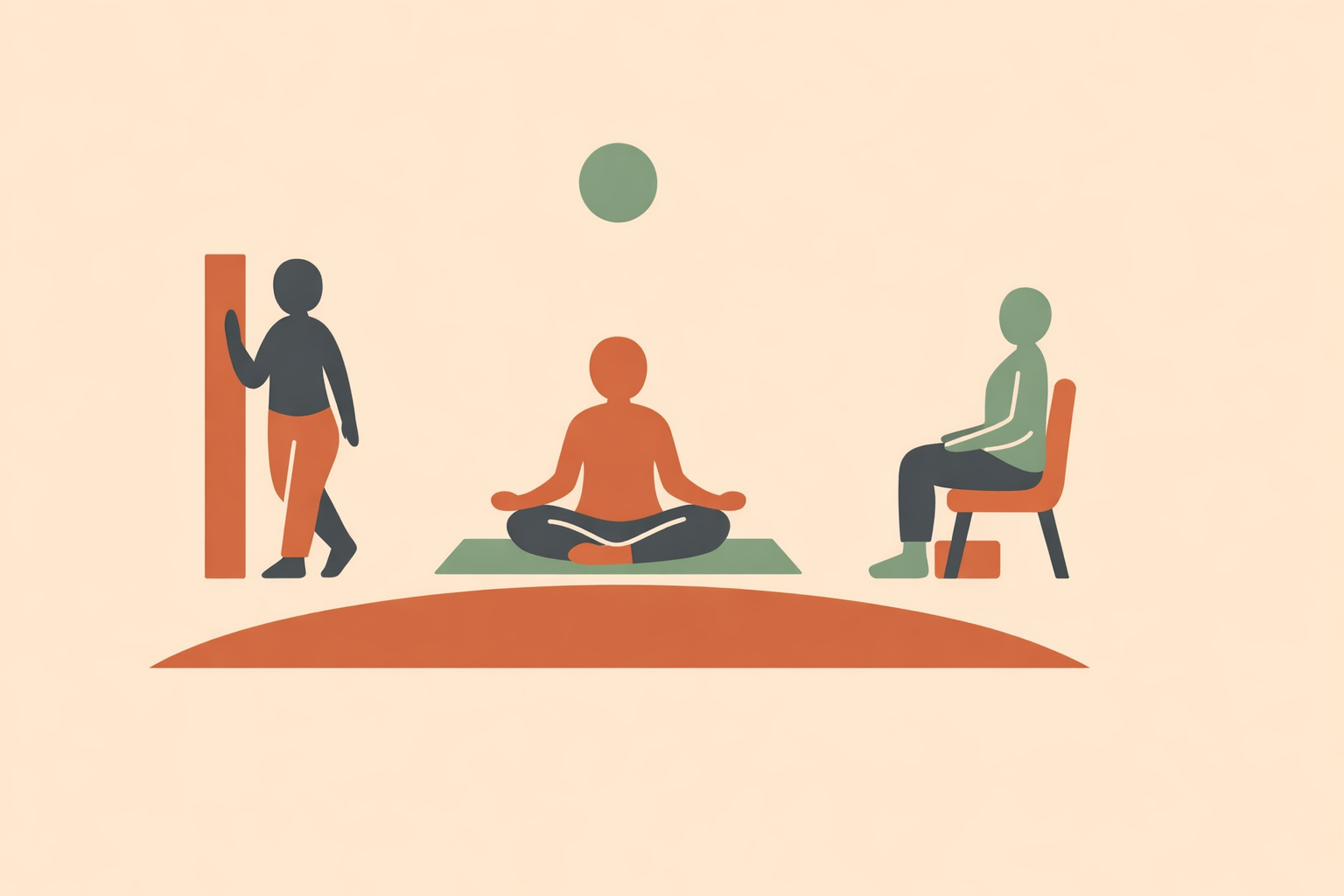
Most yoga teachers learn to build a reliable sequence and guide it well. In menopause support, that default can fall short. People can arrive with broken sleep, low energy, heat surges, and mood shifts all at once, so a fixed flow might push one person too hard while leaving another without enough support.
Key Takeaway: Menopause-wise yoga works best when it is inclusive, option-rich, and taught as whole-system support rather than a single-pose solution. The most useful approach combines movement, breath, rest, and reflection; offers chair, wall, and mat pathways from the start; and frames benefits honestly around steadiness, coping, and well-being instead of overpromising.
Why menopause calls for adapted, inclusive yoga support
Menopause doesn’t follow a neat script. Authoritative guidance highlights common experiences such as sleep disruption, low energy, hot flashes, and mood changes. In real classes, that natural variability is exactly why one-size sequencing so often misses the mark.
Picture two people arriving to the same session. One needs grounding after weeks of broken nights. Another wants to rebuild trust in movement without aggravating sensitive joints. Both can be supported when choices are designed in, not added on.
Adapted teaching also protects agency. Instead of hunting for the single “best” posture, the smarter aim is a practice structure that makes it easy to scale effort up or down without explanation or pressure.
Traditional yoga has long supported life transitions by emphasizing steadiness, self-study, and wise pacing. In menopause-focused spaces, that lineage comes through most clearly in simple, flexible structures: a slower arrival, more than one route through the sequence, and explicit permission to change course at any time.
A helpful start is a brief check-in that lets each person choose a direction for the day: cool and calm, gentle build, or steady strength. When that choice is normalized, people feel included from the first breath.
Beyond poses: a whole-system approach to menopause well-being
Supportive menopause yoga works best as a whole-system practice: movement, breath, relaxation, and reflection woven together.
That approach also matches how menopause yoga is often studied, with multicomponent programs that combine postures with breathing, meditation, relaxation, education, or group discussion. It’s a practical confirmation of what traditional teaching has emphasized for generations: the practice is bigger than the shapes.
Each piece plays a different role. Movement can discharge restlessness and loosen stiffness. Breath practices create a steadier internal rhythm. Relaxation offers a true downshift. Reflection helps people notice what supported them this week, not what “should” work.
Breathwork deserves special attention. A systematic review suggests yoga breathing may improve autonomic balance, which fits well with the lived experience of slower breathing feeling settling during everyday stress.
A simple 20-minute home practice might look like this:
- 6 minutes of gentle breath-led movement
- 5 minutes of paced breathing
- 7 minutes of supported rest
- 2 minutes of reflection
This format is easy to remember and repeat. It also gives several clear “dials” to adjust day to day: pace, effort, temperature, stillness, and attention.
Designing inclusive menopause yoga for every body
Inclusion begins before the first posture. Many people arrive with understandable hesitation: joint sensitivity, discomfort getting up and down from the floor, a larger body in spaces that haven’t felt welcoming, or a simple fear of being watched.
The most respectful solution is to build the class so nobody has to request special permission to participate. Offer chair, wall, and mat versions from the outset. Create sequences that don’t rely on kneeling, wrist loading, frequent floor transitions, or unsupported balance unless those are clearly optional.
Setup supports belonging. Stable chairs, clear wall access, generous spacing, and visible props all help people settle quickly. NCCIH notes that some people may need pose modifications, which reinforces the value of planning options from the start.
Words matter as much as logistics. Replace hierarchy-based cues like “full expression” with practical invitations such as “choose the version that suits your joints today.” Keep attention on comfort, agency, and function rather than appearance.
Inclusive teaching also means inclusive identity language. Not everyone moving through menopause identifies with conventional images or expectations of womanhood, and a welcoming space reflects that without turning it into a spotlight moment.
Trauma-aware choices strengthen inclusion further. Describe each practice briefly before it begins. Keep touch fully optional. Make opting out, resting, or switching versions normal and uncomplicated.
- Chair route: seated sun breaths, supported standing work, seated twists, and chair-based rest
- Wrist-friendly route: fists, forearms, straps, and upright variations
- Heat-aware route: slower pacing, quieter transitions, and more pauses
These details communicate something powerful: a range of bodies and experiences was expected, and everyone was planned for.
Adapting yoga for sleep, mood, heat, and fatigue
Once the structure is inclusive, the next step is matching practice to what’s present. Four themes come up again and again in menopause support: sleep disruption, mood strain, heat, and fatigue.
Sleep disruption. Evening practices tend to land best when they’re short and straightforward. Gentle mobility, longer exhalations, and supported rest can become a reliable wind-down ritual. Menopause guidance commonly includes sleep problems, so it makes sense to give sleep support a consistent place in your programming.
Mood and inner tension. On unsettled days, a softer flow paired with longer exhalations often helps people feel steadier. The aim is to build enough inner resource for the day ahead, not to force a particular emotional state, and this kind of support fits naturally within women's health coaching.
Heat and hot flashes. Clear framing is part of good teaching. Yoga can be supportive within an overall well-being plan, and for broader hot-flash support it helps to stay structured and realistic, yet it shouldn’t be marketed as a direct fix for heat symptoms. Cooler room conditions, moderate effort, slower pacing, and restorative pauses usually feel more welcome than anything overly stimulating.
Fatigue and energy swings. Flexibility is essential here. On low-energy days, 10 minutes of chair mobility followed by supported rest can be plenty. On brighter days, people often enjoy simple strength work such as sit-to-stand variations, wall push-offs, or heel raises.
A common pattern holds true: shorter, lighter sessions are easier to keep doing. Consistency supports well-being more than intensity.
Communication and group facilitation that protect agency
Menopause-wise teaching isn’t only about sequencing. It’s also about how you listen, frame choices, and guide the group.
A strong starting question is: what would make daily life feel a little easier this week? It keeps the practice connected to real needs.
From there, reflective listening does a lot of work. Repeat back what you heard, clarify, then collaborate on options. People feel met and respected, which makes it easier to make wise choices during practice.
Group settings can be deeply supportive when they’re facilitated with care. Shared experience helps people feel less alone, and clear agreements keep that sharing safe and steady:
- Confidentiality matters
- Sharing is optional
- The right to pass applies to discussion and movement
- Touch is never assumed
- There are multiple valid ways to participate
Tracking can help when it stays light. A simple journal with prompts like sleep window, evening practice, room temperature, and a few notes is often enough. The point is curiosity, not proof.
Ending well matters, too. Two shared breaths, one realistic next step, and a clear close can turn a pleasant class into a home practice someone actually returns to.
Building ethical menopause yoga programs people can sustain
The strongest offerings are the ones people can realistically complete. Build something clear, repeatable, and friendly to changing energy levels.
This is also reflected in research that often uses combined formats over a series of weeks. A seasonal container works well in practice: long enough to build familiarity and trust, short enough to feel manageable.
Useful formats include:
- A 10- to 12-week series with one weekly class and a short home practice
- A one-to-one format with tailored chair, wall, or mat options
- A workshop plus a small practice pack of short audio or written sessions
Access belongs in the design from day one. Minimal-prop sequences, chair-based routes, sliding-scale places, and home-friendly practices make continuity easier through travel, caregiving demands, or lower-energy weeks.
Short home practices are especially approachable. People are far more likely to return to something called “10-minute evening reset” than a vague instruction to practice more often.
Clear scope keeps the work ethical and effective. Yoga can support steadiness, mobility, rest, and coping, and it doesn’t need exaggerated claims to be valuable. Integrity builds trust, and trust is what keeps a program useful over time, especially in menopause coaching.
Where research leaves gaps, clarity fills them. If you’re offering a supportive sequence, name what’s included: chair sun breaths, supported forward folds, paced breathing, and restorative rest. That kind of specificity respects tradition and makes it easier for people to practice safely at home.
Yoga for menopause support that truly includes everyone
The throughline is simple: the most effective menopause yoga is the one people can do, return to, and adapt as their needs change. Whole-system practice, generous options, and consent-forward teaching make that possible.
Traditional yoga wisdom is a strong foundation here because it treats practice as responsive and personal. Modern evidence adds helpful perspective, especially as a reminder to speak honestly about where yoga appears supportive and where claims should remain modest.
Taught this way, yoga becomes a steady companion through transition. It offers a place to land, a way to keep moving with respect, and practical tools that translate into everyday well-being.
Menopause Coach Certification
Deepen your inclusive, option-rich teaching with the Menopause Coach Certification.
Explore Menopause Coach →