



As a Global Instructor at Naturalistico, Paul shares practical insights and strategies designed to empower individuals, support their growth, and help them turn knowledge into real-world results.
How to Design a Beginner Wilderness Survival Weekend, Session by Session
Publié le mars 26, 2026
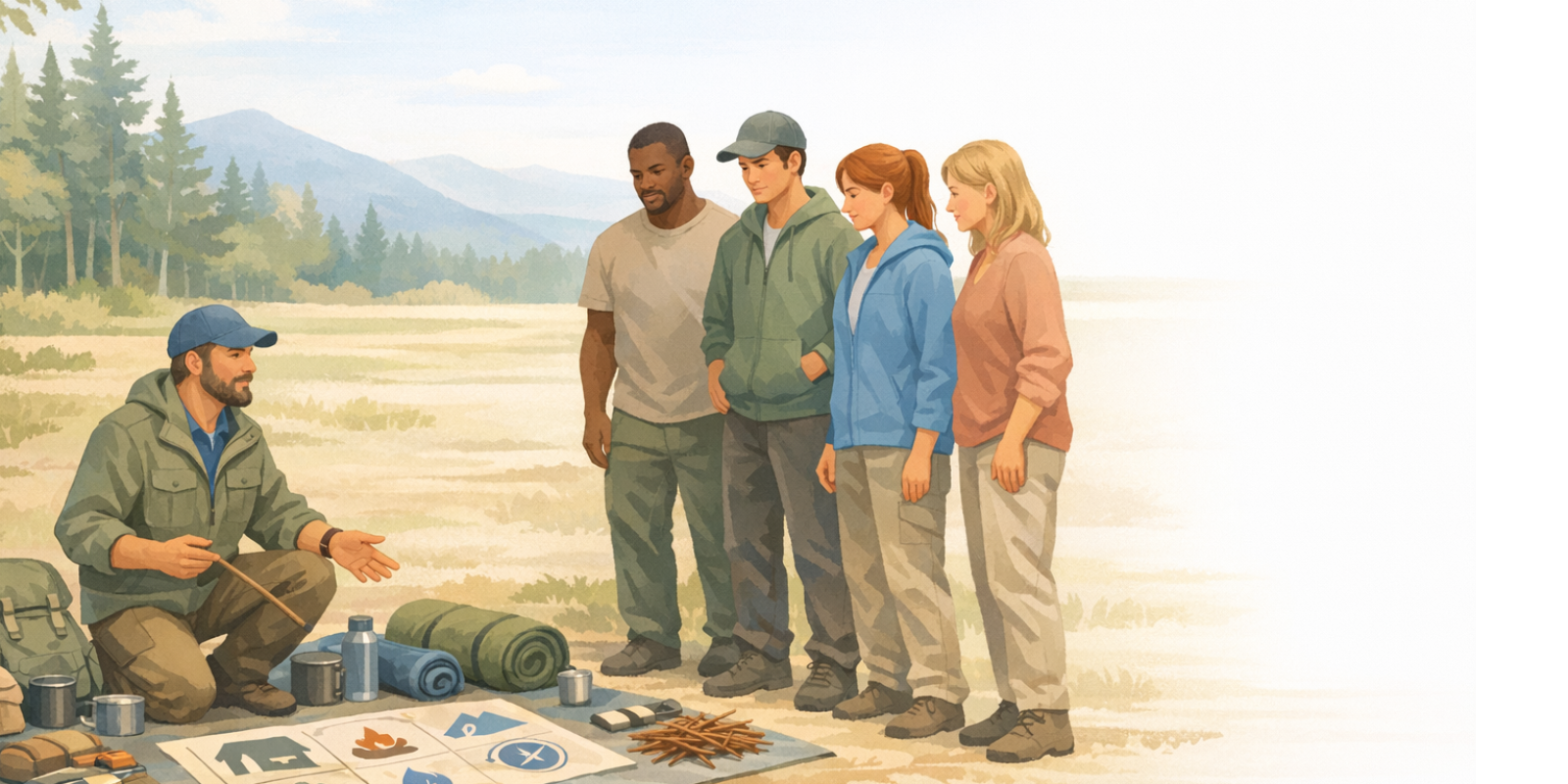
A strong beginner wilderness survival weekend moves like a good story: people arrive with nervous curiosity, cross a clear threshold into hands-on skill, and go home steadier than they came. When the arc is intentional, beginners trade anxiety for grounded confidence—and you stay aligned with a nature-based, ancestrally rooted coaching practice.
Think of the weekend as a well-held container, not a pile of techniques. The frame matters because it makes simple skills land deeply. Most beginners don’t need “everything”—they need a few right first moves that create real felt safety.
Many short-format trainings wisely focus on immediate priorities—shelter, fire, water, and basic navigation—to stabilize the first 72 hours. That limit is a gift: it helps you simplify, blend reliable tools with ancestral know-how, and teach people to slow down and work with the land instead of rushing past it.
Key Takeaway: Design a beginner weekend as a clear story arc—grounding and agreements first, then shelter, fire, water, navigation, and gentle scenarios—so participants feel safe enough to learn. Blending reliable modern tools with respectful ancestral practice turns a few core skills into steady, repeatable confidence.
Map the Story Arc of Your Survival Weekend
Start with the journey, then choose the lessons. When you design the arc from the beginning, every session supports the next—and participants feel the weekend as one coherent experience.
A dependable rhythm is: begin with group culture and shared language, then reduce exposure risk through shelter, add warmth and morale through fire, and round out with water, navigation, and low-stress scenarios. Under pressure, a simple frame like the Rule of Threes helps people decide what matters first.
This sequence also tracks the emotional path. You start with a circle and steadiness, not with knives. Clothing and shelter calm the body; that calm opens the door to firecraft. By the second morning, learners are ready for exploration—finding water, reading terrain and sky, and practicing small decisions in real space.
Hold both the old and the reliable with equal respect. Let students use a modern ferro rod, then experience the humility (and wonder) of earning an ember with a bow drill. The thread isn’t nostalgia—it’s wholeness and continuity. As Aldo Leopold reminds us, “The richest values of wilderness lie not in the days of Daniel Boone, nor even in the present, but rather in the future.” A well-designed weekend points learners toward that future with skills their hands will remember.
Arrival, threshold, and return is a simple mantra. Arrive with clear agreements and tone. Cross the threshold with shelter and fire—skills that immediately shift risk and mood. Return on Sunday with woven competence, plus enough space to integrate and name a next step.
Day 0: Screening, Safety, and Expectations
What happens before the weekend often determines how safe and spacious it feels. A clear Day 0—forms, brief calls, gear guidance, and boundaries—creates room for real challenge without overwhelm.
From first contact, model your ethos: kind, calm, and clear. Ask respectful questions about prior experience and anything that may shape comfort outdoors, and frame it as partnership rather than gatekeeping. As Jessie Krebs puts it, “Wilderness is a great equalizer. It doesn’t care who you are….” Your job is to build an honest, human-centered learning container.
Day 0 is where you quietly prevent common problems. Share simple clothing guidance (layered, non-cotton systems), a hydration plan, and a minimal kit aligned with the Ten Essentials. Add seasonal nudges people actually follow: “Bring a warm hat and gloves even if the forecast looks mild.” Set clear expectations around knives, saws, and fire—where they’re used, how instruction works, and how learners can get help fast.
Make agreements visible and easy to remember. A short briefing doc, a buddy system, and a shared “Stop and Warm” commitment can reduce hypothermia risk in cool/wet weather and heat illness in hot/dry conditions. Many educators find that clear advance agreements lower both incidents and anxiety.
Day 0 as an extension of your coaching practice means your welcome email, intake, and packing list carry the same care as your facilitation on the land. When people feel held, they’re far more willing to learn.
Session 1 (Sat AM): Mindset and the Rule of Threes
Open with grounding and shared priorities. When learners understand how to think—especially under stress—everything else sticks.
Begin with a simple arrival ritual: a few breaths, a land acknowledgment offered in integrity with local peoples, and an invitation to notice. Then set the frame: “We’re focusing on the first 72 hours. Our goal isn’t wilderness heroics; it’s steadiness, clarity, and simple moves that work.” Introduce the Rule of Threes as the weekend’s compass, and have learners say it back in their own words.
Next, teach a quick decision flow people can access when adrenaline spikes. The STOP check—Stop, Think, Observe, Plan—works beautifully as a nervous-system tool. Practice with a low-stakes scenario (“Wind picks up; a dark cloud builds on the ridge—what changes?”), then point learners to a public reference for STOP so they can revisit it later.
Keep the morning tactile. Put tarps and cord in their hands, let them strike a ferro rod, and handle a simple steel bottle they’ll later use for boiling. Demonstrate one micro-skill (like a taut-line hitch), then get everyone practicing quickly. As Jessie Krebs often reminds students, “The wilderness is not out to get you.” Hands-on success makes that belief real.
Open with grounding and immediate priorities. By lunch, participants should feel oriented, connected, and clear on the order of operations you’ll use all weekend.
Session 2 (Sat Midday): Shelter and Clothing Systems
In cool or wet seasons, teach shelter first. Reducing exposure risk brings bodies back into comfort—and makes learning easier.
Start with clothing as mobile shelter. A quick demo of layering basics—wick, insulate, protect—prevents a lot of shivering later. Have people check each other’s setups and adjust before heading out.
Then teach a shelter pattern they can repeat under stress. A simple “ridgeline + tarp + debris” sequence works well: choose a site with wind and water in mind, avoid dead branches overhead, pitch the tarp tight, add dry insulation below, and mark guy lines so nobody trips. Keep reps short, rotate roles, and make sure each person leads a step.
- Assess: wind, water, widow-makers
- Set: ridge line and anchor points
- Shape: tarp pitch and guy lines
- Soften: ground insulation and simple comforts
Weave in warm-up protocols as part of skill, not as an interruption: the moment someone mentions cold fingers, pause and assess. Prevention is foundational for hypothermia. The aim isn’t a perfect shelter—it’s embodied competence that makes people say, “Oh. I can do this.”
Shelter as primary protection and nervous-system support isn’t just theory. When a tarp goes up and insulation goes down, the body exhales. That exhale is the doorway to everything else.
Session 3 (Sat Evening): Firecraft and Ancestral Warmth
Firecraft is where confidence often clicks. Layer reliability (matches, lighters, ferro rods) with ancestral practice (friction fire), and let the evening become both a skill lab and a communal hearth.
Begin with a safety check: local regulations, fire bans, safe clearings, and water on hand. Teach preparation and structure—tinder, kindling, fuel; building for the wood you have; testing a spark bundle before committing. Start with a one-match challenge in pairs, then backstop with a ferro rod and a cotton pad if needed.
Once a few fires are going, shift into ancestral mode with care and credit. Share where your teachers learned, and name the lineage respectfully. Demonstrate a bow drill set—parts, posture, and locally appropriate wood choices—then invite those who want to try with close coaching and plenty of levity. For many learners, friction fire becomes a rite of passage: skill meeting spirit.
Close by grounding the fire in real uses: warmth, smoke for bugs, signal fire principles when appropriate, and basic water purification by boiling in a steel bottle. Let the circle linger; fire is also belonging and integration.
From modern tools to ancestral fire by friction mirrors the whole weekend: start with what’s dependable, then step toward the old ways with humility and care.
Session 4 (Sun AM): Water, Navigation, and Simple Scenarios
With shelter and fire established, turn to resourcefulness: finding and making safe water, orienting without drifting farther off course, and practicing small decisions in gentle scenarios.
Teach learners to locate water by reading the land—terrain funnels, lush vegetation, and animal sign. Then offer clear purification choices. Demonstrate boiling and compare it with common backcountry options like filters and chlorine dioxide tablets. Essentially, you’re giving them a simple “choose what works here” framework rather than a gear debate.
Introduce navigation only to the level that lowers anxiety. A minimalist block on navigation basics—orienting a map, taking a bearing, and using handrails like ridgelines or streams—goes a long way. Add a few natural cues: sun arc and a shadow stick by day, and big-dipper-to-Polaris at night through celestial navigation. Put simply, the goal is less wandering and more noticing.
Then knit it together with low-stress scenarios using STOP again. Keep prompts close to camp and time-boxed: “You realize you left the trail 10 minutes ago—what’s your next move?” If your bioregion allows it and you hold the knowledge respectfully, a brief nod to wild seasonal foods can deepen connection, paired with foraging ethics—and a reminder that in the first 72 hours, shelter, fire, and water come first.
Teach resourcefulness without tipping into overwhelm by ending with a shared win: a group water boil that becomes tea, or a clean map decision that lands everyone at a real landmark.
Session 5 (Sun Midday): Integration Challenge and Closure
Offer a small, well-held challenge that weaves shelter, fire, water, and navigation into one coherent response, then close with story, gratitude, and practical next steps.
Integration should feel meaningful, not macho. Think 60–90 minutes in trios with radio or cell check-ins: choose a shelter site, pitch a tarp, secure water and boil it for tea, and take a bearing to a nearby landmark. Set clear boundaries and success definitions, and offer options for different bodies and energy levels so everyone gets a real taste of self-reliance.
As teams return, welcome them across a threshold—a small cedar bough to brush past, a warm drink waiting—then debrief with simple questions:
- What choices worked?
- What surprised them?
- Where did they feel the land offer help?
Capture insights so the weekend’s story becomes visible: Saturday mindset, shelter and fire, Sunday resourcefulness, and now the weaving.
End with a closing circle and a path forward that fits real life: “Pitch a tarp twice this month; practice fire in damp conditions; walk a neighborhood loop using a bearing.” Invite those who want deeper skill and mentorship into your continuing pathway, and keep the community thread alive between weekends.
Design a small challenge that knits the skills together and a closure that honors the land, the ancestors who carried these ways, and the learners who will carry them forward.
Conclusion: From Weekend Template to Signature Pathway
A single beginner weekend can become a signature pathway in a nature-based practice. This structure—mindset, exposure safety, warmth, water, and orientation, followed by light integration—naturally scales into seasonal immersions, family-friendly offerings, and advanced tracks.
In many traditions, wilderness skills aren’t the destination; they’re the doorway. When people realize they can make calm decisions and meet their needs, confidence grows—and with it, presence and connection. Even broad overviews of wilderness survival often describe this same arc: skill supports confidence, which supports presence, which can open into service.
Design your pathway as a living system, not a fixed syllabus. Blend modern tools with ancestral knowledge, keep agreements clear, and track what truly changes—steadier choices under stress, not just cleaner knots. As Cheryl Strayed writes, “We don’t reach the mountaintop from the mountaintop… We start at the bottom and climb up.”
To close with one practical caution: keep risk management simple and consistent—weather checks, local regulations, conservative boundaries, and clear communication—so learners can relax into the work. Held well, a beginner wilderness survival weekend becomes more than an event: it becomes a repeatable way to support well-being, self-trust, and respectful relationship with place.
Published March 27, 2026
Ready to Go Deeper?
Take the next step with a Naturalistico certification — designed for practitioners ready to deepen their expertise.
Explore the Course →

