


Every Ashtanga teacher eventually meets the same moment: the room is warm and bright after backbends, yet a few students are pinned by a restless, anxious current. Cueing “deeper breaths” can swell effort, and faster techniques can tip the system into more activation. The practitioner version is familiar too—you sit to close your own practice and the mind won’t follow the metronome of ujjayi.
What helps most is usually simple: a few gentle, repeatable breaths you can return to in minutes, with language that protects comfort and choice. Kept nasal, smooth, and modest in volume, anxiety-wise pranayama settles rather than pushes. A slightly longer exhale, an orderly rhythm, and steadiness over depth often create the clearest shift.
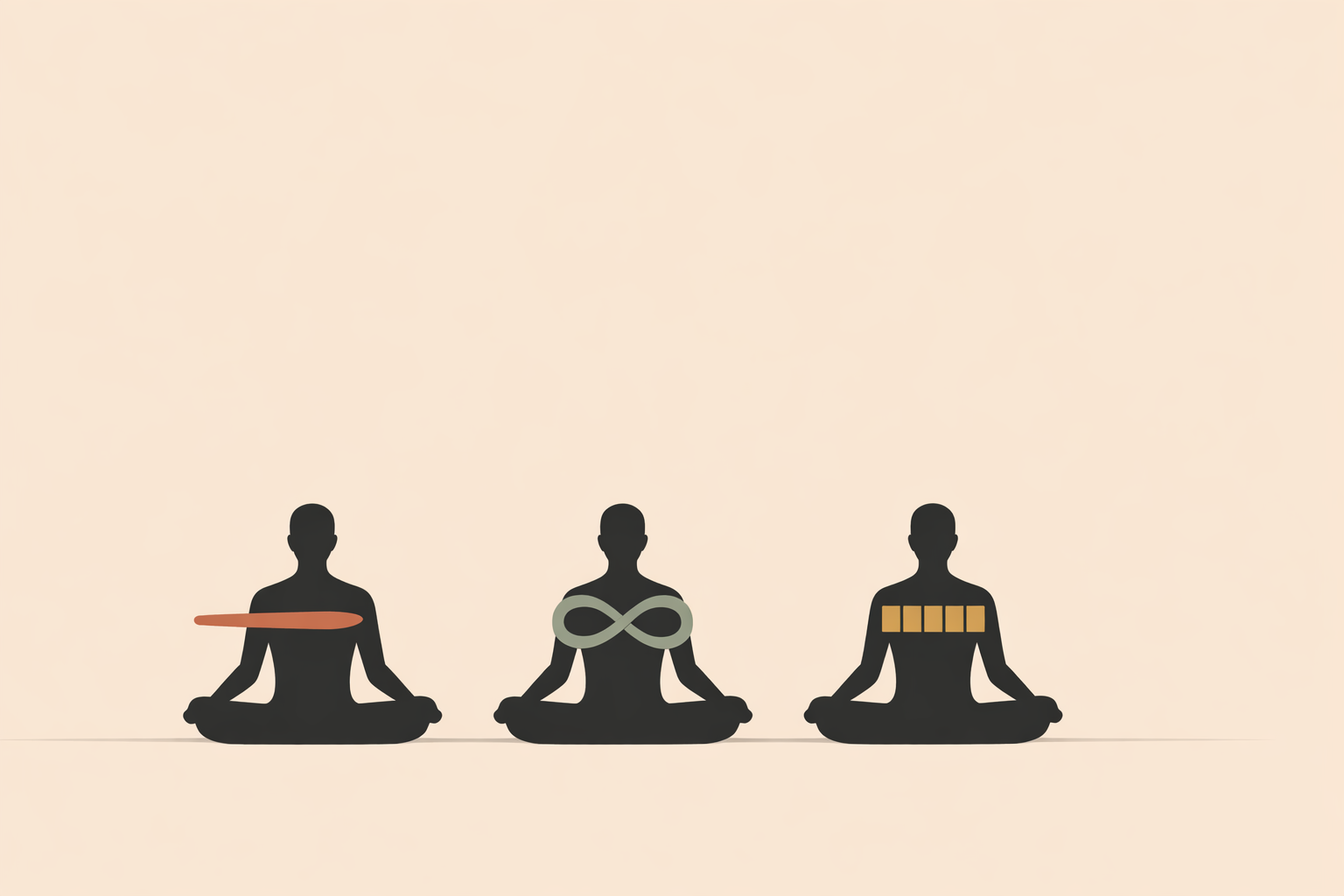
Key Takeaway: For anxiety-sensitive students, pranayama works best when it stays nasal, smooth, and choice-based, prioritizing comfort over depth. Sequence from an extended exhale to settle the system, into Nadi Shodhana for balance, and finish with gentle ratio breathing to give attention a steady anchor.
Extended Exhale Pranayama for Grounding Anxiety
Lengthening the out-breath is often the most direct place to begin. Done gently, it creates a settling shift without asking for heroic effort. That’s why it works so well after strong movement, and in those moments when the mind feels too busy for subtler practices.
In traditional teaching, pranayama is conscious regulation of prana. When the exhale becomes smooth and slightly longer, the mind’s fluctuations quiet and attention gathers. Many lineages start here for anxiety support for a simple reason: it’s not about force, it’s about an unhurried release—like pouring sand from a jar until the last grain falls, continuous and unforced.
Modern research echoes what practice rooms have long observed: slow breathing with a prolonged exhale decreased anxiety and supported steadier regulation. In everyday terms, people often feel less inner rush, more steadiness, and a little more space around thoughts.
“You can work with anxiety by focusing on your exhalations and lengthening exhalations… then rest peacefully in the stillness at the end of each out-breath.”
Read-aloud script: 5-minute extended exhale grounding
- Set-up (30 seconds): Find a comfortable seat or reclined rest. Soften your jaw and belly. Let the shoulders drop. Close your mouth and breathe through your nose.
- Orientation (20 seconds): Feel where your body meets the ground. Imagine the earth receiving your weight. Notice the natural pace of your breath without changing it yet.
- Technique cue (60 seconds): Begin to count your inhale silently for 4, and your exhale for 6. If that feels easy, try exhaling for 7 or 8. Keep the breath smooth, like pouring warm tea—no effort at the top, no push at the bottom. If you feel any strain, return to 4 in, 6 out.
- Refinement (90 seconds): Let the lower ribs widen as you inhale. As you exhale, feel the navel gently draw toward the spine. Sense the subtle sound of your breath, and allow a tiny, restful pause at the very end of each exhale—just a sip of stillness.
- Grounding image (40 seconds): Imagine exhaling down and out through the sit bones or the soles of the feet, like roots spreading into soil. With each breath, settle a little deeper.
- Close (40 seconds): Release the counting. Return to an easy, natural breath. Notice the overall quality of your energy and attention now.
Teaching notes
- Keep it nasal, steady, and comfortable.
- Avoid “bigger” or “deeper” cues if they create breath hunger.
- After stronger asana, use this as a bridge from effort into quiet.
- If students are sensitive: shorten the count before asking for more length.
Nadi Shodhana for Balance and Mental Ease
Once the breath has begun to settle, Nadi Shodhana adds organization. Alternate nostril breathing gives anxious minds a clear rhythm to follow, and a handful of gentle cycles is often enough to feel the shift.
On the energetic map of yoga, ida and pingala shape mood, focus, and vitality. Nadi Shodhana invites prana to move more evenly through both sides, which often brings mental ease before deeper concentration. It remains a trusted balancing practice because it doesn’t demand the mind stop—it simply gives it a steady pattern to inhabit.
For many people, that structure is the whole gift: the hand position, the side-to-side rhythm, and the measured exhale create clarity without harshness. An anxious mind often responds best to exactly that—something clear enough to hold attention, but gentle enough not to provoke more effort.
Read-aloud script: 6 gentle cycles of Nadi Shodhana
- Set-up (30 seconds): Sit comfortably with a tall, easy spine. Relax your face, jaw, and tongue. Left hand rests on the thigh. With the right hand, make a soft Vishnu mudra.
- Cycle 1 (40 seconds): Close the right nostril softly with the thumb. Inhale left for 4. Switch—ring finger to close left. Exhale right for 6. Inhale right for 4. Switch. Exhale left for 6. That is one full cycle.
- Cycles 2–3 (60 seconds): Continue for two more cycles at the same count. Keep the pressure light; you are guiding, not blocking. Shoulders stay relaxed, elbows heavy.
- Cycles 4–6 (70 seconds): If you feel comfortably steady, keep the exhale at 6 or lengthen to 7 or 8. No breath holds today; simply even, fluid transitions.
- Completion (40 seconds): Release the hand. Breathe naturally through both nostrils. Notice if the mind feels more spacious, the inner talk a little softer.
Adaptations
- If hands tire easily: lower the elbow or support it with the other hand.
- If the sinuses feel sensitive: use a mental Nadi Shodhana and imagine the breath moving left and right.
- For beginners: fewer rounds done softly are better than a long, effortful set, especially when teaching beginners.
Like the extended exhale, this fits beautifully after movement and before rest, when the body is already open to subtler work.
Gentle Ratio Breathing to Steady an Anxious Mind
Simple ratios give the mind a precise, soothing anchor. You can start with equal count or a 4-6 rhythm, then adapt for daytime focus or evening unwinding—without forcing depth or long holds.
Ratios such as 4-4, box breathing, or 4-7-8 organize inhale, optional pause, and exhale into a predictable rhythm. The counting can interrupt spirals of thought and cue safety. Think of it like giving the mind a simple walking path to follow: not distracting it, just guiding it.
Discernment matters here. Not every ratio suits every nervous system on every day. Equal count often supports steadiness without heaviness. A 4-6 rhythm tends to land more softly when there’s obvious agitation. And 4-7-8 can be supportive in the evening, provided the holds feel spacious rather than restrictive.
Read-aloud script: 4-6 or equal-ratio breathing for focus and sleep
- Set-up (30 seconds): Choose seated for daytime clarity or reclined for evening wind-down. Breathe through your nose. Soften the back of the tongue and the space around the eyes.
- Equal-ratio option (2–3 minutes): Inhale for 4. Exhale for 4. Keep the sound and feel of the breath even on both sides. If you enjoy this, try 5-5. Stay where it is easy and quiet.
- Extended-exhale option (2–3 minutes): Inhale for 4. Exhale for 6. If your body invites it, 4-7 or 4-8. No holds today unless you are steady and curious.
- Sleep-friendly option (1–2 minutes): For those who like it, try very gentle 4-7-8: inhale 4, hold 7, exhale 8—only if holds feel comfortable. Otherwise, continue with 4-6 or equal-ratio. Fewer rounds are often more settling at night.
- Close (30 seconds): Release the counting. Let the breath return to a natural pace. Notice the softness in your belly and jaw.
Supportive cues
- Pair counting with a simple inner visual, such as tracing a quiet square.
- Shorten counts at the first sign of strain.
- Skip holds if they create urgency rather than calm.
- Keep the voice slow and the pauses generous when guiding this aloud.
How to Sequence These Pranayama Techniques in Yoga Teaching
The simplest sequence is usually the strongest: ground first, balance second, then fine-tune. Begin with extended exhale, move into Nadi Shodhana, and finish with a gentle ratio if more focus or containment is needed.
Here’s why that order tends to work. The longer exhale settles the field. Alternate nostril breathing organizes it. Then ratio breathing gives attention a clear shape to rest inside. In many rooms, students naturally move from scattered, to steadier, to quietly attentive.
In an Ashtanga-informed setting, place these techniques after movement and before stillness. A short closing arc might look like this:
- 2–3 minutes of extended exhale after backbends and seated folds
- 3–6 cycles of Nadi Shodhana for balance and mental organization
- 1–3 minutes of ratio breathing, tailored to context: equal ratio before seated stillness, 4-6 before rest
Voice and pacing matter as much as technique. Speak slowly, and allow enough silence for students to feel the breath rather than chase the next instruction. Cue “smooth, quiet, and comfortable” more often than “deep.” Keep bandhas soft unless students are already experienced, and let drishti become an inner gaze toward the sound and feel of breathing.
Choice matters too. Some people prefer to keep the eyes open, place a hand on the belly, or skip nostril alternation entirely. Welcome that. These practices land best when students feel included rather than cornered by a form, much like choice-rich cueing in quieter classes.
Consistency, Care, and Scope
Extended exhale, Nadi Shodhana, and gentle ratios are easy to learn, kind to sensitive systems, and powerful when practiced consistently. Even a few minutes a day can build familiarity and trust with the breath. Brief, regular home practice is associated with reduced anxiety and improved mood.
As teachers and practitioners rooted in tradition, it’s natural to trust what generations have observed: the breath guides prana, and prana shapes mind. Modern research offers parallel language, suggesting deliberate breathing can reduce stress and shift mental state. Old and new don’t need to compete; together, they give us a richer map.
To keep practice supportive, stay nasal, smooth, and comfortable. Skip or shorten holds if there is breath hunger, dizziness, or rising agitation. Forceful methods and strong retentions are usually poor choices for anxiety-sensitive students, especially in groups. It’s better to underdo the practice and leave someone feeling resourced than to overdo it in search of a dramatic result.
Above all, stay curious and kind. These techniques aren’t a contest—they’re a companionship with your own breath, one steady cycle at a time.
Teach Pranayama with Confidence
Apply these breath cues safely in real classes with the Yoga Teacher Certification.
Explore Yoga Teacher Certification →










