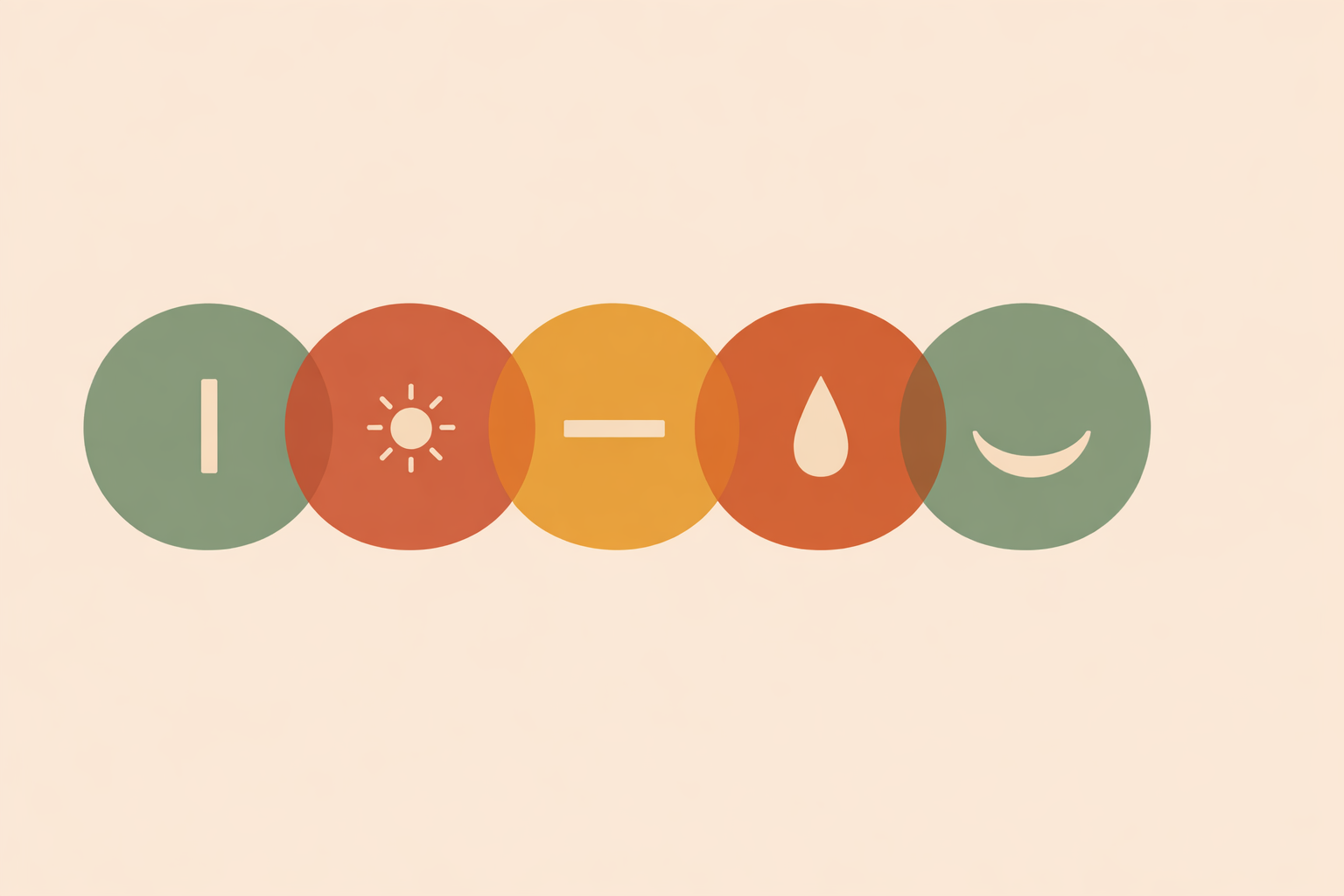
Seasonal self-care works best when it fits real life. In the Five Elements tradition, each season carries a distinct quality and a clear invitation: spring encourages movement, summer favors wise enjoyment, late summer supports steadiness, autumn calls for refinement, and winter asks for restoration. Treated as a gentle guide rather than a rulebook, the seasons become a way to make small, well-timed choices.
Key Takeaway: A practical Five Elements approach uses the seasons as timing for small, specific shifts. Spring supports gentle movement and freshening habits; summer asks for hydration, pacing, and protected rest; late summer favors warm meals and grounded routines; autumn supports breath, boundaries, and moistening care; winter calls for earlier nights, warmth, and softer movement. The value is not perfection but rhythm: choosing the right support at the right time.
Wood & Spring: clear stagnation and start moving
Spring belongs to Wood: upward movement, flexibility, and renewed direction. It’s a natural moment to loosen what feels stagnant and restart with steady, gentle momentum.
After winter’s stillness, most people benefit from more walking, stretching, and lighter daily rhythms. A short morning walk, a few minutes of spinal mobility, or one simple weekly plan often supports consistency better than an intense reset.
Spring focus: movement, flexibility, and small beginnings.
If you feel irritable, stuck, or impatient, Wood responds well to motion. A helpful reflection is: “Where do I feel blocked, and what is one action that loosens things?” That keeps spring energy flexible instead of pressurized.
Here is a simple 10-minute spring sequence:
- 2 minutes easy neck rolls
- 2 minutes slow spinal twists
- 2 minutes gentle hip circles
- 2 minutes standing side bends
- 2 minutes ankle and knee bends
Food can follow the same “lighten and lift” principle. Many people feel best with meals that are fresher, greener, and less heavy: tender greens, herbs, sprouts, scallions, plus a small sour note like lemon or lime. A bowl of rice with sautéed greens and tofu, or a warm broth with herbs and spring vegetables, fits the season without requiring complexity.
- Move for 10 to 20 minutes a day with walking or easy stretching.
- Add more greens across the week.
- Clear one small area at home to create a sense of space.
- Press the web between the big toe and second toe for 30 to 60 seconds per foot if that feels supportive in your routine.
When spring is paced well, it creates clean momentum that carries smoothly into summer.
Fire & Summer: protect joy without overextending
Summer belongs to Fire: warmth, connection, expression, and outward movement. This season is for enjoyment, and it also rewards pacing, so that brightness stays steady rather than draining.
Summer focus: joy, connection, and wise pacing.
A useful check-in is: “Am I genuinely energized, or am I overstimulated?” That one question helps you choose which invitations to accept and which to decline.
Hydration, lighter meals, and real breathing room in the schedule often matter more in summer than strict routines. Many people thrive when they keep a few anchors non-negotiable, especially sleep and evenings. Earlier, playful movement tends to feel more supportive than late-night intensity.
Cooling foods can be helpful when they stay moderate. Cucumber, leafy salads, watermelon, herbs, and brothy meals often refresh more comfortably than very heavy choices or lots of iced drinks.
- Keep a bottle of water nearby and refill it intentionally through the day.
- Choose social plans you truly want rather than saying yes by default.
- Alternate fuller days with lighter ones.
- Set a clear evening wind-down time, especially during busy weeks.
A gentle summer rhythm might look like mint tea instead of another afternoon coffee, a relaxed meal with people you enjoy, and an earlier return home so the next morning still feels like yours. That’s Fire in balance: warm, connected, and well-held.
Earth & Late Summer: restore steadiness and nourishment
Late summer belongs to Earth: gathering, integrating, and settling. After spring’s motion and summer’s outward energy, this is a time to return to rhythm, nourishment, and grounded presence.
Late summer focus: nourishment, routine, and stability.
In Five Elements practice, Earth is often associated with the Spleen–Stomach pairing and the quality of being centered. Late summer suits simpler meals, steadier schedules, and less mental overactivity, all within the broader landscape of traditional and eastern medicine.
Warm, regular, easy meals tend to match Earth best: oatmeal, congee, soups, stewed fruit, rice dishes, and cooked vegetables. When you want to feel clearer and more settled, easing back on excess sugar and greasy foods often helps.
This season also benefits from less noise. If your thoughts loop, add a small structure: write them down, choose one next step, and close the notebook.
- Begin the day with a warm breakfast.
- Create more regular mealtimes where possible.
- Use a simple focus rhythm, such as one work block followed by a short pause.
- Rub the abdomen clockwise for a minute before meals if that feels soothing and grounding.
Late summer care is often quiet. Over a few weeks, simple meals, fewer inputs, and a calmer pace can bring you back to a steadier baseline, which makes autumn easier to meet.
Metal & Autumn: refine, breathe, and let go
Autumn belongs to Metal: inward movement, clarity, boundaries, and release. It’s a season for refining what stays and letting go of what’s complete.
Autumn focus: refinement, simplicity, and discernment.
As the air cools and dries, many people benefit from warm layers, slower breathing, and moistening comforts. Autumn naturally highlights clutter in the home, the calendar, and the mind, so editing and simplifying often feel surprisingly satisfying.
A short breathing practice fits well here. Inhale for a count of four and exhale for a count of six for a few minutes, once or twice daily. The longer exhale often brings a sense of settling that matches autumn’s gentle release.
Warm fluids and naturally moist foods such as pears, sesame, almonds, broths, and honey are often welcomed as the weather shifts. If indoor air feels dry, a humidifier in the bedroom can be a modest support that makes the season feel kinder.
- Practice 4-count inhale and 6-count exhale breathing for 5 minutes.
- Declutter one drawer, shelf, or bag at a time.
- Wear warm layers as mornings and evenings cool.
- Sip warm drinks and bring in more moistening foods.
- Briskly rub the chest and upper back with a towel before a warm shower if you enjoy invigorating self-care rituals.
Emotionally, Metal is often linked with grief and release. This season can hold that experience with dignity: noticing what mattered, what has ended, and what deserves your care going forward.
Water & Winter: restore reserves with rest and warmth
Winter belongs to Water: depth, quiet, conservation, and repair. It’s the time of year to protect reserves and let restoration take the lead.
Winter focus: rest, warmth, and conservation.
Traditional winter guidance consistently emphasizes more sleep, inward attention, and a slower pace. When you move less forcefully and allow extra rest, the season often feels far more supportive.
That can mean an earlier bedtime, fewer unnecessary commitments, and more deliberate warmth. Winter tends to go better when you stop expecting midsummer speed from yourself.
Food and drink can reinforce that quieter rhythm. Seasonal winter guidance commonly recommends warm drinks, cooked meals, and protection from cold and wind. Stews, broths, beans, root vegetables, and warm teas often fit the season better than cold or rushed meals.
Movement still matters, but winter usually responds best to gentle forms. A little Qi Gong, slow stretching, or an easy midday walk keeps you mobile without draining you. Traditional winter practice also emphasizes gentle movement that preserves energy rather than spending it all at once.
- Dim lights earlier and create a calmer evening routine.
- Keep feet, lower back, and neck protected from cold.
- Choose warm, nourishing meals more often.
- Practice 10 to 15 minutes of soft movement most days.
If winter brings fear or worry to the surface, treat it as a cue for more restoration, not more pushing. In this season especially, support often begins with rest, warmth, and less pressure.
When winter is honored, the cycle renews itself naturally, and spring arrives with more available energy.
How to turn the Five Elements into a seasonal self-care plan
Keep the Five Elements practical with a one-page grid: five rows for Wood, Fire, Earth, Metal, and Water, and three columns for food, movement, and reflection. Under each element, write two or three practices you genuinely enjoy and will actually repeat.
The aim is a rhythm you can return to and adjust, season after season.
- At the start of the month, choose one practice that fits the current season.
- Mid-month, add one small support if needed.
- At the end of the month, note what felt nourishing and what felt unnecessary.
Over time, this becomes intuitive. You start to recognize when life calls for Wood’s movement, Fire’s warmth, Earth’s steadiness, Metal’s refinement, or Water’s restoration. Seasonal practice works best when it stays kind and flexible, rooted in respect for the tradition and supported by Traditional Chinese Medicine Foundations.
As with any self-care approach, personal needs vary. If a practice feels depleting, irritating, or hard to sustain, scale it down, make it gentler, or choose a different support that fits your body and your life.
Learn TCM Foundations
Deepen your seasonal approach with Traditional Chinese Medicine Foundations and connect Five Elements ideas to core TCM principles.
Explore TCM Foundations →