Most practitioners learn this through experience: a home visit loses clarity when the pendulum is asked to answer everything, rods and charts appear without a clear sequence, and the client leaves more uneasy than supported. The tools themselves are not the issue. Structure, scope, and language are.
Key Takeaway: The safest geobiology sessions tend to follow a simple order: map patterns with rods, use the pendulum for bounded comparisons, start with small reversible layout shifts, cross-check impressions with lived experience and simple measurements, and keep the whole process calm, consent-based, and non-alarmist. This creates a workflow that is easier to explain, easier to document, and easier to refine over time.
Safe Call 1: Map the room with rods first, then refine with the pendulum
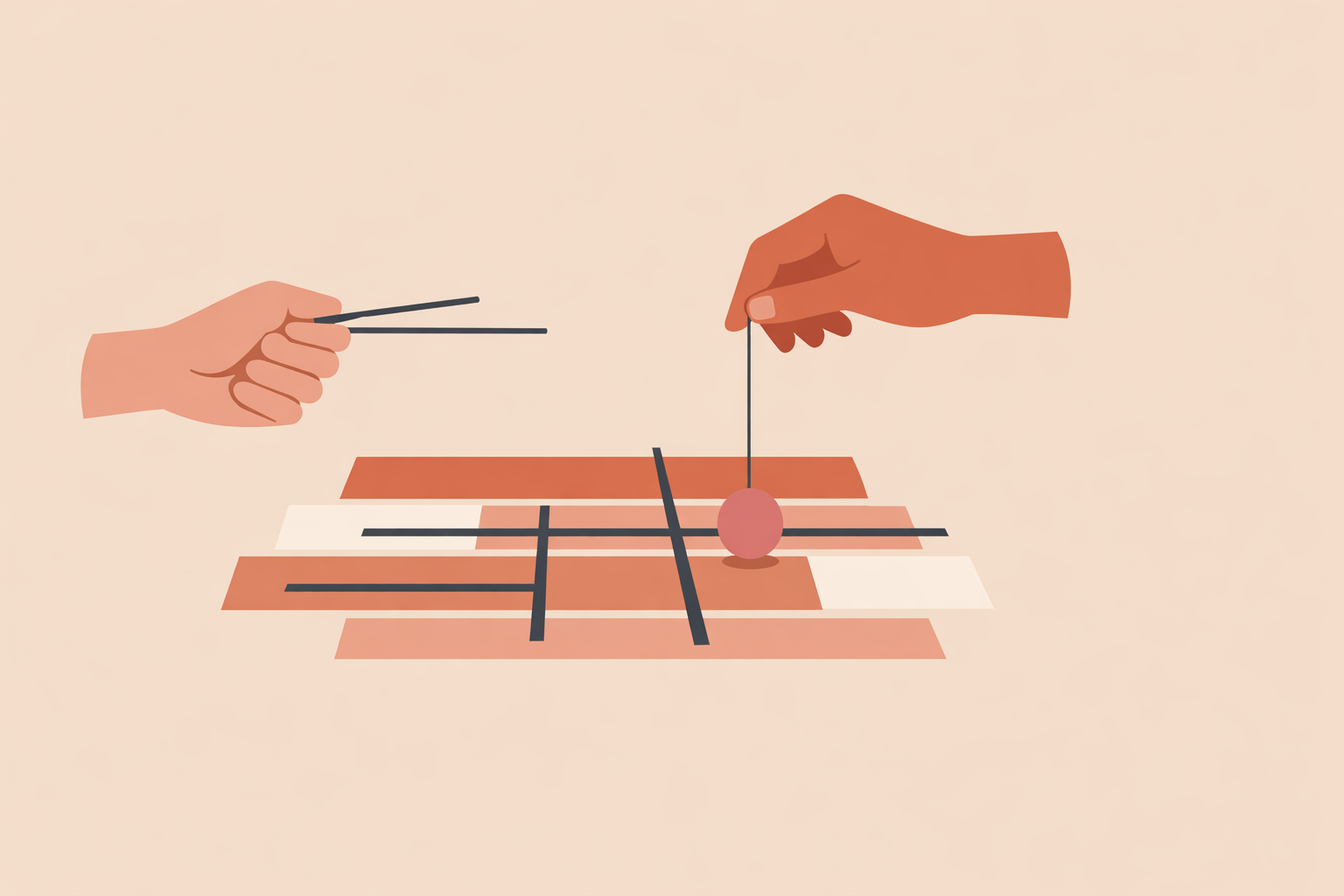
Start with structure. Rods are at their best when you’re walking the room and noticing recurring patterns: repeated lines, concentrated crossings, and how long-stay areas (bed, desk, sofa) relate to them. Once you have a rough map, the pendulum can help you compare a few specific options.
Slow the pace and make it practical. Mark repeated rod reactions on the floor, then transfer them to a simple sketch with notes. In traditional geobiology, these patterns are often read as Hartmann-style grids, nearby faults, groundwater traces, or other subtle pathways. Mainstream overviews generally consider Hartmann grids unvalidated, so it helps to treat your map as a working hypothesis you can test in the home.
With the map in hand, the pendulum becomes easier to use well because your questions are narrow. Compare two or three placements for a bed, desk, or chair, then choose the option that feels most settled and workable for the client.
If you use a Bovis chart, keep it light. A Bovis sweep can support a qualitative sense that one area feels more expansive or calm than another, but it’s most useful as a descriptive impression rather than a fixed “reading.”
- Do two rod passes and mark recurring reactions.
- Transfer the lines to a simple room sketch.
- Highlight long-stay zones such as the bed, desk, or sofa.
- Use the pendulum to compare a small number of placements.
- Note the reason for the choice in plain language.
A common scenario is finding a crossing near the pillow zone, shifting the bed slightly, then comparing old and new positions with the pendulum. The strength is the sequence: rods outline the space; the pendulum helps refine a choice within it.
Safe Call 2: Use rods for patterns and the pendulum for comparisons
Clarity improves when each tool has a job. Rods help you spot patterns in space. The pendulum helps you compare options inside that space.
There’s also a grounded reason to keep pendulum questions modest. Fine handheld tools can be influenced by the ideomotor effect, where tiny unconscious movements shape what the tool does. Controlled tests have also found dowsing results can stay around chance under tight conditions. Traditional practice still has value, and this is exactly why a disciplined question style matters.
The most useful pendulum questions are neutral and environmental:
- A or B?
- Here or there?
- Now or later?
- Which placement feels steadier for work or rest?
This keeps the session supportive and workable. “Which desk position feels more coherent for two hours of focused work?” stays close to what the client can actually try and observe.
If the movement turns inconsistent, don’t push through. Re-check the rod map, restate the comparison, or pause and return later. A steady practice doesn’t need to force an answer.
Safe Call 3: Start with reversible layout changes
Begin with changes the client can undo easily. Move the bed, rotate the desk, shift the chair, or relocate devices. Small adjustments are simpler to test and far easier to evaluate honestly.
This also keeps the story proportional. You’re helping the client explore one variable at a time, which naturally brings more calm and better feedback.
- Slide the bed and re-check the pillow area.
- Rotate or relocate the desk and test focus over several sessions.
- Move long-stay seating away from a crossing if one appears on the map.
- Increase distance between routers or powered devices and rest areas where practical.
Some practitioners use advanced methods, such as placing metal pieces to alter a perceived line or using outdoor earth-acupuncture techniques. These approaches are traditionally known, yet earth acupuncture is lacking robust scientific validation. In most homes, layout changes remain the most dependable first step.
A clean rule protects everyone: change one thing, live with it briefly, then review what actually shifted.
Safe Call 4: Cross-check subtle impressions with experience and simple measurements
Subtle work becomes more useful when it’s documented and cross-checked. Keep several forms of feedback side by side: your rod map, the pendulum comparisons, the client’s lived experience, and any simple environmental measurements you decide to take.
Traditional geobiology includes ideas such as Hartmann and Curry grids, cosmo-telluric chimneys, and Bovis values. Many of these models are not scientifically validated, which makes careful observation and honest note-taking even more important.
If modern environmental exposures are part of the picture, basic meters can add helpful context. Public guidance from the WHO recognizes ongoing attention to both wireless and power-field exposures. Readings give you numbers you can record and revisit alongside what you sensed during mapping.
Keep the record simple and consistent:
- Date and sketch of the room map.
- Main rod reactions and crossings.
- Pendulum comparisons and brief notes on felt sense.
- Any meter readings by location.
- Client feedback after a few days or a week.
Bovis values also land better when treated as impressions rather than units. Reviews note that radiesthetic scales lack validation as quantitative detectors, so they’re best used as a descriptive layer in your notes.
On a follow-up visit, look for convergence. Did the map, the comparison, the client’s lived response, and any measurements point in a similar direction?
Safe Call 5: Protect emotional safety with calm, clear language
The fastest way to destabilize a session is to make the client afraid of their own home. Traditional geobiology asks for sensitivity, and emotional safety is part of that craft. Calm language keeps perception open and decision-making steady.
Fear-heavy messaging can increase anxiety when people feel they have little control. So frame the visit as exploration and adjustment, with choices the client can test and reverse.
Consent is central to good practice. Ethics guidance for energy-based work highlights informed consent, clear scope, and the person’s right to pause or stop. Those principles fit geobiology naturally.
A simple opening script can keep the tone grounded:
- “We’ll use traditional geobiology tools to explore the space.”
- “We’ll treat findings as impressions that guide small, testable changes.”
- “You remain in charge throughout, and we can pause at any time.”
- “Our aim is to support ease, comfort, and better use of the room.”
If someone asks a loaded question, narrow it to what you can explore together. Bring it back to placement options, practical changes, and what the person notices after living with the adjustment.
Many practitioners also close with simple energetic hygiene familiar in energy healing: clearing tools, taking a breath, or thanking the space. Done quietly, these small rituals support closure and presence without amplifying worry.
Conclusion: Build a geobiology workflow you can repeat with confidence
A steady geobiology practice comes from a repeatable order. Map first. Compare second. Change one thing at a time. Cross-check what you sense. Speak calmly and keep consent visible throughout.
That workflow makes rods and pendulum work easier to explain, easier to document, and easier for clients to live with. It also keeps the work respectful of tradition while staying anchored in observation and real-world feedback.
In the end, the main cautions are straightforward: avoid overpromising, avoid alarmist language, and don’t let any single tool become the sole authority. Keep it simple, kind, and well documented, and your process will naturally sharpen over time.
Train in Geobiology Certification
Build a repeatable, consent-based workflow in the Geobiology Certification course.
Explore Geobiology Certification →