Most small-yard food projects begin with a practical instinct: squeeze a couple of beds into the sunniest corner, add a few pots, and hope the space settles into a rhythm. In compact urban yards, that can feel scattered. Shadows land in the wrong places, paths get awkward, containers dry out fast, and the whole area can look more improvised than designed.
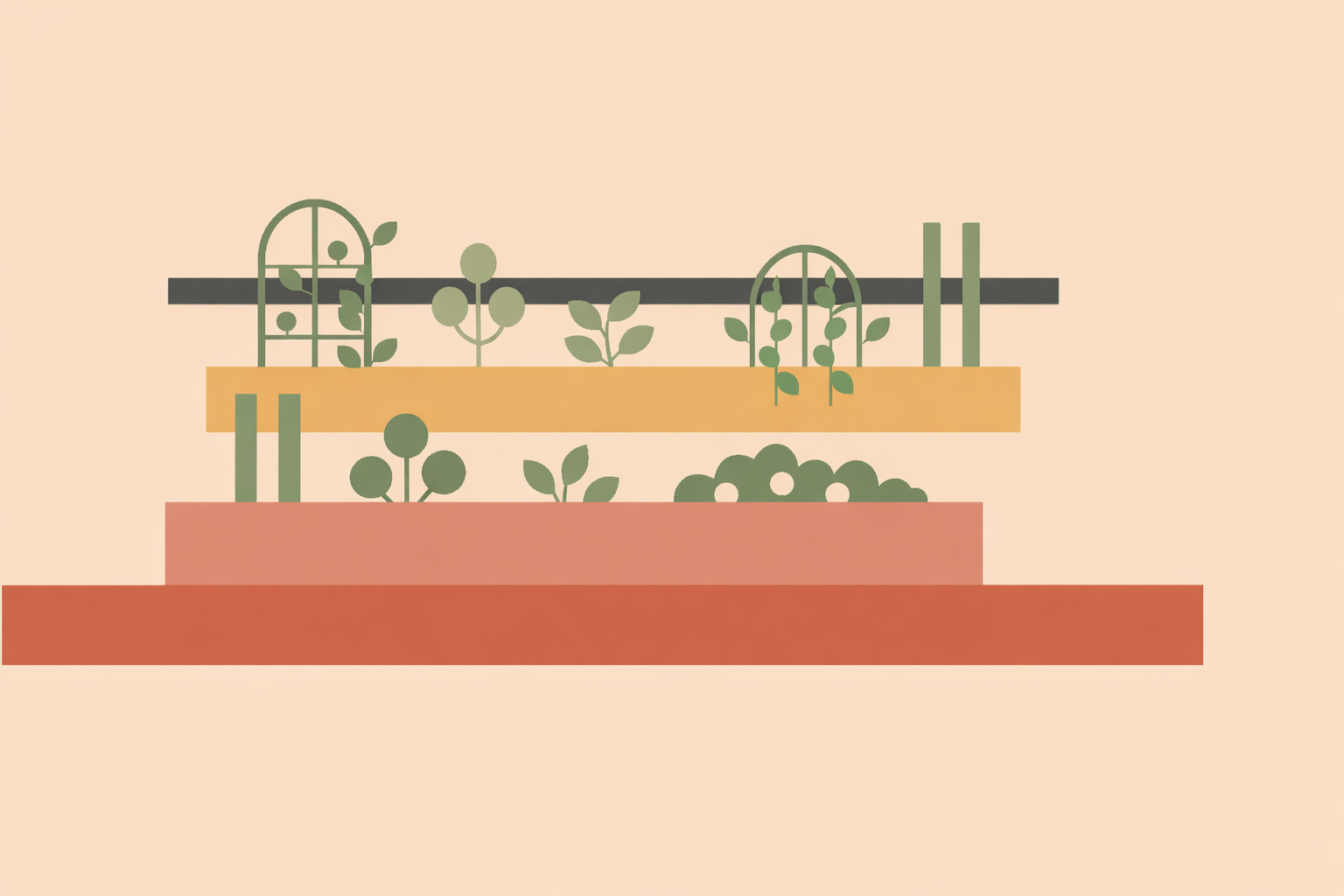
A stronger approach is to plan the yard as a layered edible landscape from the start. Use walls and fences for climbers, organize the ground plane into compact growing zones, bring in containers where soil is limited, and anchor everything with small fruiting shrubs and trees. Then soften edges with edible groundcovers and support the whole system with pollinator-friendly planting.
Key Takeaway: Small urban yards become far more productive and coherent when they are designed in layers. Start with vertical growing on fences and walls, then organize the ground with compact raised beds and micro-beds. Add containers where needed, establish a perennial backbone with dwarf fruit and berries, replace leftover bare ground or turf with edible living cover, repeat visually strong edible plants for a designed look, and place pollinator-supporting flowers close to crops to help stabilize harvests.
Vertical food walls and trellises for small yards
Start with the boundaries. Fences, railings, and bright walls are often the most underused parts of a small yard, yet they can carry a surprising amount of food without taking up floor space.
A reliable setup is simple: run two taut galvanized wires at about 45 cm and 120 cm on a sunny fence, then add seasonal netting. That narrow strip can hold peas in spring, cucumbers in summer, and lighter climbers later in the season, turning a hard edge into a long harvest line.
Shallow wall modules are also excellent for frequent-pick crops near the kitchen. Basil, thyme, parsley, cilantro, lettuce, arugula, spinach, and many Asian greens all fit well in this vertical layer.
Where there is enough sun, trellis netting fixed to a fence or frame makes room for pole beans, peas, and cucumbers with very little footprint. This is especially useful in courtyards where the ground area is tight but the boundary line is generous, a practical fit within urban agriculture.
Espalier deserves special attention. Apples and pears trained flat against a warm wall can fit into a narrow planting zone while still giving the presence of fruiting trees. A 4-meter run can comfortably hold two trees spaced about 2 meters apart, adding structure, screening, and harvest in one move.
Verticals also bring visual order. Repeating trellis lines, a simple arch, or one well-placed obelisk helps a compact plot feel intentional rather than crowded.
- Use fences for peas, beans, cucumbers, or trained fruit.
- Keep wall planters for herbs and quick-cut greens.
- Repeat one or two vertical forms to give the space rhythm.
Try this layout: On a 1.8 m fence with afternoon sun, mount a 1 m-wide, 2 m-tall frame with wire mesh. Grow snap peas in spring, then switch to cucumbers and malabar spinach for summer. Below, keep a lower band of parsley and violas for color and kitchen use.
Compact raised beds and micro-beds that stay manageable
Once the walls are working, the ground plane becomes much easier to organize. In a small yard, raised beds help because they improve drainage and let you concentrate fertility where it matters most.
Keep beds narrow enough to reach from both sides. A width of about 4 feet or less helps you avoid stepping into the growing area, and that choice reduces compaction over time.
In tight spaces, a simple grid makes mixed planting easier to manage. Marking rough 30 cm sections supports succession sowing, interplanting, and rotation, and it helps a busy bed read as calm and planned.
Do not ignore the narrow strips along paths, fences, or driveways. A 30 cm band is enough for lettuces, chard, parsley, thyme, or scallions, and these slim beds often become the most harvested areas because they are right where you walk.
Soil care keeps compact beds generous. A mulch layer around 3 to 5 cm, topped up with a little compost each year, helps hold moisture and steadily improve the growing medium.
Example layout for one 1.2 m × 2.4 m bed:
- Northern edge: 2 tomatoes on supports, underplanted with basil.
- Center: chard planted on a broad checkerboard spacing.
- Southern edge: a ribbon of leaf lettuce resown every few weeks.
One intensively planted bed like this can keep a household in regular salads and cooking greens through much of the growing season.
Container foodscapes for patios, balconies, and paved courtyards
Where there is no open soil, containers still let you grow a productive foodscape. They also add flexibility: you can shift crops as the season changes, move tender plants into shelter, and refine the layout as you learn the site.
Match the container to the crop. Herbs and salads handle shallower volumes, while fruiting plants and roots need more room to stay steady and productive. In day-to-day practice, herbs often do well with around 15 cm of soil depth, while tomatoes, peppers, eggplants, and similar crops appreciate much more.
Bigger pots can also carry patio fruit. A single 50 to 75 liter container is often enough for a dwarf fig, compact apple, or climate-appropriate citrus, as long as watering and feeding stay consistent.
For hot, windy urban sites, self-watering systems can make care much easier. Sub-irrigated planters show more stable moisture and less frequent watering than standard top-watered pots, which matters because balcony and patio containers lose water quickly in sun and wind.
Patio plan for a 2 × 3 meter sunny space:
- Two large pots for a dwarf fig and a patio apple.
- Four medium self-watering tubs for tomatoes, peppers, eggplant, and bush cucumber.
- One shallow trough for lettuces, parsley, and nasturtiums.
- One hanging basket of strawberries at hand height.
Keep maintenance simple. Check moisture with your fingers, water deeply when needed, and group thirstier containers together so daily care stays quick.
Small fruit trees, berry shrubs, and edible guilds
Perennial structure gives a small yard a sense of permanence. Even one compact fruit tree or a short line of berry shrubs can shift the space from a temporary vegetable patch to a settled food garden.
Dwarf fruit trees often act as the anchor. Figs, compact apples, plums, and climate-suited citrus all work well in small urban settings when matched to light, warmth, and shelter. Berries make an easy second layer around them.
Blueberries, currants, gooseberries, and raspberries can form edible hedges that also offer shelter and food for birds. At the base, strawberries, thyme, chives, and calendula soften the soil line and make the planting feel complete.
This is where “guilds” become practical: one fruiting anchor, a ring of useful shrubs, and a lower herb or flowering layer. The planting looks composed and spreads harvests across heights and seasons, which aligns well with self-sufficiency and sustainability in small spaces.
Use warm microclimates when you have them. A south-facing wall or fence can speed ripening and encourage sweeter fruit, making side yards and boundary edges surprisingly valuable.
Simple mini-guild for a 2.4 m circle:
- Center: one dwarf apple.
- Middle ring: three currant bushes.
- Inner ring: alternating chives and calendula.
- Ground layer: alpine strawberries.
By the second season, this kind of planting often feels established: currants settle in, the ground layer knits together, and the tree begins to define the space.
Edible groundcovers and borders instead of leftover lawn
The ground layer is where a small foodscape starts to feel generous. Instead of leaving awkward patches as turf or bare mulch, fill them with low-growing edible cover.
Strawberries, creeping thyme, oregano, and low mints are all useful choices, depending on climate, foot traffic, and light. They can run between stepping stones, sit beneath small shrubs, or form ribbons along paths.
Living groundcovers bring more than harvest. Living mulch trials show weed suppression, moderated soil temperature, reduced erosion, and better moisture retention compared with bare ground.
They also help soften heat. Vegetated covers generally create a cooler ground layer than exposed soil or non-living mulch, which is especially welcome in heat-prone urban yards.
For stronger visual definition, plant edible borders as edging. Rainbow chard, compact kale, parsley, peppers, and even carrots can hold a line beautifully when used in repeating drifts.
Some low edibles support the wider garden too. Strawberries and thyme provide nectar resources while they cover the soil.
Walkway idea: Between pavers, alternate alpine strawberries and creeping thyme in a loose checkerboard. The effect is soft, fragrant, and far more alive than a strip of exposed filler.
Edible ornamentals that make the garden feel designed
A productive yard is easier to care for when it is also beautiful. People naturally pay attention to what they enjoy looking at, and attention leads to consistent care.
Many edible plants already earn their place as ornamentals: rainbow chard, purple basil, bronze fennel, red lettuces, frilled kale, and compact peppers bring color, structure, and seasonal change. When you repeat them, the garden gains shape without losing productivity.
Herbs are especially valuable because they bridge function and design. Lavender, rosemary, sage, dill, fennel, chamomile, and calendula add texture and scent, and they slip easily into mixed beds.
Edible flowers add a bright finishing layer. Nasturtiums, violas, pansies, borage, and calendula soften edges, lift containers, and keep the yard expressive through the season.
In small spaces, repetition is the guiding principle. Group plants in clusters and repeat them across the yard, and the whole layout reads as intentional.
- Choose 3 strong foliage plants.
- Add 2 flowering edible accents.
- Repeat each selection at least 3 times.
- Include 1 clear vertical feature, such as an obelisk or trellis.
Simple formula for a 3 × 3 meter yard: combine rainbow chard, purple basil, and bronze fennel with calendula and nasturtium, then anchor the composition with one tomato obelisk. Even a very small space can feel composed with that level of restraint.
Pollinator-friendly planting that supports harvests
The final layer is the living network around the crops. When a small yard welcomes pollinators and beneficial insects, harvests are often steadier and the whole system feels more balanced.
Planting trials show flowering support plants can reduce pest pressure while increasing helpful insect activity. Over time, gardens with more beneficial presence tend to show better fruit set and fewer dramatic pest spikes.
Culinary herbs are one of the easiest ways to build this layer. Lavender, borage, bee balm, thyme, and oregano are widely recognized as nectar sources for pollinators, and they belong naturally in productive yards.
Companion flowers help too. Calendula, nasturtium, marigold, and alyssum are popular because they can attract beneficial predators while also making vegetable beds feel softer and more welcoming.
Small habitat features round out the support system. A shallow water dish with pebbles, a patch of bare soil, or a modest insect hotel can increase activity in urban gardens where nesting sites are limited.
Placement makes the difference between “nice to have” and truly effective. Flowering resources near fruiting crops can increase yield and improve pollination reliability, and grouped nectar plantings make foraging easier than scattered single plants.
One-square-meter support patch:
- Plant thyme, oregano, calendula, and borage in repeating groups.
- Add a shallow terracotta saucer with stones and water.
- Place the patch within a few meters of tomatoes, cucumbers, or berries.
This planting does not need to be large to matter. In a compact yard, even one well-placed pollinator patch can noticeably improve how the whole space performs.
Bringing the layers together
These ideas work best when they function as one system. A small edible yard becomes genuinely effective when the layers support each other: climbers on the fence, compact beds at ground level, containers in hot corners, fruiting shrubs for structure, groundcovers to protect exposed soil, and flowers that keep the garden active for both people and insects.
If you are starting fresh, begin with one corner instead of tackling the whole yard. Add a trellis, build one raised bed, place one large fruiting container, and underplant with strawberries, herbs, and a few flowers. That small start quickly teaches you how the light moves, where wind funnels through, and which harvests you actually reach for each week.
Then expand layer by layer. Add a berry line for privacy, train a pear along a side fence, or turn a forgotten path edge into a herb strip. Small urban foodscapes do not need size to feel abundant; they need coherence and the patience to let plants settle in, which is also central to urban agriculture certification.
To close with a practical note, give climbing crops secure support, keep watering consistent in containers, and choose pollinator plants that bloom across the season. With those basics in place, a well-made small yard can feel quietly generous for years.
Explore Urban Agriculture Certification
Build on these layered foodscape strategies with the Urban Agriculture Certification.
Explore Urban Agriculture →