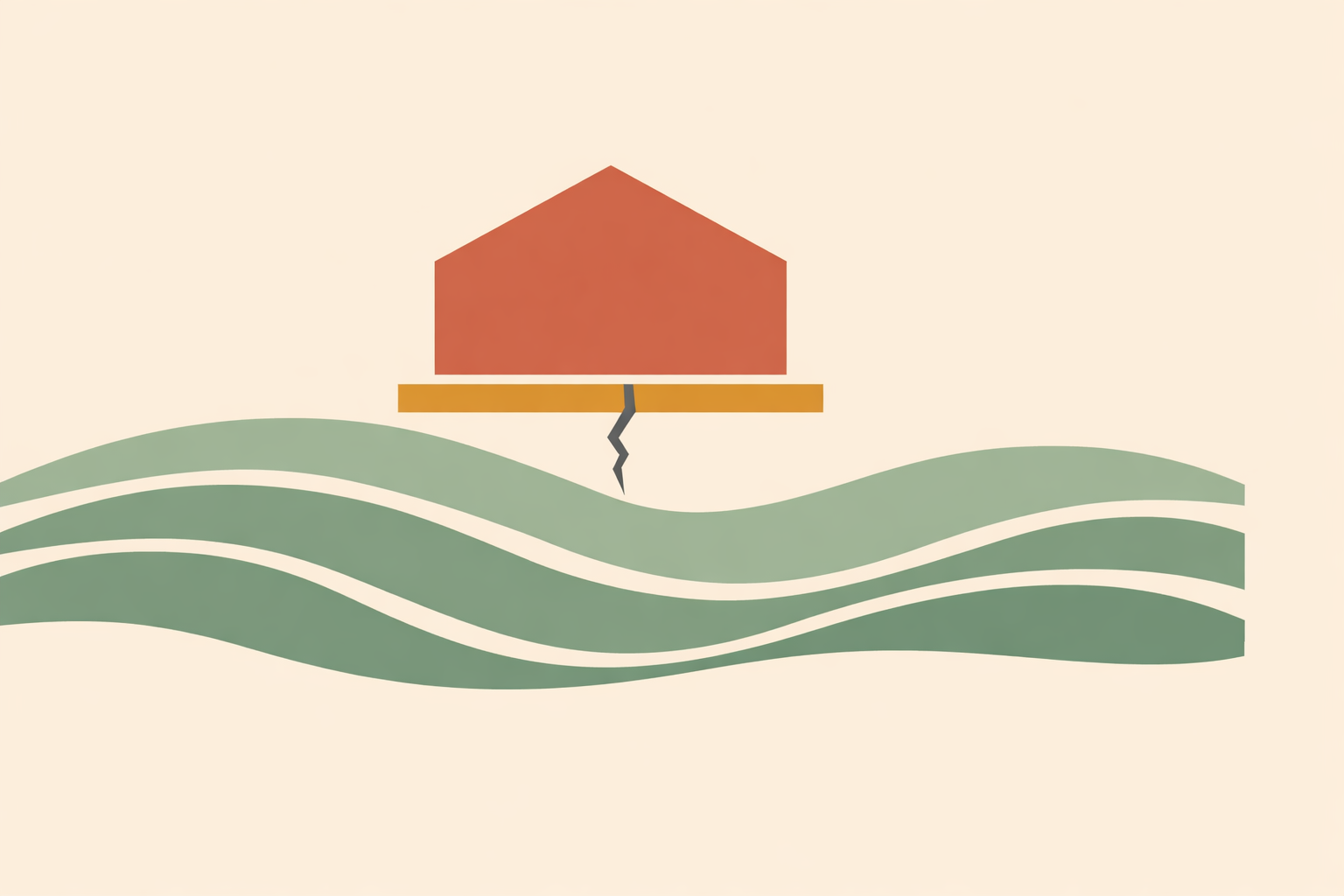
Most home assessments start the same way: a musty room, a scuffed baseboard, and a quick fix that seems to help for a while. Then the stain returns, the room feels unsettled again, and the pattern repeats. In geobiology, that repetition matters. It suggests you may be looking at more than a surface issue.
Key Takeaway: Groundwater-aware geobiology begins with repeatable moisture patterns rather than isolated incidents. The clearest fast signs tend to be recurring damp at the floor–wall junction, horizontal salt bands, basements that stay cold and clammy, foundation cracks linked with moisture, outdoor drainage clues, musty localized microclimates, and repairs that fail in the same place. Read these signs together, then use them to guide a respectful, stepwise assessment.
1. Recurring Damp at the Floor-Wall Junction
Start where the wall meets the floor. If dark patches, swollen skirting, or wrinkled paint keep showing up at the base of the wall, the building is pointing to moisture rising from below rather than a single spill or a passing bout of condensation.
Repetition is the key. When the same lower-wall marks return after repainting, or flare up again after wet weather, they’re worth treating as part of a wider subsurface pattern.
In traditional geobiology, creeping damp at the base of walls can be read as the visible edge of deeper movement: water veins, telluric flows, or cosmo-telluric pathways, especially in rooms where people rest for long periods. Many practitioners therefore avoid placing beds close to zones associated with subsurface water movement, and some consider it sound and judicious to position the bed away from underground water streams and fractures.
Seasonal timing helps you interpret what you’re seeing. Marks that intensify after rain and fade slowly tend to carry more information than marks that appear and vanish quickly.
A simple field note is enough to begin:
- Which wall or corner is affected
- How high the damp band rises
- Whether the skirting feels soft, swollen, or cold
- Whether the pattern worsens after rain
2. White Tide Lines and Efflorescence
A horizontal white line on masonry is rarely meaningless. These salt deposits show up when moisture moves through a wall and evaporates, leaving minerals behind. In building terms, rising damp describes moisture moving up from the ground into walls.
These bands are especially helpful because they often repeat with a steady logic. If the same line returns at a similar height, it can point to a stable moisture level or pressure zone within the structure.
In geobiology fieldwork, salt bands are also sometimes treated as “edges” worth mapping with rods or an antenna, to explore whether a water vein or cosmo-telluric feature seems to concentrate there. For many practitioners, this is a practical way to generate working hypotheses and decide where to look next.
When the bloom is scraped away and returns in the same band, treat it like a map rather than a cosmetic annoyance.
- Measure the average height of the band in several places
- Sketch the line on a room plan
- Compare it across seasons
- Check whether the same height appears inside and outside
3. Basements and Crawl Spaces That Never Feel Dry
Some lower rooms air out. Others stay clammy, cool, and slightly heavy no matter how often they’re aired. That difference is worth respecting.
When a basement stays cold near the slab edge, carries a persistent earthy smell, or shows damp patches without an obvious leak, many practitioners start to suspect groundwater influence below the floor.
Traditional geobiology also pays attention to the felt quality of a space. Some basements located over strong water veins feel energetically heavy or draining, and sensitive occupants sometimes report more unsettled sleep after spending long hours in zones believed to sit over strong groundwater movement.
Odour can be especially informative. Musty smells that spike after rain and gather near the slab edge can point to groundwater-linked humidity even when the upper floors seem fine. On the practical side, drainage around affected walls is often part of reducing the moisture load that drives rising damp.
A quick room check can include:
- Floor temperature compared with room temperature
- Humidity at ankle height versus chest height
- Whether the smell intensifies after storms
- Whether one corner consistently feels colder or denser than the rest
4. Foundation Cracks and Moisture Movement
Cracks tell you more when you read them as part of a pattern. A hairline crack that stays dry often matters less than one that darkens in storms, carries a faint salt blush, or sits beside a damp lower wall.
In geobiology mapping, some practitioners find that foundation crack lines sometimes seem to echo energetic grids or water-vein lines detected during a survey. That kind of overlay can be useful in practice because it brings material and subtle observations into one clear picture.
A crack that weeps during storms and later dries with a pale mineral trace often suggests a combined moisture-and-structure story, even when the deeper driver is still being clarified.
What matters most is convergence:
- A crack
- Moisture nearby
- Salt traces
- A cold or clammy microzone
When several of these gather along the same line, that line deserves priority in the assessment.
5. Outdoor Clues: Soil, Slope, and Vegetation
The land often explains what the room can’t. Before reaching for subtler tools, step outside after rain and watch how water behaves around the building.
Persistent wet strips, puddles hugging one wall, slight soil depressions, and greener linear growth can all help a practitioner hypothesize the path of an underground water vein or a redirected drain. These observations are part of land-based practice and are often enough to guide the next practical checks.
Some drainage clues are straightforward. If the building edge stays wet after rainfall, or the grade carries water toward the house rather than away from it, the moisture burden on that side of the structure increases.
Useful outdoor notes include:
- Where puddles consistently form
- Which way paths or patios slope
- Whether one side of the building has greener, denser growth
- Whether wet ground lines up with indoor damp corners
Often, the strongest insight comes from matching outdoor and indoor signs on the same side of the property.
6. Musty Odours and Heavy Microclimates
Your senses are part of the assessment. A localized earthy smell, a clammy floor-level chill, or a corner that consistently feels dense becomes meaningful when it repeats over time.
One corner can hold more moisture than the rest of the room, even when the overall space seems fine. Floor-level checking helps you find what “average” readings can miss.
Geobiology also takes body-based perception seriously. A room above strong groundwater is sometimes experienced as a heavy zone, especially after wet periods, and some practitioners work with the view that stagnant water can subtly affect the atmosphere of a living space.
It’s common to pair intuitive methods, such as muscle testing or a Bovis biometer, with simple humidity and temperature readings. The aim is to see whether multiple forms of observation point to the same spot.
A simple three-part pass can be enough:
- Smell check at the floor-wall edge
- Humidity reading low and high in the room
- Energetic check in the corners versus the doorway
7. Repairs That Never Hold
Repeated repair failure is one of the clearest signs that something deeper is still active. If paint peels again, plaster blisters again, or the same skirting degrades again, the source hasn’t been fully addressed.
For geobiologists, this is often the moment to look beyond surface correction and consider placement, flow, and how the room is used. A bed, desk, or favourite chair may be positioned in the strongest part of a disturbed zone.
Many geobiology and building-health assessments treat geopathic stress as a blend of underground water veins, geological faults, and room use. The same source noted earlier describes underground water streams and fractures as key zones to consider around beds and living areas, and again sees it as sound and judicious to keep the bed away from those areas.
Clusters matter. Stains, odour, a crack line, and a cold patch in the same corner usually tell you more than any single sign on its own.
At that stage, small reversible changes are often the wisest first step:
- Move the bed or desk
- Reduce time spent in the heaviest corner
- Improve grading outside
- Track changes through weather cycles
Bringing the Signs Together in a Geobiology Assessment
A good assessment rarely rests on one dramatic clue. It’s usually a steady accumulation: a damp skirting, a salt line, a cold basement corner, a crack that marks itself after storms, a wet strip outside, and a repair that keeps failing.
From there, geobiology adds its own layer. Some practitioners confirm suspected paths with rods, a pendulum, or antenna-based methods, then compare those findings with humidity, temperature, and room-use patterns. Others build the picture through observation first and only later bring in subtler tools.
It’s wise to rule out ordinary leaks early, so indoor plumbing isn’t confused with land-driven moisture.
What matters most is the quality of attention. Read the building, read the land, notice what repeats, and choose changes that are proportionate and reversible. Over time, that approach often brings more clarity than forcing a quick answer.
That is the heart of groundwater-focused geobiology: listening carefully to the relationship between house, land, and rest, then responding with grounded, thoughtful support.
Explore Geobiology Certification
Build on these assessment cues with structured practice in the Geobiology Certification course.
Explore Geobiology Certification →