Many practitioners try to shift outcomes by working on the latest flare-up: the tense email, the missed deadline, the boundary wobble. The session can feel productive, insight lands, and yet the same loop returns a week later because the work stayed at the incident level. When pressure rises, people usually default to what the body already knows, not what they merely understood in session.
Key Takeaway: Lasting change is more likely when clients can see, name, and rehearse their recurring loops in real time. A practical sequence is to map the pattern, establish a somatic baseline, use simple state language, track protectors with compassion, pair each loop with one micro-regulation ritual, keep between-session reflection light, and close with embodied integration.
Move 1: Shift from isolated problems to visible pattern loops
Start by widening the frame. Instead of “that argument with my manager,” move toward “here’s the loop I enter under pressure.” Once the pattern is visible, the work becomes less personal, less foggy, and far more repeatable.
Try a quick map in session: “Let’s sketch what tends to happen before, during, and after that moment.” You might write: Sunday email → chest tightens → inner line: “Don’t drop the ball” → late-night fixing → next-day crash → brief relief → repeat.
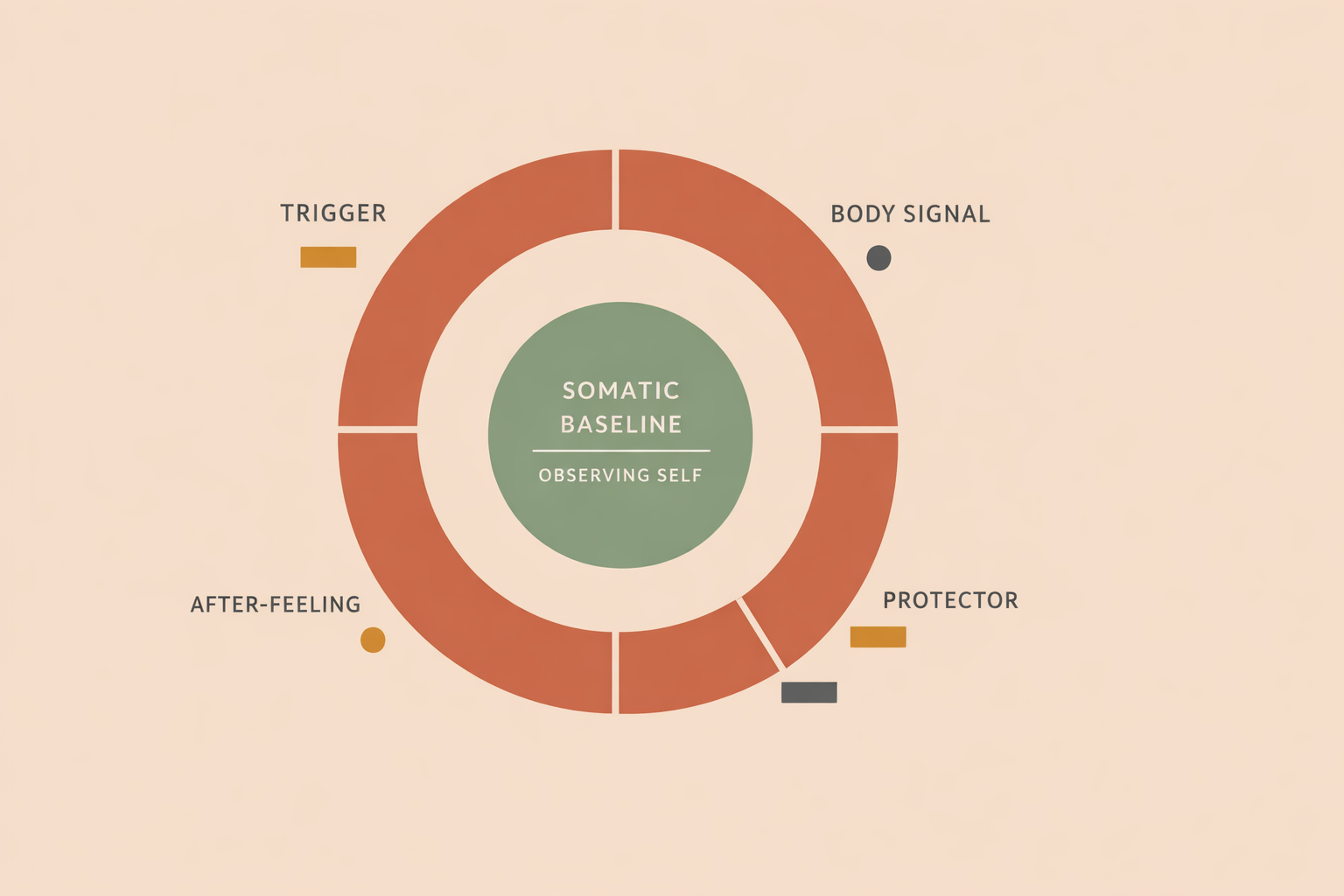
Keep the map simple enough to recreate anywhere:
- Trigger or context
- Body signal
- Protector or inner line
- Action
- After-feeling
Example: “Slack ping → jaw clamps 6/10 → ‘answer now’ → instant reply → resentful and buzzy.”
Once the loop is on paper, clients often gain more distance from it. That observing stance is a powerful coaching shift, and metacognitive capacity has been linked with stronger relational process and better outcomes.
Language helps cement the shift. Replace “I have anger issues” with “I’m in the Fuel-and-Fix loop.” Replace “I procrastinate” with “I’m in the Freeze-and-Flee loop.” Named loops are easier to spot, talk about, and interrupt.
Move 2: Build a somatic baseline clients can actually feel
Before changing a pattern, learn how it shows up in the body today. A somatic baseline becomes a felt dashboard clients can return to in seconds.
A structure that stays grounded and non-judgmental is: sensations, breath, posture, and tension. You’re not labeling anyone as broken; you’re noticing what is here.
In practice, personal history often shows up in breath style, movement rhythm, muscle holding, and expression pattern. These cues typically appear before a client can “explain it well,” which makes them a reliable doorway into pattern work.
Slow, mindful movement can bring the baseline into focus quickly. Two minutes of standing, reaching, rolling the shoulders, or rising from a chair while tracking the breath often reveals automatic bracing, collapsing, rushing, or holding.
A quick numerical check makes change easier to notice. Ask, “On a 0 to 10 sense of steadiness or safety, where are you right now?” Then ask again near the end.
- Example baseline: “Fuzzy head, warm hands, high quick breath, forward-leaning posture, jaw tension 7/10, safety 3/10.”
- Mini-practice: “Place a palm on your sternum for three breaths and notice whether any sensation changes by even 1%.”
The goal is consistency, not perfect body awareness. When clients learn their baseline, regulation skills become easier to build and progress becomes easier to recognize.
Move 3: Name states in simple, shared language
Clients remember simple maps under pressure. A three-word legend is often enough: Revved, Dim, Steady.
“Revved” might show up as quicker breath, tighter jaw, raised shoulders, faster speech, or urgency. “Dim” can look like low energy, postural collapse, reduced expression, shallow breath, or fading out. “Steady” often comes with softer eyes, easier breath, a more settled voice, and a more open posture.
To keep the map practical, teach five neutral indicators:
- Breath
- Posture
- Voice
- Eyes
- Tempo
Then ask: “Notice your breath, posture, voice, eyes, and tempo. Which word fits right now: Revved, Dim, or Steady?”
- Example: “My tempo is fast, my voice is tight, and my eyes feel narrow, so I’m Revved 7/10.”
This kind of naming replaces moral judgment with observation. Instead of “I’m doing badly,” the client has a usable description of their present state, which often softens shame and supports better choices.
Move 4: Track protectors and emotional imprints with compassion
Once the loop and state are clear, listen for the protector inside the pattern. Repetitive behaviors usually make more sense when you understand what they’re trying to prevent, preserve, or manage.
You might ask:
- “If this tightness had a voice, what would it say?”
- “If this reaction had a job, what would it be protecting?”
- “What does this part not want to happen?”
This often turns raw sensation into something workable. A jaw clamp may become “The Driver.” A collapsed posture might reveal a part that says, “Stay small and stay safe.” An urge to over-explain can belong to a protector trying to prevent conflict or rejection.
Symbolic language can help too. Clients may describe “an iron band around my ribs,” “a fog behind my eyes,” or “a voice saying don’t relax yet.” You don’t need to force a big story out of these images; respectful tracking is often enough.
Keep the tone de-shaming and precise:
- “A strong protector is showing up here.”
- “This looks like a well-practiced survival strategy.”
- “Something in you learned this for a reason.”
Example map: “The Driver says, ‘Move faster or you’ll lose control.’ Body cue: jaw 8/10. Pattern: over-functioning. New option: two slow exhales before replying.”
Move 5: Pair each loop with one micro-regulation ritual
Insight fades if it isn’t paired with practice. For each recognizable loop, create one small ritual the client can remember under real-life pressure.
Keep it brief and specific: one loop, one ritual, one clear cue.
For Revved states, paced breathing is often a practical starting point. Breathing at about six breaths per minute with a slightly longer exhale is associated with increased vagal activity during practice.
Traditional approaches also remind us that rhythm, sound, and repetition matter. Humming, chanting, swaying, rocking, and walking in cadence can all be useful options in the right context. Not every client regulates best through breath alone.
Short mindfulness practices can also help. Research on brief interventions suggests even a single session can support shifts such as reduced anxiety in the moment, which supports the wider coaching principle that “short and now” can still matter.
- Revved loop: “Chest tight? Inhale 4, exhale 6, twice. Roll shoulders once. Then respond.”
- Dim loop: “Before scrolling, hum one note for three breaths and rock gently.”
- People-pleasing loop: “Sip water, say ‘Let me check my capacity,’ then take two longer exhales before answering.”
- Identity squeeze loop: “Hand to heart, soften the gaze, and say: ‘I move at my pace.’”
Seal it with a simple formula: “When X happens, I do Y for 60 seconds.” Then rehearse it in session as an embodied sequence, not just a good idea.
Move 6: Keep between-session tracking light
Tracking works best when it’s small enough to maintain. If reflection becomes elaborate, most people stop using it.
A mini-log can fit on a sticky note or phone note:
- Trigger or context
- Body sensations
- Support used
- Result
- Optional 0–10 steadiness or safety score
Example: “Mon 3:40 p.m., Slack ping; breath high, jaw 6/10; used two exhales and a hum; replied three minutes later; felt 5/10 steady instead of 2/10.”
This kind of real-time noticing strengthens self-awareness and pattern recognition. It also gives you better material for the next session because you’re working from lived moments rather than vague memory.
Consistency matters. Across studies, homework compliance has been linked with improved outcomes. In practitioner terms, between-session practice is where insight starts becoming a lived habit.
Keep the tone light. The purpose is not self-surveillance; it’s to notice, learn, and reinforce what helps.
Move 7: Close with embodied integration and one 60-second next step
How you end a session matters. A strong close leaves the client more settled, more oriented, and clearer about their next tiny step.
A predictable arc is often enough: arrival, focus, tracking, protector work, integration, closure. Familiar structure makes the process easier to recall in daily life.
Before closing, revisit the day’s loop and pair it with the new ritual again. That side-by-side rehearsal helps the body register a fresh option when the old pull returns.
Then get practical. Ask:
- “What is your 60-second practice this week?”
- “When will you use it?”
- “What will remind you?”
- Closing script: “Name your state: Revved, Dim, or Steady. Let’s do your 60 seconds now. Where will this live in your day?”
- Stability check: “You arrived at 3/10. Where are you now?”
End with grounding rather than chasing one more big insight. A clean finish often gives clients something more usable than a dramatic breakthrough.
Bring the seven moves into one coherent practice
These seven moves work best as one arc. Help the client see the loop, feel the body’s baseline, name the state, understand the protector, rehearse one ritual, track lightly between sessions, and close with embodied integration.
You don’t need to perfect all seven at once. Start with one or two, perhaps the pattern map and the somatic baseline, then add state naming and micro-rituals as they become natural in your work.
This approach fits a culturally grounded, respectful neuroscience and brain health practice. Breath, rhythm, posture, voice, imagery, and meaning-making have deep roots across many traditions. Used thoughtfully, they offer practical support without stripping them of context or reducing them to trends.
Close with care and stay within scope. Work at the speed of trust, and avoid forcing stories or intensity. When clients leave with a body-level reference they can return to in daily life, insight becomes something steadier: a practiced new pattern.
Train DNR Pattern Skills
Deep Neural Repatterning Certification helps you apply these loop-mapping and micro-regulation moves with embodied precision.
Explore Deep Neural Repatterning →