Group stress programs often stall for a simple reason: the goal is framed as “make stress go away.” Participants try to be calm, then judge themselves when they are not. Progress becomes vague, check-ins lose texture, and people either push harder or quietly disengage.
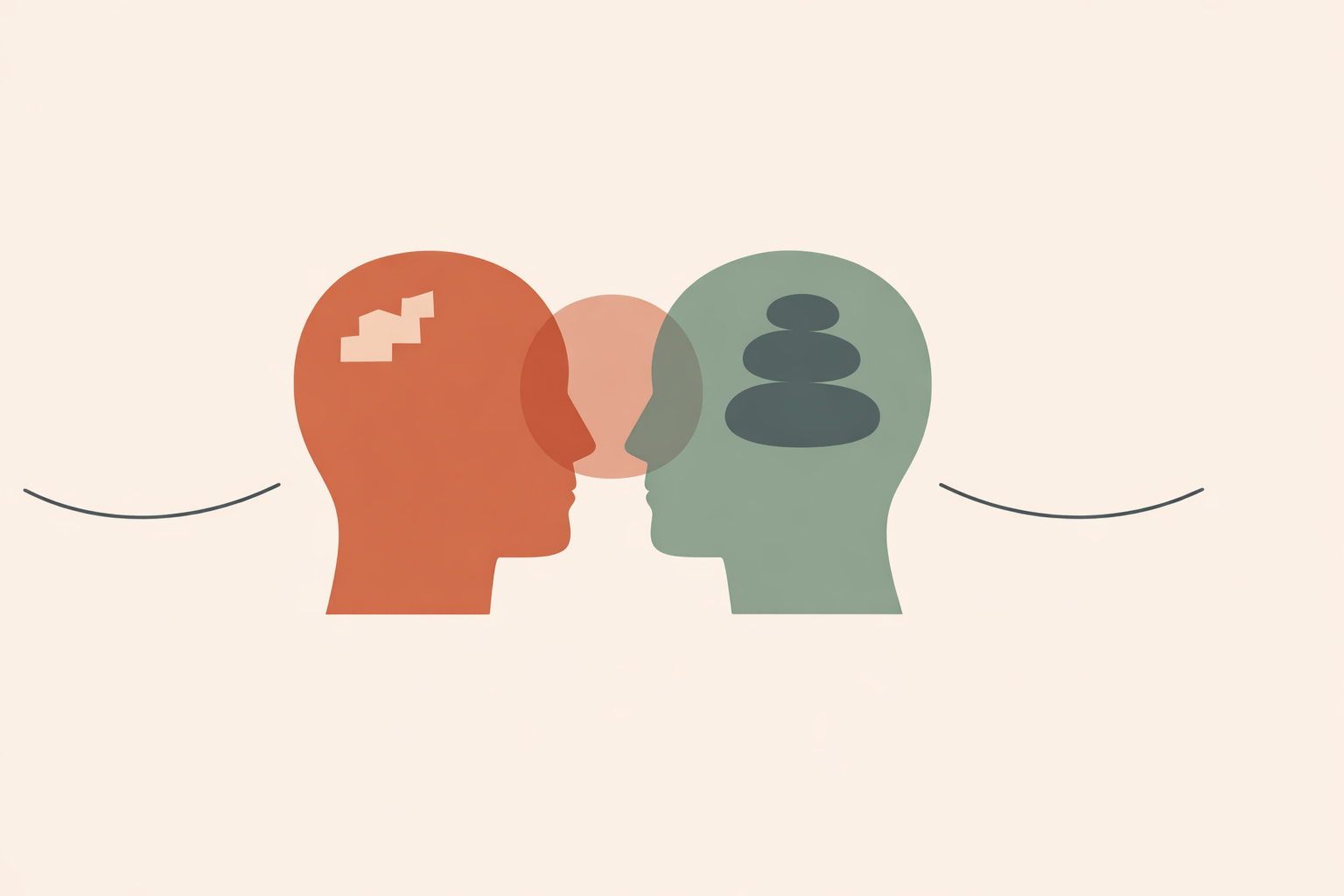
A more useful approach is to coach two complementary states: the stress response that mobilizes, and the relaxation response that restores. This shifts the work from chasing constant calm to building response flexibility. Stress becomes information. Recovery becomes a skill. In group settings, that change alone often reduces shame and opens up more honest learning.
Key Takeaway: Reframing stress and relaxation as complementary states helps groups build response flexibility instead of chasing permanent calm. When participants learn to recognize activation and recovery cues in body, mind, and behavior, they can respond with more choice. From there, a well-held group container and simple, culturally respectful practices make the work practical, repeatable, and useful under real-life pressure.
Stress Response and Relaxation Response in Group Coaching
The stress response is not the enemy. It is a natural mobilizer in demanding situations, involving narrowed attention, bodily readiness for action, and a rise in energy. In the right moment, that activation can help someone focus, protect a boundary, or finish what matters.
The relaxation response is a trainable capacity for settling, broader attention, and increased choice. Breath-based training has been linked with attention improvements and a softer emotional tone, which is one reason these practices translate so well to group spaces.
When facilitators present these two states as partners, participants stop treating stress as proof they are “doing it wrong.” The shared goal becomes practical: notice activation early, then invite recovery when it’s useful.
This changes the feel of the room. Goals get clearer, progress is easier to spot, and peer support naturally becomes gentler. Instead of “Why am I like this?” the question shifts to “What state am I in, and what would help now?”
That question is the heart of response flexibility: knowing when activation is serving you and when recovery would bring more perspective. For example, before a presentation, someone might notice heat in the face, a tight jaw, and urgent thoughts. Rather than battling it, they can name the state, ease one area of tension, and add a few longer exhales to relate to the energy with more skill.
How Activation and Recovery Show Up in Everyday Life
People can’t work with what they can’t notice. Early on, it helps to translate both states into cues that are familiar and easy to spot in daily life.
Common activation cues include:
- Body: quicker or shallower breathing, jaw or shoulder tension, a racing heartbeat, restlessness, digestive fluttering, sudden warmth or chill
- Mind: urgency, looping thoughts, threat-focused attention, black-and-white thinking, decision fatigue
- Behavior: rushing, snapping at loved ones, over-checking messages, procrastinating, overworking, seeking rapid reassurance
Common recovery cues include:
- Body: steadier breathing, softer facial muscles, grounded weight through the feet or seat, warm hands
- Mind: broader attention, easier prioritization, kinder inner dialogue, increased curiosity
- Behavior: slower movement, deliberate pauses, deeper listening, playfulness or humor
Controlled breathing has been associated with calm-attention networks, which fits what many facilitators observe: as recovery comes online, thinking often clears and choices get easier.
The aim is not to label one state as “good” and the other as “bad.” Activation helps people mobilize. Recovery helps them replenish and widen perspective. In group coaching, the win is learning to move between them with awareness.
To make this real quickly, try a two-minute mapping drill. Invite participants to name one body cue, one thought cue, and one behavior cue from the last 24 hours, then sort each cue as mostly activating or mostly recovering. Abstract discussion turns into usable self-observation.
Creating a Safe and Inclusive Group Container
Before introducing practices, establish a container that protects choice, dignity, and steady pacing. People explore activation and recovery more honestly when they know they won’t be pushed.
A simple group agreement might include:
- Confidentiality: share lessons, not identifiable stories
- Choice: anyone may pass on an activity or question
- Respect: honor cultural roots, language, and spiritual traditions without appropriation
- Pace: participants choose eyes open or closed, seated or standing, shorter or longer practice
- Scope: this is coaching and education, not a substitute for specialist support
- Care: breaks, water, and movement are always welcome
Safety is also relational. Psychological safety is the shared sense that people can speak honestly, ask questions, and express concern without being shamed. That matters when participants are practicing new language for tender experiences in front of others.
As trust builds, stress becomes less isolating. Shared belonging has been linked with reduced stress responses, and group facilitators often see this plainly: people soften when they realize their urgency, overload, or shutdown isn’t unique.
Inclusivity shows up in the options you offer. If breath focus feels uncomfortable, use visual orienting instead. If sitting still is hard, invite standing, swaying, or leaning against a wall. Small choices like these make the work accessible across different needs and nervous-system sensitivities.
Session 1: Naming Activation and Building a Personal Map
The first session works best when it turns vague overwhelm into clear, non-judgmental language. Once participants can name their patterns, the rest of the program becomes easier to use in real time.
Begin with a gentle check-in: “On a scale from 0 to 10, where is your activation right now?” Remind the group that numbers are optional. A single body cue is plenty.
Then introduce a small set of core terms you’ll return to throughout: demand, perception, activation, recovery, resource, choice, and response flexibility. Consistent vocabulary helps people track what’s happening without getting lost in explanations.
A simple teaching loop is:
- Trigger: what happened
- Interpretation: what I made it mean
- Body response: what shifted in breath, muscle tone, or tempo
- Impulse: what I wanted to do
- Chosen action: what I actually did
Invite participants to map a recent experience using a stem such as: “When I notice [cue], I tend to interpret it as [meaning], my body does [response], and I usually [behavior]. A supportive option I could try is [experiment].”
This builds accuracy. “I was a mess” becomes “My shoulders climbed up, my breath got choppy, and I started multitasking.” That detail gives the group something workable.
When self-criticism appears, guide the room back to curiosity. The body is offering information, and the group’s tone sets the standard for how participants learn to relate to themselves and each other.
Session 2: Guiding Recovery with Gentle Breathwork
Once participants can recognize activation, the next step is helping them invite recovery on purpose. Breathwork is often a strong fit because it’s simple, adjustable, and easy to use between sessions.
Slow, conscious breathing has been used for generations across many lineages, including yogic pranayama, Daoist cultivation, and forms of song or chanting rooted in traditional community practice. When taught with respect for cultural roots, these approaches offer reliable ways to return to steadiness and presence.
Set expectations clearly: this is not a performance. Participants choose pace, posture, and duration. If anything feels off, they pause and return to ordinary breathing right away.
A gentle starting practice looks like this:
- Posture: seated or standing, with an easy spine and unclenched jaw
- Attention: eyes softly open or gently closed
- Breath: inhale naturally, then let the exhale run 1 to 2 counts longer without strain
- Duration: begin with 2 minutes
- Exit: return to normal breathing, look around, and reorient to the room
For many people, a slightly longer exhale invites recovery. Research suggests parasympathetic activity may be supported by relaxed exhalation, which matches what practitioners observe: the system often settles when the out-breath softens.
Breath-based practices also travel well. Reviews suggest they can be used in daily life, including at a desk, on public transport, or before a difficult conversation.
Keep alternatives available:
- If breath focus feels edgy: invite orienting to color, sound, or contact with the floor
- If someone feels lightheaded: return to ordinary breathing and rest
- If stillness feels difficult: add a tiny sway or gentle movement on the exhale
- If humming feels naturally soothing: it can be explored softly and without strain as a simple experiment
Language that supports agency helps the practice land. Try phrases like “find a breath that feels friendly” and “let your body tell you when enough is enough.”
Close with home practice that fits real life. Ninety seconds of longer exhales before opening the inbox often beats an idealized twenty-minute routine that never happens. Consistency builds familiarity and supports the kind of repeated practice emphasized in neuroplasticity coaching.
Bringing the Arc Together
When stress is framed as mobilization and relaxation as a learnable recovery skill, group work becomes kinder and clearer. Participants learn to notice cues, interpret them with more accuracy, and respond with tools that support well-being without forcing anything.
Across traditions, breath, sound, movement, and attentional shifts have helped people return to balance for generations. Modern research can illuminate parts of what practitioners have long observed, while the core remains experiential: notice, choose, and practice.
Keep promises realistic and structure flexible. Celebrate small shifts: an unclenched jaw, a slower reply, a kinder inner voice, a pause before reacting. Those are real signs of response flexibility taking root.
To close responsibly, remind participants that these practices are supportive skill-building, and intensity should always match the individual. Choice-based pacing, opt-outs, and referrals to appropriate specialist support when needed protect the integrity of the group container and the people inside it.
Train Neuroplasticity Coaching Skills
Apply activation-and-recovery coaching in real sessions with the Neuroplasticity Coaching Certification.
Explore Neuroplasticity Coaching →