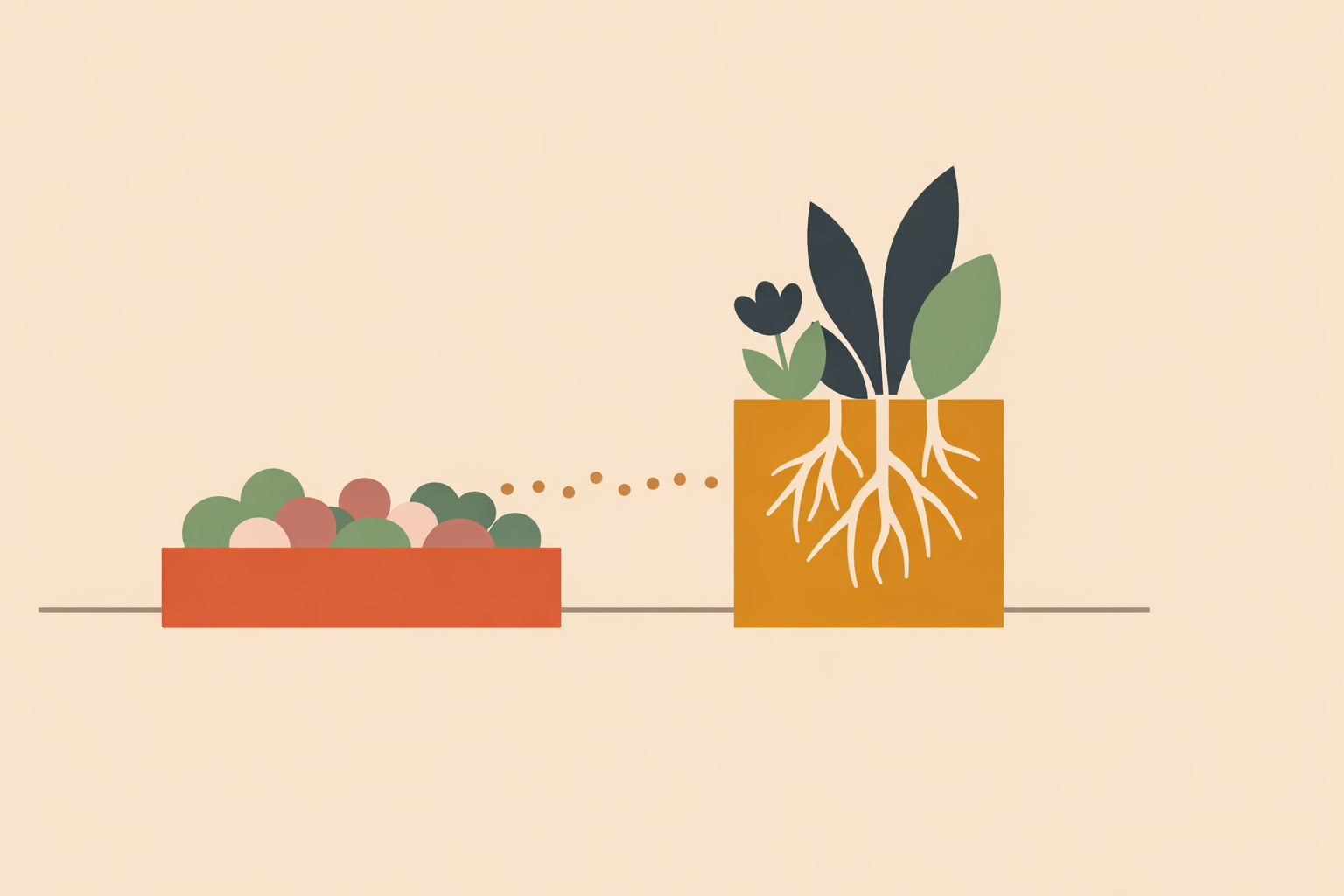
The default move in a new front yard is often fast impact: a cart full of blooming plants, a few flats of annuals, and the hope that everything will somehow settle into balance. By midsummer, that usually means uneven growth, thirsty gaps, and a second round of rearranging once the longer-lived plants reveal their real size. A better approach is to design for time from the beginning.
Key Takeaway: The strongest annual-vs-perennial designs do not choose one over the other. They give annuals a short-term role—fast color, gap-filling, and seasonal observation—while perennials build the long-term structure. Add drought-tolerant roots where watering needs to come down, layer bloom times for pollinator support, and use groundcovers or edible perennials to keep soil covered and productive over time.
Smart Pick 1: Use annuals for fast color while the long-term design settles
Annuals shine when they’re used for what they do best: quick, generous color while a new bed finds its rhythm. They fill open space, soften hard edges, and help you learn how sun, wind, and moisture behave across the season before you commit every gap to long-lived plants.
They’re especially helpful near entries, paths, and the front edge of beds where you want the garden to feel “done” right away. Plant them as temporary companions around young perennials, with enough breathing room for the plants meant to stay.
In a new 6-by-12-foot front bed, planting 18 zinnias at 12-inch spacing creates fast color while keeping the bed easy to edit later. Underplant with a light scatter of calendula, and leave open circles around young salvias or coneflowers so they aren’t shaded in year one.
Some annuals also support a more relaxed, self-renewing pattern. Many self-sow when a few seed heads are allowed to mature, and you selectively keep the seedlings you want in spring.
- Use annuals as placeholders, not permanent crowd-fillers.
- Keep clear breathing room around future perennial clumps.
- Favor varieties that are easy to remove once the bed matures.
- Where pollinator support matters, choose annuals that can bridge first-year bloom gaps.
A simple client-facing line is: “We’re using annuals for this season’s color while the permanent structure gets established underneath.”
Smart Pick 2: Build the backbone with flowering perennials
If annuals buy you time, perennials create the bones. They return each season, reduce repeated replanting, and give the garden a steady visual rhythm that feels intentional from year to year.
Strong perennial design comes from repeating a few reliable forms rather than collecting one of everything. As the planting settles, deeper roots and fuller coverage help the bed feel more stable and ask for less hands-on input.
Flowering perennials work best when planted in drifts instead of as single specimens. In a 12-by-20-foot south-facing bed, you might repeat coneflower, black-eyed Susan, salvia, and yarrow in broad sweeps, then add spring ephemerals at the edge and a few shrubs behind for summer height. This step-by-step approach can carry color from late spring into fall with relatively light upkeep.
The payoff is straightforward: clearer structure, fewer seasonal resets, and a bed that improves as it fills out. Annual accents can still play a role early on, then gradually step back as the perennials take over.
- Repeat a small palette instead of planting one of everything.
- Use drifts for cohesion and easier maintenance.
- Allow roughly 18 inches on-center for clumping forms and more for broader spreaders.
- Mulch in the first seasons, then shift toward fuller plant cover as the bed matures.
When the perennial framework is sound, the rest of the design becomes much easier to adjust.
Smart Pick 3: Choose drought-tolerant perennials to lower watering over time
When summer turns dry, shallow-rooted plantings show their limits fast. Drought-tolerant perennials help a bed hold its shape through heat and settle into a calmer watering routine once established.
A big part of that steadiness is below the surface. In some perennial grains, researchers have observed about four times the root mass of comparable annual grains. In ornamental beds, the same principle applies: persistent roots support more consistent moisture access and soil structure.
Those roots also help stabilize planting beds and improve how water moves into the ground. Over time, that often translates into a garden that stays attractive with fewer top-ups.
Reliable low-water choices after establishment often include sedum, yarrow, catmint, salvia, blanket flower, and coneflower. These are widely recognized as low irrigation plants once they’re settled. Group them by similar water needs, keep the soil covered, and focus on deep watering during the first season rather than frequent light sprinkles.
For planning, it helps to estimate. A newly planted 200-square-foot bed often needs around 1 inch of water per week through the first summer, which works out to roughly 125 gallons. By year two, a drought-tolerant perennial bed on improved soil often needs much less, especially when roots have been encouraged downward and the surface is mulched or living-covered.
- Water deeply in establishment, then gradually stretch the interval.
- Use tougher, low-water plants on hot edges and exposed corners.
- Match plants by water demand rather than mixing thirsty and dryland species together.
- Check the soil before watering instead of following the calendar too rigidly.
This is one of the clearest ways perennial planning pays back over time: less hose-chasing, better summer composure, and a bed that holds its shape under pressure.
Smart Pick 4: Layer annuals and perennials for season-long pollinator support
A lively garden is built on continuity, not just a single peak bloom. When flowers overlap across early, mid, and late season, the bed stays animated and pollinators have consistent forage.
Planning in “windows” keeps it practical. Early bloomers open the season, midsummer perennials carry the main show, and late flowers keep things going when other areas start to fade.
Annuals are especially valuable in year one, when the perennial sequence is still filling in. A few cosmos or Mexican sunflower plants in a sunny gap can keep both color and activity going while the longer-lived layers catch up.
In a compact 10-by-10-foot bed, for example, you might start with spring lungwort or creeping phlox, repeat yarrow and coneflower through midsummer, and finish with asters or sedum for autumn. Then weave annual cosmos into the sunny edge in year one so the bloom rhythm stays continuous.
- Aim for several flowering species in each seasonal window.
- Use annuals to fill timing gaps, not to replace the perennial sequence.
- Repeat a few dependable midseason plants for visual unity.
- Let late bloomers carry the garden into autumn instead of ending the show too early.
Seen through a permaculture lens, this is classic stacking: beauty, habitat, and continuity all coming from the same planting decisions.
Smart Pick 5: Add groundcovers and edible perennials for soil cover and recurring yield
Once the taller structure is in place, ground level decides how “finished” a bed feels. Bare soil dries out, erodes more easily, and invites weeds. Groundcovers and edible perennials close those gaps while adding long-term usefulness.
Keeping soil covered is one of the most dependable ways to support resilience. Ground cover plants can reduce erosion and weeds by protecting the surface from sun and the impact of rain. As that living layer thickens, the whole bed tends to need less rework.
Perennial cultivation also tends to involve reduced tillage, which is closely tied to lower erosion and healthier soils. In garden terms, that means fewer seasonal disruptions and more continuity in the root zone.
Good options depend on site and climate, but strawberries, thyme, and white clover can all work as low-growing covers in the right setting. Edible perennials such as rhubarb, asparagus, sorrel, and walking onion add a recurring harvest without the annual reset that many vegetable beds require.
A simple fruit-tree guild under a semi-dwarf apple might include comfrey at the dripline, chives beneath, a broad pad of white clover, and strawberries added later around the outside. This kind of planting protects the soil, reduces bare-ground maintenance, and makes the space work in more than one way.
- Watch where rain hits bare soil hardest; that is your first groundcover priority.
- Choose low layers that support the upper planting rather than competing heavily with it.
- Favor species with more than one role: cover, bloom, yield, or nutrient cycling.
- Use edible perennials where clients want recurring harvests with less annual replanting.
These quieter layers rarely get the credit that showier flowers do, but they often determine whether a planting feels durable year after year.
Conclusion: Design the planting as a sequence, not a snapshot
The annual-versus-perennial question gets easier when each plant has a job in time. Annuals bring speed, flexibility, and generous first-year color. Perennials build continuity and structure, and they usually make maintenance feel lighter as the garden matures.
Groundcovers and edible perennials complete the design by protecting the soil and offering dependable returns at the lowest layer. Together, these choices create a front yard that looks abundant early on and becomes more rooted and coherent with every season.
As always, results improve when plant choices match the site: sun exposure, soil type, and local rainfall patterns matter. If watering is limited, prioritize tough perennials and soil cover first, then use annuals selectively where you want extra color while the long-term planting settles in.
Design with Permaculture
Apply these planting strategies with systems thinking in the Permaculture Design Course.
Explore Permaculture Design →