


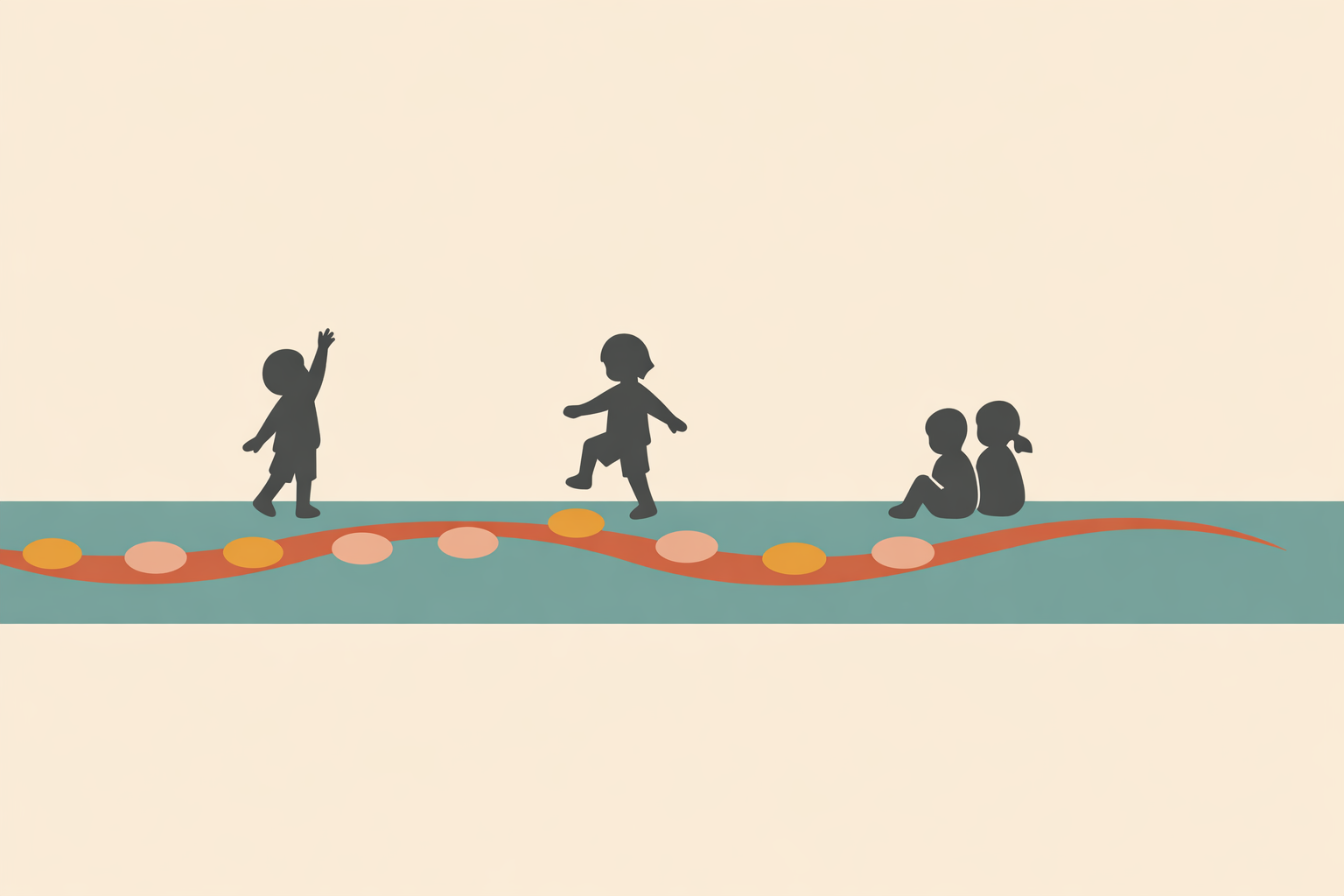
Many aquatic sessions for children start at full volume: big splashes, busy circuits, and rapid skill drills. That pace can look productive while leaving children with little time to settle, notice, and choose. In practice, a calmer structure often works better. When shallow-water games are predictable, low-demand, and easy to repeat, children tend to find their footing sooner and stay available for movement, attention, and shared play.
The three games below follow a dependable arc children can grow into over time: individual exploration, then controlled transitions, then group rhythm. Simple set-ups, short routes, clear pauses, and sensory choice do most of the heavy lifting.
Key Takeaway: Structured, low-demand games in shallow water can improve balance and support steadier participation when sessions stay simple, predictable, and well supervised. A useful sequence is to begin with individual orientation, move into controlled transitions, and finish with shared rhythm.
Game 1: Treasure Trail for choice-making and goal-directed movement
Treasure Trail begins with a straightforward invitation: follow a short line of objects in shallow water, choose what to collect, and decide how to move. For cautious children, that “mission” creates a reason to engage without demanding speed, splashing, or social performance.
Water helps because it slows movement and offers steady sensory feedback as children reach, turn, and shift weight. In a game like this, those cues can make small movements feel more organized and satisfying.
Setting up Treasure Trail
Use water no deeper than the child’s belly button. Create a 3- to 5-meter route with 6 to 8 visible objects (floating rings, small toys, or weighted pool items). Mark a clear start and finish with cones, a kickboard, or a towel so the path is easy to read at a glance.
Keep language simple and choice-based: “Would you like the yellow ones or the blue ones first?” Choice supports agency without adding pressure.
- Watch: model one slow reach and return.
- Try with support: stay beside the child or offer a noodle for comfort.
- Repeat: keep the same route and tempo.
- Progress: skip every second object, change the color pattern, or add one gentle turn.
- Reflect: ask what felt easy and what felt trickier.
Readiness often shows up when a child starts changing the route themselves: choosing a color order, requesting a zig-zag, or reaching farther without prompting.
What to observe in Treasure Trail
- Do the eyes find the next object before the body moves?
- At turns, does the child pivot smoothly or stop and reset?
- Can they make a simple choice and follow it for a few steps?
- Can they keep a steady pace rather than rushing through the route?
End in a grounded way. The child places the last object down, holds the pool edge or step, and notices one sensation: heavy hands, cool water, quiet feet. This helps link action with self-awareness.
Safety remains central: one adult should be the active watcher, distractions stay out of their hands, and close supervision stays constant throughout.
Game 2: Island-to-Island Journey for balance and smooth transitions
Once a child feels oriented to the water and the session rhythm, Island-to-Island Journey introduces controlled transitions. The story is simple: move from one safe point to the next, pause, settle, and continue.
This structure is especially helpful for children who become disorganized when excitement rises. The route gives movement a beginning, middle, and end, while the water adds steady whole-body input through hydrostatic pressure and resistance.
How to run Island-to-Island Journey
Create three to five “islands” with floating mats, hoops on the pool floor, or stable markers in shallow water. Keep the route obvious. Give each island one visual cue such as a color, symbol, or hand sign.
You might say: “Start on Pine Island, cross the red bridge, pause on Moon Island, then come home.”
- Approach: “Soft feet to Pine.”
- Cross: “One step, then the other.”
- Pause: “Hands on the mat. Notice if the water feels busy or quiet.”
Add one new challenge at a time: step over a noodle, carry a foam ring, turn toward a bell, or shift from one foot to the other. Incremental changes usually keep children integrated rather than overwhelmed.
Make pauses part of the game. At each island, stop for three steady beats with hands on the wall or mat. This shared pause helps keep energy in a workable range without turning the stop into a correction.
What to watch during transitions
- Can the child move between stations without losing the route?
- Do pauses help them settle and continue more smoothly?
- Can they accept one new challenge without the whole pattern breaking down?
- Do they begin to anticipate the next step on their own?
Keep the route surface-based and simple. Avoid underwater tasks and skip games involving prolonged submersion. Safety guidance is clear that breath-holding games increase risk, so it’s better to celebrate turning, orienting, wall holds, and steady crossing.
Game 3: Ripple Orchestra for rhythm, imitation, and turn-taking
After individual exploration and route-based movement, shared rhythm often becomes the easiest doorway into group connection. Ripple Orchestra uses simple water sounds and repeated patterns so children can join at different levels while still staying with the group.
For quieter children, predictable rhythm can feel reassuring. A clear pattern, a clear stop, and one leader at a time are often enough to support imitation and turn-taking without pushing for performance.
How to lead Ripple Orchestra
Use a small group of 3 to 6 children in shallow water or on a pool step. Cups, sponges, or foam paddles can help children who prefer object contact rather than direct splash on the skin.
Begin with the stop signal: “When I lift the yellow ring, all sounds stop.” Practice that twice.
Then introduce one short rhythm such as tap, tap, pause.
- Leader pattern: you model, the group echoes once.
- Child leader: one child creates a simple pattern, the group follows.
- Contrast: strong hands, then soft hands.
- Object shift: switch to cups or paddles if needed.
Offer sensory-choice tracks so participation stays flexible:
- Splash Track: bigger sounds with hands.
- Ripple Track: tiny circles with fingertips.
- Object Track: cups or paddles.
- Watch Track: observe first, then join when ready.
These options let children stay connected without pushing through sensory input that feels too intense. Over time, many children who usually hang back begin joining in with more confidence.
What these three games build over time
Together, Treasure Trail, Island-to-Island Journey, and Ripple Orchestra create a practical progression: choose, move, pause, and connect. Across sessions, many children build stronger choice-making, balance, rhythm, and self-awareness.
A short 20-minute session might look like this:
- Opening: greeting, boundaries, and one predictable warm-up.
- Treasure Trail: low-demand orientation and object route.
- Island-to-Island Journey: one route with one new challenge per lap.
- Ripple Orchestra: brief group rhythm with sensory-choice options.
- Closing: one soft finish and a one-word reflection.
Track change with specifics rather than broad labels. Note minutes engaged, number of independent choices, smoother turns, willingness to pause, following a short sequence, taking a turn, or asking for a sensory variation.
Across aquatic support programs, progress usually shows up through repetition rather than all at once. Reviews have linked these approaches with improvements in motor skills, while broader summaries also note changes in self-confidence and participation.
Keeping aquatic sessions ethical, calm, and well bounded
Safety in water is always layered. Close supervision, clear roles, visible boundaries, and age-appropriate water familiarity all matter. If you work outdoors or beyond the pool edge, properly fitted flotation support may also be part of that picture.
The relational frame matters just as much. Children do best when they aren’t rushed, compared, or pushed through distressing input. Choice, pacing, and consent are part of what makes blue therapy techniques and other aquatic work genuinely supportive.
Aquatic work also lands best as one strand within wider support around the child. It can complement land-based learning, family routines, and other developmental supports without trying to replace them. In the research literature, aquatic approaches are often described as an adjunct approach, which matches what practitioners see in real sessions.
Why water can matter so much
Water naturally changes the pace. It slows movement, softens impact, and gives many children a clearer sense of where they are in relation to their body, the environment, and the people around them. That shift alone can transform participation.
More broadly, time spent in and around water has been associated with psychosocial wellbeing. In hands-on practice, the deeper gains tend to arrive gradually and in each child’s own style.
Confidence built in the pool often carries into everyday life. You may see steadier movement in play, more willingness to join group activities, or quiet pride in trying something new. Keep sessions predictable, keep boundaries clear, and keep supervision non-negotiable; those foundations allow simple blue therapy games to do their best work.
Train in Blue Therapy
Build safer, calmer aquatic sessions with the Blue Therapy Certification.
Explore Blue Therapy →








