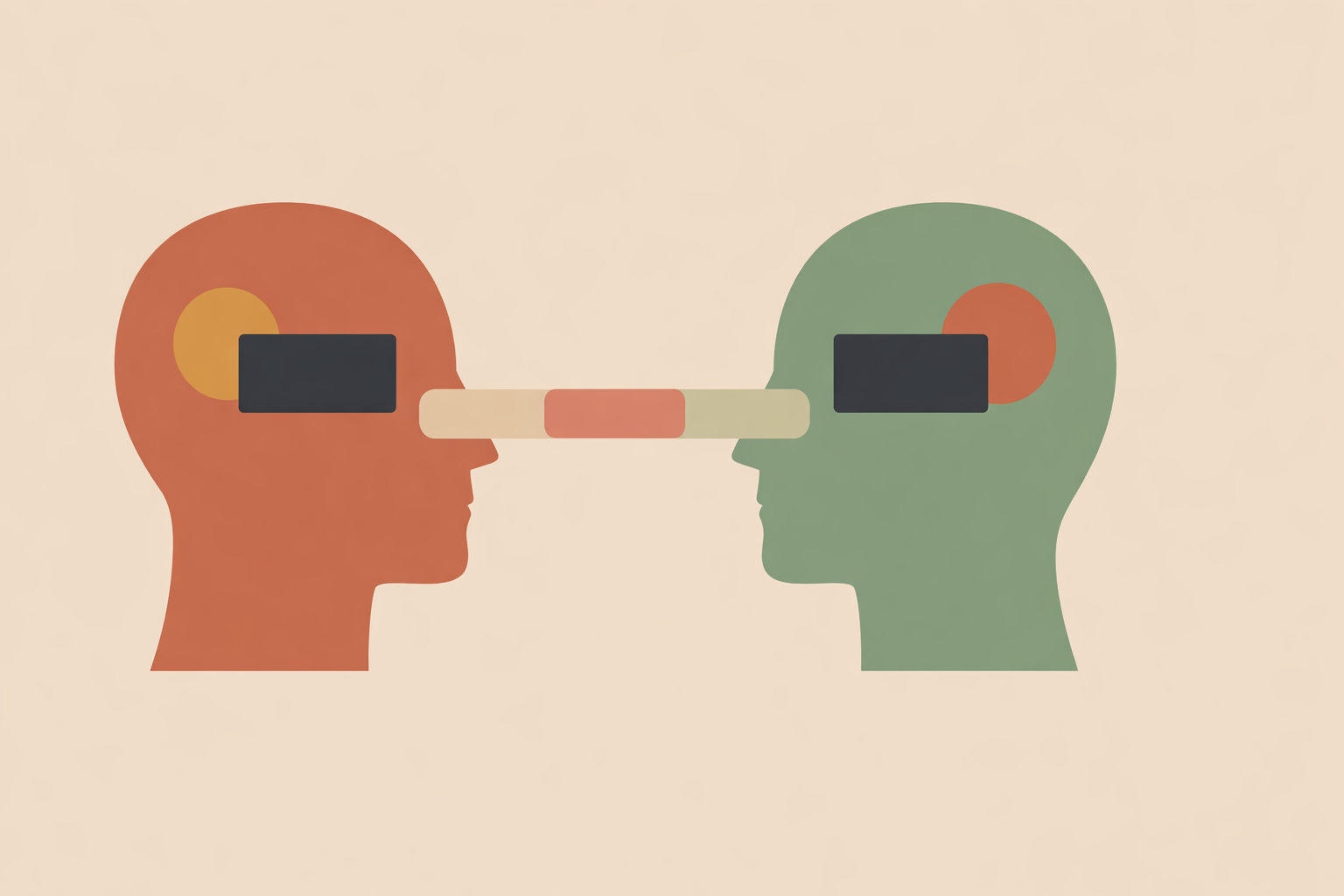
The standard playbook for “improving communication” with autistic clients still leans heavily on eye contact, small talk, and tone-reading. In real sessions, that can create friction fast. Questions built on hints can land as requests for facts. Topic-focused replies get labeled blunt. Body signals are misread, and both sides work harder while understanding less.
Most of the time, the problem is not effort. It’s a mismatch of communication norms. When neurotypes differ, signals are sent and received through different rules. Autistic communication becomes much easier to work with when it’s treated as difference rather than deficit. From there, the work is practical: make conversations predictable, consent-led, clear where needed, and flexible across channels. That lowers performance pressure and makes more room for meaning, autonomy, and steady progress.
Key Takeaway: Effective autistic–nonautistic communication improves when misreads are treated as differences rather than failures. In practice, that means using shared rules: start with consent and preferences, communicate clearly and literally, protect processing time, respect all communication channels, shape the environment to reduce overload, and repair misunderstandings quickly and explicitly.
Why autistic communication is so often misread
Autistic communication is often misread because people may be working from different expectations about what “good communication” looks like. One person might expect implication, tone, and social hints. Another may prioritize accuracy, directness, and concrete meaning.
This is captured well by the double empathy problem: mutual misunderstanding between autistic and non-autistic people. The practical question becomes what each person needs in order to understand and be understood.
That shift changes the tone of a session immediately. Instead of reading a mismatch as resistance or poor rapport, it becomes a cue to clarify the rules of the exchange.
Body language is one of the biggest areas of confusion. Reduced eye contact and flatter facial expression are common autistic expressions, yet disinterest is a common neurotypical interpretation of low eye contact. For many autistic people, self-regulation is a key reason gaze shifts happen. When atypical eye contact is respected, more energy is often available for listening, thinking, and responding.
In sessions, a simple reframe can keep things collaborative: “Let’s assume we’re both being clear and still missing each other. What needs adjusting?”
- If a client answers a different question than the one you meant: “That’s helpful. Would it be okay if I ask the version I meant more directly?”
- If you sense confusion: “I think I asked that too broadly. Let me make it more specific.”
- If tone has become tense: “We may be using different rules here. Let’s slow it down and make them explicit.”
Reframing autistic communication as difference, identity, and style
A steadier approach is to treat communication as part of identity, pattern, and lived style. That supports better coaching outcomes and a more respectful working relationship.
Many autistic communities prefer identity-first language because it recognizes autism as part of self. In strengths-based coaching, this matters: it starts from who the person already is, not from a correction project.
From there, it helps to presume competence, including with nonspeaking autistic people. Guidance on autism and inclusion emphasizes presumed competence as part of respecting autonomy and participation.
It also helps to expect unevenness rather than uniformity. Many autistic people have a spiky profile: strong ability in some areas, real strain in others. And monotropism, or deep focus on a few topics, can be a genuine resource in coaching when you plan with it.
In practice, focus on questions that center agency:
- “How do you communicate best?”
- “What helps you think clearly here?”
- “Do you want broad discussion, or one specific next step?”
- “What strengths do you already rely on when things are going well?”
When a client prefers email for scheduling, text for brief check-ins, or written follow-up after a session, honoring that preference often increases engagement. It also signals something important: your role is to build a workable bridge, not require one “acceptable” style.
Practice rule 1: Start with consent, preferences, and clear intent
The quickest way to reduce misreads is to agree early on how you’ll communicate and what the conversation is for.
Ask about preferred channels, pace, and sensory needs. Some people think best with short spoken prompts and typed replies. Others want camera off, lower light, or more silence. When the channel fits the person, unnecessary friction drops away.
Consent matters throughout, not just at the beginning. Autism guidance emphasizes consent and choice as central to autonomy. In coaching, this can stay simple: “Is it okay if I offer an observation?” “Do you want reflection or problem-solving?” “Shall we keep going, or pause?”
Clear intent-setting is just as important. When the purpose is spoken plainly, roles and goals become easier to follow, and many autistic adults find it easier to engage when goals connect to values and the structure stays predictable.
A short session opener can cover most needs:
- Preferred channel: “Talk, type, or both?”
- Pacing: “Do you want short questions and longer pauses?”
- Environment: “Anything you want changed before we start?”
- Purpose: “What would make this conversation useful today?”
- Consent: “Okay if I ask something direct?”
- Goal anchor: “What matters most here?”
This takes little time and prevents a lot of avoidable strain later.
Practice rule 2: Use literal language and protect processing time
Clarity is kind. For many autistic communicators, direct wording lowers cognitive load, while ambiguity increases stress.
Say what you mean as plainly as you can. Replace implication with direct requests. Tag jokes and metaphor when needed. Offer one idea at a time. Direct wording is often experienced as respectful because it reduces guesswork.
Processing time deserves the same respect. Communication guidance recommends extra processing time to support understanding and reduce overload. A pause after an important question can lift the whole conversation, especially with complex or emotionally loaded topics.
Breaks matter too. Support guidance recommends offering breaks during overload so attention and regulation can recover.
Written backup also improves clarity. Communication guidance recommends written information to support recall, particularly when stress or environmental noise is high.
Some emotional questions benefit from more structure as well. Alexithymia and interoception differences can make “How are you feeling?” too abstract, so narrower options often work better.
- Instead of “How are you feeling?” try “Does this feel more frustrating, tiring, or overwhelming?”
- Instead of “Could you deal with that soon?” try “Please send that message before 4 p.m.”
- Instead of repeating a question quickly, pause first and let the answer form.
- After discussing next steps, send them in writing.
Practice rule 3: Honour all communication channels equally
Speech is only one communication channel. When it’s treated as the only valid option, meaning that’s already present can get overlooked.
AAC as equal to speech is a basic principle of respectful communication. Typing, symbols, gesture, silence, movement, and shared written notes all count.
It also helps to support more than one channel at once. AAC recommendations encourage multiple modalities so a person can switch methods when stress, fatigue, or overload makes one channel harder to use.
Movement belongs here too. Stimming often helps regulate arousal and stabilize attention. If a client rocks, taps, fidgets, looks away, or types instead of speaking, making room for it is usually more supportive than redirecting it.
Honoring a preferred mode also builds self-advocacy over time. Self-advocacy frameworks emphasize preferred modes as part of autonomy.
Useful structures include:
- Offer a response menu: “Speak, type, point, or pass.”
- Keep a shared note open during sessions.
- Allow silence without rushing to fill it.
- Normalize channel shifts: “Typing is fine. We can continue that way.”
- Do not rank one channel above another.
When speech becomes effortful, staying connected through another channel often preserves the depth of the exchange.
Practice rule 4: Shape the environment, not the person
Sometimes the communication challenge isn’t the conversation. It’s the environment around it.
Noise, glare, and strong smells can trigger sensory overload. During overload, some autistic people may lose access to fluent speech, with reduced speech or silence becoming more likely. When the environment is adjusted, more attention becomes available for understanding and responding.
Autism-friendly guidance recommends reducing sensory load to support concentration and communication. That might mean dimmer lights, fewer competing sounds, less visual clutter, fewer people in the room, or a predictable agenda.
Nervous-system state also affects expression and pacing. Autonomic state shapes facial expression, tone, and pace. And predictability and choices help people stay more regulated and socially available.
This is why universal design can be so effective in coaching spaces. Universal design reduces reliance on memory, inference, and fast social decoding. You build the conversation to be easier to enter from the start.
A quick sensory and structure check can help:
- Sound: quieter room, headphones, white noise, fewer interruptions
- Light: lamp instead of overheads, reduce screen glare
- Visual load: one document open, simple agenda visible
- Pacing: fewer agenda items, scheduled pause midway
- Choice: seat options, camera optional, permission to move
Shaping the environment is often the fastest route to better communication because it removes preventable load before it turns into a rupture.
Practice rule 5: Repair misreads quickly, gently, and explicitly
Even with good structure, misunderstandings will happen. What matters most is how reliably you return to shared meaning.
Start by naming intent. A brief tag like “I’m trying to understand, not challenge you” or “I’m offering options, not pushing you” can prevent escalation. In coaching contexts, explicit intent-setting reduces misreads because the frame is clearer.
Then use a meaning check: “This is what I heard. Is that right?” That slows the jump from interpretation to reaction.
Written recap helps after complex conversations. A short message with agreements, next steps, and timing can protect clarity after the live conversation ends.
It also helps to avoid control-based repair. Forcing eye contact or policing tone often increases stress. Increased masking also carries a real wellbeing cost. When someone has to perform acceptable body language to stay in the conversation, trust and useful information both shrink.
Better repair scripts stay simple and concrete:
- “I think I was too vague. Let me ask that more directly.”
- “What I heard was X. Is that accurate?”
- “I meant that as information, not criticism.”
- “Would you rather type your answer?”
- “Let’s pause for five minutes and come back.”
The goal is a reliable path back to understanding.
Bringing these rules into everyday coaching
These practices work best as a set. Begin with consent, preferences, and purpose. Use direct language. Protect processing time. Respect all channels. Reduce sensory strain. Repair clearly when needed. The thread running through all of it is consistent: less pressure to perform, more support for meaning.
This approach also tends to be easier on everyone involved. Communication becomes less dependent on guessing, fast social inference, or conventional body language, and more grounded in shared structure that both people can actually use.
A few cautions belong at the end. Avoid assuming one language preference fits everyone; ask. Avoid treating silence as refusal, eye contact as honesty, or flat affect as lack of care. And avoid turning neuro-affirming practice into another rigid script. The point is responsiveness.
Small changes add up: one consent check, one literal question, one longer pause, one written recap, one sensory adjustment. Repeated consistently, these moves create sessions where autistic communication is not merely accommodated, but genuinely welcomed, including in broader autism coaching practice.
Train in Autism Coaching
Deepen these neuro-affirming communication skills in the Autism Coach Certification.
Explore Autism Coach Certification →