Most practitioners meet the same impasse: clients arrive between back-to-back commitments sounding flat, unfocused, and short on patience. The reflex is to add more: a longer routine, a more elaborate practice, a stronger push. In real life, that usually backfires. When capacity is low, simplicity is what people can actually use.
That is where qigong micro-sets shine. A brief pause of movement, breath, and attention helps someone shift gears without turning it into another task to “do right.” Used well, these short practices honor the spirit of Traditional & Eastern Medicine: working with timing, rhythm, and relationship rather than forcing change.
Key Takeaway: Quick, well-placed qigong micro-sets can support steadier energy, attention, and self-awareness through the day. The most useful versions stay simple, repeatable, and easy to adapt. Framing them through plain-language TCM ideas such as Qi and Yin-Yang helps clients notice patterns without feeling labeled, while a clear structure—arrival, grounding, gentle mobilizing, breath-led movement, integration, and close—makes the practice practical enough to use between real-life commitments.
Why brief qigong pauses work so well
Short practices often work precisely because they are short. When someone is stretched thin, a tiny sequence is easier to start, easier to repeat, and easier to trust.
Qigong is a family of practices, which makes it easy to tailor for real transitions: between meetings, before meals, after a difficult conversation, or at the threshold between work and home.
Traditional use has long valued qigong for cultivating steadiness through simple, regular practice. A micro-set respects that principle. It does not try to do everything; it gives the person one reliable way to return to themselves.
Modern evidence also points in a supportive direction. Reviews have found anxiety relief in some qigong research, which fits what many practitioners observe when a client takes even a brief reset.
You can often see the shift: the breath softens, the jaw unclenches, speech slows, and attention becomes more available.
Try language like this: “Let’s stand for 90 seconds. As you inhale, let the hands float up to shoulder height. As you exhale, let them settle. We’ll do a few rounds and then notice what changed.” The smallness is part of the design.
Using Qi and Yin-Yang in client-friendly language
Traditional Chinese Medicine offers a vocabulary many people grasp quickly when it’s kept close to lived experience.
Qi can be described as felt aliveness: the sense of movement, warmth, momentum, and availability in a person. Yin and Yang help name changing qualities in daily life: active and quiet, outward and inward, rising and settling.
Used this way, the language becomes practical. It helps clients notice patterns and make choices that match the moment:
- When do you feel outward, bright, and active?
- When do you feel quieter or more inward?
- What kind of movement meets this moment best?
This approach supports observation without turning someone into a “case.” A client might notice that late afternoon usually feels depleted and scattered while mornings feel more expansive. Then the micro-set becomes a fit, not a fight.
For the practitioner, meridian theory, Qi and blood, and the broader TCM framework can deepen how the work is held. Even when the client receives a simplified version, the practice carries a coherent view of balance, flow, and relationship.
What a qigong micro-set looks like
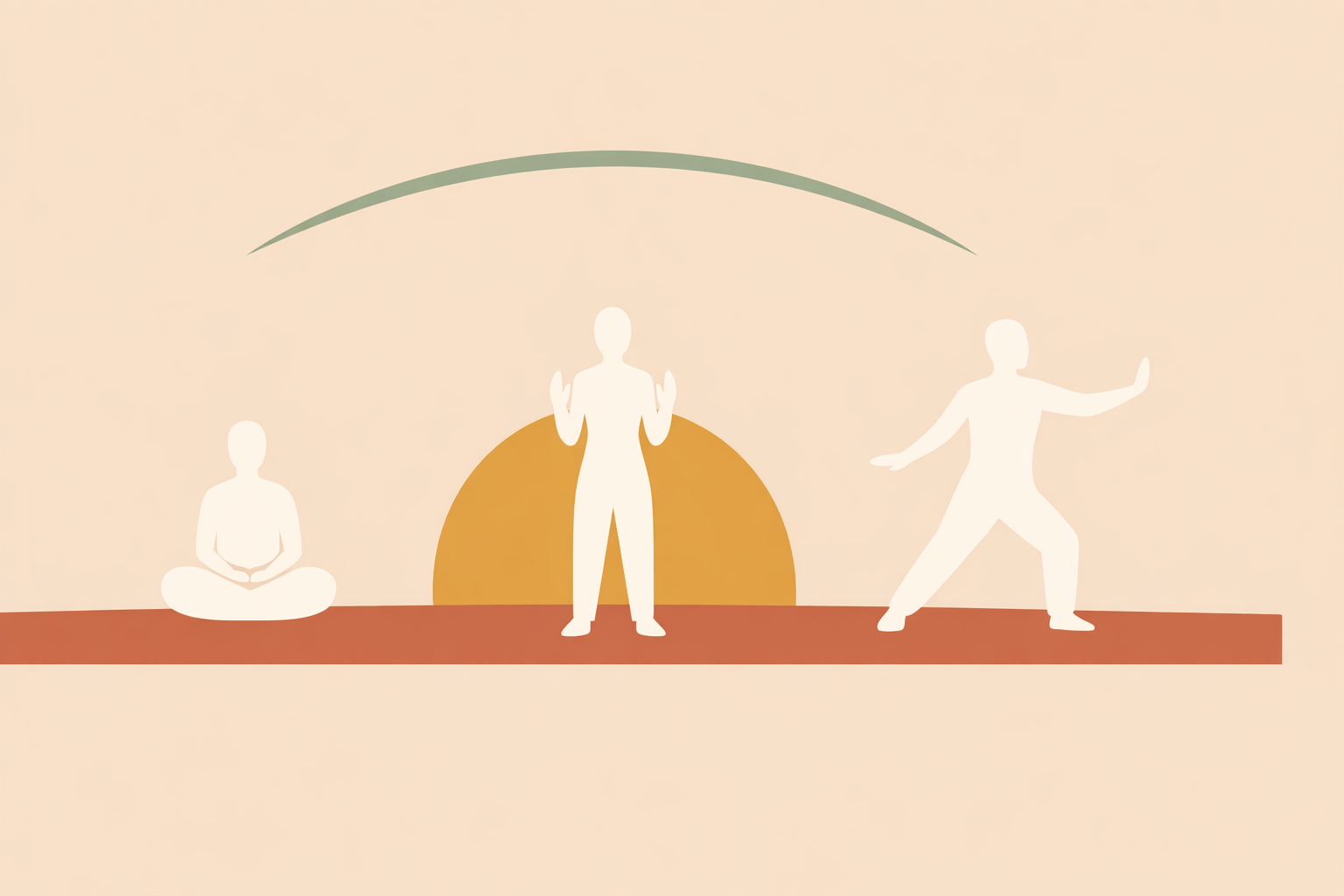
A vitality micro-set is a brief, repeatable sequence that fits into ordinary life. It might last two minutes or ten, but it follows a clear arc so the person feels guided from start to finish.
A simple structure looks like this:
- Arrival: Notice the room. Let the eyes and jaw soften.
- Grounding: Find a comfortable seat or stance.
- Mobilizing: Add one or two gentle movements such as shoulder rolls or hand opening.
- Breath-led movement: Pair a simple motion with easy breathing.
- Integration: Pause and notice warmth, space, steadiness, or alertness.
- Close: Name how you feel and return to the day.
This arc helps the practice feel complete even when it’s brief. A closing moment is often where the change becomes noticeable and usable.
Most formal research looks at longer qigong programs, so the best “dose” for micro-sets comes largely from experienced teaching: start small, keep it regular, and build only when it continues to feel supportive.
That realism makes micro-sets stick. Many people will practice three minutes consistently, while a longer routine becomes an idea they admire but rarely use.
Two simple qigong micro-set scripts
Clear, permissive language works best. The aim is not performance; it is contact, steadiness, and ease.
Gather and release
- Notice your feet on the floor or your body on the chair.
- Let the jaw soften.
- As you inhale, let the hands float out or up to shoulder height.
- As you exhale, let the hands come back down.
- Repeat slowly for 3 to 6 rounds.
- Pause and notice your breath, your hands, and the quality of your attention.
- Choose one word for how you feel now.
Desk transition reset
- Step back from the screen if possible.
- Let the arms hang and unclench the hands.
- Roll the shoulders forward and back a few times.
- Turn the head gently right and left within a comfortable range.
- Shift your weight side to side or press the feet softly into the floor.
- Take 3 unforced breaths.
- Look toward a distant point and let the eyes widen a little.
You can also invite a quick before-and-after check, such as groundedness, alertness, or ease on a 1-to-5 scale. Many people report feeling calmer or clearer within minutes, and some research suggests immediate relief can occur in certain contexts.
Keep the effort level low. “Let’s stay at about 3 out of 10” is often enough to prevent the reset from becoming another kind of strain.
Adapting micro-sets for different bodies and nervous systems
Accessibility is part of good practice. A useful micro-set reduces pressure, and it welcomes different bodies, energy levels, and preferences.
Seated versions are fully valid. Gentle hand movements, shoulder circles, soft spinal lengthening, and relaxed breathing translate easily to a chair. Qigong can be practiced in different positions, including seated ones, so adaptation is built in.
For limited mobility, reduce range, use support from a chair or wall, and remove any balance demand that feels unnecessary. Comfort matters more than form.
For trauma-sensitive delivery, keep choice visible. Some people do better with eyes open, an external focus, or a looser relationship to breathing. Invitation works better than insistence.
Useful phrases include:
- “Keep your eyes open if that feels better.”
- “You can make the movement smaller.”
- “If anything feels too much, pause or skip it.”
General safety summaries describe qigong as generally safe when practiced appropriately, and good teaching still depends on pacing, consent, and adaptation. If someone feels faint, sharply uncomfortable, unusually breathless, or unsettled in a way that does not pass quickly, stop and reorient.
For pregnancy, modify conservatively. National guidance notes limited research and advises consultation with qualified health professionals, with stronger demands avoided through thoughtful movement modification.
Helping micro-sets become part of daily life
The most effective micro-set is usually the one that’s easy to remember and easy to repeat.
Rather than relying on motivation, place the practice next to an existing rhythm:
- after logging in
- before lunch
- after a meeting
- before closing the laptop
- during the evening transition out of work mode
This is where qigong works beautifully in coaching and in broader traditional and eastern medicine practice. The practice doesn’t need special conditions; it needs a reliable place in the day.
Tracking can stay simple. A client might note:
- time of day
- which micro-set they used
- a quick before-and-after rating
- one word about mood or comfort
Over time, these notes reveal personal patterns. One reset may work best after mental overload, while another supports evening settling. With steadier practice, qigong has also been associated with better sleep quality.
The deeper aim is agency. Clients learn they have a workable way to meet the moment they are actually in.
Closing thoughts on qigong vitality micro-sets
Well-timed qigong micro-sets are simple, but their value adds up quickly. They give people a practical way to pause, gather themselves, and move forward with more steadiness.
For practitioners, micro-sets are a clean bridge between traditional wisdom and modern life. The language of Qi, Yin-Yang, rhythm, and balance makes everyday fluctuations easier to understand without turning them into labels.
Start small, adapt generously, and close each sequence with enough space to notice what changed. Keep expectations kind, and encourage clients to stop or adjust if anything feels off. Consistency matters more than intensity.
Deepen TCM Foundations
Connect qigong micro-sets to core TCM principles in Traditional Chinese Medicine Foundations.
Explore TCM Foundations →