Many practitioners treat brain development as something that matters in childhood, then reuse the same coaching tools for everyone else. Real life quickly proves otherwise: a routine that settles a second-grader can irritate a teenager, and a script that motivates a 28-year-old may land poorly with a 72-year-old. Lifespan coaching works best when development is seen as ongoing, plasticity is understood as changing shape with age, and support is built from repeated, meaningful, culturally grounded experience.
Key Takeaway: Effective lifespan coaching starts with a dynamic, culturally grounded view of development and then fits tools to how plasticity shows up at each age. Children tend to benefit from structure, play, rhythm, and multisensory cues; adolescents from prediction practice, identity-based habits, and emotion-aware planning; young and midlife adults from role-specific systems and focused repetition; and later life from clear cues, external supports, repetition, and community enrichment. Across every stage, the common thread is the same: design routines and environments the brain can learn from daily.
Coaching children with structure, play, and multisensory ritual
Childhood is a powerful time for learning because early development includes connection overproduction followed by refinement. Practically, many children learn best through rhythm, imitation, repetition, and play.
There are also sensitive windows in the early years for capacities such as language, music, and sensory skills. Later learning remains possible, yet early experiences often leave a strong imprint when they are predictable, engaging, and emotionally safe.
That’s why environments that feel secure and organized can be so supportive. Emotionally secure settings with clear routines, warm connection, and varied activity tend to support learning better than constant novelty or heavy explanation.
In coaching, this often means leading with experience first and words second. Multisensory, emotionally engaging activities can support learning and self-regulation, especially when rhythm, movement, and story work together.
Imagine a circle: a soft beat, a short story, a repeated phrase, and a simple movement pattern. The sequence matters because the body can anticipate it and the mind can follow it.
- Use short transition rituals with the same order each time.
- Give one-step cues before multi-step instructions.
- Pair learning with rhythm, gesture, images, and story.
- Draw on culturally familiar songs, greetings, and sensory anchors where appropriate.
A practical example: before a focused task, begin with a two-sentence story, one repeated phrase, and a small movement like two shoulder rolls. Keep it consistent for a week or two so the pattern becomes familiar and settling becomes easier.
Coaching adolescents through prediction, identity, and emotional learning
Adolescents are sometimes approached as if they should be fully independent or constantly corrected. This stage tends to respond best to guided practice that respects growing capacity while keeping support close at hand.
By early adolescence, predictive processing is already strong, with prediction abilities near adult-like by around age 12. Sustained attention can still show substantial improvement from ages 10 to 16, and control systems keep developing through adolescence.
Teens can often foresee outcomes vividly, and many still benefit from help turning foresight into consistent action. Rehearsal works well: invite them to pre-live a difficult moment by naming what they expect, what they might feel, and what they will do first.
This is also an excellent stage for building future-oriented habits. Prospective memory tends to strengthen into late adolescence and young adulthood, which supports planning routines and reliable cues.
- Use identity statements: “I am someone who prepares before pressure.”
- Practice if–then plans tied to real situations.
- Rehearse the first 30 to 60 seconds of a challenge, not just the outcome.
- Help teens name bodily signals so emotion becomes workable rather than overwhelming.
A useful session sequence is: identify an upcoming challenge, imagine the moment just before it begins, name the likely emotional cue, and choose one first action. Over time, that loop trains anticipation, emotional awareness, and follow-through together, drawing on principles that also matter in emotion-aware coaching.
Coaching young adults and midlife with focused, role-specific systems
In young adulthood and midlife, many capacities are near their peak. Cognitive performance in areas such as attention and working memory is often strong, yet life becomes crowded with competing roles and constant switching.
So the challenge is often friction, not ability. When demands multiply, follow-through usually improves more from better design than from more motivation.
Adults retain plasticity, though it often becomes more selective. Reviews describe adult plasticity as continuing in a more constrained form, and cognitive training tends to show task-specific effects more than broad transfer. Coaching tends to work best when supports match the person’s real roles and repeated environments.
That’s where role-specific design shines: build supports around meetings, school pickup, late-night admin, creative work, or the transition from home mode to work mode, a practical focus within neuroscience and brain health.
- Map the three contexts where follow-through most often breaks down.
- Create one visible cue or ritual for each context.
- Reduce goals to a few priorities per week.
- Define the first minute of action so starting becomes easier.
A practical example for a busy professional: before deep work, close messaging apps, use a familiar scent, write one sentence about why the task matters, and set a timer. Small repeated starts often become reliable entry points into focus.
This stage also supports long-range resilience. Ongoing novelty, complex learning, and mentally engaging activity are linked to delayed decline later in life, so it’s wise to build habits now that will keep paying dividends.
Coaching later life with clear supports, repetition, and dignity
Later life still includes adaptation, and it often rewards thoughtful design. Plasticity remains present, and coaching tends to work best when cues are clear, repetition is kind, and autonomy stays central.
Typical age-related shifts can affect memory, learning, and control, even while the capacity for change remains. External supports and practical scaffolding often help more than pressure or complexity.
Future-oriented remembering is a clear example. Older adults often do better when cues are clear and plans are concrete, and implementation intentions can provide a steady scaffold for follow-through.
“If it is 6:50 pm, then I open the storybook” gives a cue and an action. “I should remember to read later” leaves too much undefined.
Everyday tools can help when they’re kept simple. Calendars, alarms, and visual prompts can support daily follow-through when used consistently.
- Use larger, clearer visual cues.
- Keep plans short and concrete.
- Repeat important routines in the same form.
- Build around meaningful relationships and daily rhythms.
Training gains in later life are often domain-specific, so set goals that are practical and personally meaningful. If the goal is remembering calls with grandchildren, build the structure around that specific routine.
Community strengthens follow-through too. Group activities such as walking circles, song circles, or book circles can support mood and attention, which helps people stay engaged in learning and daily rhythms.
The deeper principle is dignity. Later-life support should honor wisdom and make participation easier and more enjoyable, without framing the person as a problem to be managed.
The throughline across the lifespan
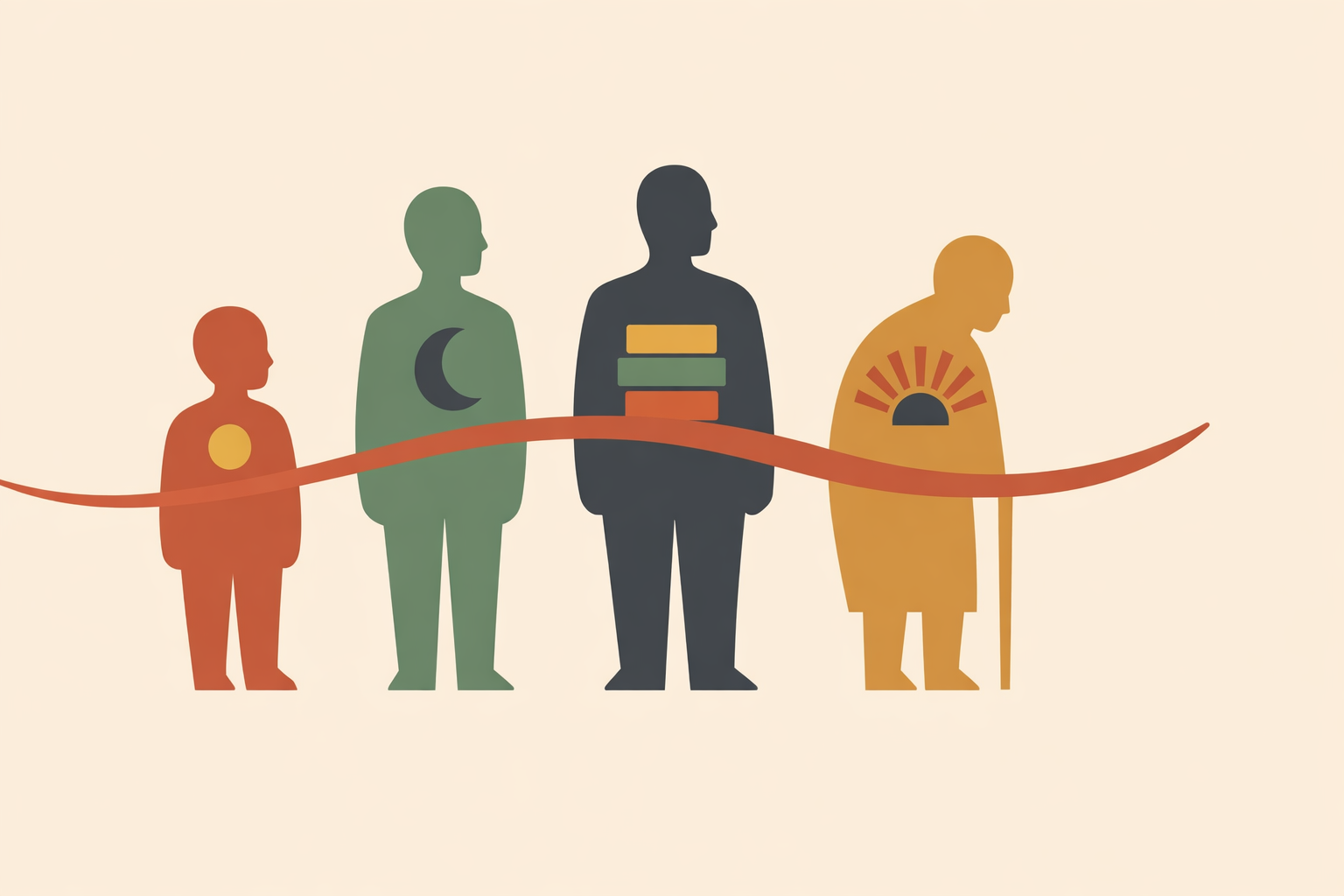
Across every age, the same principle returns: the brain reshapes itself through repeated experience. What people practice often, feel deeply, and connect with meaning tends to become easier over time.
Strong coaching goes beyond advice and builds real-world conditions people can live inside. With children, that often means rhythm and play. With adolescents, rehearsal, identity, and emotional skill. With adults, role-specific systems. With older adults, clear supports, repetition, and community.
Traditional knowledge adds practical power when used respectfully. It carries rhythms and forms of belonging that help people remember what matters and return to it, day after day.
A reliable stance is to observe the season of life, respect the person in front of you, and shape conditions for steady growth. Capacity can evolve at five, fifteen, forty-five, and eighty-five, and good coaching meets that truth with structure and care. In the conclusion of any plan, include sensible safety boundaries: keep practices culturally respectful, stay within coaching scope, and coordinate with appropriate licensed support when someone needs help beyond well-being coaching, including when deeper study in cognitive neuroscience would help clarify mechanisms.
Explore Cognitive Neuroscience Certification
Connect lifespan coaching strategies to brain mechanisms with the Cognitive Neuroscience Certification.
Explore Cognitive Neuroscience →