Natural builders often work with a short weather window, a modest crew, and a shifting forecast. In that reality, “fast” means reaching a stable, roof-ready shell, not just stacking material quickly.
Key Takeaway: With earthen walls, speed is mostly about drying and stability, not wall height. Cob can rise quickly by hand, but it keeps drying in place, which can delay the roof stage. Adobe shifts more of that waiting earlier, because bricks are dried before wall assembly. When the goal is to get covered within a tight weather window, adobe often has the edge. Climate, crew size, and sequencing still decide the outcome, and hybrids can offer a strong middle path.
What “fast” means in cob vs adobe building
If your priority is a dried-in shell, the key question is simple: are you gaining height, or are you gaining dryness?
A roof protects earthen work from rain, rewetting, and surface erosion. So the most useful comparison is how soon the wall system becomes stable enough to carry the next stage of work.
With cob, the building day can feel immediate, but the wall stays wet as it rises. UN-Habitat notes that full cob walls may need 6–9 weeks to dry fully, so the real bottleneck often becomes moisture leaving the wall rather than mixing or shaping.
A cob review also flags drying times as a major scheduling constraint. Traditional practice recognizes the same truth: cob rewards steady rhythm and good timing.
Adobe follows a different sequence. Bricks are dried before they become part of the wall, so once materials are ready, wall-raising usually moves faster and tends to reach the roof stage sooner because less moisture remains in the system.
- Walls up: Adobe often has the advantage because units arrive dry.
- Roof-ready shell: Adobe often stays ahead for the same reason.
- Overall project finish: This depends on much more than the wall system.
Cob and adobe follow different workflows
The speed difference starts with sequence.
Cob is monolithic and sculptural. You mix, carry, place, and shape in one continuous process. It asks for very little equipment or staging space, which is exactly why many small teams love it.
It also asks for respect between lifts. Builders commonly pause to prevent slump, and guidance from the Natural Building Alliance points to a familiar rule of thumb of about a foot of wall height per day in dry weather.
Adobe relocates much of the waiting to the yard. Bricks are formed, dried, turned, stored, then brought to the wall line. Once wall work begins, the process is modular: lay units, keep courses true, and progress in a repeatable rhythm.
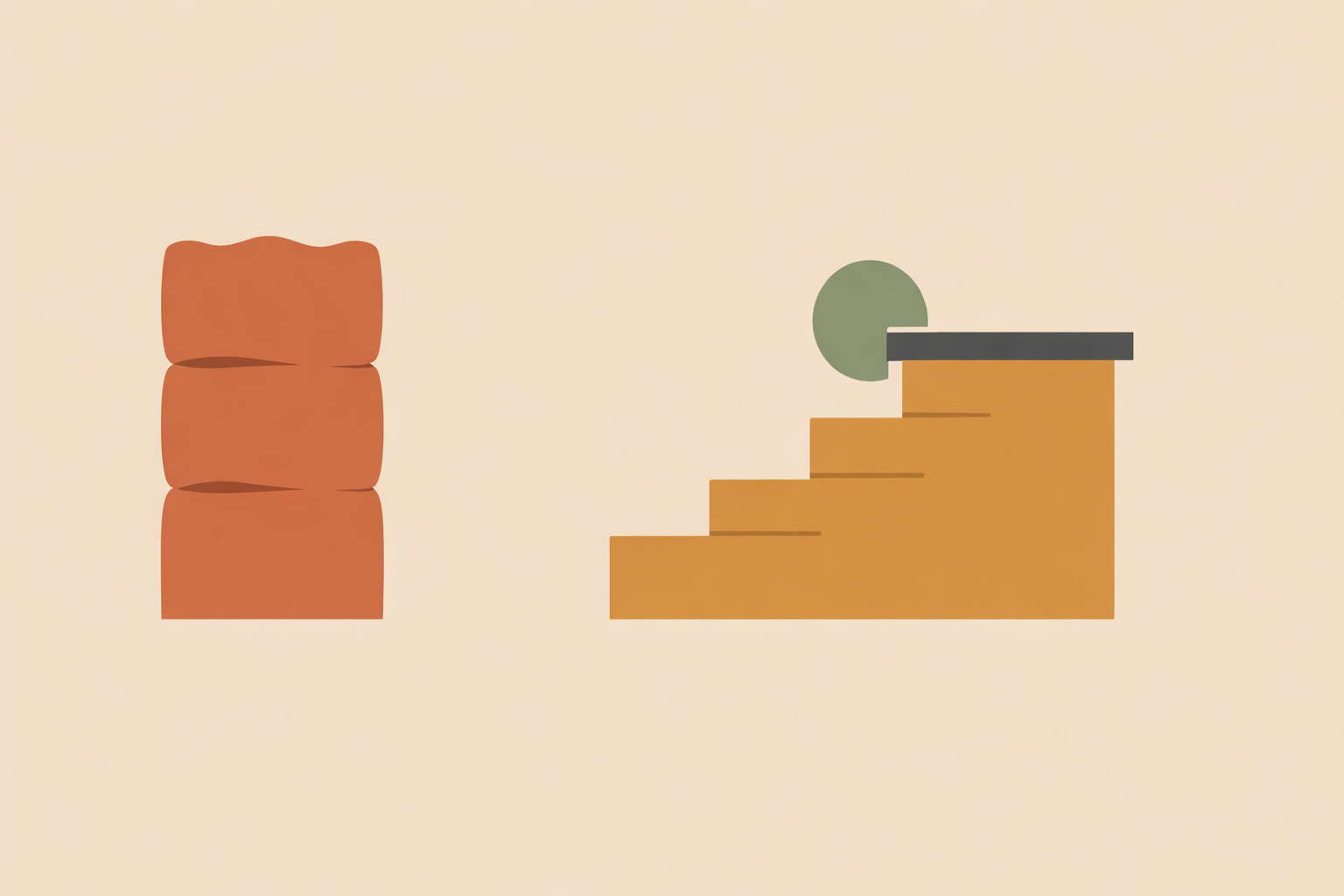
For scheduling, this is the heart of it: cob dries in place, while adobe does much of its drying before the wall exists.
Cob build rates: quick progress, slower readiness
When weather and crew energy are on your side, cob can show strong daily progress. Many builders still work around the practical expectation of roughly one foot of wall height per day on small footprints in good summer conditions.
That pace, though, is not the same as roof readiness.
UN-Habitat describes cob as slow to build compared with lighter or more modular approaches, largely because substantial lifts need time to release moisture. On site, that often looks like steady wall-making paired with a calendar that’s quietly governed by drying.
Conditions decide how fast lifts firm up. A cob construction review notes drying changes depending on the weather, which is why the same crew can feel speedy in one climate and delayed in another.
In cool, humid settings, thick cob walls typically need prolonged drying before they’re ready for the next load-bearing stage.
- Plan lift height around weather, not optimism.
- Expect drying to govern the schedule.
- Use shelter, airflow, and sequencing to keep progress steady.
Why adobe often reaches the roof sooner
Adobe’s practical advantage is straightforward: walls rise from pre-dried units rather than from a continuously wet mass.
So even when overall effort is similar, adobe often reaches a roof sooner because more waiting happens before wall week begins. For a dried-in shell, it also typically has less moisture left to lose after stacking.
This is especially helpful when the season is closing in. When less drying sits on the critical path, roof timing becomes easier to plan with confidence.
Adobe is only as fast as its brick yard, though. If you can’t reliably form and dry good bricks ahead of time, the usual advantage fades quickly.
- Adobe shifts waiting earlier, into brick making and drying.
- Wall assembly is often easier to pace and organize.
- Roof timing is usually more predictable once bricks are ready.
Climate decides more than theory does
Site conditions can outweigh any abstract comparison.
In hot, arid, windy places, earthen materials dry readily. A field comparison describing Arizona versus wetter mountain conditions highlights how hot, arid weather can speed drying dramatically, while rainy environments can stretch the process over many months. This is why adobe can feel exceptionally efficient in sun-rich climates.
On damp coasts or in monsoon patterns, adobe’s edge can shrink or disappear if bricks can’t dry reliably in the yard. In those places, many practitioners value cob’s adaptability and its ability to keep moving in a more sheltered, incremental way.
Cob still responds strongly to weather. The same cob review literature emphasizes that drying varies with conditions, so planning that matches the season matters as much as good technique.
Let local humidity, airflow, warmth, and forecast guide the method. Earthen building rewards listening to place, and self-sufficiency and sustainability work best when methods match local conditions.
Crew size, scale, and when hybrids make sense
Material choice is also a crew choice.
For a solo builder or a pair, cob can be simpler to organize. There’s no separate brick yard, no stacks to manage, and less repeated handling of units.
For larger teams and community builds, adobe often scales smoothly because the tasks are modular and repeatable. It’s easier to divide labor between production, transport, and laying.
When time is tight, hybrids can be the most pragmatic approach. Straight wall runs can be handled in adobe, while cob is saved for curves, niches, transitions, and built-ins where sculptural freedom matters most.
- Small team: Cob may be easier to manage day to day.
- Larger crew: Adobe often organizes better at scale.
- Deadline build: A cob-adobe hybrid can be a balanced option.
Which one is faster?
If your main goal is the quickest path to a stable, roof-ready shell, adobe usually comes out ahead.
The reason is sequencing: drying happens before assembly rather than after. When the weather window is narrow, that shift can decide the whole build.
Cob still earns its place. It offers a direct, low-tech workflow, sculptural freedom, and a strong continuity between material and hand. For small builds, sheltered builds, or projects where form matters as much as schedule, it can be the better fit.
Match the method to your site, season, crew, and tolerance for waiting. If the roof date is the priority, lean toward adobe or a hybrid. If you can plan around drying and want a more monolithic building rhythm, cob remains deeply rewarding, especially within broader sustainable building goals.
In earthen building, speed comes down to moisture, sequence, and timing. A sensible plan protects the material so it can do its best work, and a natural building course can help you apply that sequencing on site.
Build Faster, Build Smarter
Apply these cob-vs-adobe timing insights in the Natural Building Course for better sequencing and drying control.
Explore Natural Building Course →