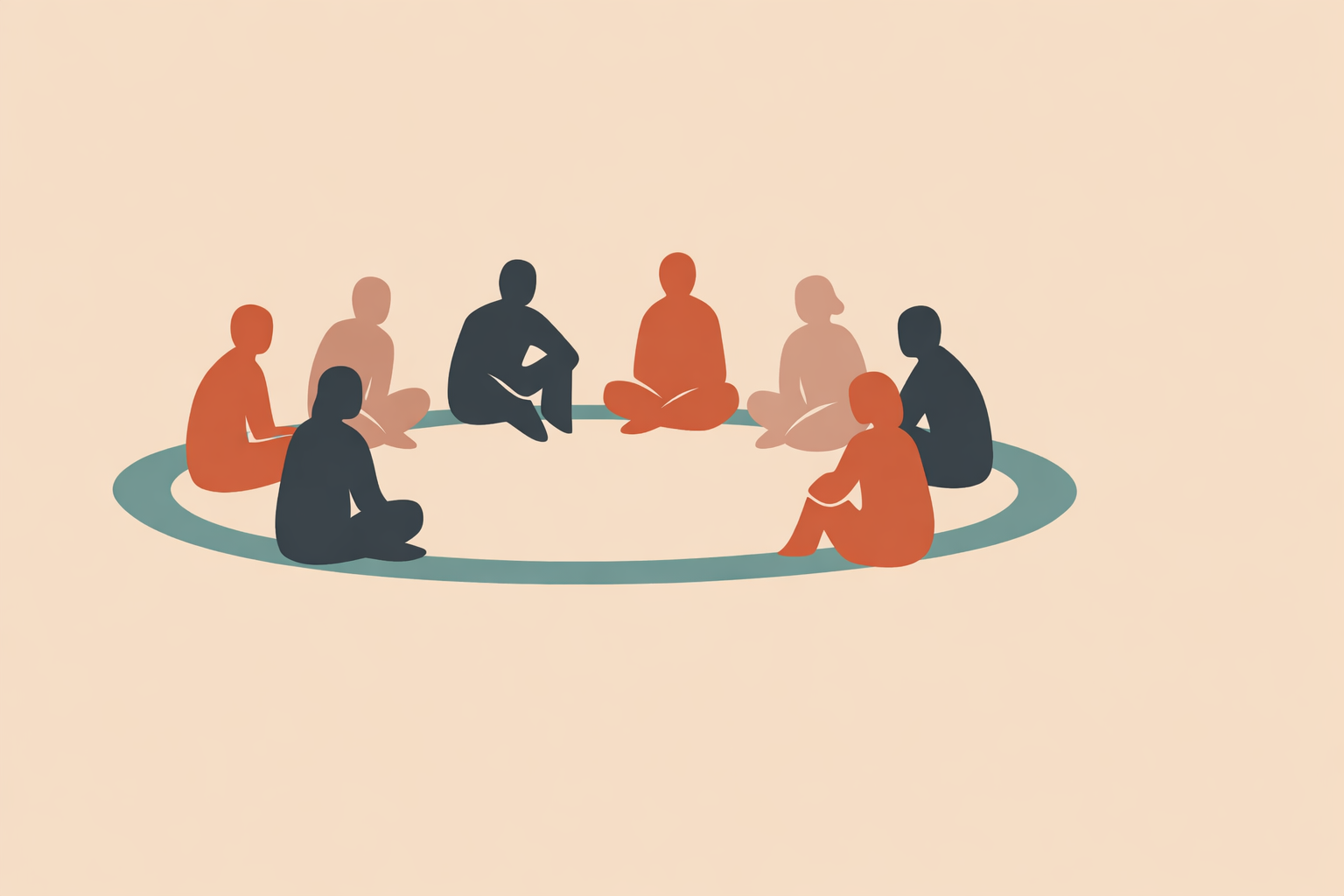
The promise of group entrainment is easy to understand. A room of people breathing, listening, and settling together can start to feel coherent very quickly, and that shared rhythm is real and often valuable.
Where facilitators need more care is the explanation around it. In group sound work, it is more accurate to speak about pacing, atmosphere, and individual response than to promise that everyone in the room will shift into the same brainwave state.
Key Takeaway: Group brainwave pacing can support relaxation and focus, but uniform EEG synchronization in a shared room is unlikely. The strongest group offering is not a claim of identical internal states. It is a well-held session with honest language, thoughtful acoustics, and enough choice for each participant to work with sound in their own way.
Why Group Brainwave Entrainment Appeals to So Many People
Group sound has long helped people move, breathe, and feel together. Across traditional communal practices such as drumming, chanting, and call-and-response, shared rhythm can strengthen synchrony, bonding, and a sense of belonging.
That’s why brainwave pacing feels like such a natural modern extension. It offers a bridge between ancestral sound traditions and contemporary language about calm, focus, and inner state, without needing to flatten the mystery of what people actually feel.
Groups also make practice easier to return to. The timing is set, the atmosphere is already held, and the shared container helps many people stay with the experience longer than they would alone. That value stands on its own.
A clear frame helps: the session uses rhythm and sound to invite steadier pacing, and people will respond differently. That keeps the invitation both compelling and honest.
What Brainwave Entrainment Actually Means
In this context, entrainment refers to the idea that rhythmic external input, such as pulsed sound, may influence rhythmic activity in the brain. It is a meaningful concept, but it does not operate like a single switch that flips the same way for everyone.
Binaural beats are a good example. When an 8 Hz binaural beat is created by playing slightly different tones to each ear, the beat is perceived rather than physically present in the room. Because of that, delivery matters: distinct left and right signals need to reach the ears clearly.
It also helps to keep a few commonly blended ideas separate:
- Physical vibration, such as what the body feels from a drum or gong
- Audible pitch, or the tone we consciously hear
- Beat frequency, whether heard acoustically or perceived by the auditory system
- EEG labels such as delta, theta, alpha, beta, and gamma
Those EEG labels are broad ranges, not fixed emotional states. So it’s more accurate to say a session can invite conditions people associate with rest or focus than to claim that one frequency always produces one specific inner result.
Different pacing tools also behave differently. Binaural beats, monaural beats, and isochronic tones are distinct approaches, so good facilitation starts with being clear about which one is actually in use.
What the Evidence Supports, and What It Does Not
The current research picture is mixed. Some findings point toward useful effects for certain outcomes, while others don’t show the same consistency. Practically, this calls for proportionate language, not a retreat from the work.
On the specific question of measurable EEG alignment, the literature remains inconclusive. That makes it hard to claim that binaural stimulation reliably produces the same brainwave shift across different listeners.
This matters in groups because visible synchrony is not the same as identical internal activity. People may breathe together, soften together, or move together, but behavioral synchrony does not, by itself, demonstrate synchronized brain activity.
At the level of experience, there is still plenty to work with. Reviews describe possible improvements in stress-related outcomes, focus, rest, and other short-term shifts, while also noting the overall picture is equivocal. There is no clear optimal protocol that broadly applies across frequencies, durations, and participants.
In real-world group settings, the implication is straightforward: paced sound is one supportive layer among others. Breath, voice, silence, repetition, expectation, and the social field all shape what people take from the session.
Why Group Sound Still Works Without Uniform Brainwave Claims
Effective group sound doesn’t depend on proving that everyone reached the same internal rhythm. A facilitator can hold a session that feels grounding, connective, and clarifying even when each participant’s nervous system responds in its own way.
Traditional communal sound practices have always understood this through lived experience: rhythm creates connection, meaning, and belonging. In modern rooms, the same pattern often shows up in a simple arc—people arrive scattered and leave feeling steadier or more aware.
This is usually the most trustworthy way to talk about it. Rather than saying, “This room will put everyone into alpha,” it’s more grounded to say, “This session uses steady sound and rhythm to support rest, focus, and inner listening, and each person may respond differently.”
One Room Never Sounds the Same to Everyone
Acoustically, a shared room is never uniform. Position, reflections, furnishings, instrument placement, and the presence of bodies all change the sound field, so what feels gentle in one seat can feel intense in another.
This is especially important with binaural beats. Because they depend on distinct left and right signals, headphones are the most accurate delivery method. In an open room, channels mix, so it’s wiser to describe speaker playback as a pacing element rather than a precise binaural experience for everyone present.
Even without beat-based audio, the room shapes perception. Low frequencies from drums or gongs can feel physically strong for some participants, and reflective spaces can make repetitive sounds feel sharper than intended.
A quick acoustic check before people arrive prevents many issues:
- Listen from several seating areas, not just the facilitator position.
- Notice where bass gathers or high tones become harsh.
- Mark quieter and stronger zones so people can choose consciously.
- Keep enough headroom in the sound that people can remain oriented and at ease.
One honest sentence does a lot of work: sound lands differently across the room, so participants are welcome to move if another place feels better.
Different Participants, Different Responses
No two listeners enter a session with the same history, sensory profile, or expectations. One person softens quickly into stillness; another feels restless, overstimulated, or simply neutral. In sound work, variation is normal.
Hearing differences, tinnitus, sound sensitivity, migraines, headphone comfort, and prior experiences with repetitive audio all shape how a session is received. Some people find repetition deeply soothing; others find the same pattern irritating or fatiguing. Strong facilitation makes space for both, without framing discomfort as failure.
Research on adverse effects remains limited, and reviews note that little is known about harms. In practice, that supports a choice-led approach: options, flexibility, and an easy “you’re welcome to adjust” culture.
There is also a broader population reality. Much of the literature leans younger, while real groups include older adults, highly sensitive participants, neurodivergent people, and those arriving after long, overstimulating days. Design for range, not a single “ideal” response.
How to Design Honest and Effective Group Sessions
The most dependable group sessions do three things well: they set accurate expectations, offer meaningful choices, and keep the pacing coherent.
Start with plain, supportive language. A short opening is enough: the session includes rhythmic sound that some people find calming or focusing; responses vary; participants are welcome to adjust at any time.
Then build an arc people can follow:
- Arrival: orient the room, slow the pace, and name the options.
- Gradual settling: introduce rhythm or tonal repetition gently.
- Centering phase: sustain the main soundscape without constant surprise.
- Return: reduce intensity, reorient attention outward, and leave time to transition.
If you use a paced element, treat it as an underlayer rather than the whole event. Bowls, voice, humming, soft percussion, and silence often carry group process just as effectively as a highly branded beat track, and many practitioners build this kind of work through energy healing study.
Choice is equally important. Helpful options include:
- Earplugs available at the entrance
- Seating choices near or far from stronger instruments
- Sitting, lying down, or leaning against a wall
- Permission to step out and return without explanation
- Optional headphone use when appropriate to the format
For tracking outcomes, subjective measures are often the most useful. A brief before-and-after calm rating, a note on focus or restfulness, or a short follow-up can tell you more about how sessions land than grand claims about what “should” have happened.
Session notes sharpen craft over time. “Most participants reported feeling steadier; several preferred less low-frequency intensity” is practical, honest, and immediately useful for refining future sessions.
Consent, Screening, and Scope
A brief intake makes group sound work more considerate. Asking about sound sensitivity, tinnitus, migraines, hearing aids, panic history, or simple preferences around volume and distance helps participants prepare and helps facilitators shape the room responsibly.
This doesn’t need to be heavy or clinical. It can be as simple as asking whether there is anything about sound, repetition, headphones, or volume that would help the person feel more comfortable and supported.
Consent isn’t a single announcement at the start. It’s reinforced through steady pacing, predictability, visible options, and a facilitation style that never pressures people to have a particular kind of experience. When adjustment is truly welcome, the group field becomes more trustworthy, which also matters in broader sound therapy practice.
A Grounded Way to Speak About Group Brainwave Pacing
The strongest position is both modest and confident. Group sound can offer a held atmosphere, shared rhythm, and genuine opportunities for rest, focus, reflection, and connection. Some participants notice clear shifts; others appreciate the steadiness of a well-supported space.
What the work does not need is overstatement. Claims of room-wide, uniform EEG synchronization go further than the evidence supports and further than most skillful facilitation requires. The deeper value is often simpler: sound gives people a structure through which to settle, listen inward, and feel part of something shared.
When traditional communal sound wisdom is paired with careful language and evidence-informed design, group brainwave pacing becomes more credible, not less. It stays evocative and practical while respecting individual difference, and that is the foundation for groups people want to return to.
Sound Therapy Certification Next
Apply honest pacing principles in real sessions with the Sound Therapy Certification.
Explore Sound Therapy Certification →