You’re mid-review and a client asks you to “apply the golden ratio” because they’ve heard it guarantees harmony. A student overlays a spiral on a shell and wants you to confirm that nature proves the point. In a group setting, someone arrives expecting a geometric exercise to deliver a breakthrough. The pressure is familiar: sound credible, stay respectful, and avoid promises you can’t stand behind.
Key Takeaway: The most grounded way to work with the golden ratio is to treat φ as a compositional tool for exploration, not as a guarantee. Clear practice means defining terms plainly, testing layouts rather than idealizing them, separating observation from interpretation, and speaking carefully about nature, history, symbolism, and expectations.
Why Precise Golden Ratio Language Builds Trust
Trust grows when your words match what people can actually see and verify. With the golden ratio, that means clearly separating what is measured, what is interpreted, and what is a familiar cultural story.
The strongest claim is also the most useful in practice: φ is a useful armature for exploration, not a guarantee of outcomes. In day-to-day design work, it works best as a guide you can test alongside other structures.
This framing keeps sacred-geometry work respectful. It lets you honor symbolism and tradition without turning them into proof, and it keeps the room relaxed because no one has to “believe” anything to participate.
A simple client script can sound like this: “I’m happy to test a φ-based layout alongside two alternatives. We’ll compare readability and audience response, then choose the version that best serves the message.”
If someone says, “I’ve heard the golden ratio always makes designs beautiful,” a steadier answer is: “It’s a widely used proportion, and we can explore it here, but I won’t frame it as a promise.”
Script 1: Defining the Golden Ratio Without Hype
A plain definition usually serves people better than a mythic one.
You might say: “The golden ratio is a proportion called φ, about 1.618. If a line is divided so the whole relates to the larger part the same way the larger part relates to the smaller, that relationship is the golden ratio.”
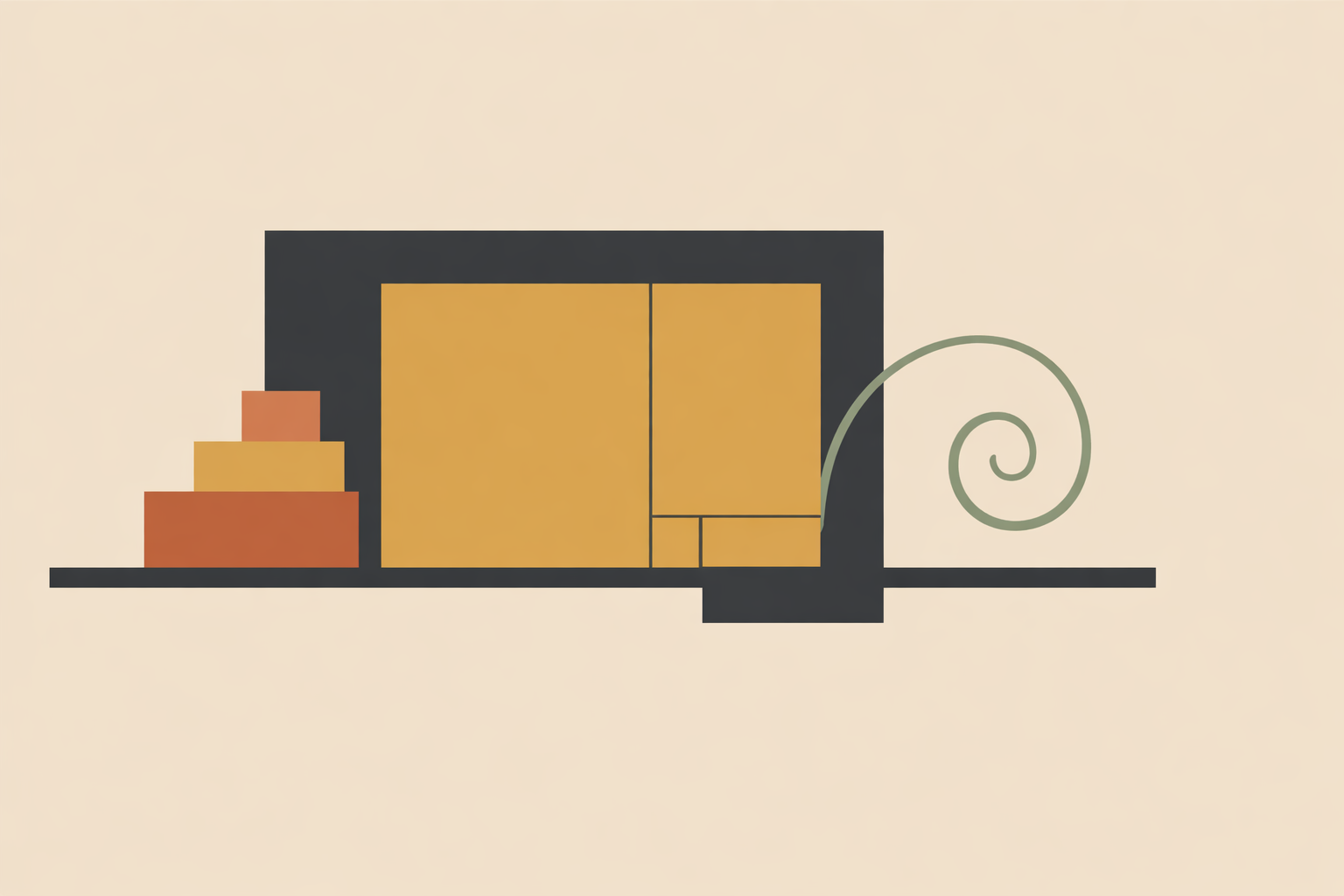
Then add the practical version: “A golden rectangle uses a 1:φ relationship. If you remove a square from it, the remaining shape repeats the same proportion.”
It helps to clarify the spiral too. Many people use “golden spiral” loosely, but not every spiral found in nature is golden. In practice, the spiral shown in design teaching is a construction tool built from nested rectangles and quarter-arcs, and keeping golden and Fibonacci spirals distinct helps avoid confusion.
You can place Fibonacci in the same clear lane: “Fibonacci numbers often appear beside the golden ratio because neighboring ratios move closer to φ over time.”
For a workshop or slide deck, a concrete example makes this easier to feel: “If my artboard width is 1080 px, a φ-based height is roughly 667 px.” Then place it beside a different proportion and invite the group to notice what shifts in balance, spacing, or emphasis.
To keep the ethical frame visible, close with one line: “In this project, I’m using φ as a compositional option, not as a universal law of beauty.”
Script 2: Framing Golden-Ratio Layouts as Experiments
The most reliable way to present a golden-ratio layout is as a test you can compare, not a formula that must be right.
One helpful structure is to separate three levels of language:
- Design fact: “This panel’s width-to-height ratio is about 1.618:1.”
- Interpretation: “Some viewers may experience this as spacious or orderly.”
- Overclaim to avoid: “This ratio automatically creates harmony for everyone.”
Then the process stays straightforward. Create three versions of the same piece: one on a φ grid, one on another armature, and one shaped mainly by content hierarchy or accessibility needs. Compare legibility, emphasis, and feedback.
This also makes collaboration easier. Instead of debating the ratio itself, you’re comparing outcomes, which usually leads to calmer conversations and better choices.
A useful proposal sentence is: “This grid is an organizing tool we’ll test, not a hidden law inside the image.”
For facilitation: “For this homepage hero, I’ll prepare three options: a φ-based layout, an alternative grid, and a task-led version. We’ll review which one feels clearest and most supportive of the message.”
Script 3: Speaking About Nature, Bodies, and Spirals Carefully
Nature is often where golden-ratio conversations get stretched into certainty. A shell, sunflower, or body chart can quickly be presented as “proof” when it may only be resemblance.
A more grounded approach is to say: “Nature uses many proportional strategies. The golden ratio is one lens among several.”
In practice, spiral overlays work best as visual analogies rather than demonstrations. A shell may resemble a golden spiral without having grown according to φ in an exact way. Plant patterns can also be rich with repeating forms and number relationships without every specimen resolving into a single ratio.
Body diagrams deserve the same care. Ratios shift with posture, landmark choices, and individual variation. That can make them meaningful for reflection and pattern-study, but they’re weak foundations for sweeping claims about “the” human form.
A precise script sounds like this: “When I show a spiral overlay, I’m offering one way to look at pattern. It doesn’t prove that the form was generated by φ.”
If you want to bring this into practice, lead with observation rather than conclusion. Count spiral directions in a sunflower head, sketch branching in a leaf, or compare several shells side by side. Let the exercise train attention.
Structured visual practices can support attention or reflection for some people. Often the benefit comes from the quality of looking: slowing down, noticing proportion, and engaging form with care.
Script 4: Handling Parthenon, Leonardo, and “Ancient Secret” Stories
Historical claims around the golden ratio are often repeated more confidently than they’re documented.
The clearest way to handle this is to distinguish between modern overlays and recorded intent. A building or artwork can be analyzed through φ today without that proving the maker designed it that way.
That distinction is especially useful when discussing the Parthenon, Leonardo, or other frequently cited examples. Rather than repeating inherited stories, stay with language like: “This is a modern proportional reading” or “Documented intent here is uncertain.”
This does not flatten tradition or ancestral craft. It keeps attribution honest, which is part of respectful practice. Cultures and lineages deserve accuracy, not mythology used as a shortcut to authority.
You can still acknowledge that proportional systems have long mattered across design lineages, and that later designers have consciously worked with φ. Name documented use where it exists, and present the rest as interpretation.
A strong lecture script is: “Resemblance is not proof of intention. I’ll name φ where documentation supports it, and where it does not, I’ll describe the overlay as a modern reading.”
A reusable image caption can be just as clear: “Overlay shown for comparison; proportions illustrated are interpretive, not documented design instructions.”
Script 5: Teaching Symbolism With Two-Language Communication
One of the most useful habits in sacred-geometry teaching is to hold measurable form and symbolic meaning as two related, distinct languages.
For example: “In measurement language, this rectangle is approximately 1:1.618. In symbolic language, some people associate this unfolding proportion with growth, relationship, or continuity.”
This keeps interpretation where it belongs: as meaning-making, not as a built-in property of the shape itself.
You can make it even simpler in a classroom: “In mathematical language, this is a proportion. In symbolic language, it may invite reflection. The meaning is personal and cultural.”
That wording supports diverse groups because it creates room without demanding agreement. People can participate thoughtfully while holding different beliefs.
It also helps to define your use of “sacred.” You might say: “Here, sacred geometry refers to the study of proportion, pattern, form, and symbolic significance. It does not require one religious interpretation.”
When patterns touch living traditions, be equally clear about boundaries: “This exercise is a respectful adaptation for contemporary design study, not a reproduction of community-specific practice.”
In facilitation, keep it practical: “First we construct the form. Then we reflect on what, if anything, it evokes. There is no required meaning to find,” a stance that also supports responsible shape talk.
Script 6: When Someone Expects Guaranteed Results
Sometimes the challenge is expectation rather than definition or history. Someone may arrive hoping the golden ratio will unlock insight, bring calm, or create a specific shift.
Your role is to protect choice and keep the experience grounded.
A gentle opening can be: “This exercise is an invitation to observe and create. People respond in different ways. Some feel engaged, some feel neutral, and some prefer another approach.”
Then offer options clearly:
- Pause or step back from the exercise.
- Use a different armature.
- Work privately rather than share.
- Observe without constructing.
Be clear about scope: “The structure may support attention or reflection for some people, but the golden ratio does not guarantee a particular feeling or insight. We’ll notice what happens for you today.”
If someone seems uneasy, stay with consent and choice: “Thank you for noticing that. Would you like to switch to a simpler symmetry study, take a break, or continue in a different way?”
Turning These Scripts Into Daily Practice
The simplest way to stay grounded is to run a quick claim audit before you teach, publish, or present. Ask: What exactly am I claiming here—mathematical, historical, perceptual, symbolic, cultural, or practical? Which parts are measured, and which parts are interpretation?
Then do a language pass. Words like “proves,” “always,” “universal,” “perfect,” or “guaranteed” usually need softening. Swap in phrases like “in this example,” “for some viewers,” “as a modern reading,” or “something we can test.”
In day-to-day work, this comes down to a short checklist:
- Construct the form cleanly and label approximations.
- Compare φ with at least one other armature.
- Separate observation from interpretation in your wording.
- Name cultural or historical references carefully.
- Offer choice in reflective or contemplative exercises.
- Avoid promises the proportion cannot carry.
A grounded closing statement might be: “The golden ratio is a mathematical proportion and a useful design experiment. Its natural, historical, perceptual, and symbolic associations vary in strength. I’ll use clear construction, honest language, and respectful context rather than guarantees.”
From there, the practice stays steady: construct it, compare it, observe what happens, and choose the proportion because it serves the work.
Explore Sacred Geometry Certification
Apply clear, ethical proportion practice with guided study in the Sacred Geometry Certification.
Explore Sacred Geometry →