Most natural builders and small design practices hear a familiar dream sooner or later: a compact earth-bermed “hobbit” room tucked into a hillside, quietly belonging to the landscape. The real question isn’t whether it can look beautiful—it’s whether a low vault can carry permanent soil, stay dry, and age gracefully without turning into a long-term project of cracks and patching.
The answer is yes—when the vault is built as a true compression shell, not just a charming shape. Roman-style vaults are especially well suited to burial because the earth above can support the same structural logic that has served arches for centuries. That reliability depends on sound geometry, steady springings, disciplined backfill, and a clear pathway for water to move away.
Key Takeaway: A buried Roman-style vault can age well when it’s built as a true compression shell with stable springings, conservative geometry, and balanced, compacted backfill. Pair that structure with dependable drainage and moisture detailing, and the soil above becomes a stabilizer rather than a long-term source of cracks and leaks.
What Changes Once the Vault Is Buried?
Burial doesn’t just add weight—done well, it completes the system.
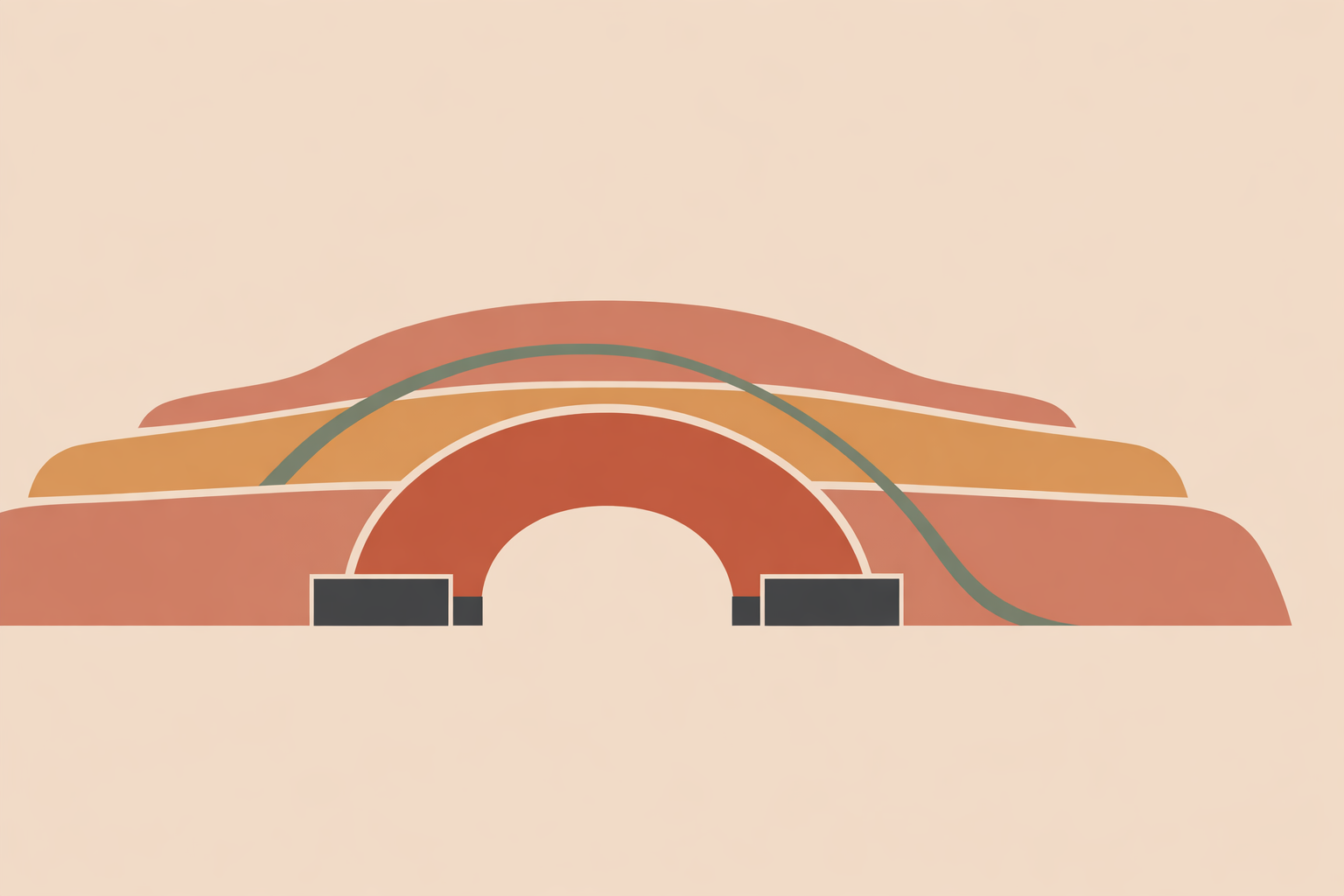
With even, well-compacted backfill, the surrounding earth can help restrain outward thrust and reduce bending. Essentially, the soil and the vault start cooperating: the shell carries load in compression, and the earth helps keep the whole form calm. On modest spans, that partnership can make a buried vault feel steadier than an exposed one.
This is why experienced builders often say Roman-style vaults “perform best” when buried. As traditional craft knowledge, it’s a practical observation: the soil acts like a brace, while the cover also supports a more stable indoor climate.
The main vulnerable window is construction and partial burial. Before the backfill is balanced on both sides, a shell is easier to distort—one-sided loading is where good work can get unnecessarily stressed.
As Brian Liloia notes from the field, “Once you bury a small, well‑designed vault and control for moisture, the ground does 60–70% of your heating and cooling for free.”
Whether or not every site hits that exact number, the principle holds: earth contact can noticeably soften temperature swings when moisture detailing and ventilation are handled with care.
How Buried Vaults Usually Fail
Buried vaults rarely fail out of nowhere. More often, they slip into trouble through familiar patterns: uneven loading, moving supports, trapped water, or rushed backfill.
Early signs are usually subtle—fine cracks near the crown, slight movement at a springing, or step cracking around the haunches when the shell is being pushed unevenly. What this means is simple: the vault is telling you the load path is no longer flowing cleanly through compression.
Just as often, the shell isn’t the original issue. A well-formed vault can still struggle if one side of the foundation settles more than the other. In traditional masonry work, many midspan cracks trace back to unequal support below rather than poor arch geometry above.
Moisture is another early messenger. Damp staining that follows a crack line often suggests movement has opened a path for seepage. And if water is trapped outside the shell—especially if drains clog—pressure can build in ways that bow, crack, and leak even a strong buried structure.
- Hairline crown cracks often point to uneven cover or shifting thrust.
- Outward drift at a springing suggests the supports need attention.
- Step cracks at the haunches often reflect one-sided loading.
- Fresh damp marks along cracks are a prompt to inspect drainage fast.
“It doesn’t just show the pretty shots; it walks you through the awkward corners. In practice, those details are where buildings either fail or become truly durable.”
Why Stable Foundations Matter So Much
If the springings stay quiet, the vault has a good chance to stay quiet too. If they move, the shell has to adapt—and that’s when cracking and distortion begin.
This is why foundations are the real deciders in buried vault work. The arch may be the visible star, but the base determines whether the geometry can keep doing its job year after year. Roman builders understood this well, and their achievements repeatedly show careful attention to foundations before trusting the arch above.
For a small earth-bermed vault, the field lessons are refreshingly practical:
- Keep both springings at the same elevation.
- Favor continuous support over isolated points.
- Prepare the sub-base carefully where soils are variable.
- Build drainage into the foundation strategy from the start.
A continuous footing or grade beam usually gives a calmer base than separate bearing points that can settle independently. On variable ground, many builders also over-excavate and replace with compacted, free-draining fill so the support is more uniform.
“The first buried structure many of my students build isn’t their forever home. It’s a prototype. The Hobbit Vault model treats the project as a full‑scale experiment where mistakes are cheap and the learning is priceless,” says Brian Liloia, encouraging a steady, iterative path.
That mindset fits the tradition: learn the materials, learn the site, then scale up with confidence.
Backfill and Drainage: The Real Craft of a Dry Buried Vault
The most durable buried vaults are rarely the most dramatic. They’re the ones backfilled patiently and detailed for water with real respect for what moisture can do over time.
Backfill is a process, not an afterthought. Build up in thin lifts, alternate sides, and compact consistently. Avoid dumping a tall mass against one side while the other remains exposed—experienced builders recognize that’s where many avoidable cracks begin.
Water management deserves the same discipline. A strong vault can still become uncomfortable and high-maintenance if water is trapped against it. The shell needs a drainage layer, a dependable membrane approach, protection for that membrane during burial, and drains that remain clear and serviceable.
In practice, a calm buried vault usually comes down to a few steady habits:
- Use free-draining material around the shell where appropriate.
- Keep backfill balanced from side to side.
- Protect waterproof layers before any soil touches them.
- Grade the surface so water leaves quickly.
- Make drains inspectable and easy to maintain.
Get these quiet details right and the building tends to fade into the background—in the best way. Rush them, and the structure may keep asking for attention.
“Your biggest vulnerability shifts from energy to moisture management. If you get water and ventilation right, the building will quietly take care of almost everything else for decades,” a perspective aligned with experienced earth-integrated design practice.
Safe-Feeling Spans and Materials for Hobbit-Scale Builds
At “hobbit” scale, restraint is a real advantage. Smaller spans and fuller curves are easier to execute well, easier to support, and easier to bury with confidence.
For soil-buried unreinforced barrel vaults, many practitioners gravitate toward spans of roughly 2.5 to 4 meters with a rise that feels generous rather than flat. It’s not a hard rule—more a traditional sweet spot—because it keeps the structure behaving like an arch instead of flirting with beam-like bending.
Thickness follows the same conservative logic. Historic vaults under meaningful load are often sturdier than newcomers expect, and small earth-sheltered builds tend to benefit from that same bias toward robustness.
Material choice also shapes the comfort margin:
- Masonry or earthen units: excellent for compression when proportions are conservative and supports are stable.
- Reinforced concrete shell: useful where builders want more freedom, continuity, or a thinner shell under cover.
- Timber rib vault: well suited to smaller spans and lighter cover, especially in owner-built projects.
Timber deserves extra modesty. Many small ribbed timber vaults work beautifully, but they’re generally happiest with shorter spans and shallower cover unless additional support, ties, or stronger materials are built in.
A practical approach for early projects is to repeat moderate bays instead of forcing one dramatic span. It’s more forgiving to build, easier to refine, and often more pleasing to live with.
“A buried vault behaves more like a greenhouse attached to a battery than a conventional house,” one instructor notes. “You get slow, buffered temperature swings—which is exactly what you want if you’re coaching for resilience rather than mere efficiency.”
Using One Small Vault as a Living Lab
A single small buried structure can do more than provide shelter. It can become a hands-on learning space for reading the site, sequencing the build, managing moisture, and developing low-tech building intelligence.
That’s part of the appeal of the roughly 333-square-foot hobbit-vault concept: it stays human in scale. You can test foundations, drainage, arch geometry, ventilation, and burial strategy without taking on an overwhelming footprint.
Costs will always vary by region, material availability, and how much labor is your own. It’s best to treat ultra-low budget stories as inspiring examples rather than fixed expectations. What remains consistent is the deeper benefit: a small prototype lowers the barrier to entry and makes earth-sheltered building feel learnable.
It also makes the process easier to teach and repeat. Instead of treating a buried vault like a mystery, the work can be broken into clear stages:
- Read the site and set levels.
- Prepare a stable base.
- Form the vault with conservative geometry.
- Install moisture and drainage layers carefully.
- Bury slowly and evenly.
- Observe how the structure behaves through seasons.
People tend to trust this pathway because it includes the unglamorous steps—the parts that quietly decide whether the build will be easy to live with later, especially in a dry, cozy Hobbit Vault.
“What excites me about the Hobbit Vault approach is how it lowers the psychological barrier to entry,” says Brian Liloia. “When people see they can build a 333‑square‑foot buried home for under $5,000, they realize resilient living isn’t only for specialists.”
Another mentor adds, “You’re not just hearing about passive design; you’re following a specific build from concept to buried reality—that narrative makes the learning stick.”
Conclusion: Does Roman Arch Construction Hold Up Under Buried Roof Loads?
Yes—when the craft is honored.
A Roman-style vault is naturally suited to burial because the shape prefers compression, and the surrounding earth can help the shell do what it already wants to do. The long-term success comes from discipline more than romance: steady springings, conservative proportions, symmetrical backfill, and water that always has somewhere easier to go than into your structure.
In that sense, buried vault work is both ancient and thoroughly practical. Traditional builders left a pattern that still works; today’s small earth-bermed projects simply adapt it with careful sequencing and maintainable detailing.
Build Your Hobbit Vault
Apply these buried-vault principles step by step in the Hobbit Vault Course.
Explore Hobbit Vault Course →