


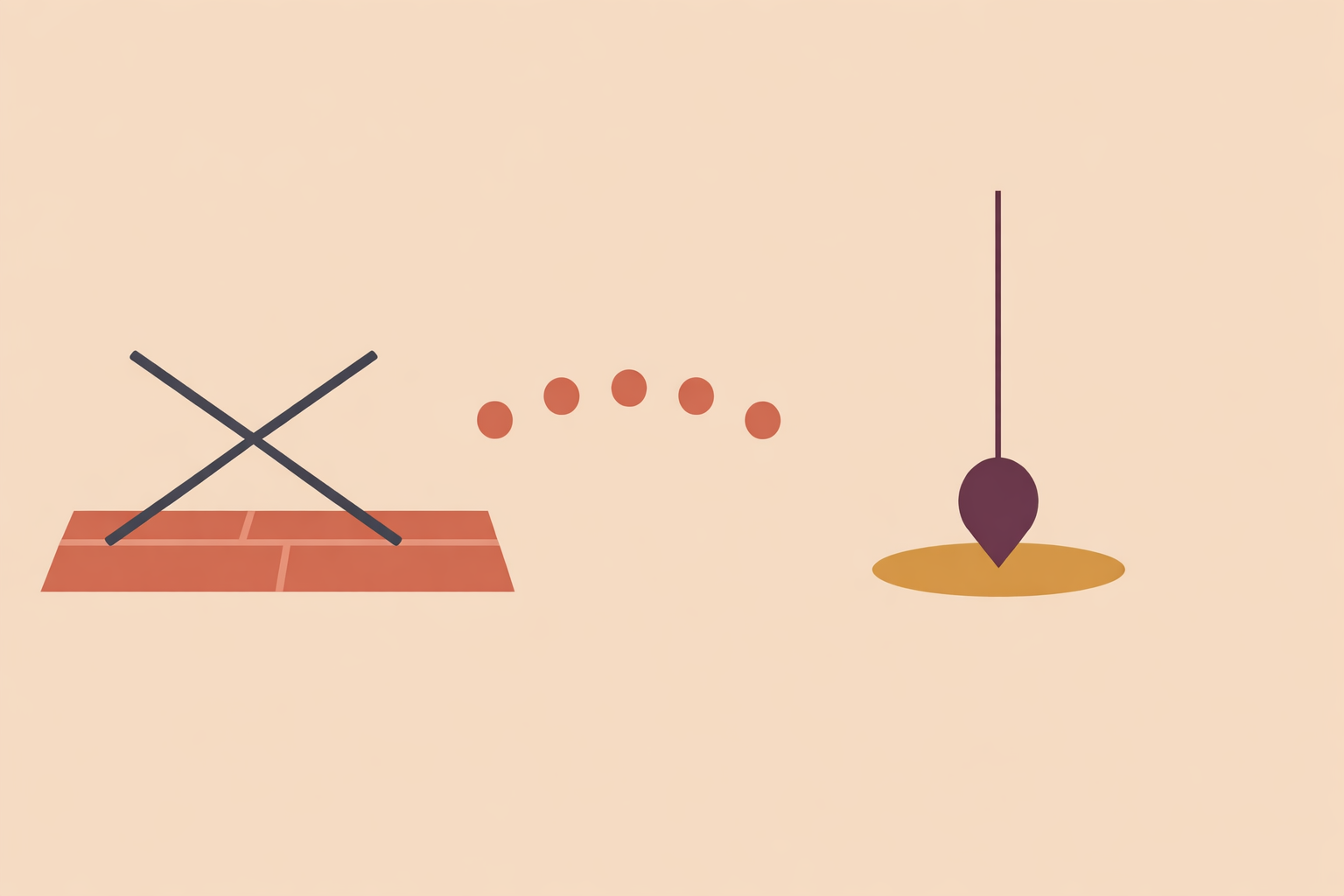
The on-site debate that wastes the most time is “rods or pendulum?” In real-world practice, the strongest approach is using each tool for its proper role. Rods help you locate where patterns run through a room. The pendulum helps you compare how specific spots feel for rest, focus, and everyday ease.
When you keep the sequence consistent, your session gets cleaner. Map first, qualify second, then make small changes you can retest. That keeps notes simple, reduces projection, and gives the household something practical to try.
Key Takeaway: For on-site place-memory checks, start with rods to map repeatable lines, crossings, and localized pockets. Then use the pendulum to compare placements and assess the quality of specific spots. This makes it easier to distinguish structural patterns from residual imprints, suggest gentle reversible changes, and retest over time with a calm, ethical approach.
Why place memory matters in geobiology
Some rooms feel straightforward. Others feel charged, heavy, tender, restless, or unexpectedly moving even when the practical setup seems fine. In geobiology, that layer is often approached as place memory: the subtle atmosphere shaped by previous use, emotional residue, and what a space has gathered over time.
This isn’t only about structure; it’s also about relationship. Research on place experience describes an affective dimension that includes attachment, reverence, and being moved by a place. In practitioner terms, that helps explain why one corner can feel distinctly different from another before you can name a reason.
In the field, an imprint can influence rest, focus, or mood much like a grid crossing can. That’s why many practitioners include place memory in on-site checks rather than treating it as an extra.
It also explains why in-person visits matter. A site can look neutral on paper yet feel dense, story-rich, or unsettled once you’re inside it, sensing it directly.
Step 1: Walk the room with rods
Start with the site’s skeleton. Before asking what a room means, find out how it behaves.
Walk slowly with relaxed hands and steady pacing. Look for repeatable responses: crossings, openings, directional pulls, and places where the sensation clearly thickens. Make at least two passes from different directions, then transfer responses to a simple sketch.
Mark long-stay zones first:
- beds
- desks
- sofas
- reading chairs
- children’s play areas
As you map, many practitioners use structural grid ideas such as Hartmann and Curry patterns. Modern summaries do not confirm a distinct earth grid in a straightforward way and suggest reported Hartmann/Curry lines may be explained differently. Even so, within dowsing practice, these frameworks remain useful as observational tools when lines show up straight, repeatable, and continuous across space.
Traditionally, the Hartmann network is often mapped with spacing around two meters at mid-latitudes. Whether you hold that as literal or as a working model, it helps you notice when a bed or desk repeatedly lands on a line or crossing.
Simple room-walk sequence:
- Pause at the doorway and settle your attention.
- Walk one slow north–south pass.
- Mark crossings or strong responses with small notes.
- Walk one slow east–west pass.
- Sketch the room and transfer the marks.
- Circle all long-stay positions.
- Star any area where several responses overlap.
Plain-language script: “I’m mapping where the room’s repeating patterns run first. Once we can see that clearly, we’ll compare the best placement options together.”
Step 2: Use the pendulum to qualify the key spots
Once the map is in place, the pendulum becomes far more precise. You’re no longer asking into a vague field; you’re asking about defined locations.
Establish your signals first: yes, no, unclear, and not now. Keep questions specific, present-tense, and limited to one variable at a time.
Good examples include:
- “Is the bedhead better on the east wall than the south wall?”
- “Does this chair placement support evening reading as it is?”
- “Would moving this desk out of this pocket improve the room’s overall ease?”
You can also use the pendulum to compare a location’s quality in simple practitioner language: more supportive or more draining, calmer or more agitated, lighter or denser. The value comes from consistent comparison, especially before and after a change.
Some practitioners track shifts with a numerical chart; others stick to qualitative labels. Either works if you stay consistent and document what you did.
Example note: “Reading corner felt dense on first pass; pendulum preferred chair moved 60 cm toward window; space felt calmer on retest.”
How to tell grids from residual imprints
Not every strong response is place memory. Some patterns behave like structure. Others behave like residue.
Long, straight, repeatable bands that continue through doorways and often outside the building usually read more like grid features. They hold their direction and remain present regardless of furniture changes.
Localized pockets that don’t align with grid directions, don’t travel cleanly through the house, and cluster around particular uses or emotional histories are more suggestive of residual imprinting. These are often the areas that feel unusually loaded even when the overall layout looks ordinary.
A practical distinction:
- Structural patterns: straight, repeatable, continuous, often extending beyond one room
- Residual imprints: localized, irregular, activity-linked, more responsive to environmental or ceremonial shifts
This is where rods and pendulum pair well. Rods reveal shape and continuity. The pendulum helps you check whether a localized zone is still active, whether it relates to current use, and whether a gentle change is worth testing.
Composite scenario: A living room shows one diagonal band continuing through the patio doors, plus one dense pocket beside an old piano that does not extend beyond that area. After a furniture shift and a simple clearing ritual, the pocket softens while the diagonal band stays where it was. That is a classic difference between structural backdrop and localized imprint.
Small changes that often shift a room
Once you’ve mapped and qualified the space, keep changes modest. The aim is steady support that the household can live with and retest.
Start where people spend the most time. If a bed, desk, or chair sits on a strong crossing or in a dense pocket, trial a small move first. Even a limited adjustment can change the felt quality of a room.
For heavier corners or story-rich spots, practitioners often experiment with simple environmental changes such as:
- decluttering the area
- adding textiles to soften the atmosphere
- bringing in a healthy plant
- moving furniture to reduce prolonged exposure
- unplugging devices near rest zones at night
- using prayer, bells, or another respectful clearing practice aligned with the household’s traditions
It’s common for pendulum-based quality ratings to shift after these changes even when rod-mapped structural lines remain in the same place. That difference can be useful information: the framework stays stable while the atmosphere becomes easier to live in.
One-hour protocol:
- Move the bed or chair out of the strongest overlap if possible.
- Retest the new position with the pendulum.
- Clear one heavy corner through decluttering and a simple ritual.
- Retest that corner.
- Switch off or remove nearby devices from the sleep area at night.
- Track how the room feels over the next seven days.
Client line you can borrow: “Let’s change one thing at a time and listen to how your home responds.”
Conditions that can affect your sensitivity
Dowsing responds to context. Your own state and wider conditions can influence how clearly you read a space.
A review of dowsing observations notes that weather, solar position, and drinking water were reported to affect sensitivity. Many practitioners also track grounding, fatigue, emotional state, and pace of work because those factors show up repeatedly in day-to-day practice.
This is why condition tracking matters. If reads feel inconsistent, log the basics and repeat the check later. Patterns over time are more trustworthy than a single pass.
Useful items to log:
- weather and storm activity
- time of day
- hydration
- your own steadiness or fatigue
- whether the room was busy, quiet, freshly cleaned, or emotionally charged
A simple conditions log supports more responsible interpretation and helps separate repeatable site patterns from temporary noise.
Ethics and communication on site
Place-memory work benefits from a calm nervous system, clear consent, and non-dramatic language. That protects the household and sharpens your discernment.
Explain what you’re doing in plain words and invite agreement at each stage. Keep the focus on environmental support rather than fear. If a room feels heavy, describe it gently and practically, then test changes.
Good communication sounds like this:
- “I’ll map the room first, then compare two placement options.”
- “This corner feels denser than the rest, so let’s test a few simple changes.”
- “We can stop, pause, or recheck anything that doesn’t feel right.”
Cross-check subtle impressions with ordinary observation. Notice light, drafts, noise, clutter, and how the household already uses the room. The work becomes more reliable when it stays connected to lived reality.
When using prayer or clearing practices, respect cultural roots and avoid borrowing rituals carelessly. Invite people to draw from their own traditions and language of meaning whenever possible.
Building skill over time
Geobiology deepens through repetition. The more rooms you walk, the more clearly you recognize the difference between a structural line, a dense pocket, a quiet zone, and a place carrying emotional residue.
Keep your practice honest and repeatable. Rewalk the same space on different days and compare your maps. If you work with colleagues, occasional independent checks can help you see what’s consistent without flattening the subtlety of the work.
Document what happened after each visit:
- What patterns repeated clearly?
- What changes were made?
- What shifted immediately?
- What changed only after several days?
- What remained unchanged?
Over time, this becomes your real field education. It shows where traditional frameworks stay useful, where your sensitivity is strongest, and where a slower pace brings better clarity.
Conclusion
For place-memory checks on site, the rhythm stays simple: map first with rods, qualify second with the pendulum, then change one gentle thing at a time and observe what follows.
Rods show where patterns travel. The pendulum helps you compare how particular spots feel for living, resting, and working. Used together, they give structure to subtle work and make your recommendations easier to explain, test, and revisit.
Keep the process calm, consent-based, and practical. Traditional skills sharpen through repetition and good notes, and modern perspectives can help you stay clear-eyed about interpretation. A home rarely needs to be forced into harmony; it responds best when it’s listened to carefully.
Explore Geobiology Certification
Build a repeatable on-site process with the Geobiology Certification, from mapping to ethical retesting.
Explore Geobiology Certification →








