Most growers make the irrigation call in the hardware aisle: pick a kit, copy a neighbor’s zone map, and hope the timer carries the dry months. That approach works until it doesn’t. A rain tank empties sooner than expected, weeds surge between rows, evening watering keeps leaves damp, and the upkeep stops fitting the people actually tending the place.
In permaculture, drip vs sprinkler is a pattern choice about how water moves through soil and plants, and how that pattern fits the daily rhythm of care.
Key Takeaway: In permaculture, choosing drip or sprinklers is a design decision about water movement, labor, and landscape function. Drip usually suits root-zone precision, lower water use, drier inter-row spaces, and sensitive crops. Sprinklers still make sense when you need broad, even coverage, temporary cooling, frost protection, or fast establishment across a whole area. The best choice depends on climate, wind, soil, planting layout, maintenance capacity, and whether a hybrid system will serve the site better than either method alone.
Why the drip vs sprinkler choice matters
Your irrigation pattern shapes water security, soil condition, weed pressure, and day-to-day workload. The guiding question stays practical: what form of water delivery supports life on this site with the least strain?
The difference shows up quickly when stored water is part of the design. A modest rain tank can stretch much further with drip than with overhead watering, which in turn affects tank size, mulching strategy, planting density, and how much buffer you have for heat, wind, or late rains.
Both systems can serve a regenerative landscape well, but they place very different demands on the site and the people maintaining it.
How drip and sprinkler systems move water differently
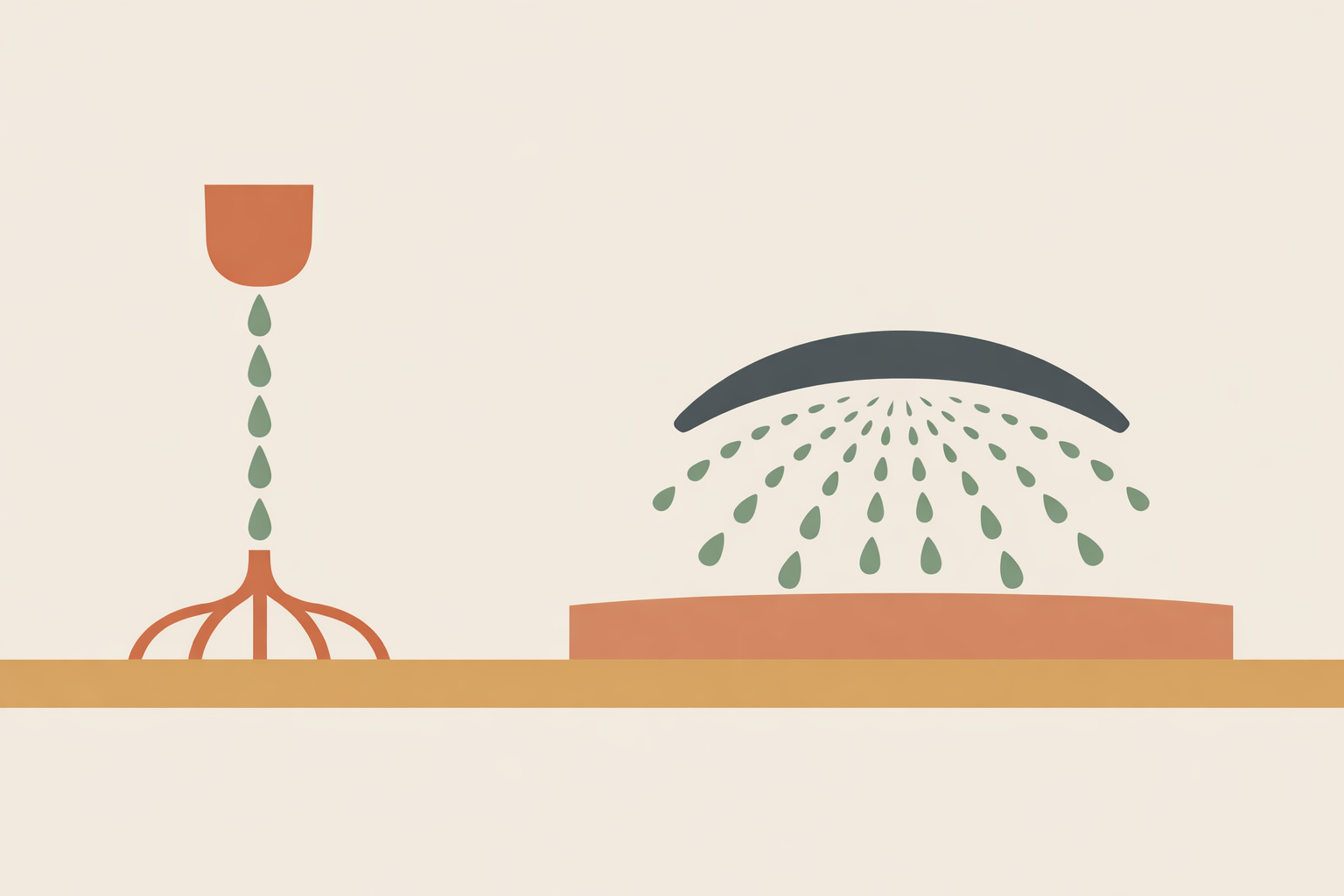
Drip and sprinklers solve different problems. Drip concentrates moisture near roots. Sprinklers spread water across a wider surface and through the canopy, closer to how rainfall lands.
Drip irrigation: slow, targeted water at the root zone
Drip delivers small, steady amounts close to where plants draw water. 1–4 L/hr is a common emitter range, which suits perennial beds, mixed plantings, kitchen gardens, and young trees.
Because drip wets a limited area, the spaces between plants often stay drier. That can lower weeds and help preserve structure by avoiding the repeated surface impact of overhead watering.
In the field, drip shines where you want accuracy. A line can trace a hedge, loop around tree basins, or run down a polyculture bed without soaking every exposed surface. Under mulch, that steady delivery often supports deeper rooting and a calmer soil environment.
Sprinkler irrigation: broad coverage from above
Sprinklers distribute water through the air, wetting foliage and soil over a wider zone. That’s useful when the goal is even coverage across a whole bed, alley, or strip, rather than plant-by-plant precision.
They still earn a clear place in permaculture for lawns, pasture strips, and fresh seedbeds, and they’re also used for frost protection in orchards. Many growers also reach for overhead watering when they want temporary cooling across a larger area.
The trade-off is exposure. Wind and heat can increase drift and evaporation, so timing, nozzle choice, and zoning matter more with overhead systems.
Where drip irrigation usually outperforms sprinklers
When water is limited, drip usually becomes the stronger pattern. It delivers moisture where it’s needed and typically asks less from a tank, pump, or supply line.
Guidance commonly shows higher efficiency for drip than for typical sprinklers, and that advantage grows in windy sites. Drip also tends to hold up better in persistent wind and in hot, arid conditions where overhead droplets are easily lost.
Drip supports cleaner foliage management, too. By keeping leaves drier, it can limit spread of some pathogens in sensitive crops, which matters in dense summer gardens where airflow is already tight.
It often simplifies work as well. Drier inter-row spaces can mean less unwanted growth, and reduced weeds often translates into fewer hours spent pulling and hoeing.
Growers usually feel this change quickly after switching systems: less water used in midsummer, fewer flare-ups of inter-row growth, and a garden that feels easier to stay ahead of. That lived result is one of the reasons drip becomes a long-term favorite in intensively planted spaces.
Where sprinklers still make sense in permaculture
Sometimes the land asks for broad coverage rather than point delivery. Sprinklers are often the practical choice when you want to establish a cover crop evenly, support shallow-rooted groundcovers across a wide area, or moisten a whole understory at once.
They’re also useful when overhead water itself serves a purpose: short-term cooling during very hot spells, or settling dust near paths and active work zones. In shared gardens, sprinklers can be easier to “read” at a glance because a spray problem is visible while the zone runs.
The trade-offs are real. Wetting a larger surface area can encourage more weeds, and in humid conditions, prolonged leaf wetness may increase risk for susceptible crops. Used thoughtfully, sprinklers remain a strong tool.
How to read your site before choosing
The best irrigation choices usually come from observation before purchase. A few site signals quickly point toward the most supportive system.
- Wind: If afternoons are consistently windy, drip usually holds distribution more reliably.
- Heat: In hot, arid climates, overhead droplets are lost more easily, while drip keeps delivery close to the soil.
- Humidity: In muggy climates, wet foliage can create more pressure on sensitive crops.
- Soil texture: Sandy ground often does well with smaller, more frequent watering. Heavy clay often benefits from slower application that allows infiltration.
- Planting pattern: Tree guilds, perennial borders, and mixed beds often suit drip. Uniform seedbeds, lawns, and broad cover-crop zones often suit sprinklers.
- Terrain: Both can work on uneven ground, but each needs thoughtful pressure management and zoning.
A quick field check teaches more than a generic chart. Run a sprinkler zone at sunrise with cups spaced in a rough grid, then compare how evenly they fill. Next, run a temporary drip line and check soil moisture after short intervals. Your own soil will show you the pattern.
Maintenance and human capacity matter as much as water
An efficient system that nobody can maintain is poor design. Appropriate technology means matching the tools to the people who will live with them.
Drip needs regular care to stay consistent. Good performance usually depends on filtration, occasional flushing, and replacing emitters when flow weakens. When that care becomes part of the seasonal rhythm, drip is dependable.
Sprinklers are often simpler for beginners and shared spaces because issues are easy to spot while running. A clogged nozzle, tilted head, or poor arc is visible right away, which suits gardens with high turnover or limited support.
Many community spaces end up with a mixed approach: sprinklers where easy onboarding matters, drip where long-term water savings and precision matter most. That balance often serves people better than forcing the whole site into one method too early.
- Weekly: Walk sprinkler zones while running and correct obvious spray issues.
- Monthly: Check drip filters and rinse screens.
- Seasonally: Flush mains and laterals, replace weak emitters, and test timers.
- Annually: Revisit zones as trees, shrubs, and beds mature.
For low-energy sites, gravity-fed micro-drip from stored rainwater often appeals because drip can run at relatively low pressure. It fits smallholdings, courtyard gardens, and modest off-grid setups.
Hybrid systems are often the strongest answer
Permaculture design rarely needs a single winner. In many landscapes, a hybrid does the best work: drip where precision supports resilience, and sprinklers where broad coverage is genuinely useful.
A hillside garden might rely on contour earthworks and mulch to hold water in the land, then add drip at tree bases for steady support through dry weeks. A movable sprinkler can still help with seedling establishment, a quick whole-bed soak, or occasional cooling.
The same logic fits shared gardens. Keeping drip and sprinklers in separate zones helps a group match water use to season, crop sensitivity, and available labor. It can also align with long-held water-sharing ethics, where fairness, timing, and collective stewardship matter as much as hardware.
- Arid courtyard pattern: Roof catchment fills a tank, micro-drip supports trees and perennial herbs, and occasional overhead watering cools and settles the space during intense heat.
- Temperate homestead pattern: Swales and mulch build the soil sponge, drip steadies perennial beds, and a portable sprinkler helps establish spring groundcover under young trees.
When irrigation is layered onto earthworks, mulch, and careful observation, the whole system becomes easier to adapt over time.
Choosing the best-fit system for your site
The real choice is which water pattern best supports this land, these plants, and these people right now.
Drip usually leads where water efficiency, drier foliage, lower weed pressure, and long dry seasons set the priorities. Sprinklers keep their place where broad coverage, cooling, frost protection, or simple shared routines matter more.
Start with observation, then make a small choice you can steward well. Watch the wind, the heat, how your soil absorbs water, how your beds are laid out, and what maintenance is realistic week after week.
Finally, keep the design flexible. Every garden changes as shade shifts, roots deepen, and the caretaking team evolves. In practice, irrigation works best when it evolves with the site too.
Master Permaculture Design Basics
Apply these irrigation patterns within whole-site planning in the Permaculture Design Course.
Explore the Permaculture Design Course →