Anyone who designs or grows in HOA neighborhoods knows the real hurdle: most boards don’t mind food plants; they mind anything that looks unfinished. In a front yard, edibles tend to be welcomed when the space reads as a complete landscape first, with clean lines, repeated shapes, and materials that suit the home.
Three layouts consistently work in curb-facing spaces: a formal entry composition with matching containers and one raised bed, a mixed edible foundation border, and a narrow dwarf fruit-tree strip designed like a classic shrub bed. Each one aims for the same outcome: a front yard that feels intentional, easy to understand at a glance, and simple to keep looking cared for.
Key Takeaway: HOA-friendly edible landscaping works best when the front yard reads as an intentional, finished landscape that also happens to produce food. Matching materials, repeated planting groups, clear height layering, crisp edges, and light but regular upkeep do more for acceptance than trying to hide edibles. Start with a small, well-composed area, keep the lines clean, and let harvest sit inside an orderly design.
Edible Landscaping Idea #1: A Formal Entry Garden with Containers and One Raised Bed
Start at the front walk, where attention naturally gathers. A symmetrical entry anchored by two matching containers and a single low-profile raised bed communicates “designed landscape” immediately, while still giving you meaningful harvests.
This approach draws on the traditional kitchen-garden spirit: useful plants arranged with restraint and pride. Instead of scattered pots and improvised corners, the geometry stays crisp, materials stay consistent, and the plant choices favor strong form and reliable yields.
How the layout works. Imagine a 12-foot path with two matching corten-steel or ceramic containers flanking the stoop. Each container holds a rosemary standard with basil and viola beneath. Off to one side, a single 4×8-foot cedar bed runs parallel to the house, finished with brick or stone edging that echoes the entry hardscape. A narrow gravel band around the bed sharpens the outline and keeps everything looking “finished.”
One bed can still produce plenty. Chard, peppers, salad greens, basil, parsley, and thyme pull their weight here because they look good from the street and keep the kitchen supplied. Leafy greens and herbs also reward you quickly, which makes this layout encouraging for beginners.
Materials that help the space read as landscape. In front yards, materials do a lot of the persuasion. Cedar or composite beds, matching pots, tidy edging, and discreet drip lines signal permanence and care, which matters more to most observers than whether the bed contains kale.
Containers are especially valuable because they create instant structure. A bold pot shape makes peppers and rainbow chard feel like a deliberate focal point. Keep irrigation tucked out of sight and limit the container styles so the entry stays calm and cohesive.
A simple one-weekend entry plan.
- Mirror two large planters at the front entry.
- Set one 4×8-foot raised bed parallel to the house.
- Add a gravel apron and brick or stone edge to define the bed.
- Use a back row of peppers, a middle layer of chard, and a front band of lettuce and thyme.
- Plant the containers with one upright focal plant and a low edible underplanting.
- Install low-visibility drip irrigation from the start.
This is often the easiest place to begin: it’s highly visible, but the footprint is small enough to manage confidently. You also get immediate “designed” impact right where a home’s curb appeal is judged.
Maintenance usually stays lighter than people assume. Frequent, brief check-ins to harvest, monitor moisture, and keep edges crisp tend to keep the whole entry looking consistently cared for.
Edible Landscaping Idea #2: A Mixed Edible Foundation Border
If your home already has a foundation bed, this is often the smoothest upgrade. Many HOA neighborhoods already expect foundation planting, and some guidelines even require foundation planting. The most natural move is to weave edibles into that familiar template rather than creating a separate “garden area.”
The visual logic stays the same: taller structure in back, medium plants in the middle, and a low edge in front. You’re swapping in useful plants while keeping the bed’s overall rhythm and clarity.
How to blend edibles into an existing border. Keep the backbone plants that already carry the design. If you have hydrangeas, boxwood, dwarf grasses, or another stable shrub layer, maintain it and add repeating pockets of culinary plants between. Chives, parsley, rosemary, thyme, alpine strawberries, basil, peppers, and compact blueberries are all strong fits.
For open pockets, loose leaf greens can act as a soft seasonal filler. When planted in tidy groups, they read like intentional texture from the street and still give frequent harvests close to the door.
Use repetition to make the bed look intentional. Massing a few plants reads more “landscaped” than sprinkling many different ones. Many designers lean on groups of three or five for visual balance, and repetition is widely recognized as a reliable way to create order. A repeated lavender–chive–thyme pattern will usually look more composed than a long list of single plants.
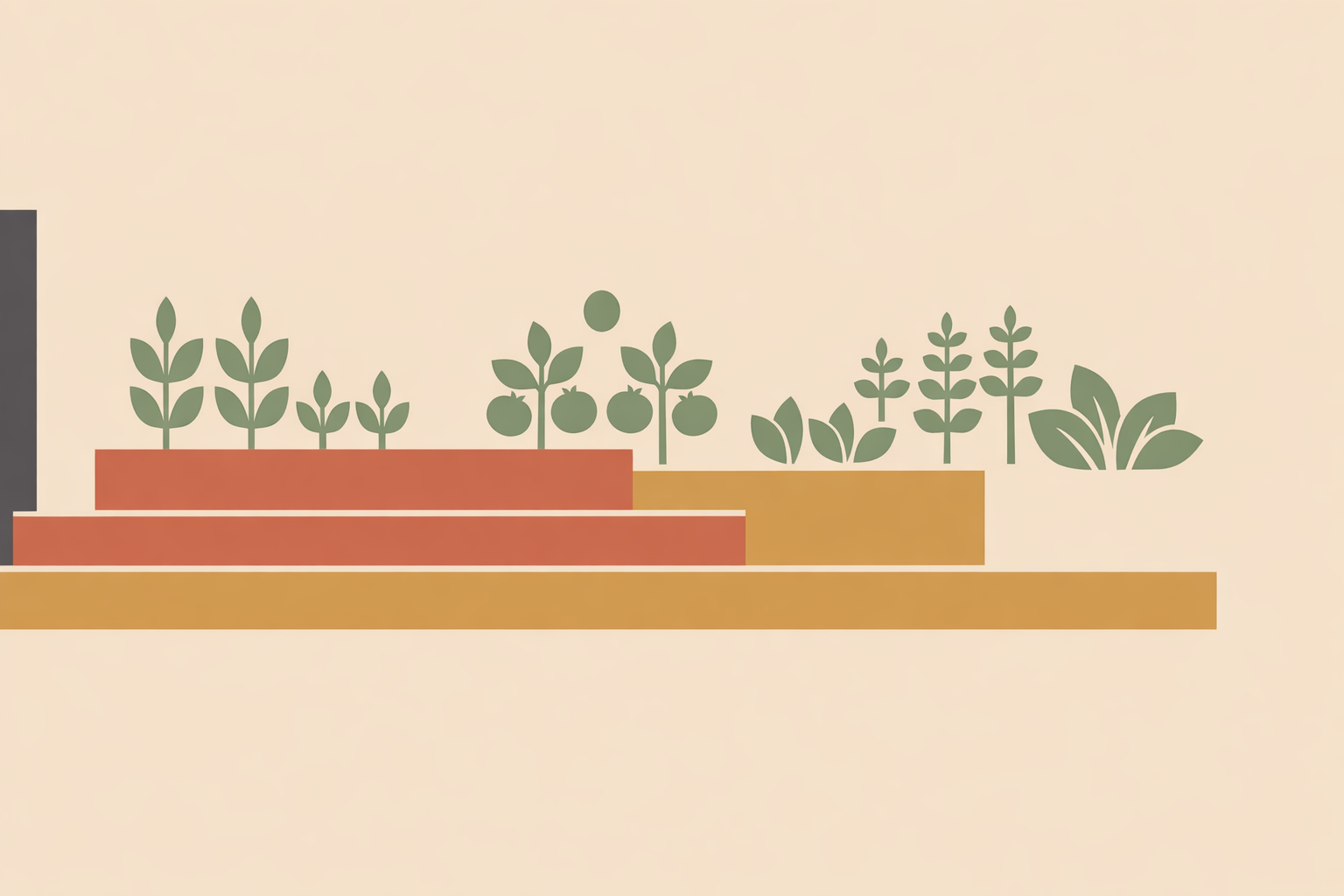
Keep the height structure calm and legible. A simple three-layer step-down keeps foundation beds looking settled: compact shrubs at the back, herbs and fruiting annuals in the middle, and low growers at the edge. If you want blueberries here, ‘Sunshine Blue’ is often chosen because it stays compact.
Sample planting recipe for a 20-foot border.
- Back layer: compact blueberries spaced evenly through the bed.
- Middle layer: repeating groups of rosemary, chives, parsley, and peppers.
- Front edge: alpine strawberries and creeping thyme as a low ribbon.
- Seasonal additions: spring peas on slim supports, or autumn kale after summer crops finish.
This pattern suits anyone who wants the front yard to stay recognizably “landscaped.” The bed keeps its conventional structure, while becoming more fragrant, more useful, and more generous over the seasons.
Edible Landscaping Idea #3: A Dwarf Fruit Tree Guild Strip
Front-yard fruit works best when it’s scaled to the setting. A narrow strip along a driveway, side line, or sunny facade can hold a few dwarf fruit trees underplanted with berries, herbs, and flowers, arranged as a tidy border.
When composed with restraint, this functions like a miniature forest garden: layered, abundant, and lively, while still looking like a polished residential planting.
Think in small, repeatable modules. Start with one compact section rather than transforming the whole lawn. A repeated module is easier to maintain, easier to present to an HOA board, and easier to refine as you learn what thrives on your site.
Choose dwarf trees that stay in proportion. Many references describe 8–10 feet as a common mature height for dwarf fruit trees, which generally keeps sight lines comfortable in residential spaces.
Build the strip in layers. A classic guild places a fruit tree as the anchor, then surrounds it with plants that protect soil, invite pollinators, and extend the harvest. In practice, that often looks like berries in the mid-layer, herbs and flowering perennials below, and a clean mulch layer tying the whole bed together.
Guild-style planting guides often emphasize that mixed underplantings can support pollinators and beneficial insects around fruit trees. Even in a narrow strip, this kind of layering brings more diversity than turf alone.
Use repetition to keep abundance looking orderly. Repeat forms to keep the planting visually calm: consistent tree spacing, one or two berry choices, and a recurring herb matrix. Clear patterning is frequently cited as a pathway to visual harmony, especially in highly visible spaces. In tight beds, fewer species repeated well usually look best.
A compact layout you can use this season.
- Trees: 2 dwarf apples, or 1 apple and 1 Asian pear if pollination needs are met.
- Shrubs: compact blueberries or currants between the trees.
- Ground and herb layer: oregano, chives, yarrow, thyme, and alpine strawberries.
- Mulch: arborist chips or another clean natural mulch, kept away from trunks.
- Irrigation: one discreet drip line serving trees, shrubs, and underplantings.
Once established, care stays straightforward: seasonal pruning to maintain form, light composting, regular harvesting, and occasional thinning so the strip keeps its clean outline.
Design Principles That Matter Most in HOA-Friendly Foodscapes
Across all three layouts, a few choices do the most to win acceptance and keep the space looking “finished.”
- Use crisp boundaries such as brick, stone, steel edging, or a clean mown line.
- Repeat plants instead of collecting too many different ones.
- Step heights from back to front so the planting feels ordered.
- Match containers and hard materials to the house.
- Keep irrigation discreet and tools out of sight.
- Harvest and tidy often so the space always looks active and cared for.
Design guidance consistently connects structure and repetition with stronger curb appeal. In real front yards, finished edges and calm geometry often increase perceived quality, which is exactly what HOA settings tend to reward.
Soil and Placement Considerations for Urban Front Yards
Urban front yards deserve a bit of extra care before growing food plants directly in the ground. Areas near roads and older buildings can contain legacy pollutants, particularly in older neighborhoods.
When possible, place edible beds away from heavy traffic and away from the immediate perimeter of older painted structures. Practical guidance also recommends habits such as wash produce well, peel root crops, and discard outer leaves of leafy greens.
If you’re working with a site you’re unsure about, raised beds filled with clean growing mix are often the simplest confidence-builder. Thoughtful placement early on also reduces the chance of having to redesign later.
Choosing the Right Pattern for Your Front Yard
For a clean, beginner-friendly start, the formal entry garden gives immediate polish in a small footprint. If you already have an established front bed, the mixed foundation border usually blends in most naturally. If fruit is the main goal, the dwarf tree strip offers layered abundance while still fitting a residential streetscape.
Whichever pattern you choose, the guiding principle stays consistent: front-yard edibles thrive socially when they look composed. Repetition, crisp edges, compact forms, and steady upkeep make a productive planting feel like it truly belongs within urban agriculture and the broader work of self-sufficiency and sustainability.
Over time, these small foodscapes often do more than support a household. They invite conversation, showcase thoughtful land use, and prove that beauty and usefulness can share the same space. Keep cautions in mind—especially around urban soil—and let the design do the talking.
Explore Urban Agriculture Certification
Build on these HOA-friendly foodscape designs with deeper planning skills in the Urban Agriculture Certification.
Explore Urban Agriculture →