Practitioners often recognize the moment: a group arrives wired from work, study, or family life. The trees are ready to hold the space, but attention is scattered. In those sessions, adding more prompts rarely helps. A small, repeatable arc settles people faster, especially when guidance stays gentle and choice-led.
This three-move sequence fits that need. It starts with regulation, moves into soft cross-body movement, and closes with simple meaning-making. It works particularly well for beginners, mixed-ability groups, and anyone who appreciates clear, unhurried guidance.
Use the full arc in 25 to 45 minutes, or borrow one move when time is tight. The aim is steadiness and clarity, so participants leave with a felt sense of connection they can carry into daily life.
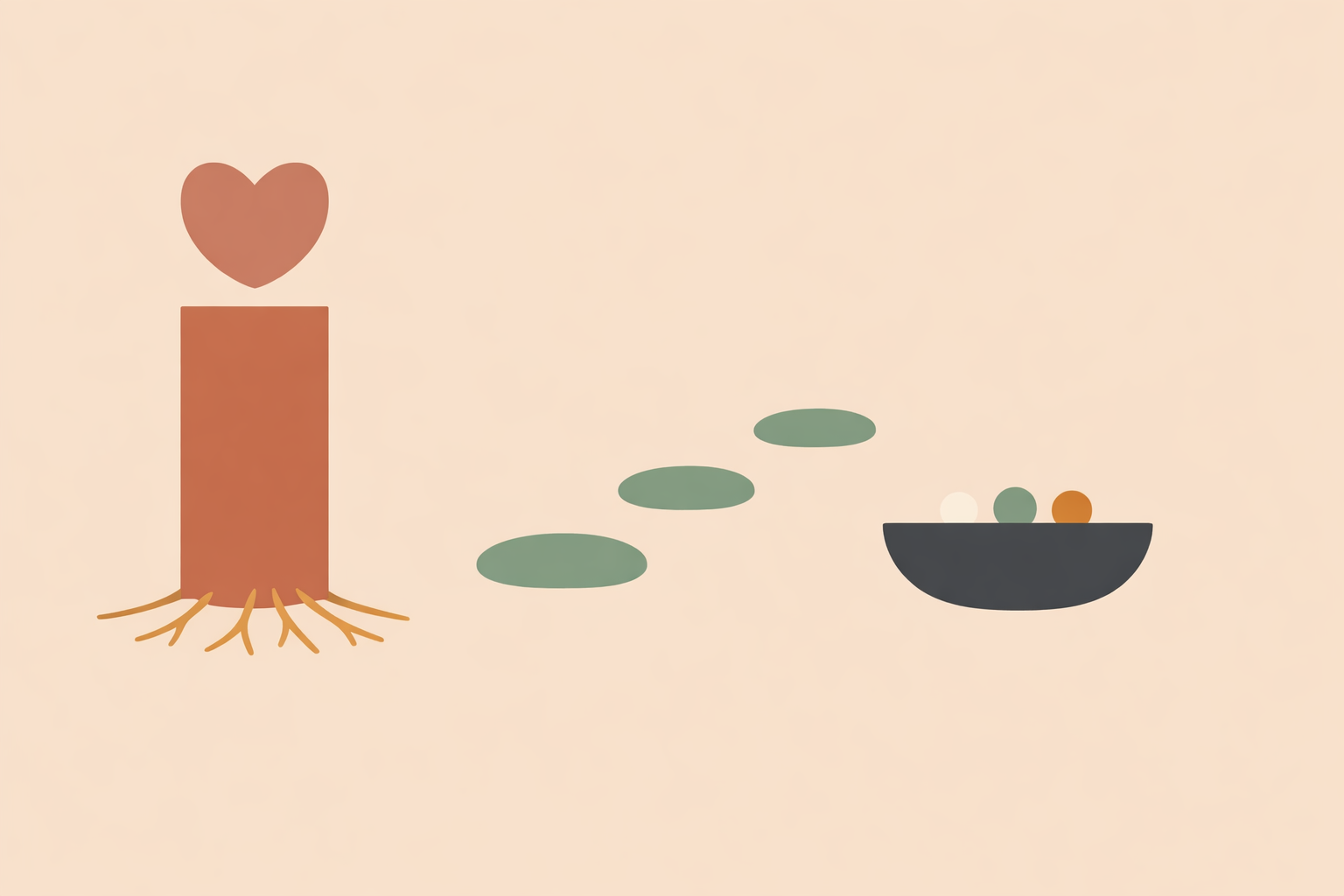
Key Takeaway: Energy sylvotherapy often works best as a minimal, repeatable arc: regulate first, move second, integrate last. This article walks through three practical moves in that order: grounding with one tree and a root–heart axis, whisper-pace walking with micro-movements, and a simple three-object closing ritual. It also covers timing, adaptations, pacing, and group-safety culture.
Why this first move works
Forest settings are widely associated with calmer physiology and a greater sense of vitality. In day-to-day facilitation, focusing on one living presence also tends to quiet “busy” attention, because the practice asks for depth rather than variety.
The root–heart axis is a traditional, body-based image: awareness drops down for steadiness, then rises toward the chest for warmth and presence. Participants remember it easily, which makes it useful later in the walk.
Offer contact as an option, never a requirement. A palm or shoulder to the trunk can feel supportive for some; others prefer hovering the hand, sitting nearby, or simply studying the bark. Choice is the feature that makes this grounding reliable in client work.
- Set-up: Choose a stable tree with enough space around it for different comfort levels.
- Timing: 5 to 8 minutes is usually enough.
- Options: Standing, sitting, touch, no touch, eyes open or softly lowered.
Composite example: a lunchtime group arrives chatty and restless. Two participants lean lightly into smooth bark, one stays a step back, another sits on a nearby bench. After a few quiet minutes, the whole group is noticeably less hurried.
Read-aloud script: root–heart grounding
“Find a place with your tree that feels right for you, closer or farther away.”
“Let your feet meet the ground. Notice your heels, the balls of the feet, the toes. Soften your knees a little.”
“If touch feels welcome today, rest one hand on the bark. If not, keep your hands by your sides or simply look at one area of the trunk.”
“Invite one long, easy exhale.”
“Bring awareness to the soles of the feet and the base of the body. Imagine that area becoming heavy and steady, as if gravity is helping you root.”
“Now bring awareness to the chest space. Let it feel open, warm, or simply present.”
“Sense a gentle line between the ground below and the heart space above. On the inhale, awareness rises. On the exhale, it settles back down.”
“Notice texture, temperature, shade, sound, and breath. Nothing to force.”
“When you’re ready, thank the tree in your own way, and keep a thread of that steadiness as we begin to walk.”
A helpful opt-out line for groups: “If touching the tree is not for you today, let your breath be your anchor and keep the tree as a visual companion.”
Move 2 – Whisper-Pace Walking and Micro-Movement
Once the group is more settled, begin walking very slowly. Not hiking pace, not performance pace, just slow enough that breath, gaze, and footfall can come back into relationship.
This is often where excess activation starts to unwind without effort. Slow walking offers rhythm without pressure, and that rhythm supports re-settling.
Why slow walking helps
A quiet environment paired with gentle pacing supports a steadier internal state. In traditional practice, this is the point where people start to “come back into themselves” after arriving overstimulated.
Micro-movements can deepen the effect by keeping activation in small, workable amounts. Somatic pacing approaches emphasize small, manageable amounts rather than strong catharsis, so tiny choices like jaw release, shoulder spirals, soft spinal shaking, and cross-lateral stepping can help participants feel more fluid and coordinated.
The guiding principle is softness. Trauma-informed pacing consistently favors gentle titration over pushing intensity, and forest sessions rarely need anything more dramatic than a quiet, steady return to rhythm.
- Route: Choose a short path with stable footing and one place to pause.
- Pace cue: Walk slowly enough to notice small details without stopping.
- Timing: 8 to 15 minutes.
- Adaptation: Offer seated or stationary versions from the start.
In many groups, this middle section is where shoulders drop, jaws unclench, and conversation naturally quiets. You don’t need to force quiet; the pace often invites it.
Read-aloud script: walking discharge
“Let’s begin walking at a whisper pace.”
“Feel each step from heel to toe.”
“Let your eyes rest softly on the path ahead, then widen your gaze to include the edges: light, shadow, leaves, trunks.”
“On your next exhale, let the jaw soften.”
“Allow the shoulders to unwind a little.”
“Let the arms swing naturally. If it feels helpful, every few steps bring one hand lightly across the body, then the other.”
“If you want a little more movement, try a slow shoulder spiral or a gentle softening through the spine as you walk.”
“Keep the breath unforced. Keep the pace easy.”
“If at any point you feel unsettled, pause, widen your stance, and look at one steady thing nearby until you feel ready again.”
For seated participants, mirror the same pattern on a bench: feet pressing into the ground, soft gaze, jaw release, shoulder circles, and light cross-body taps.
Move 3 – Close With a Three-Object Ritual
Close with a brief ritual that marks the shift from “being held by the forest” back into the day. This helps participants leave with a clear thread, rather than drifting out of the session too quickly.
The format stays intentionally simple: three fallen objects, three intentions. The value is in the pause and the personal meaning, not in making it elaborate.
Why a simple ritual helps integration
Small closing actions help people register that something has changed. In practice, that makes the experience easier to remember and easier to bring into the week ahead.
Forest air can also be part of the closing. Tree-derived phytoncides are one reason many people report a blend of calm and renewal in wooded settings. A short, scent-aware pause near pine, cypress, or other aromatic trees can deepen that feeling without adding complexity.
Keep the ritual respectful and grounded. Use personal language, avoid borrowed ceremonial forms, and work only with what’s appropriate to the place. Fallen objects are usually enough.
- Materials: Three simple fallen objects per person.
- Timing: 8 to 12 minutes.
- Ethics: No picking from living plants, no rare items, no imitation of traditions not taught in context.
Read-aloud script: release, receive, remember
“Spread out within sight and gather three fallen objects that draw your attention.”
“Return to your place and set the three objects in front of you.”
“Choose one for release. You might name something you are ready to put down, even just for today.”
“Choose one for receive. Name a quality you would like to welcome in.”
“Choose one for remember. Let it hold the part of today you want to carry forward.”
“If you’d like, bring the three objects together in your hands for one breath.”
“Now gently return them to the ground, or keep one if that is appropriate in this place.”
“Take a final moment to notice the scents around you, the air, the temperature, the feeling in the chest and belly.”
“Close by appreciating one way the natural world met you today.”
Indoor adaptation: use three everyday objects already in the room and keep the same three intentions. If you include scent, keep it light and optional.
How to weave the three moves into one session
Together, these moves create a clean, teachable arc: settle, move, integrate. It works well for newer groups because each stage has one job, and the group always knows what it’s doing and why.
- Tree grounding: 6 to 8 minutes
- Whisper-pace walking: 10 to 15 minutes
- Three-object close: 8 to 10 minutes
- Final check-out: 2 minutes
Regular short sessions in green spaces often build steadier resilience over time. Many practitioners find the rhythm matters more than making each session long, whether in animal wellness or sylvotherapy practice.
A useful home practice between group meetings is a five-minute solo version:
- 1 minute of root–heart grounding
- 3 minutes of slow walking
- 1 minute of release, receive, remember
Keep group safety culture simple and human. The strongest safeguard is the tone you set: choice, kindness, clear pacing, and no pressure to perform. Participants should always be free to step back, sit down, skip touch, or simply observe.
As facilitation deepens, this kind of sequence becomes more valuable, not less. It’s easy to remember, adaptable across ages and settings, and spacious enough to let the forest do its part. In the end, it often comes down to a few steady ingredients: one tree, one slower pace, one small closing act, and a reminder of what steadiness feels like in the company of trees.
Train in Sylvotherapy Practice
Build on these three moves with the Sylvotherapy Practitioner Certification.
Explore Sylvotherapy Certification →