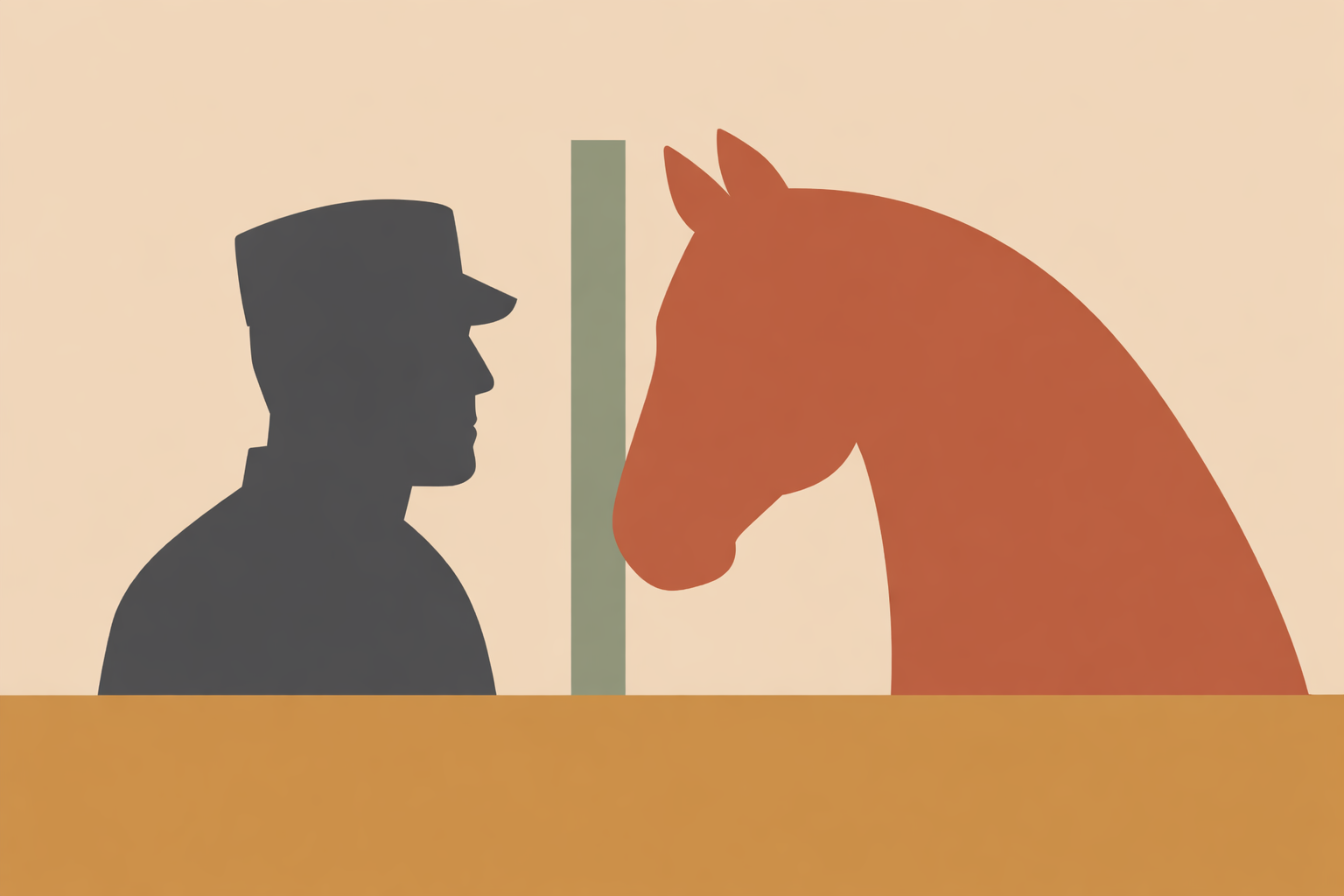
Equine work with veterans is powerful because horses meet people with steady, embodied honesty—and that makes safety non-negotiable. When safety is built in from the start, veterans and horses can both soften, and real contact becomes possible.
Across veteran programs, many sessions focus on groundwork—grooming, observing, and leading—so no riding skills are required. Horses offer feedback in the moment, helping veterans practice boundaries, breath, pacing, and trust with a partner who doesn’t ask for explanations.
Modern findings are beginning to echo what traditional horse cultures have long understood: horses can help people return to steadiness. In Columbia’s eight-week program, over half of participants reported meaningful reductions in PTSD and depression that lasted for months. A systematic review also notes how widely these services are growing for veterans, often through coaching, experiential learning, and horsemanship-based formats.
This isn’t a new idea—it’s a modern expression of an old partnership. Many veteran programs consciously honor these traditional partnerships by centering quiet presence, grooming, and mindful movement together.
With that spirit in mind, these five safety checks can become a simple ritual before every session—supporting veterans’ nervous systems and respecting the horses who stand with them.
Key Takeaway: Equine therapy works best for veterans when safety is treated as a repeatable ritual—clear team roles, protected horse welfare, predictable spaces, readiness screening with a co-made plan, and thoughtful pacing and integration—so both people and horses can stay regulated enough for real connection.
Safety check 1: Clarify your team, your role, and your scope
Safety begins before anyone enters the arena: name the team, define the roles, and stay disciplined inside them.
Veteran-focused equine work is inherently collaborative. Models like Eagala emphasize a team-based approach, where an equine specialist and a mental health professional work together—while treating the horse as a central member of the team. Clear co-facilitation lets sessions go deep without losing the structure that protects everyone.
In Columbia’s program, sessions were co-led using a consistent manual, supporting emotional depth with a structured protocol. A proposed standardized model similarly recommends groundwork-only sessions with mindfulness woven in, delivered by trained teams who understand both trauma and horsemanship.
Build a veteran-informed facilitation team
- Assign roles clearly: equine specialist, coaching/therapy lead, safety support, and program coordinator.
- Agree on shared language for horse behavior, pacing, and stop/slow signals—and rehearse it together.
- Design for the culture of service. Veteran-focused designations value facilitators who understand military culture so the space feels grounded and familiar.
- Keep communication crisp. VA guidance highlights clear roles and dependable handoffs as core safeguards.
As one practitioner notes, “Horses can detect when a person’s outward calmness hides inner turmoil… If a client says they’re fine but the horse behaves anxiously, practitioners see this as a cue to dig deeper” outward calmness. That kind of moment lands best when the team is aligned and confident about what it can—and cannot—hold.
Know your coaching scope and boundaries
- State what you offer: equine-assisted coaching and experiential learning. Avoid medical claims, and partner with licensed clinicians when needed.
- Decide red-line scenarios (for example: intoxication or acute crisis). Who pauses the session, and who follows up?
- Make pre-briefs and debriefs routine. Consistency protects trust.
Safety check 2: Prepare horses as respected partners, not tools
Human safety rests on equine welfare. When horses are chosen thoughtfully and treated as sentient partners, sessions become steadier—and more meaningful.
Select calm, social horses with known histories, and do a quick wellbeing check before each session. Discomfort and stress can show up as reactivity. Many veteran programs intentionally prioritize groundwork to reduce physical risk while still creating deep connection through breath, proximity, and touch.
PATH Intl. reminds us that equine-assisted services rely on horses who are physically sound and emotionally available. Put simply: the horse needs enough rest, turnout, herd contact, and skilled handling to remain willing and present.
Match horse temperament to each veteran group
- Start new groups with steadier horses; introduce more sensitive horses later for work around impulse awareness and pacing.
- Use varied equine partners (minis, seniors, seasoned schoolmasters) to match goals like confidence, boundaries, and calmer breathing.
- Teach body language and consent before first touch, aligning with guidance to respect animal needs.
Many practitioners observe that horses respond to subtle shifts in posture, breath, and intention, helping participants notice their own patterns without feeling judged. As PATH providers put it, “It is very empowering to partner with a thousand-pound animal (or even a 200-pound miniature horse!).”
Protect equine welfare to protect human safety
- Manage workload with rest days, water, shade, and good footing; burnout often looks like withdrawal or reactivity.
- Use well-fitting tack and choose halters/ropes suited to each horse’s sensitivity.
- Respect “no”: pinned ears, tight jaw, high head, swishing tail. Adjust the activity rather than forcing participation.
As Linda Kohanov says, “Horses help us to learn about ourselves, and to overcome our fears and limitations” overcome. That learning deepens when the horse is treated as a partner, not a tool.
Safety check 3: Create calm, predictable spaces and equipment
The environment teaches, too. A clear, predictable setup reduces hypervigilance for both veterans and horses, so attention can move from scanning to relating.
Walk the space before each session. Check gates, fencing, and footing; remove hazards flagged in common hazard checks. Inspect halters, lead ropes, and grooming tools—basic equipment checks that prevent avoidable surprises.
Many programs use contained spaces like arenas and round pens to support both physical safety and emotional containment. Groundwork-only approaches can lower risk while still supporting meaningful regulation and relationship skills.
Design arenas that soothe hypervigilance
- Keep sightlines open; reduce clutter near gates.
- Use consistent entry rituals (pause, breathe, orient to exits) to create predictability.
- Offer water and basic comfort supports like sun hats or ear protection when appropriate.
When the container is dependable, people can be pleasantly surprised by what opens up. As one participant shared, “I thought this would be an hour of awkwardness… I’m glad I decided to go—what I learned was enlightening” hour.
Treat tack and tools as a daily ritual
- Run your hands over ropes and halters; check snaps, stitching, knots, and fit.
- Stage cones, poles, and barrels before participants arrive to keep the session rhythm calm.
- Keep a simple “calm kit” at the gate: spare rope, towel, water, and a written stop protocol.
When the environment feels reliable, confidence grows—and qualities like focus and self-esteem often follow in these safe environments.
Safety check 4: Assess veteran readiness and co-create a safety plan
Readiness isn’t a judgment; it’s a form of respect. Simple screening and a personal safety plan support choice, agency, and steadier learning.
Start by meeting each veteran where they are. Explore stress load, sleep, and substance use patterns; safety planning work highlights certain risk factors that are worth naming early and kindly. Then help participants identify their early signs of rising activation—sensations, thoughts, or behaviors—so they can slow down before they feel flooded.
Animal partnerships can strengthen coping when the frame is clear. Studies of service dogs report better functioning across daily life for many participants, and dog-assisted psychotherapy research notes gains in adaptive skills. Think of it like this: supportive contact plus structure creates a safer pathway back to regulation.
Screen for red flags before entering the arena
- Ask about sleep, current medications or substances, and whether they’ve eaten and hydrated.
- Invite a simple 1–10 arousal rating and a 1–10 “window of tolerance” rating; if they don’t overlap, slow down.
- Confirm grounding options that already work: breathing, orienting, stepping aside for water, or a hand on the rail.
Next, co-create a written plan. The intention behind no-harm agreements is practical: clearer next steps reduce risk and increase follow-through. Many programs use simple plan templates because they keep language concrete and shareable.
Use safety plans as empowerment, not policing
- Write it together in plain language: early signs, actions, people to contact, and when to pause equine activities.
- Practice it on the ground: “If I hit 7/10, I step to the fence, breathe with the horse across the rail, and sip water.”
- Normalize choice: anyone can opt out at any time, without needing to justify it.
Families often feel the difference when a program centers agency. “This program helped my son while he was going through a rough patch… it helped him manage and overcome many obstacles,” shares one parent rough patch.
Safety check 5: Honour timing, weather, and post-session integration
Nature sets the tempo. Adapting to weather, herd energy, and group capacity—and closing well—can be as protective as any piece of equipment.
Begin with practical conditions. Many protocols include weather checks—heat, wind, cold, storms—plus shade, water, accessible first-aid supplies, and shorter sessions when fatigue rises for horses or people.
Mindfulness also belongs in the arena. Some models blend mindfulness with equine exposure, and many veteran programs add nature walks, yoga, tai chi, or creative reflection as integration ideas. Essentially, the goal is to help participants “carry the lesson home,” not just experience it in the moment.
Adapt to weather and group energy, not just the clock
- Shorten plans on hot, cold, or windy days; move to shade or a quieter covered area if available.
- If the herd is unsettled, choose observation and breathwork rather than close-contact tasks.
- Use simple pacing cues: if speech speeds up or shoulders rise, widen distance, slow movement, or step to the rail.
Close with care. Even brief therapy-animal interactions have been associated with changes in stress markers like cortisol and heart rate. A calm closing helps those shifts “stick,” and turns insight into a usable skill. Columbia’s program emphasized horses’ accurate feedback, and debriefing helps participants translate that feedback into everyday choices.
Close every session with grounding and reflection
- Three breaths with a hand on the rail; name one body sensation, one emotion, and one intention.
- Offer a clear “thank you” to the horses—voice, breath, or a gentle touch if welcomed.
- Share a small take-home: a journaling prompt, a photo of the setup, or a 60-second breathing practice.
As one participant reflected, “After the first session I was amazed… instant feedback on my own state and on relationship dynamics” instant feedback. Another shared, “I am a new woman… I attribute this to the companioning the facilitators provided, coupled with the gracious healing the horses offer” new woman.
Conclusion: Weave these 5 safety checks into your veteran equine practice
These five checks—team and scope, horse partnership, environment, readiness and planning, and timing and integration—create a repeatable safety ritual. Done consistently, they protect the lineage of horse–human partnership and support better experiences for veterans.
The direction of the field is encouraging. A systematic review connects equine-assisted services for veterans with trauma to improvements in quality of life, especially when programs are shaped around veteran culture. Hands-on horse care has also been linked to a more positive outlook over time—relationship, not spectacle, does the heavy lifting.
Because funding and access can be inconsistent in some regions where coverage patchy, safety-forward design matters for sustainability as much as it does for day-to-day facilitation. Many nonprofits support accessibility by prioritizing calm, safe environments for trauma survivors, including veterans.
For practitioners, the invitation is steady: keep learning, keep listening to horses, and keep refining the container. Equine work can complement other supportive approaches by easing nervous-system activation through breath, grounding, and repeated safe experiences. It’s also, as many of us witness, “phenomenal at team building and leadership within the context of our work lives” team building.
With any equine program, common-sense boundaries still matter: use trained teams, keep participation voluntary, and have clear escalation pathways when someone needs a higher level of support than a coaching environment can provide.
Train in Equine Therapy Practitioner
Build a safety-first framework for veterans using the Equine Therapy Practitioner course.
Explore Equine Therapy Practitioner →