In classes and client sessions, Fibonacci is an easy crowd-pleaser—until it isn’t. You show a sunflower, a shell, a spiral overlay, and the room nods along. Then someone asks about honeycomb, spiderwebs, or that storm image where the curve will not fit. Another notices the nautilus overlay drifting off after a few turns. In that moment, what matters is not having a grand claim. It is being able to tell the difference between a useful pattern tool and a universal law, and between symbolism and measurement, without flattening the wonder.
Key Takeaway: Treat Fibonacci as a powerful pattern family and composition tool—not a universal rule. In plants, Fibonacci-like counts are common but not absolute; in shells and other spirals, logarithmic growth matters more than forcing a golden fit; and in sacred-geometry practice, symbolic meaning is strongest when it is not confused with empirical fact.
Myth 1: Fibonacci is nature’s secret code
Fibonacci is beautiful, useful, and genuinely relevant in some recurring forms, but it is not a master key for everything. The sequence and the golden ratio do have a meaningful mathematical relationship, and it can be a wonderful doorway into pattern literacy. It just doesn’t explain every natural form or every pleasing design.
The “secret code” framing tends to train selective seeing. People collect the examples that fit, then quietly step around the ones that don’t. “It appears everywhere” sounds strong in a room, but it unravels quickly when learners bring real counterexamples.
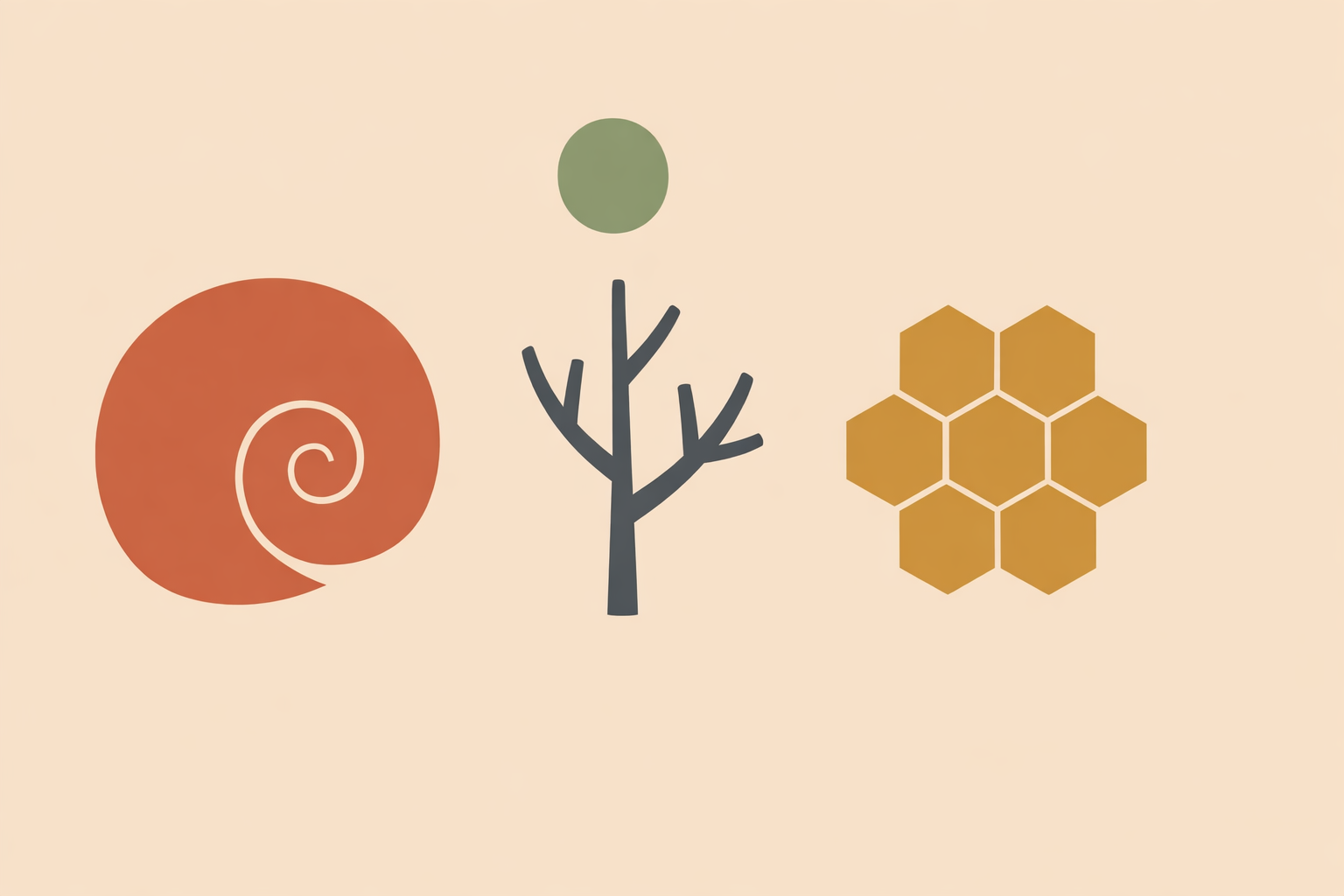
A steadier way to teach is to place Fibonacci where it belongs: as one pattern family among many. You can celebrate a sunflower while also making room for hexagonal honeycomb, branching trees, ripples, tiling, and irregular growth. Once one explanation is no longer expected to carry everything, the field gets richer.
- Language swap: Replace “nature’s secret code” with “a recurring pattern family we can observe, measure, and work with.”
- Teaching prompt: Bring three examples that fit and three that do not. This keeps pattern recognition honest.
- Studio cue: If a spiral must be forced to fit, do not call it proof. Call it an interpretation.
Framed this way, Fibonacci moves out of dogma and back into relationship. It becomes something to study, draw, test, and question.
Myth 2: Every leaf, flower, and seed head follows Fibonacci
This myth lasts because plants really do offer compelling examples. In sunflower heads and pinecones, 21/34 and 34/55 spiral counts show up often enough to leave a strong impression, which is why they’ve become classics in both art and mathematics.
Even so, plant patterning is best taught as a tendency rather than a rule. In phyllotaxis, divergence angles are often close to the golden angle of about 137.5°. This arrangement tends to efficient packing and good light access, so it’s no surprise that similar forms arise again and again.
And these arrangements don’t require a mystical blueprint. Steady spacing can emerge through simple local interactions as new leaves or seeds form into the largest available gap. Fibonacci-like counts can appear as a natural outcome of packing and spacing, without needing to claim plants are “following a code.”
Practitioner language makes the difference here. When you say, “Fibonacci often shows up where space must be shared fairly,” learners can connect the pattern to lived observation. They don’t need an invisible law; they need careful looking.
Careful looking also reveals variation. Fibonacci spiral counts are frequent, but they’re not guaranteed; many deviate. Visible spirals can also shift as the structure develops, with seedheads showing different parastichy pairs with scale. Non-Fibonacci arrangements can appear when growth is perturbed or spacing drifts, and the form can still be entirely healthy.
- Photograph the seedhead straight-on.
- Count spirals clockwise and counterclockwise.
- Record the pair without assuming it should be Fibonacci.
- If the count changes across the head, label it as a developmental shift.
A practical phrase I often return to is this: the plant is not failing the pattern; the pattern is describing one moment in a living process. That keeps observation precise while honoring the vitality of the form.
Myth 3: The nautilus shell proves perfect golden growth
The nautilus is one of the most repeated Fibonacci images, and it’s easy to understand why. It is elegant, self-similar, and visually persuasive. But the familiar golden overlay is often more aspiration than measurement.
The key distinction is straightforward: the nautilus is a logarithmic spiral, but it is not usually a golden spiral. Measurements place its average growth ratio at about 1.33 per quarter turn, not 1.618. For that reason, the shell is not golden in the strict mathematical sense, even though it still expresses graceful proportional growth.
That doesn’t make the shell less meaningful. It invites better language and cleaner teaching. “The nautilus shows logarithmic growth, and golden overlays are one visual comparison among several” keeps the image useful without asking it to carry more than it can.
A strong live demonstration is to measure the radius every quarter turn on a shell image. If the scaling matches phi, you can call it a golden spiral. If it doesn’t, name what’s there: a logarithmic spiral with a different growth factor. Learners usually trust measured clarity more than inherited slogans.
- Slide fix: Title the image “Nautilus: logarithmic growth.”
- Studio exercise: Compare a golden overlay with a best-fit logarithmic spiral.
- Language cue: “Beautiful” and “golden-ratio based” are not the same claim.
In sacred-geometry spaces especially, this is a helpful example of two truths sitting side by side. The shell may still symbolize unfolding, continuity, and return. Symbolically rich does not have to mean mathematically exact.
Myth 4: All natural spirals are golden
Most spirals in nature are not golden. They’re better described as logarithmic spirals with different pitches. The golden spiral is one special case within that wider family.
This becomes obvious as soon as you measure rather than assume. A review of natural forms notes that many natural spirals are logarithmic without precisely matching the golden spiral. Spiral galaxies follow the same broader logic: their arms are well represented by logarithmic spirals, with varying pitch angles rather than a single fixed phi-based rule.
For creative and contemplative practice, this is freeing. If you use spiral armatures in art, photography, or drawing, you don’t need every subject to resolve into 1.618. You can fit the curve that actually belongs to the form in front of you, which often improves composition and strengthens the quality of attention.
It also prevents cherry-picking. When only close matches are shown, Fibonacci looks universal because the mismatches were edited out. A more trustworthy visual practice includes both: the elegant fit and the awkward fit.
- Fit a general logarithmic spiral first.
- Note the growth factor.
- If it sits near phi, say so.
- If it does not, label it “logarithmic spiral” and move on.
That small discipline keeps pattern work clean. It also opens a wider visual vocabulary, which is often where the real creative energy starts.
Myth 5: Fibonacci patterns prove a timeless spiritual law
This is the deepest confusion, because it’s less about numbers and more about mixing two kinds of language without naming the difference: symbolic meaning and empirical claims.
Spirals and proportional systems hold a valued place in many traditions. They can evoke balance, continuity, emergence, and interconnection. Used with care, they offer a strong contemplative language, and none of that depends on forcing every motif into phi.
Overfitting phi onto diverse traditions can also flatten their histories and unique meanings. In practice, it’s more respectful to name a symbol within its cultural roots than to project one universal story across many lineages. This matters in sacred-geometry teaching, where enthusiasm can easily outrun context.
The cleanest approach is two-language communication:
- Measurement voice: “This rectangle relates by 1:1.618, so we can use it as a golden rectangle.”
- Symbolic voice: “For some people, this spiral suggests expansion and return.”
When these voices stay distinct, learners can choose how they want to engage. Some will love the measured structure. Others will respond more to contemplative meaning. Both are valid, and neither needs to impersonate the other.
This clarity also supports inclusive, non-judgmental facilitation. Claims that phi defines an ideal body or face don’t hold up well under scrutiny. A recent review found no convincing evidence that golden-ratio conformity drives aesthetic preference, and one facial assessment study reported no association between phi-based measures and evaluation scores. The practical takeaway is that proportions are tools for exploration, not standards people are expected to match.
- Consent language: “Use any armature that feels supportive, or skip the grid entirely.”
- Grounding language: “We are exploring structure, not ranking bodies or faces.”
- Respect cue: If a motif comes from a living tradition, name the source and avoid rewriting it through a Fibonacci lens.
When these boundaries are kept, the work becomes calmer and more trustworthy. Symbolism is free to inspire, and measurement is free to clarify.
Conclusion: Fibonacci as pattern language, not doctrine
Letting go of Fibonacci myths doesn’t reduce the beauty of the pattern. It restores proportion. Fibonacci belongs to a wider field of recurring forms: spirals, branching, symmetry, tiling, packing, and rhythm. In that wider context, it becomes more useful because it no longer carries the burden of being everything.
In practice, this means observing carefully, measuring honestly, and naming what you actually see. Sometimes the count will be 21/34. Sometimes the shell will grow closer to 1.33 than 1.618. Sometimes the spiral overlay will fit beautifully, and sometimes another armature will serve the work better. That flexibility is mature pattern literacy.
- Observe three spirals from different contexts.
- Measure before labeling.
- Separate symbolic meaning from empirical description.
- Teach both wonder and precision together.
One caution is worth keeping in view: avoid turning a pattern tool into a value system, especially around human appearance or cultural symbols. With that boundary in place, Fibonacci stays what it does best: a living pattern language that invites curiosity, discernment, and respectful use.
Explore Sacred Geometry Certification
Deepen your symbolic and measurement-based practice with the Sacred Geometry Certification.
Explore Sacred Geometry →