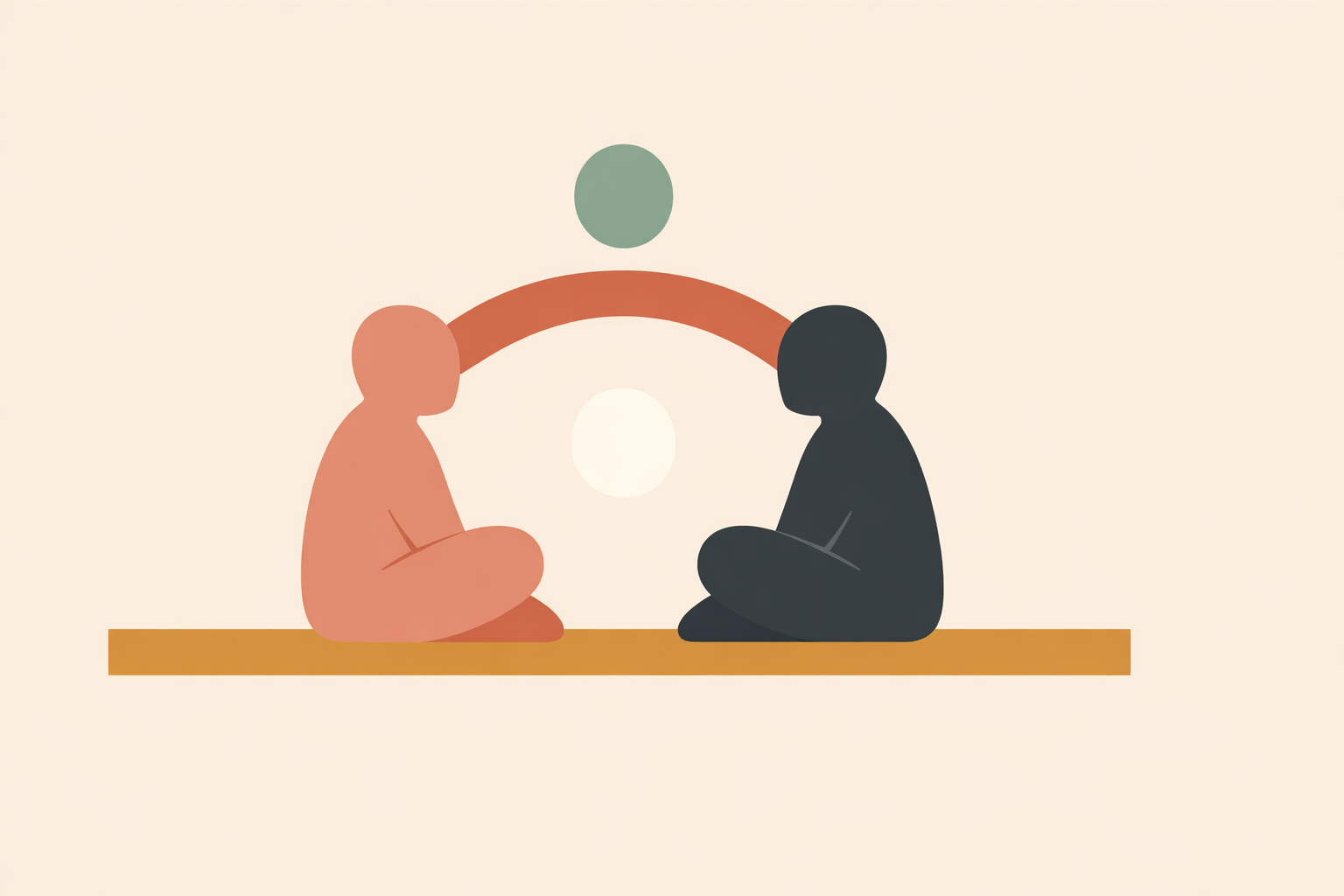
Talk-based coaching works—until it doesn’t. You can clarify goals, reframe the story, tighten the action plan, and still find the client can’t reach the feeling under the words. The mind keeps circling; emotion runs hot or goes quiet. In those moments, a gentle creative process can shift the session while staying within coaching scope.
The aim isn’t “doing art.” It’s using simple, low-pressure activities to help someone express what language can’t yet hold, then turning that insight into a grounded next step.
Arts-based coaching is a present-focused approach that uses drawing, collage, writing, movement, and other accessible activities to support reflection, self-awareness, and action. It remains distinct from formal art therapy by staying client-led, goal-aware, and centered on well-being rather than interpretation.
Key Takeaway: Arts-based coaching uses simple, time-bound creative activities to complement conversation and support client-led insight within clear coaching scope. It works especially well when reflection has become repetitive and a more embodied, expressive route can help the client reconnect with meaning, choice, and action.
What arts-based coaching is, and how it differs from formal art therapy
Arts-based coaching uses creative process to help clients externalize inner experience, gain perspective, and choose their next step. It might involve drawing, collage, movement, writing, or image-based reflection. In facilitation settings, expressive arts is commonly described as using creative process for growth, self-expression, and well-being in coaching and educational contexts, not only in clinical ones—consistent with how expressive-arts facilitation is often taught.
The distinction from formal art therapy matters. In coaching, the role is not to analyze imagery, assign fixed meanings, or move beyond your scope. The role is to guide a structured process, ask thoughtful questions, and help the client connect what emerged to present-day choices.
A clear framing statement can help:
“I offer arts-based coaching to support expression, reflection, and next steps. This work is present-focused and goal-aware. It is not formal art therapy, and if your needs fall outside my scope, I will help you find appropriate support.”
That kind of language protects the client, protects the practitioner, and keeps the work honest.
A simple five-phase structure for arts-based coaching sessions
Most arts-based coaching sessions follow a gentle arc: arrive, set an intention, create, reflect, and integrate. The structure is simple, but it gives both coach and client something steady to lean on.
1. Arrive and check in.
Begin with consent, timing, and choice. Keep the opening small: one feeling, one sensation, one hope for the session. If the client doesn’t want to speak much at first, let the creative process do the heavy lifting.
2. Set an intention.
Offer one brief invitation linked to the client’s goal. For example:
- “Create two images: where you are and where you want to move.”
- “Show today’s inner weather.”
- “Make a collage of what supports you and what drains you.”
3. Create.
Keep instructions short and normalize experimentation. A five- to 15-minute warm-up reduces self-judgment and makes the process feel safer. You don’t need a masterpiece; you need enough honesty for something useful to emerge.
4. Reflect.
Ask the client to describe before explaining. Useful prompts include:
- “What do you notice first?”
- “What stands out?”
- “What surprised you?”
- “What part of this feels most connected to your goal?”
5. Integrate.
Bring the session back to everyday life. Ask what the client wants to remember, what one small action follows from the work, and what they want to do with the piece itself. Keep the closing calm and practical.
This five-phase arc works because it balances freedom with structure. It lets the client explore without drifting.
How creative process supports insight and change
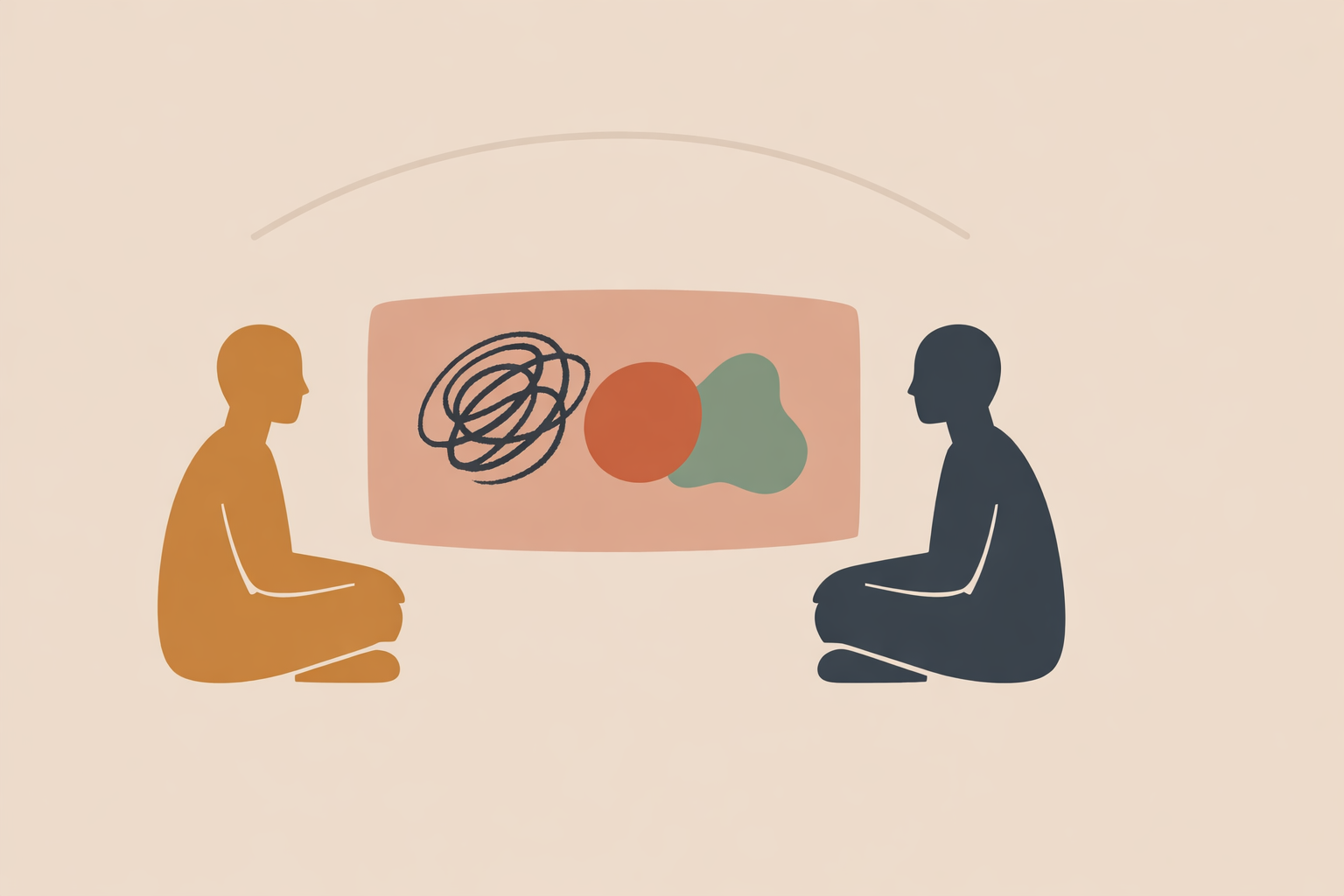
Creative work helps because it moves experience from inside the person to something visible. When a feeling becomes an image, a shape, a color field, or a few lines on a page, it can be observed instead of only endured. Research on creative arts interventions suggests that emotional externalization can support self-awareness and regulation.
A client who says, “I just feel blocked,” might draw a wall with one small opening. Suddenly there’s something to work with. The conversation shifts from abstract frustration to a concrete question: what helps widen that opening?
Image and object work can also change the felt sense of choice. A client can place a burden outside themselves on the page, give it shape, rename it, shrink it, move it, or place a boundary around it. These small acts often create distance and agency that talk alone struggles to evoke.
Creative engagement tends to involve attention, sensation, memory, and imagination all at once. Traditional practice has long recognized that this kind of whole-person involvement softens rigidity and invites new responses. When the hands are engaged, the story often starts to move.
Choosing the right medium for the coaching goal
Different materials invite different kinds of reflection. Choosing the medium well makes the session feel natural and useful.
- Pencils or pens: suit precision, mapping, journaling, and structured reflection.
- Paint or pastels: invite sensory flow, feeling, and less controlled expression.
- Collage: supports selection, comparison, rearrangement, and pattern-seeing.
- Clay or tactile materials: feel grounding and immediate through touch.
- Writing: helps shape narrative, clarify values, and hear different inner voices.
Collage is especially supportive for identity and values work because it lowers performance pressure. The client doesn’t have to invent from scratch; they can select, place, layer, remove, and rearrange until something fits.
Writing can be ideal for clients who feel exposed by visual work. A five-minute free write, an unsent letter, a dialogue between two parts of the self, or a short “I choose” poem can bring structure without making the process heavy.
Whatever medium you choose, let the client define meaning. Avoid fixed symbolism. Ask, “What does this color carry for you today?” or “What does this shape seem to know?” Personal and cultural associations matter more than generic interpretations.
Access matters too. Offer large-grip tools, digital options, dictation, tactile objects, high-contrast materials, or spoken imagery when needed. Inclusion is part of good facilitation.
Useful prompts for arts-based coaching
The best prompts are brief, clear, and open enough for the client to make them their own.
- Clarity: “Draw the situation as it feels right now.”
- Decision-making: “Make a collage of competing priorities, then rearrange them.”
- Values: “Write 10 lines beginning with ‘I choose…’”
- Boundaries: “Draw two circles: what is in, and what is out, this week.”
- Support: “Create an image of what steadies you.”
- Transition: “Show now and next in two panels.”
Match the prompt to the person in front of you. Visual work can interrupt overthinking for highly verbal clients, while writing or verbal imagery can feel safer for clients who resist drawing. The aim is a form that helps truth move.
Facilitation skills matter more than being “artistic”
You don’t need to be an artist to facilitate meaningful arts-based coaching. What matters is your presence and how you hold the process. In facilitator training, the emphasis is typically on boundaries and support skills, and facilitation skills are treated as central.
Useful facilitation skills include:
- attentive listening
- clear, uncluttered prompts
- respect for pace and consent
- cultural humility
- the ability to notice activation and slow the process
- the discipline to return meaning-making to the client
Good facilitation helps the client meet their own material in a supported, ethical way, then translate it into choice and action.
Safety, pacing, and scope
Arts-based coaching can be gentle and effective, and it can also bring up strong emotion. For people under intense stress or experiencing trauma-related activation, expressive work can feel like a lot at once. That’s where pacing, consent, and scope become the foundation.
Keep the work present-focused. Offer simple prompts. Make it easy to pause, shift medium, or stop entirely. If activation rises, slow down and return to choice.
A practical safety checklist includes:
- clear consent about the activity and its possible emotional effects
- freedom to pause or opt out without explanation
- gentle grounding options such as feet on the floor, looking around the room, or holding a neutral object
- less activating alternatives such as tracing, pattern-making, or short writing
- clear referral boundaries when needs move beyond coaching scope
The artwork is not evidence, and it isn’t a hidden code to be cracked. It’s a doorway into the client’s own meaning-making. Stay with questions like, “What do you notice?” and “What feels important here?”
Training in this area should be explicit about boundaries. Programs in therapeutic or expressive arts facilitation commonly distinguish present-focused support from psychotherapy and place this work in coaching, education, leadership, and well-being settings, while also emphasizing scope and referral when appropriate.
What progress can look like over time
Arts-based coaching usually works through accumulation rather than dramatic breakthrough. A single session can bring relief, clarity, or one useful next step. Over time, patterns become easier to see and easier to shift.
Many practitioners use weekly sessions and shape the work over a short series, then invite brief between-session practices to maintain momentum. Even five to 15 minutes a few times a week can keep the thread alive.
Over time, you may notice changes such as:
- richer emotional language
- more consistent self-observation
- clearer boundaries
- greater ease naming values and priorities
- small actions taken with more steadiness
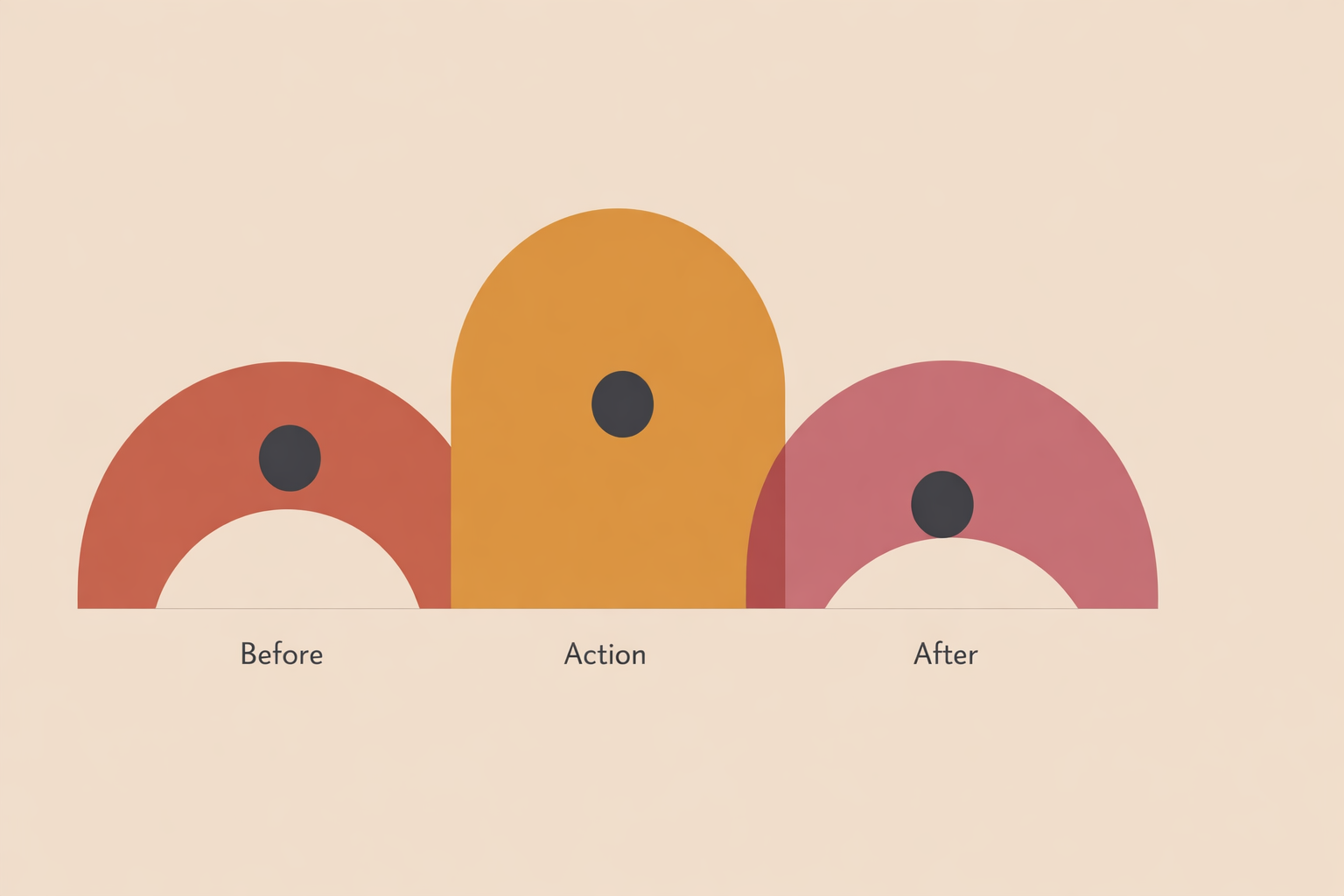
A simple way to track shifts is a quick pre- and post-activity rating. Ask the client to rate clarity, emotional intensity, connection to goal, or perceived usefulness on a 0–10 scale. It keeps progress visible without turning the session into an assessment exercise.
Often the most meaningful change is modest: a client who arrives saying “everything is too much” leaves with one named feeling, one clearer boundary, and one next step they genuinely want to take. In coaching, that counts as real movement.
Bringing arts-based coaching into practice with integrity
Arts-based coaching isn’t about making people artistic. It’s about offering another path into awareness, expression, and choice—especially when sessions get overly verbal or stuck.
Start small. Try an inner-weather drawing, a two-part collage of now and next, or a short values poem. Use a clear structure, keep prompts light, reflect before interpreting, and close with one grounded action.
Hold the work with integrity. Respect cultural roots, stay within scope, and let the client’s meaning lead. Creative and expressive therapies practice has long helped human beings make meaning and restore balance; used well in coaching, it helps clients see more clearly, feel more honestly, and move forward with steadier intention.
Explore Therapeutic Arts Certification
Build ethical, client-led creative facilitation skills with the Therapeutic Arts Certification.
Explore Therapeutic Arts →