Most architecture teams know the frustration: a concept that looks resolved in 2D can unravel the moment it becomes 3D. A clean plan may hide ventilation routes that clash in section, a façade idea that complicates structure, or daylight goals that slip once the mass turns toward the sun. When the governing logic isn’t clear in the sketch, parametric tools can multiply options instead of clarifying them—and the project slowly drifts from intention into compromise.
A steadier anchor is to begin with biomimicry, letting natural patterns and living-system logic guide the earliest lines. When the building is treated as an ecosystem—with flows, hierarchies, and relationships—your 2D rules already contain the “why,” so 3D modeling becomes a reveal rather than a translation. Curvature, proportion, climate response, and material behavior are embedded early, helping drawings and models speak one language.
Key Takeaway: Treating a building like a living system keeps intention consistent from hand sketch to parametric model. Start with natural geometry and site cycles in 2D, then elevate those rules into 3D to simulate light, air, water, materials, and habitat—so performance is verified, not reinvented.
2D Sketching with the Hand and the Land
The most reliable 3D models tend to start in a quieter place: pencil, paper, and attention to what the site is already doing. Two-dimensional sketching sets the project’s “metabolism”—proportion, orientation, and relationships—so the later model doesn’t have to invent coherence.
A strong beginning is slow linework guided by natural geometry: golden ratios, catenary curves, harmonic spacing. Naturalistico’s approach starts here as well, grounding early sketches in golden ratios and catenary vaults—patterns many traditional builders learned by watching how weight, wind, and gravity behave. Think of it like tuning an instrument before you play: proportion sets the tone for everything that follows.
From there, map relationships that carry daily life. As Naturalistico frames it: “Sketch by hand to clarify relationships, then model and test light, structure, and living systems together so your visuals and exports stay true to the organism you’re designing.” The point isn’t just room placement; it’s rhythm—morning light where it’s wanted, entrances that meet prevailing breezes, and transitions that feel natural in the body.
Traditional pattern language fits easily at this stage. Circulation can echo spiral growth patterns; façade fields can borrow Voronoi-like logic to modulate light and view. Antoni Gaudí is a timeless example: his hanging-chain studies shaped vaults because the geometry held true from sketch through model. Modern work continues that lineage with catenary models and digital tools, and technical reviews note how his catenary logic supported precise, materially efficient vaulting.
Let natural geometry guide your first lines
- Choose one generative rule for the plan (e.g., golden rectangles) and follow it consistently.
- Mark sun, wind, and water notes directly on the plan margins so relationships are never abstract.
- Test a catenary or harmonic grid beneath your sketch; adjust room boundaries to sit “in tune.”
Mapping Climate and Cycles in 2D First
Before massing, let climate “draw” with you. When sun, wind, and water are mapped in plan and section early, comfort and resource flow become structural—rather than decorative features added late.
On paper, trace seasonal sun paths, prevailing winds, and water movement across the site. Naturalistico encourages doing this from the start—“On graph paper, map the relationships that make the place feel alive: hearth to garden, entry to prevailing wind, bed to morning light”—so environmental intelligence is present in the first decisions. Then, in section, the prompt becomes: “Draw the vertical story… a dome or vault reveals how thickness, openings, and curvature shape comfort.” Essentially, you’re designing cause-and-effect, not just form.
Eastgate’s termite-mound inspiration keeps proving the point: when air paths and stack effects are shaped intentionally in section, the approach can support comfort with around 70–90% less energy for ventilation than typical comparisons. That’s why the 2D section matters—it’s where airflow becomes real.
Newer work expands the palette without losing the same basics. The Tower of Life in Dakar explores 3D-printed clay membranes inspired by termite mounds, aiming for energy-positive envelopes using local, biodegradable material. The core move is still traditional in spirit: diagram the flows first, then let the model confirm what the diagram promises.
Drawing the vertical story of wind, sun, and water
- Overlay solar arcs and shading zones onto plan; note seasonal differences.
- Sketch a section that shows buoyancy paths for air, mass for storage, and vents for purge cycles.
- Trace water routes: roof capture, filtration beds, and gravity-fed reuse to gardens.
From 2D Lines to Living 3D Forms
In 3D, the sketch starts to “answer back.” The goal is to choose tools and habits that protect your original relationships—so proportion, curvature, and climate logic stay intact as the form becomes spatial.
Many teams block out volume quickly in SketchUp, then move into Rhino with Grasshopper to control NURBS curves and meshes. That shift helps natural geometries—branching, shell forms, venation-like networks—translate more faithfully. Naturalistico captures the mindset well: “Lift your 2D plans into 3D and start ‘listening’ from the inside. Proportion, curvature, and light become immediate—this is where the space begins to speak back.”
Here’s why that matters: 3D reveals how forces travel through curves, how openings affect structure, and where mass should gather for comfort. When parametric relationships stay connected, you can explore changes without breaking the underlying “bones” of the design. In practice, working in 3D can reduce redesign effort, with some reporting suggesting about 25% less design time compared with 2D-only CAD workflows.
Biomimicry is also gaining momentum through data. Generative design can draw on large datasets of natural morphologies, allowing forms to evolve from pattern and performance rules. A striking example is Berlin’s Crow Skull Pavilion, where lightweight shell geometries derived from CT scans show how organic logic can become buildable structure.
Choosing 3D tools that protect the flow of your sketch
- Start with fast massing to test adjacency and height, then refine with NURBS/mesh tools for curvature.
- Keep parametric “bones” (grids, catenaries, venation) connected to your model so changes ripple coherently.
- Use section cuts early. If the section stops breathing like your sketch, adjust before chasing details.
Using 3D to Model Light, Energy, and Life
Once the form holds together, bring the flows to life. Simulation turns 3D from a visual exercise into a working laboratory for daylight, airflow, heat, water, and planting—so the design evolves as a whole system.
Even simple studies are powerful. A model can simulate daylight across seasons, visualize airflow under different wind conditions, and show how temperature may behave across materials and air volumes. You’ll quickly see where shade lands, where warm air pools, and where microclimates form. Research reviews note catenary-inspired shells and porous skins can improve shading behavior and support more efficient ventilation strategies.
From a traditional lens, “life” isn’t decoration—it’s part of the architecture’s role. Naturalistico encourages designers to make cycles explicit: “Model the cycles you want the space to support.” That includes integrating systems like interior planters and water loops early, so they’re spatially honest and easy to maintain. On the urban habitat side, vertical forest concepts like Bosco Verticale have reported biodiversity increases of about 30% in species presence when building envelopes also serve as habitat.
Materials belong in this same loop of testing and refinement. Pilots in bio-inspired construction include self-healing concretes and biologic bricks, with project reporting suggesting durability gains of up to 2x and cement reductions near 80%. Add VR and AR walk-throughs, and stakeholders can experience comfort and spatial rhythm early—often the moment when living-system features become non-negotiable.
Simulating microclimates and regenerative cycles in your model
- Run daylight snapshots for solstices/equinoxes; align openings and massing to reduce glare and boost winter warmth.
- Use basic CFD or airflow proxies to test buoyancy paths; adjust inlets, outlets, and section curvature.
- Place soil, water, and planting volumes in the model; size beds and wetlands by gravity and maintenance logic.
Renderings and Portfolios that Show Living Design
Your visuals should carry the same integrity as your process. When renders make light, air, water, planting, and structure legible, people can trust what they can’t yet walk through.
Clear visualization helps non-specialists understand complex biomimetic decisions—porous skins, layered habitats, earth-formed curves—without reducing them to vague “green” claims. High-quality 3D rendering makes system logic visible. Industry commentary suggests performance-forward visuals can increase stakeholder buy-in by around 60%, largely because comfort, daylight, and planting benefits become easy to grasp.
Portfolios land best when they show the full arc: hand sketch, climate-marked plan/section, parametric exploration, then final visuals. Naturalistico recommends sharing the entire journey to demonstrate literacy, iteration, and care. It also helps to connect nature-inspired design with practical outcomes—some reporting links these approaches to less waste and leaner material use when the system is designed coherently from the start.
Collaboration tools can protect the concept through later phases. When teams share models and annotated PDFs via cloud-based workflows, it’s easier to keep the biomimicry goals visible—so essential system features aren’t quietly stripped away as budgets tighten.
Turning your 2D–3D process into a story clients can trust
- Sequence images: hand sketch → climate-mapped plan/section → parametric iterations → performance overlays → final render.
- Annotate with short, plain-language captions that connect each design move to comfort or cycles.
- Include one page per “living system” (light, air, water, habitat) so value remains visible through later project phases.
Conclusion: Make Biomimicry Your 2D–3D Advantage
The shift from drafting to living-system design is less about chasing tools and more about holding a clear thread of intention. When you sketch with the land, map climate in section, lift geometry faithfully into 3D, and test cycles inside the model, the “handoff” disappears. You’re simply working in two dimensions and three dimensions with the same set of principles.
As you apply these ideas, keep your practice rooted in respect: honor vernacular lineages, credit Indigenous knowledge holders, and avoid lifting cultural patterns without context. And, of course, balance ambition with real-world constraints—site conditions, budgets, and maintenance capacity should shape which living systems you include and how you support them over time. Done well, 2D and 3D become two hands of the same craft, shaping spaces that belong to their place.
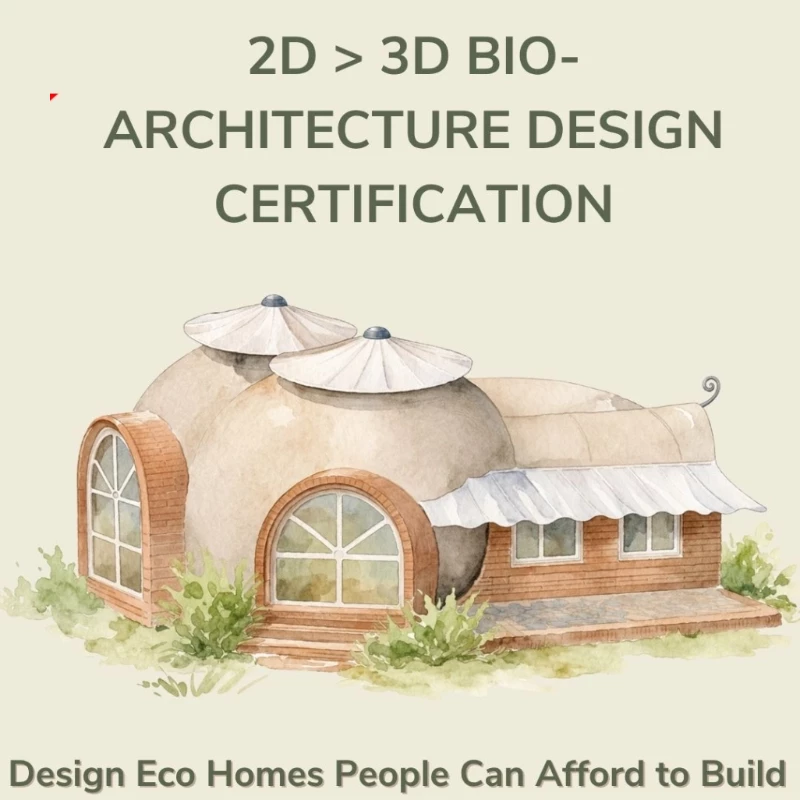
Master 2D–3D Bio-architecture
Apply this biomimicry workflow step-by-step in the 2D-3D Bio-architecture Design Certification.
Explore the Certification →