Walk a site and you’ll often feel the tension straight away: a client asks about geopathic stress or Hartmann lines, while your floor plan and meter kit pull you toward light, airflow, moisture, and wiring. Treat legacy maps as fixed facts and you risk overclaiming. Dismiss them entirely and you lose a time-tested way of focusing attention and starting a practical, respectful conversation. The grounded approach holds both: inherited frameworks and observable home conditions.
Key Takeaway: Modern geobiology is strongest when traditional frameworks organize attention, while small, testable adjustments guide decisions. Ancestral land-reading still informs how practitioners think about shelter, airflow, and placement; grid systems can function as inquiry maps rather than fixed truths; intuitive tools can be useful when clearly separated from measurements; and concerns about “geopathic stress” often translate into practical checks around humidity, layout, light, and electrical exposure. Good practice stays transparent, proportionate, and responsive to what actually changes in a home.
Hartmann grids as inquiry maps, not fixed answers
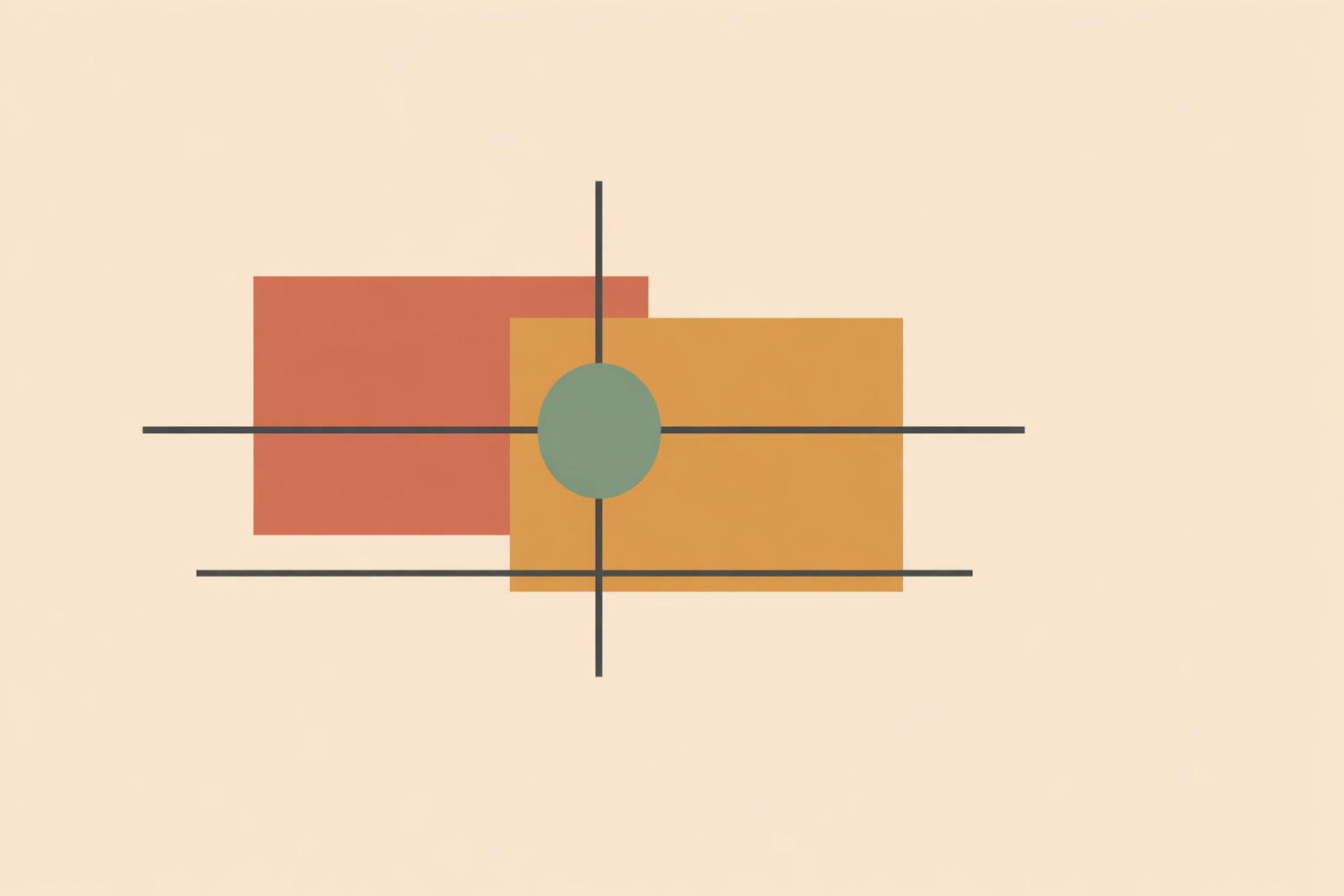
Many practitioners first meet geobiology through stories of early grid mapping. Ernst Hartmann is widely associated with a rectangular Hartmann network in the 1950s, often described as running north-south and east-west with repeating spacing patterns.
Whether you take that framework literally or symbolically, it can still be useful as a way to organize attention. A suspected crossing point invites better questions: How is this spot used? Is someone sleeping there or sitting there for hours? What else is nearby: outlets, glare, dampness, awkward circulation, devices, or a cold exterior wall?
When the grid becomes a prompt rather than a verdict, it helps you choose what to test first.
In a bedroom review, you might sketch a tentative grid over the floor plan and notice the bed appears to sit on a crossing near an outlet wall. Instead of calling that “the cause,” try a reversible trial: shift the bed slightly, reduce nearby electrical load, and track comfort for a week. If nothing changes, you move on to other likely factors such as glare, noise, mattress support, or airflow.
Used this way, historical grid systems sharpen observation without forcing certainty.
Dowsing rods, pendulums, and antennas in site work
Modern geobiology often includes intuitive tools such as dowsing rods, pendulums, muscle testing, and resonance antennas like the Lecher antenna or lobe antenna. These tools remain part of living practice for those who value subtle perception and embodied sensitivity during a site reading.
At their best, they structure intuition. They slow you down, bring attention to particular zones, and create a repeatable ritual of noticing.
They are also human instruments. Dowsing and pendulum responses can be shaped by expectations, question wording, and micro-movements, and are therefore susceptible to bias. That doesn’t make them useless; it makes honest documentation part of good craft.
A strong working habit is keeping separate notes for impressions and measurements. An impression might record that a Lecher antenna response felt stronger along one side of the bed. A measurement might show different magnetic-field readings with a lamp on or off. Both can be meaningful, but they are different kinds of information.
Within subtle-energy circles, the Lecher antenna is commonly used as an adjustable resonance tool, while the lobe antenna is often used directionally. These are practice tools, not standardized environmental meters. When they’re used, document settings, locations, and interpretations clearly, and avoid presenting them as equivalent to calibrated electrical or radiofrequency instruments.
Naturalistico’s practice history offers a helpful overview of how these approaches evolved within the broader field.
Translating geopathic stress into practical home checks
When a client says “geopathic stress,” the most helpful response is usually translation, not debate. Ask what they’re noticing, where they feel it, and when it becomes strongest. The term may come from practitioner language rather than standardized environmental terminology, but it often points to something real in daily experience.
From there, older expressions such as telluric currents, faults, or water veins can become prompts for observation. Is there dampness under the room? Is the building sitting over shifting moisture? Does the space feel stuffy, overglared, or thermally uncomfortable?
Groundwater and moisture movement can affect a building in very practical ways, so humidity is a clean starting point. The EPA recommends indoor humidity at 30–50% to help reduce mold and mildew growth.
Other adjustments are often simple and revealing:
- Open the room for a period of cross-ventilation and notice whether the space feels lighter.
- Reduce glare around midday with shades, curtains, or a small furniture shift.
- Move a chair or desk away from a cramped circulation path.
- Soften hard edges or materials if a room feels visually sharp or restless.
Practitioner traditions also speak about shape and geometry influencing the felt atmosphere of a room. You don’t need grand claims to work with that idea. Sometimes changing one harsh edge, one reflective surface, or one awkward furniture relationship noticeably improves comfort or focus.
The principle is straightforward: let subtle language guide attention, then test what can actually be changed.
EMFs, distance, and radon: practical distinctions that matter
In home work, it helps to separate different invisible influences rather than grouping everything under “radiation.” Non-ionizing electromagnetic fields and ionizing concerns such as radon are not the same, and they call for different responses.
In a home, voltage produces electrical fields and current produces magnetic fields. Low-frequency EMFs are mainly associated with wiring and appliances, while higher-frequency RF fields are mainly associated with Wi-Fi, mobile devices, and broadcasting. The most useful practical principle is often distance: increasing distance from a source can noticeably lower measured exposure where someone sleeps or sits for long periods.
That leads naturally to proportionate layout choices:
- Keep beds, cribs, and long-sit areas away from meter panels, utility walls, large appliances, or equipment when possible.
- Move routers away from bedrooms if that suits the household.
- Avoid charging devices directly beside the body during long rest periods.
- Use spot checks and simple layout changes before jumping to larger conclusions.
Families often report that moving a crib or bed away from a heavily energized wall improves settling and sleep quality. In practice, what matters is logging the change, observing the household response, and keeping your reasoning clear.
Radon belongs in a different category. It cannot be detected by sight or smell, so testing is the dependable first step when there’s reason to check.
This is balanced geobiology in action: stay open to the concern, then answer it with clear distinctions, observation, and proportionate action.
Place memory and gentle energetic cleansing
Many homes carry a felt atmosphere that people describe in personal language: heavy, flat, unsettled, or burdened by what has happened there. The language of place memory gives shape to that experience. Whether you understand it symbolically, relationally, or through subtle-energy practice, it can be approached with care and respect.
Often the most effective forms of energetic cleansing are also the simplest. Ventilate the room. Let sunlight reach fabrics. Reset lighting. Rearrange one stagnant corner. If the household wants a ritual element, add it with consent and cultural respect.
The practical value is often rhythm and renewal. A room that is aired, reordered, and consciously marked as “new again” can feel genuinely different to the people living in it.
One gentle sequence some practitioners use is a four-corners practice: air the room, pause at each corner with a breath and an intention, then refresh textiles and surfaces. Clients often describe clearer focus and a lighter mood afterward. This doesn’t need to be framed as a measurable contaminant being removed; it can be held as a sensory and symbolic reset.
Similar care applies to language around “vitality” scales or vibrational frequency. These can function as useful symbolic tools within a subtle-energy framework, but they shouldn’t overrule the basics of air quality, light, layout, and comfort. Symbolic language works best when it stays in right relationship with observation.
If you want to experiment with fragrance, fresh air, or visual warmth, keep the approach grounded and well-documented. Gentle changes, clearly observed, tend to serve households better than dramatic claims.
A modern geobiology workflow that stays accountable
The most trustworthy site work blends traditional sensitivity with practical method and gives each its proper place.
A clear workflow can look like this:
- Begin with the household’s question: what feels off, where, and when?
- Map the space neutrally: beds, desks, pathways, openings, utilities, and patterns of use.
- Observe the basics: light, noise, temperature, humidity, airflow, materials, odors, visible dampness, and arrangement.
- Measure what is appropriate: humidity, temperature, radon when relevant, and simple EMF spot checks if they fit the concern.
- Record intuitive impressions separately from measurements.
- Offer more than one possible interpretation.
- Start with small, reversible changes: move, ventilate, shade, unplug, reroute, soften, or rotate.
- Review the effects after lived experience has had time to speak.
Two phrasing habits help keep trust strong. Describe what you observed before explaining what you think it means. Present subtle findings as impressions or working hypotheses, not fixed verdicts.
This matters most in areas where strong opinions already exist, such as EMFs. A steady practitioner voice respects concern without amplifying fear, and it prioritizes lived outcomes over dramatic explanation.
Seen this way, historical frameworks such as Hartmann lines remain welcome in modern practice because they help begin the conversation with structure and attention.
Closing perspective
Geobiology is at its best when it’s lived as a disciplined art of attention. Ancestral land-reading trains the eye for shelter, exposure, water, and rhythm. Grid systems encourage mapping and comparison. Dowsing, pendulums, and antennas keep subtle perception in the room, while practical checks keep the work honest and responsive.
In real homes, well-being rarely comes from one single factor. It usually grows from several small influences working together: air quality, light rhythms, sound, thermal comfort, arrangement, household habits, and the felt meaning of place.
To keep the practice strong, bring your best observation, honor cultural roots, and document changes carefully over time. In the conclusion of any site review, it’s also worth naming limits clearly: intuitive tools can be influenced by bias, and certain concerns (like radon) require straightforward testing. With that balance, geobiology stays both traditional and accountable.
Explore Geobiology Certification
Deepen your home-assessment approach with the Geobiology Certification, balancing tradition with practical, testable observations.
Explore Geobiology Certification →