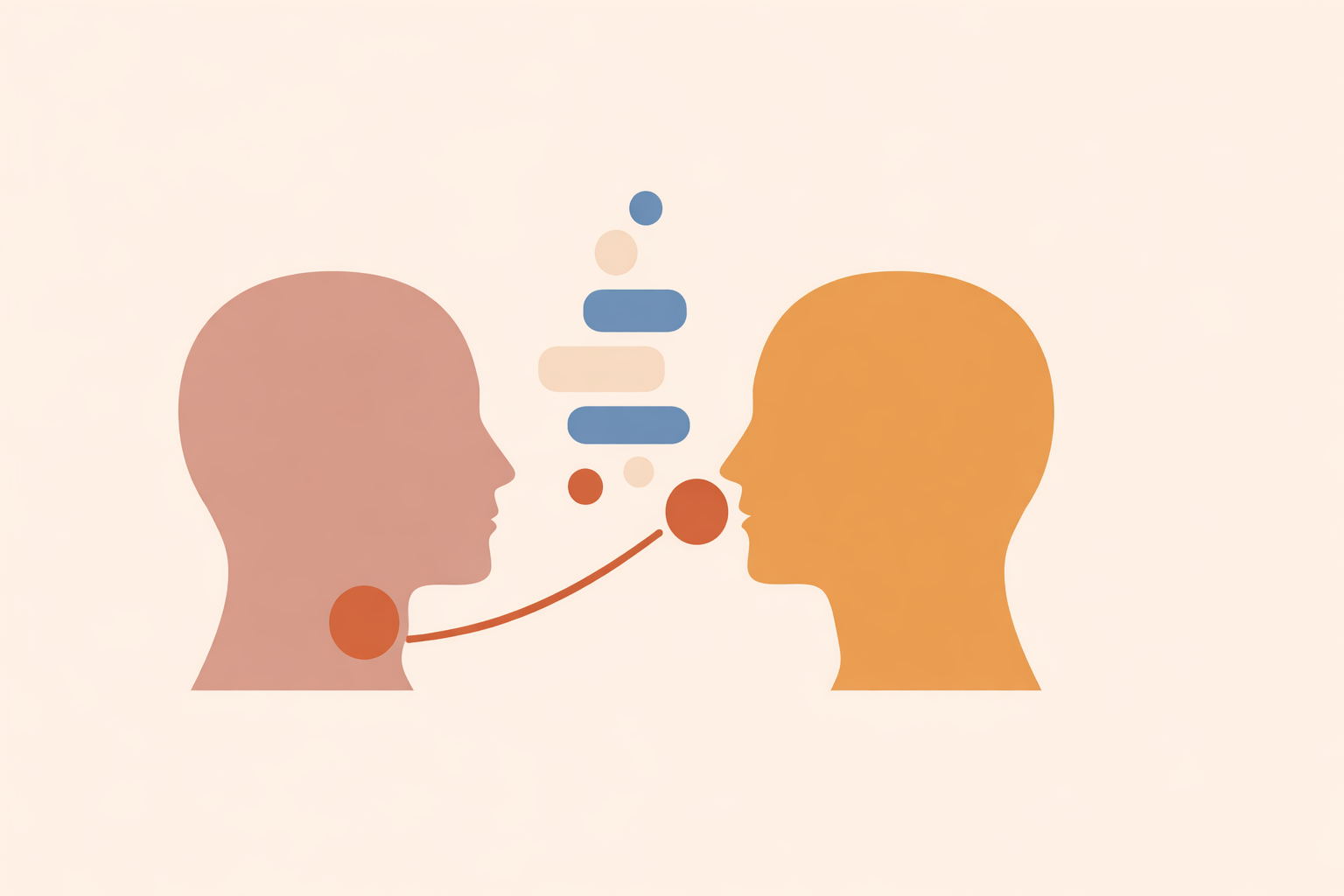
Practitioners often reach for techniques when someone tightens up: a new exercise, more analysis, a stronger explanation. But in live moments, language is often the faster lever. The first sentence can either narrow a person into threat and self-judgment or create just enough space for choice.
We hear it everywhere: “I am anxious,” “I can’t handle this,” “I failed,” “I should be there already.” These phrases don’t just describe experience; they shape a person’s stance. When stance shifts, attention, emotion, and action often shift with it.
Key Takeaway: Small language shifts can change how a moment is experienced and what action feels possible next. In practice, useful reframes include moving from identity-fused statements to time-bound, body-based feeling language; using one’s name or a pronoun shift for healthy distance; changing the gist without denying the facts; turning verdicts into experiments; anchoring effort in values; protecting identity during difficult moments; and replacing “already” thinking with process language and next steps.
1. From “I am anxious” to “Right now I feel…”
A reliable first move is to shift from identity language to present-moment description. “I am anxious” can feel total. “Right now I feel anxious in my chest” places the experience in time, gives it a location, and loosens the bond between feeling and identity.
Research on affect labeling suggests that negative intensity often softens when feelings are put into words. Many traditional lineages echo this in their own way: name the inner weather, notice its movement, and you create room to respond.
- Name the feeling.
- Locate it in the body.
- Time-bound it.
- “Right now I feel nervousness in my ribs.”
- “At this moment, there’s heaviness in my chest.”
- “For the last ten minutes, I’ve felt a buzz in my stomach.”
If precise labels make someone feel more stuck, widen the lens. “Stress,” “activation,” or “something unsettled” can be more workable than forcing emotional accuracy.
2. From “I can’t handle this” to “[Name], you’re facing a challenge”
When someone is flooded, a small shift in point of view can create breathing room. Instead of “I can’t handle this,” try: “Mina, you’re facing a challenge. Slow down. Start with the first point.”
That change often moves the inner stance from collapse to support. Research on self-talk suggests that emotional control can improve when people use their own name rather than “I” under stress.
- Say the person’s name.
- Name the moment.
- Offer one grounded cue.
- “Ravi, this is a hard conversation. Keep your feet on the floor.”
- “Elena, you’re under pressure. Speak one sentence at a time.”
- “Tom, this matters to you. Start with the clearest point.”
Some bilingual clients also feel a shift when they change pronouns or switch languages. If distance starts to feel too detached, return to first-person language and re-anchor in body sensation, values, or the immediate environment.
3. From “I failed” to “I found my current edge”
Useful reframing keeps the facts and changes what the facts mean. “I failed” can become “I found my current edge.” “I missed the deadline” can become “My planning system broke down here.”
In everyday coaching, this kind of reframe can increase attainment by redirecting what the body-mind prepares to do next. The shift is away from verdict and toward information.
- Fact: What happened?
- Meaning: What does it show?
- Direction: What changes next?
- Fact: “I froze in the meeting.”
- Meaning: “Public pressure is still a live edge for me.”
- Direction: “Next time I’ll prepare a one-line opening statement.”
This lands because it protects dignity while still holding responsibility. Many traditional learning paths treat edges the same way: they show where practice belongs.
4. From “This is a disaster” to “This is an experiment”
When a situation starts to feel final, verdict language tightens everything. “This is a disaster” closes options. “This is an experiment” opens them.
The experiment frame often shifts the room quickly: less defensiveness, more curiosity, more willingness to see what the moment is asking for. Research suggests that prefrontal overlap is involved when people relabel and reappraise emotional experience, which fits with why curiosity can feel relieving.
- “This week is an experiment in earlier check-ins.”
- “This presentation is an experiment in simpler slides.”
- “This conversation is an experiment in staying slower.”
Add one next cue to keep it grounded:
- “This is an experiment. Lead with the conclusion.”
- “This is an experiment. Ask one clean question first.”
- “This is an experiment. Keep it to ten minutes.”
This frame protects learning. It helps people stay engaged without turning every outcome into a verdict about who they are.
5. From “I have to” to “I choose to because…”
Constraint language drains energy quickly. Choice language often restores it. “I have to go for a walk” feels different from “I choose to go for a walk because I want steadiness tonight.”
The task may not change, but the inner fuel often does. The “because…” reconnects action to value, especially when someone knows what matters but can’t feel it in the moment.
- Choice: “I choose to…”
- Value: “Because I care about…”
- Window: “For the next…”
- “I choose to draft the email because clarity matters to me, for the next 15 minutes.”
- “I choose to rest now because I want to show up well tomorrow.”
- “I choose to have this conversation because honesty matters in this relationship.”
Research on value priming suggests that value interpretations can be influenced by repeated activation of chosen values. In practice, the best phrasing is usually plain and personal, not polished.
6. From “I am the problem” to “Something in me is activated”
When shame enters the room, identity needs protecting. “I am the problem” collapses the whole person into one difficult state. “Something in me is activated” creates separation without denial.
People respond better when the wording feels safe enough to stay with the experience. Research on affect labeling suggests that putting feelings into words can down-regulate high negative affect.
- “Something in me is bracing.”
- “There’s a heavy feeling in my belly right now.”
- “For this moment, I feel agitated and hot.”
- “Something in me is…”
- “It feels like… in my…”
- “Right now it needs…”
- “Something in me is racing.”
- “It feels like pressure in my chest.”
- “Right now it needs fresh air and two quiet minutes.”
This style of language also aligns with traditional ways of mapping emotion through sensation, image, and movement, rather than turning a passing state into a fixed identity.
7. From “I should be there already” to “What is my next step?”
“Already” language often creates paralysis. It compares the present moment to an imagined finish line and leaves the person stranded in judgment. Process language brings them back to movement: “What is my next step?”
Research on self-regulation suggests that planning-focused language can strengthen the link between intention and action under pressure.
- “What is step 1?”
- “What can I do in two minutes?”
- “What happens before the hard part?”
- “What would make this easier to start?”
- “Not yet. Next step is…”
- “I’m in progress.”
- “Today I only need the first layer.”
- “This is practice, not proof.”
Over time, clients often mirror this process wording, and in neuroscience and brain health work it can become a dependable pattern to return to when urgency or perfectionism takes the lead.
Using these reframes well
The power of these shifts isn’t in sounding clever. It’s in making language workable, respectful, and aligned with action.
- Keep the facts. Reframing is not denial.
- Use language the person would actually say.
- Stay culturally respectful and relevant.
- Prefer one useful sentence over a long script.
- Track what brings more steadiness, clarity, or follow-through.
Light measurement helps. Invite someone to stay with one phrase for a week and notice mood, energy, and follow-through. That steady observation often teaches more than a one-off breakthrough.
Protect identity as you go. If a phrase feels performative or makes someone feel unseen, it’s not the right fit. If it helps them feel present and able to choose, it’s doing its job.
Closing reflection
Words are small, but they are not trivial. In coaching conversations, self-talk, teaching, and leadership, they shape what a person notices, what they feel able to do, and how much dignity stays available in a hard moment.
A feeling can be named without becoming an identity. A setback can become information. A burden can reconnect to a value. A verdict can turn into an experiment. A stuck moment can become a next step.
These tools are broadly safe and easy to try, but they should be used with care for fit. If someone becomes numb, overwhelmed, or distressed, slow down, return to basics (breath, body, environment), and seek appropriate support, whether through brain health study or more formal neuroscience coaching training.
Language evolves through use. So does practice. The more carefully we listen for what opens space, the more skillfully we can support change in real time.
Train Neuroscience Coaching Skills
Go deeper on real-time reframing with the Neuroscience Coach Certification.
Explore Neuroscience Coach →